periodical issue
Freedom First
By G. S. Bhargava, Ida Dhami, Adam Adil
Edited, printed & published for the Democratic Research Service by V. B. Karnik at The Kanada Press, 109 Parsi Bazar, Bombay 1. · Bombay · 1956
12 pages
Freedom First
Summary
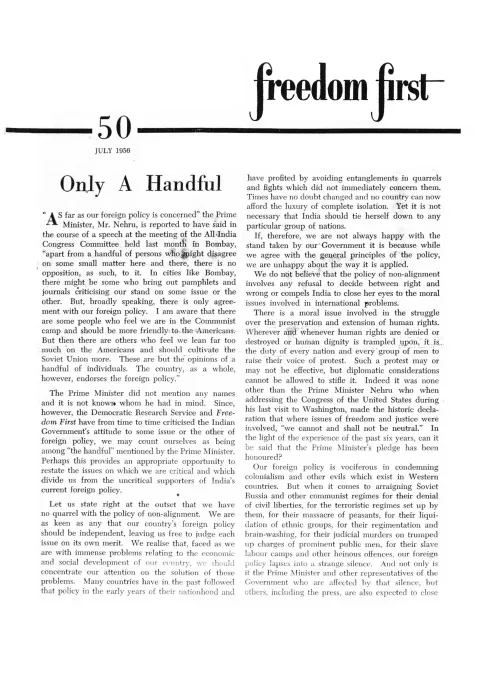
This is issue No. 50 of Freedom First (July 1956), a monthly periodical published by the Democratic Research Service, Bombay, and edited by V. B. Karnik. The issue is a compact anti-communist, classical-liberal miscellany centered on the aftermath of Khrushchev’s 20th Party Congress speech and the Soviet Union’s post-Stalin repositioning. The unsigned editorials and notes push back on Nehru’s claim that critics of his non-aligned foreign policy are ‘only a handful,’ arguing that the government and Indian press apply a double standard — readily condemning Western colonialism and McCarthyism while staying silent on Soviet purges, the persecution of Milovan Djilas, and the crushing of dissent behind the Iron Curtain. Named contributors include G. S. Bhargava, writing on the psychological ‘double standard’ of Indian intellectuals sympathetic to communism; Ida Dhami, surveying the Algerian independence crisis; and Adam Adil, arguing against any socialist-communist electoral cooperation in India by tracing the historical pattern of communist-led ‘united fronts’ collapsing into single-party dictatorship (citing Czechoslovakia’s 1948 takeover and Jayaprakash Narayan’s own account of communist infiltration of the Congress Socialist Party). The issue closes with a letter to the editor on the INTUC’s stance on the right to strike, brief ICCF (Indian Committee for Cultural Freedom) news notes, and a ‘With Many Voices’ page of aggregated press quotations on communism, Nehru, and world affairs.
Key points
-
The unsigned editorial ‘Only A Handful’ rebuts Nehru’s claim that only a ‘handful’ of critics disagree with non-alignment, arguing Indian foreign policy applies a double standard by staying silent on Soviet purges while condemning Western colonialism.
-
A ‘Notes’ section reports renewed persecution of Milovan Djilas despite Tito’s Moscow rapprochement, profiles new Soviet Foreign Minister Dmitri Shepilov’s earlier letter instructing Indian communists to avoid embarrassing Indo-Soviet diplomacy, and covers U Nu’s surprise resignation in Burma.
-
G. S. Bhargava’s ‘The Double Standard In Action,’ abridged from The New Leader, diagnoses Indian intellectuals’ selective outrage — fury at the Rosenberg executions but silence on Beria’s execution — and links Nehru’s Soviet tilt to managing domestic communists.
-
Ida Dhami’s ‘Whither Algeria?’ surveys the Algerian independence crisis, noting nine million indigenous Algerians against roughly one million French colons, and warns of Soviet or Egyptian exploitation if no settlement is reached.
-
Adam Adil’s ‘Can Socialists & Communists Cooperate?’ examines talks between Jayaprakash Narayan, Asoka Mehta and CPI’s Ajoy Ghosh, citing the 1948 Czechoslovak coup and the deaths of Jan Masaryk and President Benes as the definitive warning against united fronts with communists.
-
A letter from S. R. Mohan Das corrects an earlier note on the INTUC’s stance on the right to strike, and I.C.C.F. News reports James T. Farrell’s Bombay and Delhi visit, including a long interview with the Prime Minister.
-
‘With Many Voices’ quotes Ajoy Kumar Ghosh admitting the ‘cult of personality’ around Nehru is well developed in India, alongside Eisenhower calling communism ‘a gigantic failure.‘
Essays
Only A Handful
The unsigned lead editorial ‘Only A Handful’ responds to Prime Minister Nehru’s remark at the All-India Congress Committee meeting that only a ‘handful’ of critics disagree with his foreign policy. The piece affirms agreement with non-alignment in principle but argues the policy is applied with a double standard: Indian foreign policy is vocal against Western colonialism but falls into ‘a strange silence’ on Soviet purges, slave labour camps, and judicial murders. It invokes the examples of Stalin (lauded by the Indian government and press until his crimes were posthumously admitted) and the Munich appeasement as cases where a small minority was later proven right against the majority, arguing numbers are not evidence of correctness.
- Nehru claimed only a ‘handful’ of critics disagree with India’s non-aligned foreign policy
- The editorial accepts non-alignment as a principle but objects to how it is applied
- Argues for a moral stance against human rights violations regardless of which bloc commits them
- Cites Indian press eulogies of Stalin at his death, later proven wrong within three years
- Draws a parallel to the Munich appeasement, where a small minority was vindicated by history
- Notes other Indian journals (e.g. Times of India) share the same criticism of the government’s neutralism
He Who Sups With The Devil Needs A Long Spoon
The ‘Notes’ section covers several short items. ‘He Who Sups With The Devil Needs A Long Spoon’ reports on renewed persecution of Milovan Djilas in Yugoslavia even as Tito courted Khrushchev and Bulganin in Moscow, and notes Yugoslav trade unions’ re-affiliation with the Soviet-aligned World Federation of Trade Unions, questioning whether Tito is drifting back into the communist fold. ‘Trotsky On The Vengeance Of History’ uses Trotsky’s own prophetic remarks about Stalin’s eventual fall to frame the 20th Party Congress’s denunciation of Stalin, and reports Trotsky’s widow’s telegram demanding rehabilitation of the victims of Stalin’s purge trials.
- Milovan Djilas faces renewed persecution in Yugoslavia despite Tito’s rapprochement with Khrushchev
- Yugoslav Trade Unions have re-affiliated with the Soviet-aligned World Federation of Trade Unions
- Concerns raised that Tito may be drifting back toward the Soviet orbit after the 1948 break
- Leon Trotsky’s earlier prediction that ‘the vengeance of history’ would outstrip Stalin’s own vengeance is recalled in light of Stalin’s posthumous denunciation
- Trotsky’s widow sent a telegram demanding public vindication of Trotsky and their son Sedov, victims of Stalin-era purge trials
Who Is Shepilov?
Further unsigned ‘Notes’ items: ‘Who Is Shepilov?’ profiles Dmitri Shepilov, the new Soviet Foreign Minister and editor of Pravda, recalling an earlier letter he sent instructing the Communist Party of India to avoid embarrassing Indo-Soviet diplomacy while preparing to eventually settle scores with India’s ‘bourgeois Government.’ ‘Algeria And The Nehru Plan’ summarizes and praises Nehru’s five-point proposal for direct France-nationalist talks on Algerian independence. ‘U Nu’s Resignation’ discusses the Burmese Prime Minister’s surprise retirement, linking it to his wish to devote himself to Buddhism and to concerns about communist infiltration via diplomatic missions and ‘stooges’ within his own AFPFL party.
- Dmitri Shepilov, new Soviet Foreign Minister and Pravda editor, previously instructed Indian communists (via a leaked letter) not to disrupt Indo-Soviet diplomatic courtship of Nehru’s government
- The letter told Indian communists to eventually ‘settle scores’ with India’s ‘bourgeois Government’ once conditions allow
- Nehru’s five-point plan for Algeria calls for direct talks between France and nationalist leaders, recognition of Algerian national identity, and racial equality guarantees for French settlers
- U Nu of Burma resigned unexpectedly after an election victory, reportedly due to a wish to pursue Buddhist religious life and concern about communist activity among diplomats and internal party ‘stooges’
Notes (He Who Sups With The Devil Needs A Long Spoon; Trotsky On The Vengeance Of History; Who Is Shepilov?; Algeria And The Nehru Plan; U Nu’s Resignation; New Discovery Of Old Truths; The Face Of The Devil)
Two further unsigned items close out the ‘Notes’: ‘New Discovery Of Old Truths’ reports that Vice-President Radhakrishnan found the Soviet press had censored parts of his own speeches referencing ‘strict control,’ ‘suspicion,’ and concentration camps in Russia, and comments on the irony of former Soviet apologists now admitting facts they long denied. ‘The Face Of The Devil’ covers the All India Congress Committee’s resolution condemning political violence, Nehru’s vow that ‘Congress and the Government will combat and crush the spreading violence,’ and the Communist Party’s angry reaction to the resolution, which Nehru dismissed as ‘a case of guilty men feeling that the charge was directed against them.’
- The Soviet press omitted parts of Vice-President Radhakrishnan’s speeches referencing ‘strict control,’ ‘suspicion,’ and the need for real democracy
- The piece notes surprise that many who long denied Soviet totalitarianism are now admitting it under Khrushchev’s ‘New Look’
- The AICC passed a resolution denouncing political violence; Nehru pledged Congress and the Government would ‘combat and crush’ it
- The Communist Party interpreted the resolution as directed against itself and passed a counter-resolution condemning Congress and the Government
- Nehru characterized the Communist reaction as ‘a case of guilty men feeling that the charge was directed against them’
The Double Standard In Action
By G. S. Bhargava
In ‘The Double Standard In Action,’ G. S. Bhargava (abridged from The New Leader, May 28, 1956) diagnoses a psychological split in the Indian intellectual: simultaneously nationalist and drawn to Western modernity, contemptuous of the West’s flaws while excusing or ignoring communist atrocities. He illustrates the pattern with examples — Indian outrage over the Rosenberg executions but silence on Beria’s dismissal and execution; suspicion of pro-Western figures like Thought magazine but no scrutiny of pro-Soviet writers like Mulkraj Anand and Khwaja Ahmed Abbas; uncritical enthusiasm for Ilya Ehrenburg’s praise of Kalidasa. Bhargava argues Nehru’s own foreign policy is partly explained by a need to appease the domestic communist left while flattering Indian national pride via Soviet praise of India’s global standing.
- Bhargava frames Indian intellectuals as caught between admiration for the classical Hindu past and craving for Western modernity
- Indian press treated the Rosenberg executions with outrage but the Beria execution with a brief announcement and no analysis
- Anti-communist writers (Koestler, Kravchenko, Hyde, Haldane) are dismissed as biased, while pro-Soviet works circulate freely
- M. R. Masani is mocked as a ‘good American’ while pro-Soviet royalty recipients Mulkraj Anand and Khwaja Ahmed Abbas face no criticism
- Ehrenburg’s praise of Kalidasa was received naively as sincere rather than as calculated political messaging
- Bhargava argues Nehru’s pro-Soviet foreign-policy tilt partly reflects a need to manage domestic communists and flatter national vanity
Whither Algeria?
By Ida Dhami
In ‘Whither Algeria?’, Ida Dhami surveys the Algerian crisis, explaining why the French government’s approach to Morocco and Tunisia’s independence cannot simply be extended to Algeria. She traces Algeria’s status as legally part of metropolitan France since a postwar statute, the failure of French assimilation policy, the demographic reality of nine million indigenous Algerians against roughly one million French colons, and the colons’ entrenched resistance to reform. She surveys possible political futures — from continued status quo to Mendes France’s proposal for an Algerian Assembly with a federal link to France to full independence — and warns that failure to reach settlement risks Soviet or Egyptian exploitation of the conflict.
- Algeria, unlike Tunisia and Morocco, has been treated as part of metropolitan France since a postwar statute
- About one million French colons resist reforms that would grant Algerians a greater administrative and political share
- Nine million indigenous Algerians (about 90% of the population) consider themselves part of the Arab world despite cultural ties to France
- Algeria lacks the royal dynasty, religious tradition, and unified nationalist leadership that aided Tunisia and Morocco’s transitions
- Mendes France has proposed an Algerian Assembly to negotiate a federal link with France, short of full independence
- Dhami warns that failure to settle the conflict could invite exploitation by Soviet Russia or Nasser’s Egypt
Can Socialists & Communists Cooperate?
By Adam Adil
In ‘Can Socialists & Communists Cooperate?’, Adam Adil examines reports of talks between Jayaprakash Narayan, Asoka Mehta, and CPI general secretary Ajoy Ghosh about a possible electoral alliance against Congress, set against Khrushchev’s calls at the 20th Party Congress for ‘rapprochement and cooperation’ with socialist parties. Adil quotes the Socialist International’s Zurich and London statements flatly rejecting any united front with communists, cites Jayaprakash Narayan’s own account (in his pamphlet Socialist Unity and the Congress Socialist Party) of how communist infiltration paralyzed and captured the earlier Congress Socialist Party, and details the historical pattern — via Lazlo Rajk’s testimony and the 1948 Czechoslovak coup — by which communist-led united fronts have consistently ended in the destruction of democracy and the murder or suicide of non-communist coalition partners (Jan Masaryk, President Benes).
- Reports surfaced of talks between JP Narayan, Asoka Mehta, and CPI’s Ajoy Ghosh on a possible anti-Congress electoral alliance
- PSP’s Farid Ansari denied any electoral alliance is possible given fundamental differences with the CPI
- Khrushchev’s 20th Congress speech called for cooperation between communist and socialist parties as a broadened path to power
- The Socialist International (Zurich, March 1956, and London, April 1956) firmly rejected any united front with communist parties
- Jayaprakash Narayan’s own pamphlet describes how communist infiltration paralyzed and captured the Congress Socialist Party
- Lazlo Rajk’s account of communist tactics (‘make an alliance with all the four… until there is only a single remaining enemy’) is quoted as the template for united-front strategy
- The 1948 Czechoslovak coup, and the subsequent deaths of Jan Masaryk and President Benes, are cited as the definitive cautionary example
To The Editor
By S. R. Mohan Das
A short ‘To The Editor’ letter from S. R. Mohan Das corrects an earlier Freedom First note that had implied the INTUC was willing to give up the right to strike, quoting the actual amendment passed at the Surat Convention affirming the strike weapon should be retained but used judiciously. The editor accepts the correction. This is followed by a brief ‘I.C.C.F. News’ item reporting on American novelist James T. Farrell’s five-day visit to Bombay and Delhi under the Indian Committee for Cultural Freedom, including a public lecture on the 20th-century American novel and meetings with Marathi, Gujarati and Hindi writers and government officials.
- S. R. Mohan Das writes to correct the impression that INTUC sought to give up the right to strike
- The actual Surat Convention amendment affirmed the strike weapon should be retained as a last resort, used judiciously
- The editor acknowledges the correction and apologizes for the earlier wrong impression
- James T. Farrell, American novelist and ICCF chairman, visited Bombay and Delhi for a public lecture and meetings with writers and officials
- Farrell met the Prime Minister in Bombay for a long interview before departing for Karachi
I. C. C. F. News
No summary was extracted for this article. Listed for completeness.
With Many Voices
‘With Many Voices’ is a closing page of aggregated press quotations from May-June 1956 on communism, Nehru’s policies, and world affairs, drawn from sources including The Times of India, New York Times, Blitz, Thought, Encounter, and various world leaders (Konrad Adenauer, Khrushchev, Guy Mollet, Eisenhower, Bandaranaike, Morarji Desai). The quotes range from anti-communist statements to a Blitz remark that ‘Nehru needs a powerful Communist Party as a pressure group’ and an Ajoy Kumar Ghosh admission that the ‘cult of personality is very developed in India in relation to Mr. Nehru.’
- The page compiles short quotations from the press and world leaders on communism, Nehru, and current affairs
- Includes Konrad Adenauer’s skepticism toward the ‘latest events in Moscow’
- Includes a Blitz quote arguing ‘Nehru needs a powerful Communist Party as a pressure group’
- Includes Eisenhower calling communism ‘in the deepest sense, a gigantic failure’
- Includes Ajoy Kumar Ghosh (CPI) admitting the ‘cult of personality’ around Nehru is well developed in India
- Also includes a subscription form for Freedom First and the periodical’s imprint (edited by V. B. Karnik, printed at The Kanada Press, Bombay)
Generated by the v1.5 extraction pipeline. Awaiting editorial review.
Essay 9
No summary was extracted for this article. Listed for completeness.
Metadata and summary are AI-extracted from the source PDF and reviewed for editorial accuracy. The original work is available via the Read PDF tab above (where present); paragraph-level citation inside the PDF is deferred to a future engagement.