periodical issue
Freedom First
Edited, printed & published for the Democratic Research Service by V. B. Karnik at The Kanada Press, 109 Parsi Bazar Street, Bombay 1. · Bombay · 1956
12 pages
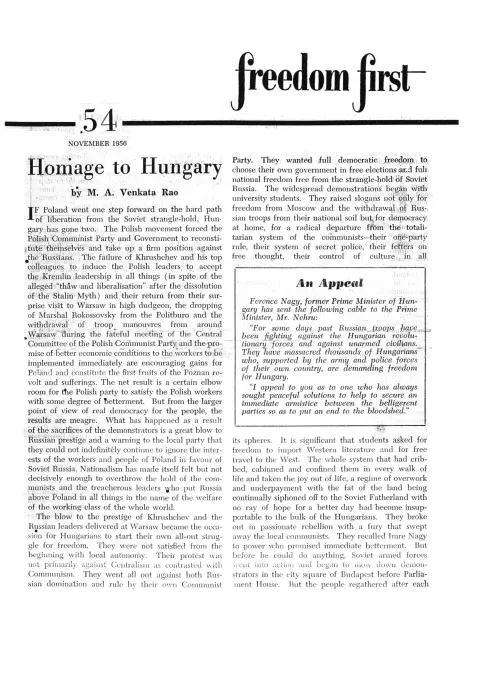
Freedom First
Summary
This is the complete November 1956 issue (No. 54) of Freedom First, the monthly journal of the Indian Committee for Cultural Freedom, edited by V. B. Karnik and published from Bombay by the Democratic Research Service. The issue is dominated by the unfolding crises in the Communist bloc: M. A. Venkata Rao’s lead essay condemns the Soviet crushing of the Hungarian uprising and situates it alongside the Polish protests as evidence that Soviet-style communism cannot satisfy popular demands for both national independence and internal democratic freedom. A long unsigned piece, “Soviet Economy And Its Problems,” marshals admissions drawn from Pravda, Khrushchev, Bulganin, and Mikoyan to argue that central planning has produced chronic shortages, housing crises, and a bureaucratic, dishonest economic culture in the USSR. V. B. Karnik’s own essay on the Asian Socialist Conference argues that Asian socialists must pursue industrialisation without sacrificing civil liberties, rejecting the view that totalitarian methods are necessary for rapid development. Adam Adil’s report, “Situation In South Africa,” documents the forced removal of Indian traders from Johannesburg and other cities under the Group Areas Act and its associated financial and legal injustices. Rounding out the issue are an editorial “Notes” section (on the Sino-Nepal Treaty, Nehru’s shifting statements on communism, press freedom, and censorship), two book reviews, a reader’s letter on electoral systems and the risk of communist victories in democracies, an I.C.C.F. news bulletin, and a closing miscellany of quotations, “With Many Voices.”
Key points
-
M. A. Venkata Rao’s ‘Homage To Hungary’ argues the Hungarian uprising went further than Poland’s protests by rejecting the entire one-party communist system, recounting Soviet suppression of Budapest demonstrators and appeals to Nehru from Ference Nagy and Western intellectuals.
-
V. B. Karnik’s ‘Asian Socialist Conference’ argues Asian socialists can pursue industrialisation without sacrificing civil liberties, rejecting the claim that totalitarian methods are necessary, and citing Nazi Germany and Stalinist Russia as counterexamples that never produced democratic societies.
-
An unsigned ‘Soviet Economy And Its Problems’ marshals Pravda, Khrushchev, Bulganin and Mikoyan’s own admissions of falling livestock numbers, chronic housing shortages and consumer-goods scarcity to indict Soviet central planning.
-
Adam Adil’s ‘Situation In South Africa’ documents the forced removal of over 100,000 non-whites, including 22,000 Indians, from Johannesburg under the Group Areas Act, with losses to Indian traders estimated at over £22 million.
-
A ‘Notes’ section reads the Sino-Nepal Treaty as extending Chinese influence at India’s expense and criticises Nehru for supporting a restrictive new Punjab press bill despite his own democratic history.
-
Reviews cover Walter Laqueur’s Communism and Nationalism in the Middle East and the anthology From Darkness to Light, drawing on the Upanishads, the Gita and modern Indian thinkers.
-
A reader’s letter signed ‘Politicus’ argues India’s Single Member Constituency system risks squeezing out moderate parties, leaving only Congress and the Communist Party viable and risking ‘hanging democracy by its own rope.‘
Essays
Homage to Hungary
By M. A. Venkata Rao
M. A. Venkata Rao’s “Homage to Hungary” argues that the Hungarian uprising of October-November 1956 represents a more radical break from Soviet domination than the preceding Polish protests, because Hungarians rejected not just Russian control but the entire one-party communist system, its secret police, and its suppression of free thought and culture. The essay recounts the Soviet military’s violent suppression of demonstrators in Budapest, the recall and subsequent betrayal of Imre Nagy, and appeals sent to Nehru by Ference Nagy and by Western intellectuals (Salvador de Madariaga, Denis de Rougemont, Nicolas Nabokov, Stephen Spender) urging him to use his moral authority to stop the massacre. Venkata Rao frames the Hungarian cause as part of a universal struggle for freedom comparable to anti-colonial movements in Algeria, Africa, and Asia, and calls on free-world governments to challenge Soviet intervention through the United Nations.
- Hungary’s revolt went further than Poland’s, targeting the one-party communist system itself, not just Russian control.
- Demonstrations began with university students demanding freedom from Moscow and democratic elections.
- Soviet forces moved militarily against demonstrators in Budapest even after a reconstituted government promised reform.
- Ference Nagy (former Hungarian PM) and a group of Western intellectuals cabled Nehru asking him to intervene diplomatically.
- The essay treats the ‘sovereignty’ of Soviet-bloc East European states as a myth exposed by the Soviet military action.
- The author calls the Hungarian cause as sacred as anti-colonial struggles in Algeria, Asia, and Africa, and urges UN pressure on the USSR.
Notes (Sino-Nepal Treaty; Prime Minister’s Second Thoughts; Freedom Of The Press; Encouraging Culture; Strange Censorship)
The unsigned editorial “Notes” section covers several short topics: the newly signed but unpublished Sino-Nepal Treaty, which the author reads as extending Chinese influence into Nepal at India’s strategic expense despite the Panchsheel principles; a critical examination of Prime Minister Nehru’s recent speeches on the Communist Party of India, in which the author welcomes Nehru’s tougher rhetoric on Stalinism and CPI tactics but faults him for supporting restrictive press legislation in Punjab; a note welcoming the Bombay Government’s decision not to tax amateur theatre, framed as encouragement of free cultural expression against commercial theatre’s box-office pressures; and a report on “Strange Censorship,” describing a railway book-stall union’s boycott of the weekly Current on the pretext that it was “anti-Indian and pro-American,” which the piece condemns as an improper private infringement on press freedom.
- The Sino-Nepal Treaty is read as extending Chinese trading and diplomatic presence into Nepal, testing India’s strategic interests despite Panchsheel.
- Nehru’s recent speeches showed a harder line against CPI methods and Stalinism, contrasted with his earlier praise of Stalin.
- The piece criticizes Nehru for supporting a new Punjab press-restriction bill despite his own history as a democracy advocate.
- Bombay Government’s exemption of amateur theatre from entertainment duty is praised as encouraging free cultural self-expression.
- A railway workers’ union banned the weekly Current from station bookstalls, alleging it was ‘anti-Indian and pro-American’; the piece calls this an improper private censorship of the press.
Asian Socialist Conference
By V. B. Karnik
V. B. Karnik’s essay marks the second session of the Asian Socialist Conference in Bombay and argues that Asian socialists face a shared challenge of achieving rapid economic development without sacrificing civil liberties. Karnik rejects the notion that totalitarian methods are necessary for industrialisation, pointing out that Nazi Germany and Stalinist Russia both industrialised under totalitarian rule without producing modern democratic societies. He warns that treating state ownership of production as an absolute tenet risks turning the state into an all-controlling “Leviathan,” and insists that the founding passion of socialism was liberty, equality, and social justice rather than any particular economic dogma. The essay calls on Asian socialists to pursue both democracy and socialism together, warning against any tendency to secure bread at the cost of freedom.
- The Asian Socialist Conference’s second session in Bombay gathers socialist leaders from across Asia and some European fraternal delegates.
- Karnik argues political servitude alone did not cause Asian backwardness; a deeper social malaise is also responsible.
- He disputes the claim that totalitarian rule is necessary for rapid industrialisation, citing Nazi Germany and Stalinist Russia as counterexamples that never produced democratic societies.
- Strict state ownership of production, if enforced dogmatically, risks creating an unaccountable state ‘Leviathan’ with no place for individual rights.
- The essay insists socialism’s original inspiration was liberty, equality, and social justice, not any fixed economic formula, and Asian socialists must combine democracy with socialism.
Soviet Economy And Its Problems
By (Contributed)
This unsigned, ‘Contributed’ article surveys admissions of failure in the Soviet economy drawn from official Soviet sources including Pravda, and speeches by Malenkov, Khrushchev, Bulganin, and Mikoyan. It documents a sharp fall in Soviet livestock numbers, chronic under-fulfilment of production targets in numerous industries, a severe urban and rural housing shortage well below the legal ‘sanitary norm,’ and pervasive shortages of ordinary consumer goods. The piece attributes these problems to two causes: structural features inherent to central planning (notably the persistent 70:30 bias toward heavy industry over light industry and consumer goods) and remediable failures of bureaucratic administration, over-centralisation, and human dishonesty (‘wangling’) bred by chronic shortage. It concludes that even a perfectly planned system still depends on human beings, and that the Soviet leadership remains caught between the alternatives of coercion and incentive, especially in agriculture.
- Khrushchev’s 1953 report revealed the USSR had millions fewer cows than before the war, despite a nearly 50 percent rise in population since 1916.
- The 1954 Pravda plan report admitted under-fulfilment of targets in cast iron, nonferrous metals, machinery, and other key products, alongside overfulfillment in less-needed goods.
- Housing remains critically short: even if the current Five-Year Plan’s urban housing target is met, living space per head would still fall below the legal ‘sanitary norm’ and below 1923 or pre-revolutionary levels.
- Consumer goods shortages are chronic and were acknowledged publicly by Malenkov and Mikoyan, including basics like needles, razors, and kerosene lamps.
- The article attributes Soviet economic troubles partly to inherent features of the system (heavy-industry bias, over-centralisation) and partly to remediable bureaucratic failure and dishonesty.
- It concludes that the human element — incentive versus coercion — remains the fundamental unsolved problem of Soviet economic management, especially on farms.
I.C.C.F. News
A brief unsigned news item reports that the Indian Committee for Cultural Freedom hosted a reception for the American poet and critic Allen Tate on October 20, and that M. R. Masani, Purshottam Trikumdas, and S. H. Vatsyayan gave evidence on October 19 before a Parliamentary Select Committee on the Copyright Bill, on behalf of PEN All-India Centre, the Indian Institute for Educational and Cultural Cooperation, and the Indian Committee for Cultural Freedom, supporting a joint representation on the Bill.
- The Indian Committee for Cultural Freedom held a reception for American poet-critic Allen Tate on October 20, introduced by M. R. Masani.
- M. R. Masani, Purshottam Trikumdas, and S. H. Vatsyayan testified before Parliament’s Select Committee on the Copyright Bill on October 19.
- Their testimony was given jointly on behalf of PEN All-India Centre, the Indian Institute for Educational and Cultural Cooperation, and the I.C.C.F.
Situation In South Africa
By Adam Adil
Adam Adil’s report describes the mass displacement of Indian traders in South Africa under the Group Areas Act of 1950 and the Group Areas Development Act of 1955. More than 100,000 non-whites, including 22,000 Indians, have been ordered to leave Johannesburg for distant, often unsuitable areas as part of the apartheid government’s segregation plan. The article details the inadequate compensation process — a Development Board sets a ‘basic value’ well below market value, leaving Indian traders facing losses estimated at over £22 million in Johannesburg alone — and recounts specific cases in Lenasia, Mafeking, and Pageview, including a Mafeking relocation site described as a former sewage-disposal farm. It also records protests from white public figures (city councillors Cutton and Miller) and describes a legal hearing in which the government block a defense lawyer’s demand for witnesses, prompting Dr. George Lowen to call the ruling a ‘travesty of justice.’
- The Group Areas Act of 1950 has forced over 100,000 non-whites, including 22,000 Indians, out of Johannesburg into distant, unsuitable areas.
- A Development Board sets a ‘basic value’ for expropriated property well below market value, leaving Indian traders facing losses (over £22 million in Johannesburg alone).
- Indians in Lenasia, Mafeking, and Pageview faced particularly harsh or degrading relocations, including to a former sewage-disposal farm at Mafeking.
- White public figures including city councillors Cutton and Miller publicly condemned the ejections as shameful and dangerous to race relations.
- In a legal hearing over the Mafeking ejections, the government-appointed board refused to require witnesses, which defense lawyer Dr. George Lowen called a ‘travesty of justice.‘
Review: Communism and Nationalism in the Middle East
By A.P.
The Review section contains two short book notices. The first, signed A.P., reviews Walter Z. Laqueur’s ‘Communism and Nationalism in the Middle East’ (Routledge and Kegan Paul), summarizing its account of how Arab nationalism and communism have interacted with Islam and with the region’s feudal social structure, and quoting Professor Hans Kohn’s skepticism toward Middle Eastern nationalism as a self-sufficient good. The second, signed M.A.V., reviews ‘From Darkness to Light,’ a Victor Gollancz anthology of world religious, mystical, and ethical writing, noting its inclusion of passages from the Upanishads, the Code of Manu, the Bhagavadgita, and modern Indian thinkers, and recommending it as a bedside resource for reflection.
- A.P. reviews Walter Z. Laqueur’s ‘Communism and Nationalism in the Middle East,’ which surveys communism’s and nationalism’s interaction with Islam across Middle Eastern countries.
- The review recounts an exchange in which a Moslem imam presses a communist leader on whether he believes in God and the prophethood of Mohammed.
- Professor Hans Kohn is quoted arguing that nationalism and national self-determination are not desirable goods in themselves absent ‘creative action for the common good.’
- M.A.V. reviews the anthology ‘From Darkness to Light,’ noting its inclusion of the Upanishads, the Code of Manu, the Bhagavadgita, and modern Indian thinkers Vivekananda, Sri Aurobindo, and Tagore.
Review: From Darkness to Light
By M.A.V.
A reader’s letter signed ‘Politicus,’ responding to an earlier Freedom First article (‘Strange If True,’ September 1956), argues that the Single Member Constituency electoral system adopted by India and Burma risks producing exactly two dominant parties — typically the ruling party and the Communist Party — because only they command the resources and ‘invisible’ funding to survive, while moderate democratic parties are squeezed out through exhaustion. Drawing on recent electoral experience in Indonesia and Burma, where communists performed strongly, the writer contends that this dynamic could eventually ‘hang democracy by its own rope’ and calls for electoral adjustments among all non-Congress parties, including with Leftist groups, to better reflect real public opinion in the legislature.
- The letter responds to a prior Freedom First article arguing for electoral adjustments among non-Congress parties, including the Hindu Mahasabha and Jana Sangh.
- The writer reports that Indonesian observers were not alarmed at communist electoral gains, believing the electoral system itself would prevent a communist takeover.
- Burmese elections showed strong Communist Front performance alongside the ruling AFPFL, prompting the writer’s concern about a two-party dynamic favoring the Communist Party in underdeveloped democracies.
- The writer argues the Single Member Constituency system tends to squeeze out moderate parties, leaving only the ruling party and the Communist Party viable.
- The letter concludes that over-stability from this system risks ‘putting the Communist Party in power by democratic means and so hang democracy by its own rope,’ and calls for electoral adjustments reflecting real party strength across constituencies.
To The Editor
By Politicus
The closing feature ‘With Many Voices’ is a miscellany of short quotations from various publications and public figures on communism, intellectuals, propaganda, and world affairs, framed by an epigraph from Tennyson. It juxtaposes remarks from Encounter magazine contributors (Stephen Spender, Irving Kristol, Peter Wiles), Indian press commentary (Times of India, Deccan Herald, Bombay Chronicle), CPI general secretary Ajoy Ghosh’s dismissal of any lessons from Poland and Hungary for Indian communists, and Winston Churchill’s quip about intellectuals, among others. The page also carries the Freedom First subscription form and the issue’s colophon naming V. B. Karnik as editor, printer, and publisher for the Democratic Research Service.
- The feature collects short, often ironic quotations from Encounter magazine, Indian newspapers, and public figures on communism and world affairs.
- CPI general secretary Ajoy Ghosh is quoted denying that recent developments in Poland and Hungary hold any lessons for Indian communists.
- Winston Churchill and Beachcomber are quoted with skeptical remarks about intellectuals.
- The page includes the Freedom First subscription form and the publication’s colophon, confirming V. B. Karnik as editor/printer/publisher for the Democratic Research Service.
Generated by the v1.5 extraction pipeline. Awaiting editorial review.
Metadata and summary are AI-extracted from the source PDF and reviewed for editorial accuracy. The original work is available via the Read PDF tab above (where present); paragraph-level citation inside the PDF is deferred to a future engagement.