periodical issue
Freedom First
By Soetan Sjarir
Edited, printed & published for the Democratic Research Service by V. B. Karnik at The Kanada Press, 109 Parsi Bazar Street, Bombay 1. · Bombay · 1956
12 pages
Freedom First
Summary
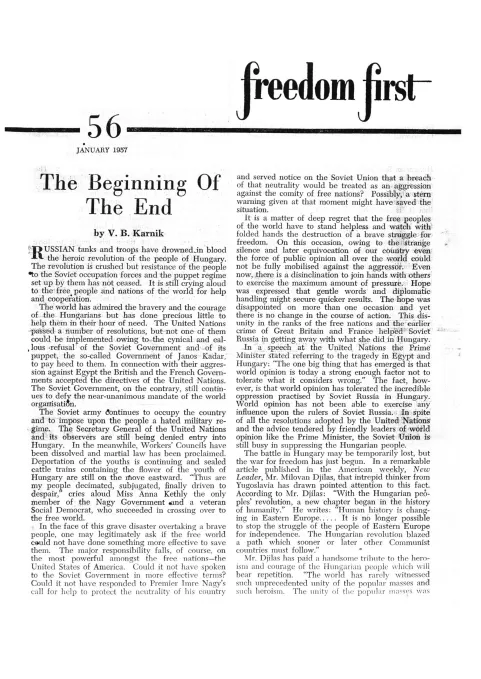
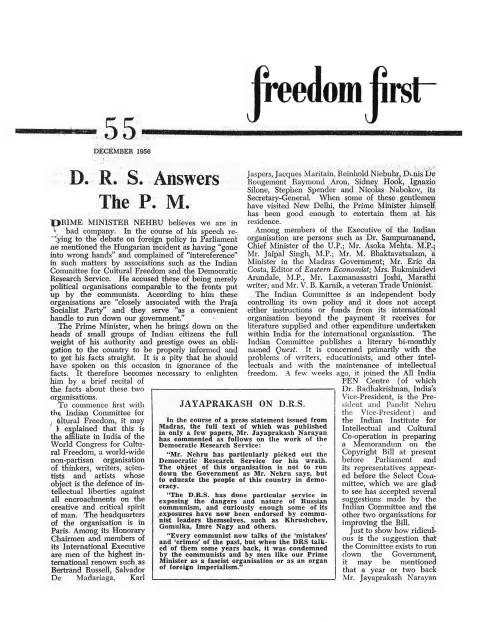
This is issue No. 55 of Freedom First (December 1956), the monthly journal of the Democratic Research Service (D.R.S.), edited, printed and published for the D.R.S. by V. B. Karnik in Bombay. The issue is dominated by the Hungarian Revolution of 1956 and its diplomatic fallout in India. It opens with an unsigned editorial, “D.R.S. Answers The P.M.”, rebutting Prime Minister Nehru’s charge in Parliament that the Democratic Research Service and the Indian Committee for Cultural Freedom are communist-front-style organisations; the piece lays out both bodies’ funding, leadership and activities to refute the claim, and reproduces a press statement by Jayaprakash Narayan defending the D.R.S. A second editorial, “India And Hungary”, criticises the Government of India’s slow and equivocal reaction to the Soviet intervention in Hungary and singles out V. K. Krishna Menon’s conduct at the United Nations for censure. A “Notes” section covers the Anglo-French attack on Egypt, the Copyright Bill, and an alleged communist-front character of a planned Asian Writers’ Conference. “Revolt In Hungary: The Background” gives an unsigned historical primer on Hungary’s post-war communist takeover through to the 1956 uprising. “Russian War Against Hungary” reproduces a speech by Soetan Sjarir, former Prime Minister of Indonesia, delivered at a Bombay public meeting under the auspices of the Indian Committee for Cultural Freedom, condemning the Soviet intervention as classical imperialism. “Indian Solidarity With Hungary” reports on the formation of the Indian Committee for Solidarity with Hungary under Jayaprakash Narayan’s presidency and his demand for Krishna Menon’s recall from the UN. “A Call For Healthy Insight” reprints a joint statement by a group of Indian writers, journalists and academics (including Ram Singh, Sudhindranath Datta, and others) criticising India’s failure to recognise Soviet/communist imperialism with the same vigilance applied to Western colonialism. The issue closes with C.C.F. News (cables sent by the Congress for Cultural Freedom to Nehru and to Hungarian writers), a letter to the editor signed “T.M.” contrasting Panchshila with Satyagraha as India’s proper moral response to Hungary, and brief D.R.S. News and subscription/advertising material.
Key points
-
The unsigned editorial ‘D.R.S. Answers The P.M.’ rebuts Nehru’s Parliamentary charge that the Democratic Research Service and I.C.C.F. are communist-front organisations, detailing the DRS’s 1950 founding under Sardar Patel’s blessing and reproducing Jayaprakash Narayan’s public defence of its record.
-
‘India And Hungary’ criticises the Government’s slow, equivocal response to Soviet intervention in Hungary, singling out V. K. Krishna Menon’s UN vote alongside the Soviet bloc as damaging India’s moral standing.
-
Soetan Sjarir, former Prime Minister of Indonesia, delivers ‘Russian War Against Hungary’ at a Bombay public meeting, condemning the Soviet crackdown as classical imperialism and urging Asian vigilance against ‘Red imperialism.’
-
An unsigned report describes the formation of the Indian Committee for Solidarity with Hungary under Jayaprakash Narayan’s presidency, who demands Krishna Menon’s recall from the UN.
-
‘A Call For Healthy Insight,’ a joint statement by writers including Ram Singh and Sudhindranath Datta, argues India’s intelligentsia refuses on ideological grounds to recognise Soviet imperialism even while vigilantly opposing Western colonialism.
-
A letter signed ‘T.M.’ argues Nehru’s shift toward satyagraha rhetoric on Hungary is more authentic than invoking Panchshila, likening the latter’s non-interference logic to Cain’s ‘Am I my brother’s keeper’ evasion.
Essays
D. R. S. Answers The P. M.
An unsigned editorial rebutting Prime Minister Nehru’s Parliamentary charge that the Democratic Research Service (D.R.S.) and the Indian Committee for Cultural Freedom are communist-front-style political organisations “closely associated with the Praja Socialist Party.” The piece details the Indian Committee for Cultural Freedom’s affiliation with the worldwide Congress for Cultural Freedom, its patrons (Bertrand Russell, Salvador de Madariaga, Jaspers, Maritain, etc.) and Indian executive members, then turns to the D.R.S.’s own founding in November 1950 with the backing of Sardar Vallabhbhai Patel, its Executive Board (Purshottam Kanji, D. P. Sethna, M. R. Masani, L. Sawhny, H. R. Pardiwala) and Advisory Committee, its publications (Freedom First, pamphlets on Stalin, Hungary, Burma), and its finances (domestically raised, donors kept anonymous). It reproduces a press statement by Jayaprakash Narayan defending the D.R.S.’s record of exposing Russian communism and reminding Nehru that “there are other men in India who love their country no less than he does.”
- Nehru accused the D.R.S. and Indian Committee for Cultural Freedom of being communist-front-style organisations tied to the Praja Socialist Party.
- The Indian Committee for Cultural Freedom is the Indian affiliate of the World Congress for Cultural Freedom, headquartered in Paris, with patrons including Bertrand Russell and Salvador de Madariaga.
- The D.R.S. was founded in November 1950 with the blessing of Sardar Vallabhbhai Patel, then Deputy Prime Minister.
- D.R.S. funds are wholly domestic; donor names are withheld to protect them from communist harassment.
- Jayaprakash Narayan publicly defended the D.R.S.’s work exposing Soviet communism, noting some of its exposures were later confirmed by Khrushchev and Gomulka themselves.
India And Hungary
An unsigned editorial praising the Indian public’s spontaneous sympathy for Hungary but sharply criticising the Government of India’s slow, cautious response, contrasted with its firmer stance on the Anglo-French attack on Egypt. It censures India’s abstention on the first UN resolution on Hungary and, especially, Krishna Menon’s vote against the second resolution in cooperation with the Soviet bloc, calling it a national disgrace that damaged India’s moral standing and led Jayaprakash Narayan to demand Menon’s recall as Chief Adviser on international affairs. It quotes Frank Moraes, editor of the Times of India, on the reputational damage done by Menon’s UN conduct, and closes with a report on public meetings organised by the Indian Committee for Cultural Freedom.
- India’s Government reacted with delay and equivocation to Soviet intervention in Hungary, unlike its quicker condemnation of the Anglo-French attack on Egypt.
- India abstained on the first UN resolution on Hungary and was the only non-communist country to vote against the second, aligned with the Soviet bloc.
- Jayaprakash Narayan demanded the recall of V. K. Krishna Menon as the Prime Minister’s international affairs adviser over his UN conduct.
- Frank Moraes of the Times of India reported that Menon’s UN performance had damaged India’s international reputation.
- The Indian Committee for Cultural Freedom held public meetings in Bombay condemning the Hungarian intervention and the Egypt aggression.
Russian War Against Hungary
By A Ranganathan
A speech titled “Russian War Against Hungary” delivered by Soetan Sjarir, former Prime Minister of Indonesia, at a public meeting in Bombay held under the auspices of the Indian Committee for Cultural Freedom. Sjarir narrates the chronology of the Hungarian uprising, tracing its roots to the Polish example of Gomulka’s defiance of Moscow, through the students’ demonstrations in Budapest, the fall of the communist government, Imre Nagy’s accession and his declaration that Hungary would be a sovereign, neutral state, and the subsequent full-scale Soviet military intervention using Czechoslovak-supplied tanks and aircraft to crush the revolt. He argues the case demonstrates that communist states are as capable of brute imperialism as capitalist ones, calls on Asian nations to recognise “Red imperialism” with the same vigilance as Western colonialism, and appeals for the immediate withdrawal of Soviet troops and free self-determination for the Hungarian people.
- Sjarir traces the Hungarian revolt’s origins to the influence of Poland’s Gomulka-led defiance of Moscow earlier in 1956.
- The movement began as student demonstrations in Budapest and grew into a mass uprising against both the Communist government and Soviet troops stationed in Hungary.
- Imre Nagy took power, declared Hungary a sovereign, non-aligned state, and pledged withdrawal of Soviet troops and democratisation.
- The Soviet Union responded with an all-out military assault, using tanks and aircraft brought from Czechoslovakia, crushing the revolt and installing a puppet government.
- Sjarir calls the Soviet action a classic act of imperialist aggression and urges Asian nations to demand withdrawal of Russian troops and free Hungarian self-determination.
Indian Solidarity With Hungary
An unsigned report describing the Indian public’s spontaneous condemnation of Soviet aggression in Hungary and detailing the formation of the Indian Committee for Solidarity with Hungary, presided over by Jayaprakash Narayan with R. V. Murthy and S. A. Sabavala as secretaries. It reproduces Narayan’s statement condemning both the Russian intervention and the Government of India’s apathy, quotes his charge that India’s foreign policy amounted to a cynical disregard of truth and its own professed principles, and reports his call, addressed to the Press Guild of India, for Krishna Menon’s recall from the UN as “at least one Indian” who felt Menon had forfeited India’s claim to neutrality.
- The Indian Committee for Solidarity with Hungary was formed with Jayaprakash Narayan as President and R. V. Murthy and S. A. Sabavala as secretaries.
- Narayan’s statement condemned both Russian aggression in Hungary and the Government of India’s apathy and indifference toward it.
- The Committee argued the Soviet intervention violated the non-interference principle in the Warsaw Pact’s own preamble.
- Narayan called for Krishna Menon’s recall from the UN, framing the demand as coming from him as an individual Indian rather than on behalf of any organisation.
- The Committee published bulletins and a detailed chronology of events in Hungary to inform Indian public opinion.
A Call For Healthy Insight
By Ram Singh, Rajakrishna, M. K. Haldar, Sudindranath Datta, Mohan Singh Sengar, Abu Syed Ayub, K. K. Sinha, Daya Krishna, I. C. Jain, Roop Narayan, Rajani Mukerjee (and others, unnamed)
A joint statement, “A Call For Healthy Insight”, signed by a number of eminent Indian writers, journalists and academics including Ram Singh (Editor, Thought), Professors Rajakrishna and M. K. Haldar of Delhi University, Sudhindranath Datta, Mohan Singh Sengar, K. K. Sinha, Daya Krishna, I. C. Jain, Roop Narayan and Rajani Mukerjee. The statement criticises the Government of India’s belated and equivocal response to the Hungarian crisis, argues that many in India’s intelligentsia refuse on ideological grounds to recognise the existence of Soviet/communist imperialism even as they vigilantly oppose Western colonialism, and calls for a “healthy insight” that judges the growth or decline of freedom anywhere without being blurred by partisan ideological categories. It warns that India’s international moral influence depends on maintaining objectivity in test cases like Hungary.
- The signatories criticise India’s belated, equivocal official response to the Hungarian revolt compared to its quicker condemnation of Anglo-French action in Egypt.
- They argue Marxist-Leninist theory has led many Indians to assume communist states cannot by definition be imperialistic, despite historical evidence to the contrary.
- The statement calls this a case of ideological ‘intellectual blinkers’ that prevent equal vigilance against all forms of imperialism.
- It argues India’s international moral authority rests on objectivity and even-handed moral discrimination, not economic or military power.
- The statement warns that failing the ‘test case’ of Hungary risks India’s credibility on future tests of the same kind.
To The Editor: Satyagraha Or Panchshila?
By T. M.
A letter to the editor signed “T.M.”, dated Bombay, November 22, titled “Satyagraha Or Panchshila?”. The writer reflects on Nehru’s reported ‘conversion’ and ‘spiritual crisis’ over Hungary, arguing that Panchshila proved an inadequate moral principle once a whole people were being crushed by an occupying power, since invoking non-interference in such a case would be Cain-like moral evasion. The letter welcomes Nehru’s shift toward the language of satyagraha and non-violence as India’s authentic contribution to world peace, contrasting it favourably with Panchshila, though it also notes non-violence’s limits when a nation must defend itself against an armed aggressor.
- The letter argues Panchshila’s non-interference principle became morally untenable once applied to a case like Hungary, where a whole people was being crushed by an occupying power.
- It likens invoking Panchshila in such a case to Cain’s ‘Am I my brother’s keeper’ evasion.
- The writer welcomes Nehru’s declared shift toward satyagraha as India’s authentic, indigenous moral resource rather than Panchshila.
- The letter notes non-violence has limits, for instance when a country must defend itself against an armed aggressor.
- It frames the episode as revealing that experience, not abstract principle alone, clarifies political ethics.
Generated by the v1.5 extraction pipeline. Awaiting editorial review.
Metadata and summary are AI-extracted from the source PDF and reviewed for editorial accuracy. The original work is available via the Read PDF tab above (where present); paragraph-level citation inside the PDF is deferred to a future engagement.