periodical issue
Freedom First
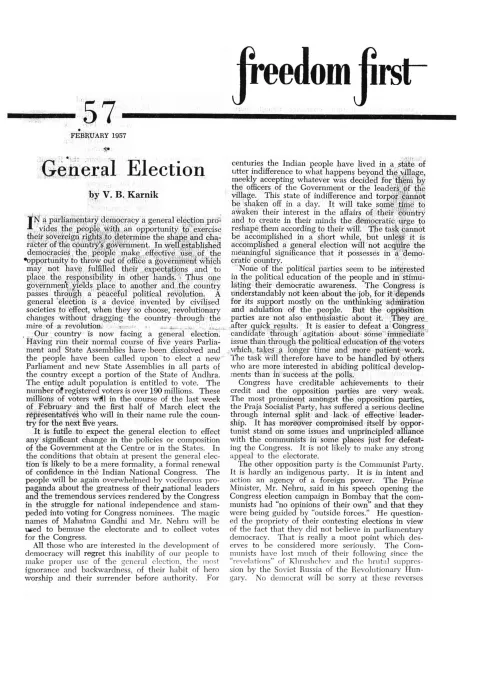
Edited, printed & published for the Democratic Research Service by V. B. Karnik at The Kanada Press, 109 Parsi Bazar Street, Bombay 1. · Bombay · 1957
12 pages
Freedom First
Summary
This is the January 1957 issue (No. 56) of Freedom First, the monthly journal of the Democratic Research Service edited by V. B. Karnik, published from Bombay. The issue is dominated by the aftermath of the Soviet crushing of the Hungarian Revolution of 1956, treating it as proof of communism’s fundamental incompatibility with freedom and prosperity. It opens with Karnik’s own editorial-essay ‘The Beginning Of The End’, which surveys the suppression of the revolution, criticises the free world’s (especially the United States’) passivity, and quotes Milovan Djilas’s prediction that the Hungarian revolt marks the beginning of the end of communism generally. A ‘Notes’ section covers student unrest in the USSR as a ripple effect of Hungary, the fracturing of international communist front organisations over the crisis, a statement by Bombay’s Education Minister Shantilal Shah opposing state control of the film industry, and a tribute to the recently deceased B. R. Ambedkar. A reprinted Times of India editorial, ‘The Difference’, argues that India’s non-alignment policy should not obscure the moral distinction between democratic and totalitarian regimes. M. A. Venkata Rao contributes a detailed legal-policy piece on the Copyright Bill as reported by the Joint Select Committee, arguing for authors’ rights against government and commissioning-body claims. Further pieces cover Milovan Djilas’s arrest and imprisonment in Yugoslavia and international protest against it; a column by ‘Saadi’ defending the Democratic Research Service and the Indian Committee for Cultural Freedom against Nehru’s charge that they engage in ‘propaganda rather than search for truth’; a report on the fractious Asian Writers’ Conference in Delhi; a compilation of international statements and declarations (‘Echoes Of The Hungarian Revolution’) from figures such as Denis de Rougemont, Norman Thomas, and W. C. Wentworth; and a closing first-person account, ‘A Moment In Budapest’ by Francois Bondy, describing conversations with Hungarian writers just before the final Soviet crackdown.
Key points
-
V. B. Karnik’s ‘The Beginning Of The End’ surveys the Soviet crushing of the Hungarian revolution, quoting Milovan Djilas’s judgment that it may mark ‘the beginning of the end of Communism generally,’ and criticises the free world’s failure to back Imre Nagy’s appeal.
-
A ‘Notes’ section reports Soviet student unrest in Moscow and Leningrad as a ripple effect of Hungary, Bombay Education Minister Shantilal Shah’s opposition to state control of the film industry, and a tribute to the recently deceased B. R. Ambedkar.
-
M. A. Venkata Rao’s ‘Copyright Bill’ reports the Joint Select Committee’s restoration of the copyright term to fifty years, while criticising the Bill’s vesting of commissioned works’ copyright in commissioning parties rather than authors.
-
‘Mr. Djilas And Marshal Tito’ reports Djilas’s secret trial and three-year sentence for his New Leader article on Hungary, with international protest from the American Committee for Cultural Freedom and Tito’s own biographer Vladimir Dedijer.
-
‘Saadi’ defends the Democratic Research Service against Nehru’s charge of being ‘propagandist rather than a search for truth,’ contrasting Nehru’s own eulogy of Stalin with the DRS’s five-year record of warnings later vindicated.
-
A correspondent’s report on the Delhi Asian Writers’ Conference describes it as nearly wrecked by communist-versus-anti-communist tensions, with Rajaji arguing art’s purpose is to create beauty, not propaganda.
-
‘Echoes Of The Hungarian Revolution’ compiles international statements, including Denis de Rougemont’s refusal to normalise relations with anyone who ‘justifies’ Budapest and Norman Thomas’s criticism of Krishna Menon’s UN vote.
-
Francois Bondy’s first-person ‘A Moment In Budapest’ recounts conversations with Hungarian writers, including Julius Hay and Tibor Dery, on the eve of the Soviet crackdown.
Essays
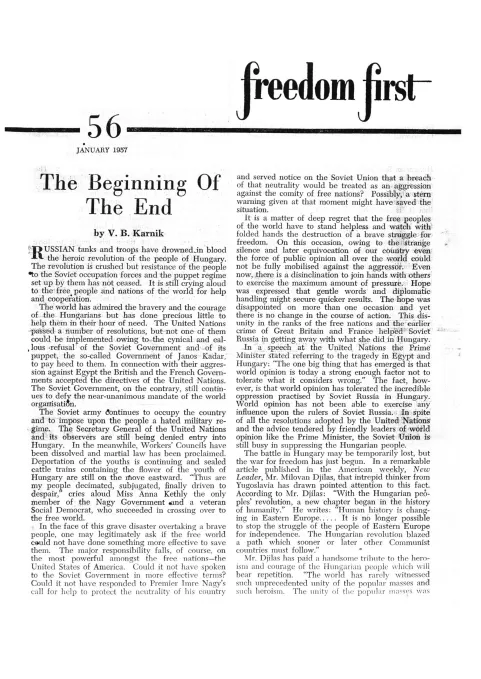
The Beginning Of The End
By V. B. Karnik
V. B. Karnik’s lead essay surveys the crushing of the Hungarian Revolution by Soviet tanks and troops, criticising the free world’s inability to translate sympathy into effective pressure on the USSR. He faults the United States for not backing Imre Nagy’s appeal to protect Hungary’s neutrality, and condemns the disunity among free nations that let Russia ‘get away with what she did in Hungary.’ Drawing heavily on Milovan Djilas’s article in the American weekly New Leader, Karnik presents the Hungarian revolt as proof that communism can only be sustained by force and that the revolution represents, in Djilas’s words, ‘the beginning of the end of Communism generally.’ He closes by arguing the uprising exposed the falsity of communist claims to have brought prosperity to Eastern Europe, noting that some Indian planners had been unduly influenced by such propaganda.
- Soviet tanks and troops suppressed the Hungarian revolution; resistance and deportations continued after the crackdown
- Karnik criticises the United States and other free nations for failing to back Imre Nagy’s call to protect Hungarian neutrality
- The UN’s resolutions could not be enforced due to Soviet and Kadar-regime refusal to comply
- Milovan Djilas’s New Leader article is quoted extensively: the revolution ‘placed on the agenda the problem of freedom in Communism’ and may mark ‘the beginning of the end of Communism generally’
- Djilas argues national communism (as in Yugoslavia) cannot escape the same contradictions exposed in Hungary
- The essay argues Hungary discredited communist claims of having brought prosperity to Russia and Eastern Europe, a claim some Indian planners had naively accepted
Notes
An unsigned ‘Notes’ section covering several short items: Soviet student unrest in Moscow, Leningrad, and the Baltic states as a ripple effect of Hungary (‘Straws In The Wind’); Chinese Communist Party’s defence of Soviet action in Hungary (‘Tell-Tale Observations’); the fracturing of international communist front organisations, including the World Federation of Trade Unions and World Peace Council, over the Hungarian crisis (‘Front Organisations’); Bombay Education Minister Shantilal Shah’s remarks opposing state control of the film industry as a threat to freedom of expression (‘State Control Of Films’); and a tribute to B. R. Ambedkar following his death, praising his role as architect of India’s Constitution and champion of the Harijans while noting he was a controversial figure.
- Reports of student unrest and expulsions at Moscow and Leningrad universities in solidarity with Hungary, plus unrest in Lithuania, Latvia, Estonia, and an anti-Soviet riot in Stettin, Poland
- China’s People’s Daily and Premier Chou En-lai are described as defending Soviet action in Hungary despite privately disagreeing with India
- International communist front organisations (World Federation of Trade Unions, World Federation of Democratic Youth, World Peace Council) split internally over how to respond to the Hungarian crisis
- Bombay Education Minister Shantilal Shah warns that state control of the film industry would lead to regimentation and stifle creative freedom
- Obituary tribute to B. R. Ambedkar calls him ‘a tower of strength to the Harijans’ and a principal architect of India’s Constitution, while acknowledging his controversial reputation
The Difference
A reprint of a Times of India editorial (December 18 issue) arguing that Nehru’s call for all foreign troops to withdraw from countries where stationed conflates totalitarian and democratic systems under India’s non-alignment policy. The editorial insists there is a real ‘difference and distinction’ between totalitarian and democratic values, and that India’s clouded thinking on this point has led it into confused positions—forceful on Egypt but hesitant on Hungary—that risk undermining its own democratic ideals.
- Reprints a Times of India editorial responding to Nehru’s call for withdrawal of all foreign troops
- Argues American opinion is puzzled by India’s habit of equating totalitarian and democratic systems under non-alignment
- Insists there is a real moral ‘difference and distinction’ between totalitarianism and democracy that India’s foreign policy thinking obscures
- Criticises India’s inconsistent posture: assertive on Egypt, hesitant on Hungary
- Warns that leaning towards the totalitarian bloc under cover of non-alignment risks undermining India’s own democratic values
Copyright Bill
By MA Venkata Rao
M. A. Venkata Rao reports on the Joint Select Committee’s revisions to India’s Copyright Bill, describing improvements won partly through evidence given by the Indian P.E.N., the Indian Committee for Cultural Freedom, and the Indian Institute for Educational and Cultural Co-operation. The chief change restores the copyright term to fifty years after an author’s death (from a proposed twenty-five), though the Committee declined to make translation rights co-eval with this, retaining instead the old ten-year post-publication period—a point on which R. D. Sinha ‘Dinkar’ dissented forcefully. Venkata Rao also criticises the Committee’s retrograde acceptance that commissioned literary, photographic, and artistic works should vest copyright in the commissioning party rather than the author, arguing copyright is a natural right inhering in the act of creation. He welcomes the removal of a clause allowing resumption of copyright by owners after 7–10 years, and notes improvements to the proposed Copyright Board, including judicial rather than bureaucratic chairmanship.
- Joint Select Committee restored copyright term to fifty years after the author’s death, up from a proposed twenty-five years
- Committee retained only a ten-year post-publication period for translation rights rather than making them co-eval with original copyright, despite dissent from R. D. Sinha ‘Dinkar’ and others citing Bengali literature and Tagore as precedent
- Venkata Rao argues copyright is a natural right inherent in creation, criticising the Bill’s clause vesting copyright in commissioning parties (government or private) rather than authors for commissioned literary and artistic works
- Welcomes removal of a clause permitting resumption of copyright by owners 7-10 years after assignment, which he argues would have disadvantaged writers
- Notes reforms to the Copyright Board making it more judicial (chaired by High Court judges) and less bureaucratic, and making registration optional rather than a precondition for asserting copyright in court
C.C.F. News / I.C.C.F. News
A short news item reporting activities of the (Pakistan and Indian) Committees for Cultural Freedom, including a Karachi seminar on Religion and Freedom, and the reconstitution of the Delhi Group of the Indian Committee for Cultural Freedom under Asoka Mehta’s chairmanship, with a new managing committee named.
- Pakistan Committee for Cultural Freedom held a Seminar on Religion and Freedom in Karachi, December 23-26, attended by Prof. Shah of Poona as an observer for the Indian Committee
- The Delhi Group of the Indian Committee for Cultural Freedom was reconstituted on December 10 under Asoka Mehta’s chairmanship, with a ten-member managing committee named
- Mrs. Leela P. Tricumdas was elected Secretary of the Delhi Group
Mr. Djilas And Marshal Tito
An unsigned report on the arrest and secret trial of Milovan Djilas in Yugoslavia for ‘hostile propaganda’ relating to his New Leader article on the Hungarian revolution, sentencing him to three years’ hard labour. The piece traces Djilas’s earlier persecutions since 1953, quotes his blunt assessments of Soviet economic weakness and the nature of Communist bureaucracy, and details international protest, including a cable from the American Committee for Cultural Freedom (signed by Norman Thomas, Sydney Hook, and Reinhold Niebuhr) and an open letter from Vladimir Dedijer, Tito’s official biographer, who was himself expelled from the Communist Party for supporting Djilas.
- Djilas was arrested November 19 and secretly tried and sentenced to three years’ hard labour for his New Leader article on the Hungarian revolution
- This was not Djilas’s first persecution: he was dismissed from all posts and expelled from the Communist Party in December 1953, then prosecuted before a tribunal in 1954
- Djilas is quoted describing Soviet economic performance as weak and communist bureaucracy, not ideology, as the real source of dictatorship in the USSR
- The American Committee for Cultural Freedom cabled Marshal Tito demanding Djilas’s release, citing violation of freedom principles
- Vladimir Dedijer, Tito’s official biographer and a fellow victim of expulsion from the Communist Party, wrote an open letter to Tito protesting the arrest
Truth And Propaganda
By Saadi
Writing under the pen name ‘Saadi’, the author defends the Democratic Research Service (DRS) and the Indian Committee for Cultural Freedom against Prime Minister Nehru’s Rajya Sabha remark that such organisations ‘appeared to be propagandist rather than a search for truth.’ The piece argues that all advocacy, including truth-telling, necessarily involves propaganda, and reproduces at length a letter by H. R. Pardiwala of the DRS contrasting Nehru’s own record (e.g., adjourning Parliament in tribute to Stalin, denying the ‘satellite’ status of Eastern Europe) with the DRS’s consistent warnings—since 1950—about Soviet forced labour and repression, warnings since vindicated by Khrushchev’s own admissions and the Hungarian revolution.
- Nehru told the Rajya Sabha on December 4 that organisations like the DRS and Indian Committee for Cultural Freedom appeared to be ‘propagandist rather than a search for truth’
- Saadi argues propaganda is unavoidable for spreading any doctrine, including truth, quoting the Oxford Dictionary definition of propaganda
- H. R. Pardiwala’s letter contrasts Nehru’s adjournment of Parliament to eulogise Stalin as ‘a man of peace’ with the DRS’s five-year record of warning about Soviet forced labour camps
- Pardiwala notes Nehru’s earlier dismissal of the term ‘satellite’ for Hungary, Poland, and Czechoslovakia, calling them ‘sovereign independent nations’
- The piece concludes that Khrushchev’s admissions and the Hungarian revolution have vindicated the DRS’s prior claims as truth, not propaganda
Asian Writers’ Conference
By (From Our Correspondent)
A correspondent’s report on the fractious Asian Writers’ Conference held in Delhi in late December, chaired by Prof. Humayun Kabir. The report describes near-wrecking of the conference by communist-versus-anti-communist tensions, the exclusion or restriction of certain delegations (South Korea unrepresented, Japan represented only by a pro-communist writer, Lin Yu Tang barred), and a notable speech by Rajaji (C. Rajagopalachari) arguing that art’s purpose is to create beauty, not propaganda. The correspondent is critical of the conference’s substance, describing communist-country reports as long, self-glorifying, and focused on colonialism and Suez rather than literature, and faults ‘woolliness’ and ‘cheap propaganda’ in the general discussion.
- The Asian Writers’ Conference in Delhi was nearly wrecked by disputes among the Indian Steering Committee before being stabilised under Prof. Humayun Kabir’s chairmanship
- South Korea was unrepresented; Japan was represented only by a pro-communist writer; Dr. Lin Yu Tang was not permitted to be invited; only South Vietnam sent a non-communist delegation among smaller nations
- Rajaji’s speech argued a work of art’s purpose is to create beauty, not carry propaganda, though it may have ‘a subtle moral colouring’
- Dr. C. P. Ramaswami Aiyar spoke on India’s cultural heritage before Rajaji’s address
- Reports from communist-country delegations were criticised as ‘unendurably long,’ self-glorifying, and focused on colonialism and the Suez issue rather than literature
- The correspondent judges the discussion sessions marred by ‘woolliness,’ clichés, and ‘cheap propaganda,’ with only a few delegates like Mr. Padhye, Prof. Gadgil, and Prof. Jagirdar attempting serious engagement
Echoes Of The Hungarian Revolution
A compilation of international statements responding to the Hungarian revolution’s suppression: Denis de Rougemont’s declaration on behalf of the Congress for Cultural Freedom refusing to normalise relations with Communist apologists; testimony from Polish writer Jerzy Zaleski defending the Hungarian ‘rebels’ against charges of being counter-revolutionaries or fascists; a report on Forum magazine’s refugee aid programme in Vienna; Australian MP W. C. Wentworth’s call for UN General Assembly delegates to march into Hungary; a Scientists’ and Scholars’ Declaration signed by over a thousand academics calling for restored intellectual freedom in Hungary; Norman Thomas’s letter criticising Krishna Menon’s UN vote alongside the Soviet bloc; and a report on a Bombay solidarity meeting chaired by Asoka Mehta demanding Nehru visit Budapest.
- Denis de Rougemont’s statement for the Congress for Cultural Freedom declares that to shake hands with anyone who ‘justifies’ Budapest is to become an accomplice in the crime
- Polish writer Jerzy Zaleski insists the Hungarian rebels are not counter-revolutionaries, fascists, or foreign agents but are fighting for democracy and national sovereignty
- Forum, a Vienna-based review sponsored by the Congress for Cultural Freedom, is organising aid for over 1,000 Hungarian refugee academics, writers, students and journalists
- Australian MP W. C. Wentworth proposes that UN General Assembly delegates march across the Hungarian frontier to assert the UN’s right and duty to intervene
- A Scientists’ and Scholars’ Declaration signed by over a thousand scholars in 23 countries appeals to the Soviet Government for restored intellectual freedom and exchange of visits with Hungarian universities
- Norman Thomas criticises Krishna Menon’s UN vote with the Soviet bloc on Hungary as a repudiation of India’s claimed moral stance in international relations
- The Indian Committee for Solidarity with Hungary held a packed public meeting in Bombay’s Sunderbai Hall on December 13, chaired by Asoka Mehta, demanding Nehru visit Budapest en route to the US
A Moment In Budapest
By Francois Bondy
Francois Bondy’s first-person account describes his final day in Budapest on November 2, just before the Soviet crackdown, capturing conversations with Hungarian writers including Peter Veres (Chairman of the Writers’ Association), playwright Julius Hay, and Tibor Dery, a longtime Communist and inspirer of the Petofi Circle. Hay describes his and other ‘old Bolsheviks” break from Party orthodoxy, citing disgust with Stalinism, awareness of social injustice, economic failure, and pressure from Hungarian youth. Bondy closes by juxtaposing these calm, hopeful conversations with the desperate final SOS broadcast from Radio Kossuth appealing to writers and scientists worldwide for help.
- Bondy recounts his final day in Budapest (November 2) amid a mood of hopeful exhilaration among Hungarian writers just before the crackdown
- Peter Veres, Chairman of the Writers’ Association, is described as a peasant writer resembling ‘a Hungarian Gorki’
- Playwright Julius Hay explains why ‘old Bolsheviks’ broke with Party leadership: disgust with Stalinism’s aesthetic and moral bankruptcy, awareness of social injustice, economic failure, and pressure from youth
- Bondy also spoke with Tibor Dery, described as an inspirer of the Petofi Circle of Hungarian intellectual dissidents
- The essay ends with the final SOS broadcast from Radio Kossuth appealing to writers, scientists, and the world’s intellectual elite for help as Budapest burned
Generated by the v1.5 extraction pipeline. Awaiting editorial review.
Metadata and summary are AI-extracted from the source PDF and reviewed for editorial accuracy. The original work is available via the Read PDF tab above (where present); paragraph-level citation inside the PDF is deferred to a future engagement.