periodical issue
Freedom First
Edited, printed & published for the Democratic Research Service by V. B. Karnik at The Kanade Press, 109 Parsi Bazar Street, Bombay 1. · Bombay · 1957
12 pages
Freedom First
Summary
This is the February 1957 issue (No. 57) of Freedom First, the monthly journal of the Indian Committee for Cultural Freedom, edited and published by V. B. Karnik from Bombay. The issue is dominated by the aftermath of the Hungarian uprising and its suppression by Soviet forces: a lead editorial on India’s approaching general election, a C.C.F. News report on the Congress for Cultural Freedom’s Paris meeting, editorial Notes covering Nehru’s remarks on socialism and planning, a report on repression in South Africa and the Ahmedabad arrests, two anguished essays on the Hungarian revolution’s betrayal by the West (Manes Sperber) and on Khrushchev’s Stalinism (Saadi), an open letter/cable campaign for the release of Milovan Djilas signed by an international roster of intellectuals, a report on a Karachi seminar on religion and freedom, a book review of Edward Shils’s study of American security policy and McCarthyism, and an essay by M. A. Venkata Rao opposing the state-driven ‘officialisation’ of agricultural cooperatives in India. Across these pieces the volume’s argumentative center is anti-totalitarian liberalism: a sustained defense of individual and civil liberty against both Communist orthodoxy and the drift toward centralized economic planning in India, paired with solidarity for dissidents and victims of Soviet repression abroad.
Key points
-
V. B. Karnik’s editorial ‘General Election’ predicts India’s 1957 poll will change little given popular indifference and hero-worship, warning fifteen unbroken years of Congress rule risks strengthening totalitarian tendencies within a nominally democratic system.
-
A ‘Notes’ section reports apartheid crackdowns in South Africa under the Group Areas and Suppression of Communism Acts, and protests the Preventive Detention Act arrests of about twenty-five Praja Socialist workers in Ahmedabad.
-
Manes Sperber’s ‘The West Has Lost The Right To Weep,’ reprinted from The New Leader, delivers a bitter indictment of Western passivity during the Hungarian revolution, invoking Rosa Luxemburg’s thesis on the spontaneity of the masses.
-
‘Saadi”s essay ‘“We Are All Stalinists”’ dissects Khrushchev’s continued praise of Stalin as a ‘model communist,’ reporting a secret Comintern-successor directive instructing all Communist Parties to defend Soviet action in Hungary.
-
An international cable to Tito, signed by figures including T. S. Eliot, Albert Camus and Indians Jayaprakash Narayan, M. R. Masani and B. R. Shenoy, demands Milovan Djilas’s release.
-
A. B. Shah reports on a Karachi seminar on ‘Religion and Freedom,’ where participants debated whether Islam or any religion can guarantee individual political and cultural freedom.
-
M. A. Venkata Rao’s ‘Officialising The Cooperatives?’ opposes Minister K. D. Malaviya’s call to officialise cooperatives, citing comparative evidence that forced collectivisation nowhere raised agricultural output above pre-revolution levels.
Essays
General Election
By V. B. Karnik
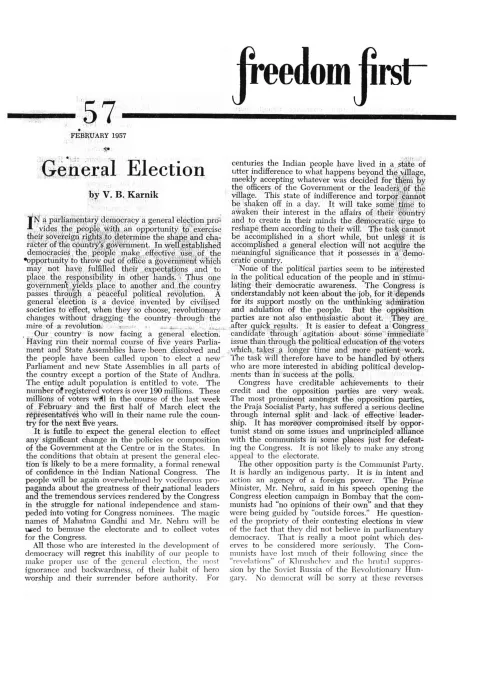
In this unsigned lead editorial, ‘General Election’ (byline: V. B. Karnik), the author argues that India’s 1957 general election is unlikely to produce any meaningful change in government policy or composition, given popular indifference, hero-worship of Congress leaders (Gandhi and Nehru), and the weakness of opposition parties. The Praja Socialist Party is described as compromised by internal splits and opportunist alliances with communists, while the Communist Party is cast as a foreign-directed agency with declining credibility after Khrushchev’s revelations and the suppression of Hungary. The piece warns that Congress’s unbroken fifteen-year rule risks strengthening totalitarian tendencies within a nominally democratic system, and calls for independent-minded public men to stand for election as a check on one-party dominance.
- A general election in a well-established democracy allows peaceful change of government, but India’s election is expected to be a mere formality reaffirming Congress rule.
- Popular indifference, illiteracy, and hero-worship of Gandhi and Nehru will be exploited by Congress propaganda to secure votes.
- Fifteen unbroken years of Congress rule risk creating packed legislatures, intolerance of criticism, and erosion of democratic vitality even if democratic institutions formally continue.
- The Praja Socialist Party is weakened by internal splits and unprincipled alliances with communists in some areas.
- The Communist Party of India is characterized as a foreign-directed agency whose standing has been damaged by Khrushchev’s revelations and the suppression of the Hungarian revolution.
- The author calls on disinterested, independent-minded public men to stand for election as a check against sliding into totalitarian attitudes.
C. C. F. News
The ‘C.C.F. News’ item and accompanying ‘Notes’ section report on the January 1957 Paris meeting of the International Executive Committee of the Congress for Cultural Freedom, which reasserted opposition to Soviet aggression in Hungary and Eastern Europe, praised Western restraint over Egypt (Suez) by contrast with Soviet defiance of the UN, and pledged continued support for persecuted intellectuals in Hungary, Poland, and Latin America. The Notes section separately covers Nehru’s Indore speeches affirming that Indian socialism will follow democratic, non-doctrinaire methods, and welcomes his acknowledgment that the unbalanced, heavy-industry-first planning of Eastern Bloc states (and by implication India’s early Second Plan drafts) neglected agriculture and the people’s needs.
- The Congress for Cultural Freedom’s Executive Committee met in Paris on January 12-13, 1957, reviewing 1956 activities and setting 1957 priorities.
- The Committee condemned continued Soviet aggression in Hungary as a violation of international morality underpinning the 1950 Berlin Manifesto.
- The Committee contrasted French and British compliance with UN decisions on Egypt against Soviet defiance regarding Hungary.
- M. R. Masani attended the Paris meeting and took a prominent part in its discussions.
- Nehru’s Indore speeches declared Indian socialism would rest on democratic principles and peaceful methods, not rigid doctrinaire socialism.
- Freedom First welcomes Nehru’s admission that East European planning was ‘unbalanced,’ overemphasizing heavy industry at agriculture’s expense, as vindication of its own earlier warnings.
Notes (Socialism And Democracy; Unbalanced Plans; Situation In South Africa; Military Regime In Hungary; Ahmedabad Arrests)
This unsigned item reports on the apartheid crackdown in South Africa under the Ghetto Act and Group Areas Act, describing the forced removal of Indian and African communities from Johannesburg-area settlements, mass trials under the Suppression of Communism Act, and disenfranchisement of coloured and Indian voters by the Strijdom Government. A separate short item, ‘Ahmedabad Arrests,’ protests the Preventive Detention Act arrests of about twenty-five Praja Socialist workers in Ahmedabad, questioning the propriety of arresting people after inviting them to a police conference rather than prosecuting them through ordinary legal process.
- The Strijdom Government’s Ghetto Act (Group Areas Act) is forcing Indian and African communities from Johannesburg-area settlements such as Lenasia despite substantial property holdings.
- Indians and Africans are being tried en masse under the Suppression of Communism Act, subjected to humiliating court procedures conducted in languages defendants do not understand.
- The South African Government has also moved to strip Indians and Africans of voting rights, described as disenfranchisement on a ‘fantastic charge of treason.’
- The piece calls on the free world to pressure South Africa despite repeated but ineffective UN General Assembly discussions of the issue.
- In Ahmedabad, about 25 Praja Socialist workers were arrested under the Preventive Detention Act after being lured to a police conference, which the author calls reprehensible absent due prosecution.
The West Has Lost The Right To Weep
By Manes Sperber
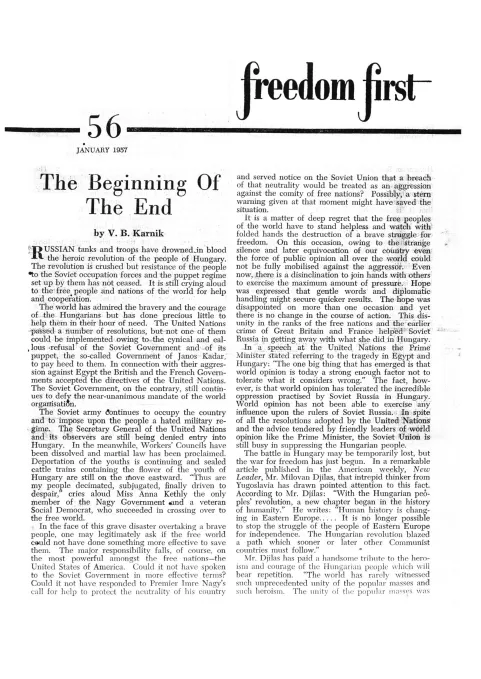
In ‘The West Has Lost The Right To Weep,’ reprinted from The New Leader, Manes Sperber delivers a bitter indictment of Western passivity during the Hungarian revolution, arguing the West offered only words while Hungarians died, repeating the historical pattern of the Warsaw ghetto and the Polish Home Army uprising. He analyzes the revolution’s spontaneous, leaderless character (with the Social Democratic party’s leadership having been liquidated by the Communists years earlier), invokes Rosa Luxemburg’s thesis on the spontaneity of the masses versus Bolshevik vanguardism, and predicts the Kremlin’s suppression of Hungary will only hasten an eventual Russian revolution, since soldiers ordered to fire on fellow citizens will ultimately refuse.
- The West’s only response to Hungary’s revolutionaries was ‘astonished silence,’ repeating the historical betrayal pattern of the Warsaw ghetto fighters and the Polish Home Army.
- The revolution’s spontaneity and lack of political/trade-union organization, following the earlier Communist liquidation of Social Democratic leadership, made it powerful but also vulnerable and prone to dangerous acceleration.
- Rosa Luxemburg’s insistence on the spontaneous role of the masses in true revolution, against Bolshevik vanguardism, is invoked as prophetic in light of the Berlin, Poznan, and Hungarian uprisings.
- Sperber argues Russia’s ‘collective leadership’ feared the demonstration effect of the Hungarian revolt on other Soviet-bloc peoples and, ultimately, the Soviet Union’s own population.
- The essay predicts an eventual Russian revolution, on the theory that soldiers ordered to fire on their own people will instead turn against the tyranny.
”We Are All Stalinists”
By Saadi
In ‘“We Are All Stalinists”,’ Saadi dissects Khrushchev’s post-20th-Congress claim of continued Stalinist commitment ‘in our fight with imperialists’ and his praise of Stalin as a ‘model communist,’ arguing this is no contradiction: Stalinism as an institution and method (ruthless, unscrupulous, totalitarian) survives even as communists disown Stalin the individual. The essay reports on the Jayaprakash Narayan-Ajoy Ghosh exchange, with Narayan’s open letter to Indian communists posing pointed questions about whether Khrushchev’s revelations were genuine reform or mere political maneuvering, and whether Indian communists have the independence to break from Moscow. Ghosh’s reply is characterized as a political rejoinder that ultimately justifies Soviet suppression of the Hungarian revolution, following a secret Comintern-successor directive of 2 November 1956 instructing all Communist Parties to defend Soviet action in Hungary.
- Khrushchev’s denunciation of Stalin at the 20th Congress and his subsequent praise of Stalin as a ‘model communist’ are not contradictory: to communists, ‘Stalin’ names an institution and method that persists as Stalinism.
- Recent crackdowns on Moscow University student dissent are cited as evidence that no genuine liberalisation has occurred in the USSR.
- Jayaprakash Narayan’s open letter to Indian communists asks whether they will pursue truth over ideology and whether they have the independence to break from Moscow’s line.
- Ajoy Ghosh’s reply is characterized as justifying Soviet suppression of the Hungarian revolution and Communist Party ‘mass following’ as proof of independence from Moscow, which the author rejects as a fallacy.
- A secret 2 November 1956 Communist Party of the Soviet Union circular directed all national Communist Parties to defend the USSR’s action in Hungary, which the author presents as proof that Ghosh was simply following the Moscow directive.
Mr. Milovan Djilas
This item reproduces a cable sent to President Josip Broz Tito by a large group of internationally renowned intellectuals and public figures protesting the arrest and imprisonment of Milovan Djilas for his advocacy of democratic freedoms in Eastern Europe, urging his immediate release. It lists signatories from the United States, Britain, France, Germany, India (Sudhin Datta, Asoka Mehta, M. R. Masani, Jayaprakash Narayan, B. R. Shenoy), Israel, Italy, Japan, and Spain, and includes a companion cable from the Congress for Cultural Freedom’s Executive Committee chairman, Denis de Rougemont, reiterating the demand for Djilas’s release.
- An international cable to Yugoslav President Tito protests the imprisonment of Milovan Djilas for advocating democratic freedoms in Eastern Europe.
- The cable frames Djilas’s fate as ‘a test of the sincerity’ of Yugoslavia’s professed liberalisation and repudiation of Stalinist tyranny.
- Signatories include prominent Western intellectuals and politicians (Sidney Hook, Norman Thomas, T. S. Eliot, Malcolm Muggeridge, Raymond Aron, Albert Camus, J. Robert Oppenheimer) alongside Indian signatories Sudhin Datta, Asoka Mehta, M. R. Masani, Jayaprakash Narayan, and B. R. Shenoy.
- A separate cable from Congress for Cultural Freedom chairman Denis de Rougemont reaffirms the demand for Djilas’s release and for Yugoslavs to be allowed to judge his views.
Religion & Freedom - A Seminar in Karachi
By A. B. Shah
In ‘Religion & Freedom - A Seminar in Karachi,’ A. B. Shah reports on a late-December seminar organized by the Pakistan Committee for Cultural Freedom, attended by about thirty intellectuals from Pakistan and observers from India, Indonesia, and Lebanon, examining how far individual political and cultural freedom can be guaranteed by Islam or any religion. Papers by A. K. Brohi, Q. M. Aslam, Syed Ali Ashraf, Hasan Zaman, Dr. Mohmad Ahmad, and Dr. Mazharul Huq argued variously that religion is a necessary foundation for freedom, duty, and morality, while other participants (Jyotirmai Guha, Takdir Alisjabano, Beshara Ghorayeb) offered more secular or comparative counter-perspectives, with Ghorayeb asserting that democracy is a-religious. The seminar left key epistemological questions about reason versus religious authority unresolved for want of time.
- The Pakistan Committee for Cultural Freedom’s seminar on ‘Religion and Freedom’ drew about thirty intellectuals from Pakistan plus observers from India, Indonesia, and Lebanon.
- A. K. Brohi’s inaugural address posed the dilemma of how much freedom a free society should permit to those who would undermine its institutions.
- Q. M. Aslam argued no major religion, least of all Islam, opposes democratic ideals of freedom, justice, and equality.
- Syed Ali Ashraf and Hasan Zaman argued for a religious orientation to education and society as a safeguard against extreme individualism and totalitarian collectivism.
- Jyotirmai Guha countered that man, as product of a law-governed universe, can be moral through reason alone without supernatural sanction.
- Beshara Ghorayeb asserted that democracy is a-religious and warned against religion being used as a rigid secular ideology.
- The seminar could not resolve, for lack of time, deeper questions about reconciling religious authority with modern science, reason, and epistemology.
Review: The Torment Of Secrecy
By MA Venkata Rao
In the ‘Review’ section, M. A. Venkata Rao assesses Edward A. Shils’s The Background and Consequences of American Security Policies (The Free Press, Glencoe, 1956), described as ‘The Torment Of Secrecy.’ Shils is portrayed as sympathetic to the view that Senator McCarthy’s anti-communist crusade disgraced America’s standing as an enlightened democratic leader, tracing McCarthyism’s roots to imperfect assimilation of immigrant groups and fears of disloyalty. The reviewer partly pushes back, arguing Shils understates the genuine danger of communist infiltration facilitated by wartime pro-Russian sentiment (citing Alger Hiss), while endorsing Shils’s constitutional argument that Congress overstepped legitimate bounds into unjust intimidation, and praising his closing pluralist theory of social life, which the reviewer likens to the Indian ethos of differential dharma across vocational groups.
- Shils’s book examines the background and consequences of American security policy shaped by Senator McCarthy’s anti-communist activities.
- Shils regards McCarthyism as having brought disgrace to America’s standing as a democratic leader, with demoralising effects on administration, education, religion, journalism, and diplomacy.
- Shils attributes public fears of disloyalty to imperfect assimilation of heterogeneous immigrant groups into an integral American nationalism.
- The reviewer argues Shils understates the real danger of communist infiltration enabled by wartime pro-Russian sentiment, citing the Alger Hiss case.
- The review endorses Shils’s constitutional argument that Congress’s fault was not oversight of the Executive per se but overreach into unjust intimidation and victimisation.
- The review praises Shils’s closing pluralist theory of social life and tolerance, comparing it to the Indian ethos of differential dharma governing different vocational groups.
Officialising The Cooperatives?
By MA Venkata Rao
In ‘Officialising The Cooperatives?’, M. A. Venkata Rao critiques a Union Minister’s (K. D. Malaviya’s) call to officialise the cooperative movement, arguing it contradicts the voluntary spirit of cooperation and represents another step in the ‘socialistic pattern of society’ displacing individual freedom with state power. Drawing on a monograph by the Indian Cooperative Union of Delhi (authored by Prof. Raj Krishna, L. C. Jain, and Gopi Krishan) evaluating resettlement cooperatives for refugee peasants since 1948, the essay distinguishes genuine ‘service’ or ‘betterment’ cooperatives that preserve farmer proprietorship from Soviet/Chinese-style collective farms that convert peasant proprietors into landless labourers under bureaucratic management. As rendered through page 12, the essay surveys comparative international evidence (Russia, China, Bulgaria, Czechoslovakia, Hungary, Poland) showing that forced collectivisation nowhere achieved decisive production gains and everywhere required force or administrative discrimination against reluctant peasants, concluding the monograph ‘marshals the evidence against Cooperative Farming’ as planned in India. The issue closes with a note on the Indian Committee for Solidarity with Hungary’s fundraising for Hungarian refugee students and its Bombay public meeting protesting the Government of India’s invitation to Marshal Zhukov.
- K. D. Malaviya’s call to ‘officialise the cooperative movement’ is criticized as contradicting the voluntary spirit of cooperation and as part of a broader drift toward state displacement of social life.
- The essay distinguishes genuine farmer ‘service’/‘betterment’ cooperatives (preserving proprietorship, pooling credit and resources) from Soviet/Chinese-style collective farms that convert peasants into landless labourers under bureaucratic management.
- The Indian Cooperative Union of Delhi’s monograph, based on evaluation of resettlement cooperatives for refugee peasants since 1948, is presented as authoritative evidence against large-scale collectivisation.
- Comparative international evidence shows collectivisation nowhere raised agricultural output above pre-revolution levels and proceeded furthest (51%) in Bulgaria, with Czechoslovakia, Yugoslavia, and Hungary around 20% and Poland, Romania, and East Germany at 11%.
- The Federation of Rural People’s Organizations, at a meeting chaired by N. G. Ranga, passed a resolution warning against hasty campaigns favouring collective cultivation.
- The essay concludes that collectivisation destroys humanist and democratic values and the class of independent peasant proprietors without delivering the promised production gains.
- The issue closes with a note that the Indian Committee for Solidarity with Hungary, chaired by Jayaprakash Narayan, is raising funds to bring Hungarian refugee students to India and protested the Government of India’s invitation to Marshal Zhukov.
Generated by the v1.5 extraction pipeline. Awaiting editorial review.
Metadata and summary are AI-extracted from the source PDF and reviewed for editorial accuracy. The original work is available via the Read PDF tab above (where present); paragraph-level citation inside the PDF is deferred to a future engagement.