periodical issue
Freedom First
By G. F. Hudson, Oscar Lange, B. K. Desai, Franklin A. Lindsay
Edited, printed & published for the Democratic Research Service by V. B. Karnik at The Kanada Press, 109 Parsi Bazar Street, Bombay 1. · Bombay · 1957
12 pages
Freedom First
Summary
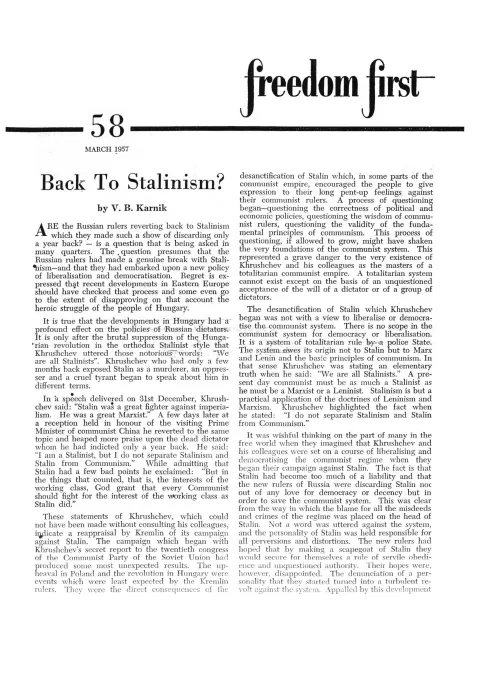
This is issue No. 58 of Freedom First (March 1957), a monthly published by the Democratic Research Service in Bombay and edited by V. B. Karnik. In the rendered pages, the issue is dominated by the aftershocks of 1956: the Hungarian revolution and its suppression, Poland’s more limited ‘national communism’ turn under Gomulka, and Khrushchev’s partial, self-serving retreat from Stalin’s cult of personality. Karnik’s lead essay argues that Soviet de-Stalinisation was never a genuine liberalising reform but a defensive manoeuvre to save the communist system from a crisis of legitimacy after Hungary and Poland. A ‘Notes’ section comments on Indian government moves against communist-front organisations, academic freedom (citing John Matthai and Vinoba Bhave), the political rights of government servants, and the birth of the Republic of Ghana. G. F. Hudson’s piece (condensed from Commentary, New York) dissects the ‘double standard’ in Nehru’s foreign policy toward Western versus Soviet-bloc actions. An editorial on Poland and translated extracts from Gomulka’s October 1956 Central Committee report, followed by extracts from Oscar Lange’s self-critical article on the failures of Poland’s Six Year Plan, document the economic and political breakdown behind the Polish crisis. The issue closes with a review of Peter Fryer’s Hungarian Tragedy by B. K. Desai, and a counterfactual news-format piece by Franklin A. Lindsay (reproduced from Free Spirit, Sydney) imagining a Hungary in which Western and UN intervention had actually stopped the Soviet crackdown.
Key points
-
V. B. Karnik’s ‘Back To Stalinism?’ argues Soviet de-Stalinisation was never genuine liberalisation but a tactical retreat forced by near-collapse of control after Hungary and Poland, quoting Khrushchev’s own admission that he does ‘not separate Stalinism and Stalin from Communism.’
-
G. F. Hudson’s ‘The Paradox Of Jawaharlal Nehru,’ condensed from Commentary, dissects a ‘double standard’ in Nehru’s foreign policy — harsh on Suez, muted on Hungary — while still affirming Nehru’s ‘basic devotion to liberal principles.’
-
‘The Truth About Poland’ extensively quotes Gomulka’s October 1956 Central Committee report admitting the Six Year Plan’s failure and attributing the Poznan riots to genuine grievances rather than foreign incitement.
-
Extracts from Oscar Lange’s Zycie Gospodarcze article, introduced as the economist who advised Mahalanobis on India’s Second Plan, detail Poland’s ‘disintegration of the national economy’ and propose a nine-point emergency programme including ‘further democratization.’
-
B. K. Desai reviews Peter Fryer’s Hungarian Tragedy, praising Fryer’s firsthand account of ‘three and a half days of freedom’ while faulting his continued loyalty to a Communist Party he intends to ‘reform from within.’
-
Franklin A. Lindsay’s counterfactual ‘What Might Have Happened In Hungary,’ from Free Spirit, imagines a UN Observation Commission and decisive Western intervention averting the Soviet crackdown.
-
A ‘Notes’ section welcomes Indian government moves against communist-front organisations, university autonomy calls from John Matthai and Vinoba Bhave, and marks the birth of the Republic of Ghana.
Essays
s own words — praising Stalin as
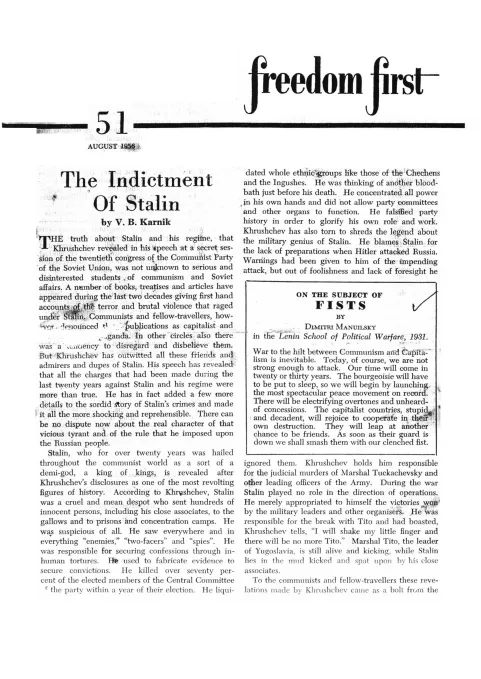
V. B. Karnik argues that the Soviet leadership’s ‘de-Stalinisation’ campaign was never a sincere turn toward liberalisation or democratisation, but a tactical retreat forced on Khrushchev by the near-collapse of Soviet control after the Hungarian revolution and Polish upheaval. He traces how Khrushchev’s own words — praising Stalin as ‘a great fighter against imperialism’ within months of denouncing him, and declaring ‘I do not separate Stalinism and Stalin from Communism’ — reveal that the campaign against Stalin’s personality was meant only to make him a scapegoat for systemic failures, not to reform the system itself. Karnik, quoting Ignazio Silone, situates de-Stalinisation as a process forced upon the rulers by underlying social pressures (workers’ strikes, a new generation’s longing for peace) rather than one they initiated. He concludes that the Kremlin’s power is far more constrained by these social forces than the free world assumes, and that no return to Stalinist forms and rhetoric can undo the doom that Vorkuta, Poznan, and Budapest have already pronounced on police states.
- Karnik rejects the premise that Khrushchev’s anti-Stalin campaign represented genuine liberalisation.
- Khrushchev’s own statements (‘We are all Stalinists’) are read as an admission that Stalinism is inseparable from Marxism-Leninism as a system.
- The de-Stalinisation campaign is framed as an attempt to make Stalin a scapegoat for systemic communist failures.
- Ignazio Silone’s essay on Hungary is quoted at length as external corroboration of a genuine social awakening in Russia and Eastern Europe.
- Karnik predicts the Soviet rulers cannot avert historical ‘doom’ by re-adopting Stalinist trappings.
Back To Stalinism?
By V. B. Karnik
The unsigned ‘Notes’ section comments on four separate items of current affairs: the Indian government’s directive discouraging ministers from patronising communist-front cultural organisations (welcomed as belated realism); Dr. John Matthai’s and Acharya Vinoba Bhave’s calls for university autonomy from gubernatorial/political control, framed as essential to democratic education; a case for narrowing the legal definition of ‘government servant’ so that industrial and clerical state employees are not barred from ordinary political participation; and a short item marking the birth of the Republic of Ghana as the first black African nation admitted to the Commonwealth.
- Endorses the Indian government’s directive against state patronage of communist front organisations such as the All India Peace Council and Indian Peoples’ Theatre Association.
- Cites Dr. John Matthai’s view that gubernatorial chancellorship of universities channels political influence into academic life and should end.
- Quotes Acharya Vinoba Bhave warning that government-controlled education fashions students ‘to think in a pre-determined manner.’
- Argues the definition of ‘government servant’ under Conduct Rules should be narrowed so that ordinary industrial/clerical state employees retain full political rights.
- Notes the emergence of the Republic of Ghana (6 March 1957) as the first sub-Saharan African nation in the Commonwealth.
The Paradox Of Jawaharlal Nehru
By G. F. Hudson
G. F. Hudson, in a piece condensed from Commentary (New York), examines what he calls the ‘double standard’ in Jawaharlal Nehru’s foreign policy: harsh criticism of Western actions (Suez) alongside muted or absent criticism of Soviet actions (Hungary), and India’s advocacy for the independence of Western colonies while acquiescing in the Chinese reconquest of Tibet. Hudson traces this partly to India’s lack of an independent diplomatic tradition prior to 1947, the formative influence of Gandhi’s anti-colonial movement on Congress leaders, and the opportunity this created for crypto-communists and fellow-travellers to shape the intelligentsia’s thinking on foreign affairs. He also situates India’s Middle East diplomacy (opposition to the Baghdad Pact, non-recognition of Israel) within this framework. Despite the critique, Hudson affirms that India remains ‘the great hope of democracy and liberal values in Asia’ and urges the West to win over Nehru through generous, unconditional support rather than further irritation.
- Hudson identifies a ‘double standard’ whereby Nehru condemns Western actions (Suez) far more severely than Soviet actions (Hungary).
- Jayaprakash Narayan is cited as having launched a damaging public attack on Nehru over his muted response to Krishna Menon’s framing of Hungary as a ‘domestic affair’.
- India’s acquiescence in the Chinese reconquest of Tibet is contrasted with its vocal anti-colonialism regarding Algeria, Aden, and Iran.
- Hudson attributes the tilt partly to India’s lack of an independent diplomatic tradition and the influence of Gandhi’s movement on Congress leaders’ worldview.
- The piece quotes Nehru’s own words to Tibor Mende on non-interference in other states’ internal affairs.
- Despite criticism, Hudson affirms Nehru’s ‘basic devotion to liberal principles’ and calls for Western engagement rather than estrangement.
The Truth About Poland
An unsigned editorial piece, ‘The Truth About Poland,’ contrasts Poland’s milder ‘national communism’ path in October 1956 with Hungary’s more revolutionary break, noting that the new Gomulka regime secured concessions and an understanding with Moscow rather than a Soviet military crackdown. The piece extensively quotes Gomulka’s own October 1956 report to the Communist Party Central Committee, in which he admits the failure of the Six Year Plan, the country’s fall into insolvency, the poor productivity of collectivised farms compared to individual holdings, and the causes of the Poznan workers’ riots — which he attributes to genuine grievances against Party leadership rather than foreign incitement. Gomulka also analyses the ‘cult of the individual’ as a hierarchical system extending beyond Stalin himself to all Communist Party leaderships, and acknowledges that innocent people in Poland were imprisoned and tortured under the old system. The editorial frames this as an authoritative internal confession — from a serving communist leader — that should warn against seeking any model in Eastern European communist regimes.
- Contrasts Poland’s 1956 ‘national communism’ with Hungary’s fuller revolutionary break and Soviet suppression.
- Extensively quotes Gomulka’s October 1956 Central Committee report admitting the Six Year Plan’s failure and Poland’s effective insolvency.
- Cites statistics showing individual farms out-produced kolkhozes and state farms per hectare despite owning less land share.
- Gomulka attributes the Poznan riots to genuine working-class grievances against Party and government failures, not foreign incitement.
- Gomulka’s account of the ‘cult of the individual’ describes a hierarchical structure of subordination extending through all Communist Parties, not confined to Stalin.
- The editorial treats Gomulka’s own testimony as authoritative confirmation of terror, imprisonment, and torture under the prior regime in Poland.
Confession Of A Communist Economist
By Oscar Lange
Extracts from Prof. Oscar Lange’s article in Zycie Gospodarcze of Warsaw — introduced by the editors as a devastating internal critique from the economist who had advised P. C. Mahalanobis on India’s Second Five Year Plan — detail the ‘disintegration of the national economy’ produced by the Six Year Plan. Lange enumerates serious structural disproportions (between agriculture and industry, investment and outdated equipment, quantity versus quality of output) and lays out a nine-point emergency programme: mobilising reserves to raise living standards, redirecting armaments-industry capacity to civilian production, restoring incentives for agricultural and handicraft production, decentralising distribution, systematising foreign trade policy, adapting the investment structure toward consumer needs, extending workers’ participation in enterprise administration, and ‘further democratization of the political and social life’ to prevent the kind of unchecked disintegration that occurred under the old command structure.
- Lange identifies structural disproportions between agriculture and industry, and between investment programmes and outdated factory equipment, as root causes of Poland’s economic crisis.
- He calls for redirecting resources frozen in the armament industry toward civilian consumer production.
- He argues collectivised agriculture requires restoring genuine cooperative self-government and incentive structures, not just administrative pressure.
- He proposes reducing bureaucracy in distribution and adapting tax policy to support individual handicrafts.
- His programme’s ninth and final point calls for ‘further democratization of the political and social life’ as the remedy for the lack of democratic control that allowed the crisis to develop unchecked.
- The editors’ introduction notes Lange had personally advised P. C. Mahalanobis on India’s Second Five Year Plan, giving the confession particular relevance for Indian readers.
Review: Hungarian Tragedy (by Peter Fryer, Dobson Books Ltd., London, 1956, pp. 96)
By B. K. Desai
B. K. Desai reviews Peter Fryer’s Hungarian Tragedy (Dobson Books, 1956), noting that Fryer — a fourteen-year British Communist Party member and Daily Worker correspondent — was the first communist journalist to reach Hungary during the revolution and underwent a bitter disillusionment there. Desai summarises Fryer’s account of the popular uprising against the Rakosi/Farkas/Gero regime’s ‘eleven years of terror and stupidity,’ the brutal Soviet suppression characterised as ‘tanks versus men,’ and the brief ‘three and a half days of freedom.’ Desai’s own critical verdict is that while Fryer’s reporting indicts Stalinism as a ‘monstrous perversion of Marxism,’ Fryer fails to recognise that Stalinism was the logical extension of Marxist-Leninist doctrine rather than an aberration, and that his continued loyalty to the Communist Party (and stated intent to rejoin it to reform it) shows he has not achieved a genuine renunciation of his communist faith.
- Fryer was a longtime British Communist Party member and Daily Worker staffer who became the first communist journalist to report from revolutionary Hungary.
- Fryer’s book rebuts claims the revolution was a foreign-engineered ‘counter-revolutionary coup,’ citing that no Western-manufactured weapons were found among the insurgents.
- Fryer characterises the conflict as ‘tanks versus men’ and describes ‘three and a half days of freedom’ before the crackdown.
- Desai’s critique: Fryer indicts Stalinism as a perversion of Marxism but fails to see it as the logical extension of Marxist-Leninist doctrine itself.
- Desai notes Fryer was suspended from the British CP for his report but has stated intent to rejoin it ‘to reform it from within,’ which Desai reads as continued unresolved faith in the communist system.
What Might Have Happened In Hungary
By Franklin A. Lindsay
No summary was extracted for this article. Listed for completeness.
Notes (Belated Wisdom; Academic Freedom; Government Servants And Politics; The Republic Of Ghana)
Franklin A. Lindsay, in a piece reproduced from Free Spirit (Sydney), constructs a counterfactual day-by-day news chronicle (November 1-9) imagining that the West and the UN had acted decisively during the three-day window between Imre Nagy’s request for UN intervention and the actual Soviet attack of November 4, 1956. In this alternate history, a UN Hungarian Observation Commission reaches Budapest, Soviet troops begin a real withdrawal under international observation, and Hungary secures genuine neutrality on the Austrian model with US-backed food, medical, and (if necessary) arms shipments. Lindsay’s closing commentary argues this outcome was genuinely within reach had the West seized the opportunity, and criticises the UN’s failure to act before the Kadar puppet regime was installed, after which Security Council action became blocked by Soviet veto threat.
- Lindsay’s counterfactual imagines a UN Hungarian Observation Commission (India, Yugoslavia, Poland, Canada, Brazil, Indonesia, Sweden) successfully deploying to Budapest before the Soviet attack.
- In the imagined timeline, Khrushchev personally orders a Soviet pullback rather than risk confrontation with UN observers in Budapest.
- Eisenhower is depicted authorising emergency food, medical aid, and (if needed) arms for Hungary while ruling out initial US troop involvement to preserve the ‘neutrality’ framing.
- Lindsay argues real UN/Western intervention was possible via the General Assembly (bypassing Soviet Security Council veto) in the three-day window after Nagy’s request.
- He criticises the actual historical failure to act before the Kadar regime was recognised, after which Security Council action became blocked by Soviet veto.
Generated by the v1.5 extraction pipeline. Awaiting editorial review.
Metadata and summary are AI-extracted from the source PDF and reviewed for editorial accuracy. The original work is available via the Read PDF tab above (where present); paragraph-level citation inside the PDF is deferred to a future engagement.