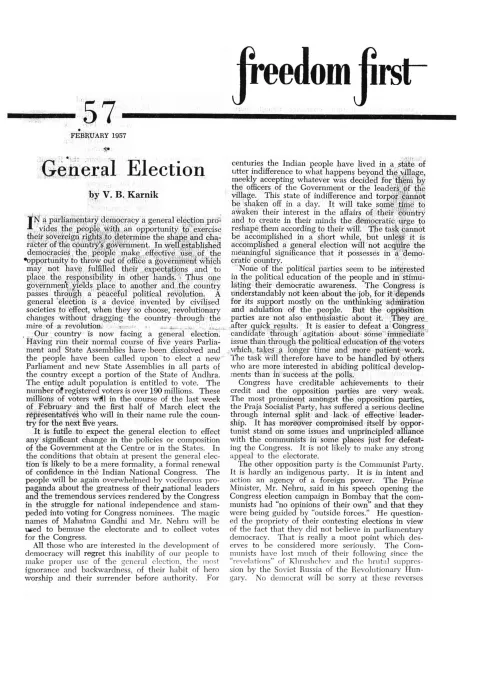
periodical issue
Freedom First
Edited, printed & published for the Democratic Research Service by V. B. Karnik at The Kanada Press, 109 Parsi Bazar Street, Bombay 1. · Bombay · 1957
12 pages
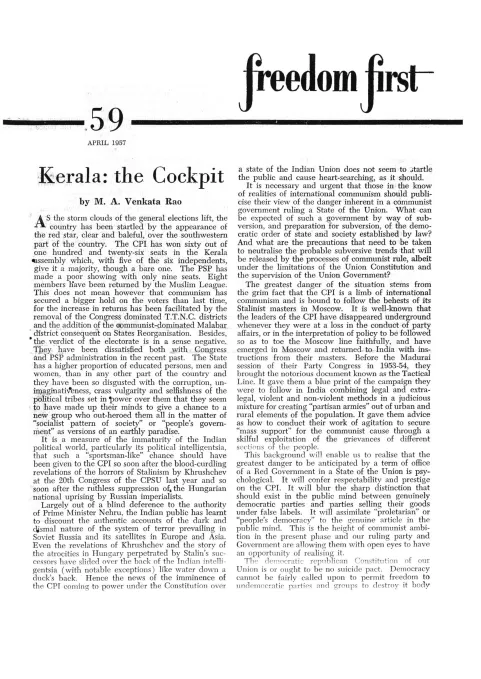
Freedom First
Summary
This is the April 1957 issue (No. 59) of Freedom First, the monthly journal of the Democratic Research Service published in Bombay under the editorship of V. B. Karnik. In the rendered pages, the issue’s dominant concern is the Communist Party of India’s electoral victory in Kerala, read as a live test case of communism’s advance through parliamentary means rather than force. Contributors include M. A. Venkata Rao on the Kerala result and its implications for Congress and democratic India, an unsigned Notes section covering Russo-Yugoslav tensions, alleged communist infiltration of Congress publications, and a communist propaganda attack on newly independent Ghana, Ida Dhami on Italian socialist leader Pietro Nenni’s break with the communists, Saadi on student unrest behind the Iron Curtain, Raja Kulkarni on the fragile state of parliamentary democracy across Asia (Indonesia, Pakistan, Thailand, Burma, and India), and B. K. Desai’s review of two Bertram D. Wolfe books on Soviet totalitarianism and Khrushchev’s de-Stalinisation speech. The issue also carries routine institutional notices from the Congress for Cultural Freedom and the Democratic Research Service, and the annual statutory ownership statement for the publication itself.
Key points
-
M. A. Venkata Rao’s ‘Kerala: The Cockpit’ assesses the CPI’s Kerala election victory, winning 60 of 126 seats, as reflecting disgust with Congress and PSP misgovernment rather than ideological conversion, warning of the psychological danger of lending communism respectability.
-
A ‘Notes’ section reports renewed Soviet-Yugoslav tension, alleges communist infiltration of the AICC’s Economic Review, and describes a Bulgarian youth organ’s attack on Ghana’s Kwame Nkrumah as evidence of a coordinated communist campaign against new states.
-
Ida Dhami’s ‘Signor Nenni’s Change Of Heart’ reports Italian socialist leader Pietro Nenni’s break from a decade-long communist alliance following Khrushchev’s revelations and the Hungarian and Poznan uprisings.
-
‘Saadi”s survey of student discontent behind the Iron Curtain documents unrest in East Germany, Hungary, Poland and the USSR, concluding that Marxism and Communism are ‘obviously losing their appeal to the Soviet students and intelligentsia.’
-
Raja Kulkarni surveys parliamentary democracy’s fragile state across Asia — Sukarno’s ‘Guided Democracy’ proposal in Indonesia, Thailand’s contested elections, Burma’s Karen insurgency — and frames Kerala’s communist government as the decisive test case for the Indian constitutional framework.
-
B. K. Desai reviews Bertram D. Wolfe’s Six Keys to the Soviet System and Khrushchev and Stalin’s Ghost, summarising Wolfe’s argument that the real twentieth-century question is ‘total state or limited state’ and that Khrushchev’s speech selectively omitted the Hitler-Stalin pact and Katyn.
-
Short obituaries mourn Philippine President Ramon Magsaysay, credited with defeating the Huk insurgency through land reform, and former Bombay Chief Minister B. G. Kher.
Essays
Kerala: the Cockpit
By MA Venkata Rao
M. A. Venkata Rao’s lead article assesses the Communist Party of India’s victory in the Kerala assembly elections, in which the CPI won 60 of 126 seats and, with independent support, secured a bare majority. He argues the result reflects less a genuine ideological embrace of communism than disgust with Congress and PSP misgovernment among an unusually educated electorate, compounded by redistricting that folded in the communist-dominated Malabar district. The essay warns that a CPI government in a state of the Union poses a primarily psychological danger: it will confer respectability on the CPI, blur the distinction between genuinely democratic parties and those that merely borrow democratic labels, and open the door to Soviet-style manipulation of law and police power. Rao predicts the new government will pursue land ceilings and land-to-the-tiller reforms that make the peasantry dependent on the state, may nationalise banks and transport, and will use ‘fronts’ to draw students, workers, and professionals into the communist net, while Kerala’s organised Christian community offers a possible seat of resistance.
- CPI won 60 of 126 Kerala assembly seats, aided by 5 of 6 independents, giving it a bare majority; PSP won only 9 seats
- Author attributes the CPI win partly to redistricting (loss of Congress-held T.T.N.C. districts, gain of communist Malabar) rather than a simple swing in voter sentiment
- Argues the Indian public and intelligentsia have been slow to absorb the lessons of Khrushchev’s revelations on Stalinism and the suppression of the Hungarian uprising
- Sees the chief danger of communist rule in Kerala as psychological: it will lend the CPI respectability and blur lines between democratic and totalitarian parties
- Predicts CPI will fill administration and police with party loyalists while formally staying within the Constitution
- Forecasts land ceiling and tenancy reforms that leave new landholders dependent on government aid, and possible nationalisation of banks and transport
- Identifies Kerala’s organised Christian church as a potential source of resistance to communist subversion of culture, education, and morality
- Frames the CPI Kerala government as a test case for the rest of India and a challenge to those who would defend democracy
Signor Nenni’s Change Of Heart
By Ida Dhami
The unsigned Notes section (the magazine’s editorial column) covers several short items: a renewed rift between Soviet Russia and Yugoslavia despite Khrushchev’s earlier overtures to Tito, presented as proof that Moscow tolerates no genuine ideological co-existence within the socialist camp; a claim that the AICC’s Economic Review bulletin has been edited under communist influence, naming H. D. Malaviya as a longstanding communist sympathiser within Congress; and a report on a Bulgarian communist youth-organ attack on Ghana’s Kwame Nkrumah shortly after Ghanaian independence, read as an opening move in a broader communist campaign against newly independent Asian and African states, following a pattern the Notes trace back to India, Burma, and Indonesia after their own independence.
- Reports fresh Soviet-Yugoslav tension, with Pravda accusing Yugoslav Foreign Minister Koka Popovic of ‘monstrous and revealing blasphemy’
- Argues Russia demands complete submission of ‘socialist’ states to Moscow, showing Khrushchev’s ‘more than one road to socialism’ line to be hollow
- Alleges communist infiltration of the AICC Economic Review, naming H. D. Malaviya as a known communist sympathiser inside Congress since the 1930s
- Describes a Bulgarian communist youth organ’s attack on Ghana’s Kwame Nkrumah just before Ghana’s independence day, calling it evidence of a coordinated communist assault on the new state
- Draws a parallel to earlier communist tactics toward India, Burma, and Indonesia after independence, alleging these were dismissed by communists as ‘fake independence’
Student Discontent Behind Iron Curtain
By Saadi
A short unsigned obituary tribute to Philippine President Ramon Magsaysay, killed in a plane crash, praising his defeat of the communist Huk insurgency through a combination of military force and land-to-the-landless reform, and his advocacy of a ‘freedom and friendship in Asia’ foreign policy at the Bandung Conference. A second short obituary mourns B. G. Kher, former Bombay chief minister and Gandhian social reformer, praising his integrity and his role in laying the foundations of Bombay’s educational system.
- Praises Ramon Magsaysay’s success in winning Filipino peasants away from communism through land reform and anti-corruption measures
- Credits Magsaysay with a rare clarity among Asian statesmen about the communist threat, demonstrated at the Bandung Conference
- Mourns B. G. Kher as an eminent scholar, able chief minister, and devoted follower of Gandhi who shaped Bombay’s educational foundations
Parliamentary Democracy In Asia
By Raja Kulkarni
A brief C.C.F. (Congress for Cultural Freedom) news item reports a $70,000 Rockefeller Foundation grant, administered via Forum Kulturhilfe in Vienna, to help refugee Hungarian musicians and actors re-establish their careers in the West, and notes an Italian lawyers’ protest telegram over political trials of Hungarian freedom fighters, plus an announcement of a Japan-hosted International Exhibition of Asian Paintings under the Congress for Cultural Freedom’s Japan Cultural Forum.
- Rockefeller Foundation grants $70,000 via Forum Kulturhilfe (Vienna) to aid Hungarian refugee musicians and actors
- 24 Italian lawyers send a telegram protesting political trials of Hungarian freedom fighters
- Japan Cultural Forum and Yomiuri Newspaper announce an International Exhibition of Asian Paintings for young Asian artists, opening July 1957 in Tokyo
Review: Six Keys to the Soviet System / Khrushchev and Stalin’s Ghost (by Bertram D. Wolfe)
By B. K. Desai
Ida Dhami reports on Italian Socialist Party leader Pietro Nenni’s decision, announced at the Venice Socialist Congress, to break his decade-long alliance with the Communist Party in the wake of Khrushchev’s revelations and the Soviet suppression of the Hungarian uprising, and his proposal to reunify with Giuseppe Saragat’s rightist Social Democrats to form a united, non-communist socialist bloc open to backing NATO defensively. She notes that Nenni’s own party proved divided on the move, with his Central Committee nominees outnumbered roughly two-to-one, suggesting the split’s full impact will take time to materialise even though it registers as a significant blow to communist influence in Italy.
- Nenni announces at the Venice Congress his readiness to reunify with Saragat’s Social Democrats and form a neutral, non-communist socialist bloc
- The move follows Khrushchev’s revelations and the Soviet suppression of the Hungarian and Poznan uprisings
- Nenni’s own Italian Socialist Party proved divided, with Central Committee nominees outnumbered about two-to-one
- Both communists and Christian Democrats reportedly relieved once it appeared Nenni’s grip on his party had weakened
- Author assesses the ultimate impact of the split as still uncertain despite its dramatic initial impact
Essay 6
Writing under the byline ‘Saadi’, this essay surveys reports of student discontent across the communist bloc — East Germany, Hungary, Poland, Romania, the Soviet Union, and China — arguing that increased repression in universities has deepened students’ contempt for communism rather than suppressing it. It details specific incidents: arrests of well-to-do Moscow youths for ‘armed robbery’ understood as anti-regime defiance, a scandal involving the daughters of a general, an air force colonel, and a political police officer tried for ‘theft and depravity’ with male associates acquitted while the women received prison terms, and contested Komsomol elections in December 1956 marked by unprecedented criticism of entrenched functionaries. The piece concludes that Marxism and communism are ‘obviously losing their appeal to the Soviet students and intelligentsia,’ while regime responses have been limited to demands for stricter ideological discipline rather than any answer to students’ actual doubts.
- Surveys student unrest and its repression across East Germany, Hungary, Poland, Romania, USSR, and China
- Cites Ulbricht’s admission of ‘counter-revolutionary demonstrations’ by Berlin University students and arrest of a Marxist professor
- Notes 15,000 of 17,000 imprisoned Hungarians are reported to be students under Janos Kadar’s crackdown
- Describes arrest of sixteen well-to-do Moscow youths for ‘armed robbery,’ read as disguised anti-regime defiance
- Details a Moscow trial in which daughters of senior officials received one-year sentences for ‘theft and depravity’ while their male associates, sons of ministers, were acquitted without appearing in court
- Reports contested December 1956 Komsomol functionary elections marked by unprecedented criticism of established leaders
- Concludes that no Marxist answer can satisfy student doubts, and that Marxism and Communism are losing their appeal to Soviet students and intelligentsia
Essay 7
An I.C.C.F. News item reports on a visit to India by Mrs. Rita Hinden, editor of Socialist Commentary and a British socialist thinker, who lectured in Bombay on ‘Recent Trends in British Labour Party Thinking’ under the Indian Committee for Cultural Freedom, addressed Praja Socialist Party workers, and went on to Delhi and Calcutta for further lectures and discussions on socialism and cultural freedom. A further note records a reception for Professor Francisco Ayala of the University of Puerto Rico, who spoke on Puerto Rico’s political and economic conditions.
- Rita Hinden, editor of Socialist Commentary, lectures in Bombay, Delhi, and Calcutta under Indian Committee for Cultural Freedom auspices
- Hinden addresses Praja Socialist Party workers on problems of the Indian socialist movement
- Professor Francisco Ayala of the University of Puerto Rico is received and speaks on Puerto Rico’s political and economic conditions
Essay 8
Raja Kulkarni surveys the condition of parliamentary democracy across Asia. He examines President Sukarno’s proposal for ‘Guided Democracy’ in Indonesia, which would replace parliamentary opposition with an all-party consultative cabinet, and records former Vice-President Mohamed Hatta’s rejection of this scheme as a symptom of profiteering political parties rather than a cure. He surveys Pakistan’s paralysed parliamentary system, Thailand’s contested February 1957 elections and resulting state of emergency, and Burma’s U Nu seeking to convert insurgent Karen rebels into constitutional opposition. Turning to India, Kulkarni argues the recent general elections have produced a fragmented, ideologically incoherent opposition unified only by anti-Congress sentiment, discusses regional party gains, and closes by warning that if parliamentary democracy fails Asia’s needs, the Chinese model of ‘Government Without Opposition’ will gain adherents; the Kerala communist government is presented as the decisive test case, given that Asian communism advances more through ‘subterranean passages of infiltration and subversion’ than by force.
- Sukarno’s ‘Guided Democracy’ proposal would replace parliamentary opposition with an all-party National Council cabinet in Indonesia
- Mohamed Hatta rejects Guided Democracy, blaming Indonesia’s crisis on political parties turned into vehicles for patronage and profiteering rather than lack of national institutions
- Surveys six underlying currents behind Indonesia’s crisis: army politicisation, regional rivalry, weak civil service, corruption, loss of federalism, and Sukarno’s push to include communists in government
- Describes Thailand’s contested February 1957 elections, allegations of ballot fraud, and Field Marshal Pibul Songgram’s declaration of a state of emergency
- Notes Burma’s U Nu seeking to convert Karen insurgents into constitutional opposition and urging opposition parties to support the ruling party on issues of national interest
- Analyses India’s post-election opposition as fragmented and united only by being ‘anti-Congress,’ spanning rightists, leftists, socialists, communists, and regionalists
- Cites J. B. Kripalani’s metaphor comparing Congress to a ‘rich neighbour’ whose uncleanliness breeds problems for his own ‘humble cottage’
- Warns that if parliamentary democracy cannot satisfy Asian needs, the Chinese ‘Government Without Opposition’ model will find more adherents
- Frames the Kerala communist government as the focal current test of whether the Indian constitutional framework can absorb a state-level communist government without eventual subversion of civil and military services
Essay 9
A D.R.S. (Democratic Research Service) news note reports the establishment of a new U.P. branch of the organisation headquartered in Kanpur, listing its advisory board members, alongside the annual statutory ‘Statement about Ownership and Other Particulars of Freedom First’ filed by publisher and editor V. B. Karnik, naming the Democratic Research Service as owner and The Kanada Press, Bombay, as printer.
- New Democratic Research Service branch established in U.P. with headquarters in Kanpur
- Advisory board includes Lt. Col. K. P. Bhatnagar (Vice-Chancellor, Agra University) as chairman and several other named members
- Statutory ownership statement confirms V. B. Karnik as printer, publisher, and editor, with Democratic Research Service as owning entity
Essay 10
B. K. Desai reviews two 1956-57 books by Bertram D. Wolfe, Six Keys to the Soviet System and Khrushchev and Stalin’s Ghost, both examining the nature of Soviet totalitarianism and the post-Stalin ‘de-Stalinisation’ process. Desai summarises Wolfe’s thesis that the essential political question of the twentieth century is not ‘socialism versus capitalism’ but ‘total state or limited state,’ and that Soviet totalitarianism seeks to own not merely material production but human beings themselves, body and soul. On the second book, Desai details Wolfe’s argument that Khrushchev’s secret speech was strategically selective, beginning Stalin’s crimes only from 1934 (after Khrushchev’s own rise) and omitting the Hitler-Stalin pact, the Katyn massacre, and the earlier liquidation of Bukharin’s faction — concluding that Khrushchev denounced Stalin only as a fellow Stalinist mourning the loss of ‘honest communists,’ never intending fundamental change to the totalitarian system itself, even as the speech’s revelations nonetheless constitute a devastating indictment of the entire order.
- Reviews Bertram D. Wolfe’s Six Keys to the Soviet System (Beacon Press, 1956) and Khrushchev and Stalin’s Ghost (Praeger, 1957)
- Summarises Wolfe’s central thesis that the 20th century’s real political question is ‘total state or limited state,’ not socialism versus capitalism
- Notes Wolfe’s argument that Soviet totalitarianism aims to own not just material production but human beings themselves, ‘body and soul’
- Details Wolfe’s account of Stalin’s post-death ‘collective leadership’ period and his heirs’ inability to establish legitimate succession
- Explains Wolfe’s charge that Khrushchev’s secret speech selectively dated Stalin’s crimes from 1934 onward, omitting the Hitler-Stalin pact, the Katyn forest massacre, and earlier purges of Bukharin and Trotskyists
- Concludes, following Wolfe, that Khrushchev denounces Stalin only as a fellow Stalinist mourning ‘honest communists,’ with no intention of dismantling the totalitarian system itself
- Desai judges that despite this selectivity, Khrushchev’s revelations still constitute a damning indictment of the whole communist system
Generated by the v1.5 extraction pipeline. Awaiting editorial review.
Metadata and summary are AI-extracted from the source PDF and reviewed for editorial accuracy. The original work is available via the Read PDF tab above (where present); paragraph-level citation inside the PDF is deferred to a future engagement.