periodical issue
Freedom First
Edited, printed & published for the Democratic Research Service by V. B. Karnik at The Kanada Press, 109 Parsi Bazar Street, Bombay 1. · Bombay · 1957
8 pages
Freedom First
Summary
This is the June 1957 issue (No. 61) of Freedom First, the monthly bulletin of the Democratic Research Service / Indian Committee for Cultural Freedom, edited by V. B. Karnik and published in Bombay. The rendered pages cover the opening article and the closing pages of the issue, with a gap in between (printed pages 5-8 were not rendered). The issue opens with V. B. Karnik’s lead article “Party, Government And The People,” a critique of Nehru’s remarks on the relationship between party, government, and the people, arguing that democratic government must remain distinct from and answerable to Parliament rather than to a ruling party’s extra-parliamentary machinery, with the Communist one-party state offered as the negative model. An unsigned “Notes” section comments on the Finance Minister’s new tax burdens under the Second Five Year Plan, the Soviet Union’s 1957 decree freezing repayment of state bonds (read as a de facto default and confiscation), state intrusion into literature via bodies like the Sahitya Akademi, the arrests of Indonesian writers Takdir Alisjahbana and Mochtar Lubis, and the underground Hungarian “Literary Gazette” published in exile after the 1956 Soviet crackdown. The issue also carries Leszek Kolakowski’s celebrated anti-Soviet essay “What Is Socialism?” (reproduced from the banned Polish student paper Po Prostu via the New Leader of New York), a book review by M. A. Venkata Rao of Kwame Nkrumah’s autobiography on the occasion of Ghana’s independence, an interview with Yugoslav politician Vladimir Dedijer on Soviet exploitation and the Hungarian crisis, C.C.F. News on an East-West Music Festival and further protests over Indonesian arrests, and the tail end of an article on co-operative farming in India warning against Soviet/Chinese-style collectivisation.
Key points
-
V. B. Karnik’s ‘Party, Government And The People’ critiques Nehru’s claim that India occupies a middle position between Communist party-state fusion and Western parliamentary democracy, warning that identifying government with Congress would be ‘a step in the direction of totalitarianism.’
-
Leszek Kolakowski’s ‘What Is Socialism?,’ smuggled from the banned Polish paper Po Prostu, builds a long ironic catalogue of what socialism is ‘not’ — a police state, a system with more spies than nurses — before its deliberately anticlimactic close, ‘socialism is a good thing.’
-
A ‘Notes’ section describes new Second Plan taxation and deficit financing, the USSR’s 1957 decree freezing repayment of state bonds as a de facto default, and the arrests of Indonesian writers Takdir Alisjahbana and Mochtar Lubis without charges.
-
M. A. Venkata Rao reviews Kwame Nkrumah’s autobiography Ghana on the occasion of Ghanaian independence, describing his thought as ‘an amalgam of Marxist specialism and Mazzinian nationalism.’
-
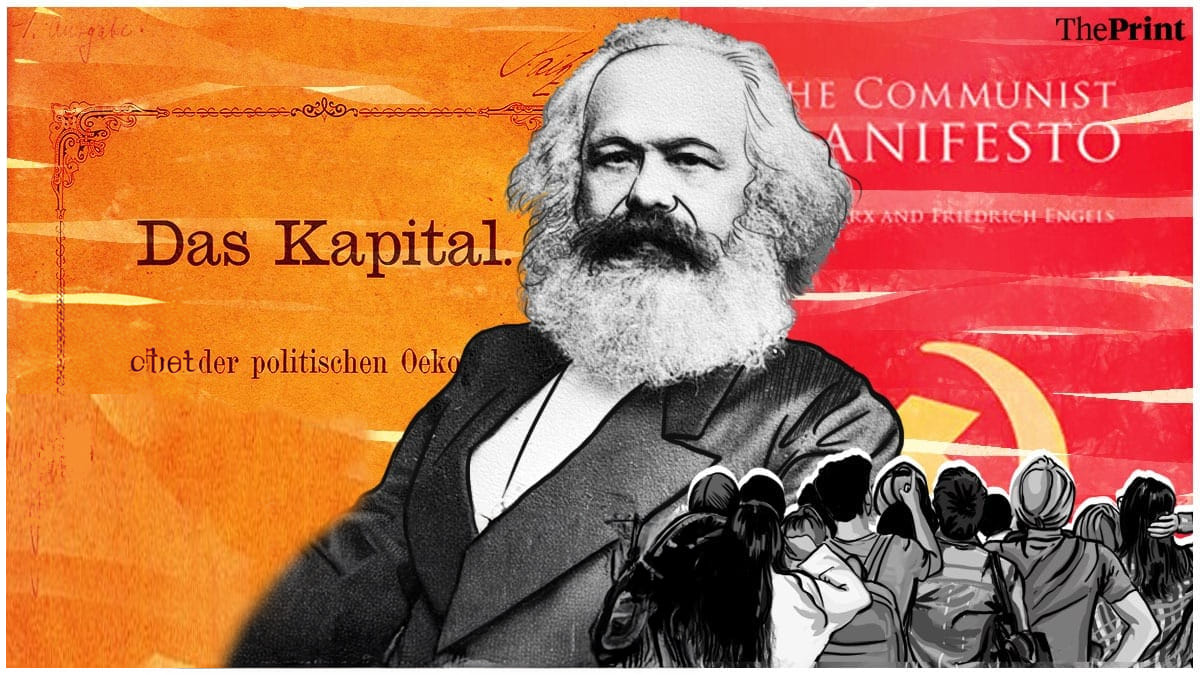
Hans Edward Teglers’s interview with Yugoslav politician Vladimir Dedijer has him argue Marx today would write Das Kapital against Soviet exploitation of its own people, concluding the Soviet experiment’s lesson is ‘how not to do it.’
-
C.C.F. News reports plans for a 1959 East-West Music Festival in Tokyo and reiterates protests over the Indonesian writers’ arrests, while an article on Indian cooperative farming warns against following the Chinese collectivisation model.
Essays
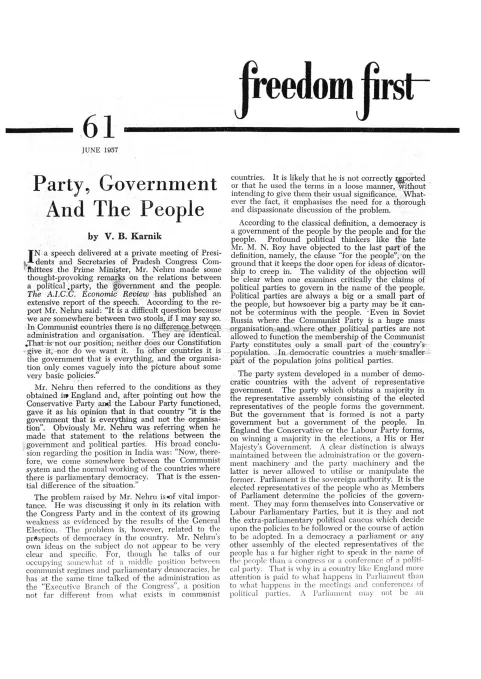
Party, Government And The People
By V. B. Karnik
V. B. Karnik’s lead article takes up Prime Minister Nehru’s remarks, reported in the A.I.C.C. Economic Review, that India occupies a position “somewhere between” the Communist system (where party and government are identical) and Western parliamentary democracies (where, per Nehru, “it is the government that is everything and not the organisation”). Karnik argues this middle position is confused and dangerous, especially given Nehru’s own description of the administration as the “Executive Branch of the Congress.” He lays out the classical definition of democracy as government of, by, and for the people, notes M. N. Roy’s objection that the “for the people” clause can open the door to dictatorship, and argues no political party — however large — is coterminous with the people. He contrasts the British system, where Parliament as the sovereign body maintains a clear separation from party machinery, with Communist states where the Communist Party absorbs and directs the entire governmental apparatus, producing police-state terror as under Stalin. Karnik warns that any identification of the Government of India with the Congress Party would be “a step in the direction of totalitarianism,” and argues that India’s democratic prospects do not depend on the fortunes of the Congress but on awakening and strengthening the democratic consciousness of the people themselves.
- Nehru described India as occupying a middle position between Communist party-state fusion and Western parliamentary systems where government, not party organisation, is paramount.
- Karnik argues government and party must remain distinct; Parliament, not any party’s extra-parliamentary caucus, is the sovereign authority in a democracy.
- M. N. Roy is cited as objecting to the classical ‘government for the people’ definition of democracy on the grounds that it can license dictatorship.
- In Communist states the Party controls the entire governmental and economic apparatus, tolerates no dissent, and this identification of party and government produces a police state and terror, as under Stalin.
- Karnik warns that treating the Indian government as the ‘Executive Branch of the Congress’ would be a step toward totalitarianism, regardless of Congress’s declining electoral fortunes.
- The article concludes that India’s democratic future depends on awakening the democratic consciousness of the people rather than on any single party’s survival.
Essay 2
An unsigned editorial ‘Notes’ column covers several current issues: the Finance Minister’s Budget proposals imposing Rs. 92.85 crores of fresh taxation alongside an overall deficit of Rs. 275 crores to be met by expanded treasury bills, which the piece argues will fuel inflation and burden the common man disproportionately despite being justified by Second Plan development goals; it quotes economist P. C. Jain’s warning in the Times of India about a ‘vicious circle’ of higher prices, taxation and costs threatening the Plan’s viability. A second note describes the Soviet Central Committee’s 1957 decree freezing repayment of 260,000 million rubles in state bonds for 20 years, characterising it as a de facto default and confiscation of citizens’ forced ‘voluntary’ savings, and situating it against the 1947 Soviet monetary reform. A third note, ‘Writer And The State,’ criticises Indian central and state government bodies like the Sahitya Akademi and National Book Trust for paternalistic overreach into literature that risks state control over artistic freedom. A fourth item, ‘Repression In Indonesia,’ protests the arrest of writer Takdir Alisjahbana (Vice-President of the University of Indonesia, Chairman of the Indonesian P.E.N. Club) following the earlier arrest of editor Mochtar Lubis, both without formal charges. The final note describes the underground ‘Literary Gazette’ (Irodalmi Ujsag), the banned Hungarian Writers’ Association’s paper, revived in exile in London after the Soviet suppression of the 1956 Hungarian revolution, including a smuggled prison poem by George Faludy.
- New Budget taxes of Rs. 92.85 crores plus a Rs. 275 crore deficit financed by treasury bills are criticized as inflationary and disproportionately burdensome on the common man.
- Economist P. C. Jain is quoted warning of a ‘vicious circle’ where higher Plan costs lead to higher taxation, higher prices, and still higher costs.
- The USSR’s 1957 decree freezing repayment of 260 billion rubles in state bonds for 20 years is characterized as a de facto default and confiscation of forced ‘voluntary’ savings.
- Indian government bodies like the Sahitya Akademi and National Book Trust are criticized for paternalistic overreach that risks state control over literature.
- The arrests of Indonesian writers Takdir Alisjahbana and Mochtar Lubis without formal charges are protested as threats to intellectual freedom.
- The Hungarian Writers Association’s banned ‘Literary Gazette’ was revived in London exile after the Soviet crackdown on the 1956 Hungarian revolution, publishing a smuggled prison poem by George Faludy.
What Is Socialism?
By Leszek Kolakowski
Leszek Kolakowski’s essay ‘What Is Socialism?’, written for the banned Polish student paper Po Prostu and circulated clandestinely before being published by the New Leader of New York, is reproduced in full across pages 9-10. Structured as a long litany of negative definitions, it first enumerates dozens of things socialism is ‘not’ — a police state, a society with more spies than nurses, a state that jails people without trial, a caste system, a state that cannot tell social revolution from armed assault, a system whose leaders appoint themselves — building a cumulative anti-Soviet indictment through irony and negation. The essay closes with a brief positive turn: ‘socialism is a good thing,’ delivered as an ironic coda after the long list of what really-existing socialist states are.
- The essay is structured almost entirely as a list of negative definitions — statements of what socialism is ‘not’ — each of which describes an actual feature of Soviet-bloc life.
- It catalogues police-state features: arbitrary arrest without trial, self-appointing leaders, more spies than nurses, more people in prison than in hospitals, slave labour, and state secrets covering even city street maps.
- It highlights economic and social absurdities: producing excellent jet planes and bad shoes, officials multiplying faster than workers, salary gaps 40 times wider than the rest of the population.
- It criticizes ideological rigidity: a state demanding uniform opinions in philosophy, economics, literature and ethics, and philosophers who always agree with the generals and ministers.
- The essay was suppressed in Poland for its anti-Soviet character but circulated privately, producing ‘a profound impression’ on Polish students before reaching the West.
- The piece ends with a deliberately anticlimactic positive definition — ‘socialism is a good thing’ — after the extensive negative catalogue.
An Interview With Dedijer
By Hans Edward Teglers
No summary was extracted for this article. Listed for completeness.
Review: Ghana (autobiography of Dr. Kwame Nkruma)
By MA Venkata Rao
M. A. Venkata Rao reviews Dr. Kwame Nkrumah’s autobiography ‘Ghana,’ occasioned by the Gold Coast’s attainment of independence as Ghana on 6 March 1957, calling it an event of ‘world historic importance’ (quoting Spengler) that will accelerate the liberation of the rest of colonial Africa. The review traces Nkrumah’s biography — his 1909 birth in the Western Gold Coast, education in the USA at Lincoln College and the University of Pennsylvania, exposure to communist and Trotskyist circles in Harlem, his organizing work in London with George Padmore and the Pan African Congress, and his eventual leadership of the Convention People’s Party after a split with the United Gold Coast Convention. Venkata Rao praises Nkrumah as free of bitterness toward former colonial rulers and committed to equal partnership, describing his thought as ‘an amalgam of Marxist specialism and Mazzinian nationalism,’ while noting he seeks Western technical and capital assistance first but hints he will look elsewhere if it is not forthcoming.
- Ghana’s independence on 6 March 1957 is described as an event of ‘world historic importance’ that will accelerate liberation elsewhere in Africa.
- Nkrumah’s biography is traced from his 1909 birth through his US education (Lincoln College, University of Pennsylvania) and his exposure to communist and Trotskyist political circles in Harlem.
- In London after 1945 Nkrumah organized African students and sailors, worked with George Padmore, and led the Pan African Congress in Manchester with 200 delegates.
- After returning to the Gold Coast in 1947, Nkrumah split from the United Gold Coast Convention and formed the Convention People’s Party.
- The review characterizes Nkrumah’s political thought as an amalgam of Marxist specialism and Mazzinian nationalism, free from fanatic ideological adherence.
- Nkrumah is said to seek Western technical know-how and capital ‘in the first instance,’ with a hint that he will turn elsewhere if the West fails to help.
Essay 5
Hans Edward Teglers reports an interview with Yugoslav politician Dr. Vladimir Dedijer, conducted in Copenhagen and originally published in Berlingske Tidende. Dedijer, a Central Committee member of the Yugoslav Communist Party who defended theoretician Milovan Djilas after Djilas’s 1954 disgrace and was himself imprisoned for ‘dissemination of enemy propaganda,’ argues that had Karl Marx lived today he would have written Das Kapital against Soviet exploitation of its own people. Dedijer describes the Soviet state apparatus as having become ‘master’ rather than ‘servant’ of society, sustained by a highly paid apparatus of suppression, and offers a definition of socialism as a society in which the individual is not exploited and is released from the chains of the State. He credits Western welfare-state democracies with real gains for the working and middle classes, comments on Soviet pressure on Yugoslavia (including a ‘postponed’ aluminium works in Montenegro) reminiscent of Stalin-era methods attributed to Molotov’s continuing hand, and closes by describing the Soviet experiment as having taught the world one essential lesson: ‘how not to do it.’
- Dedijer, a former Central Committee member of the Yugoslav Communist Party, argues Marx today would write Das Kapital against Soviet exploitation of its own population.
- He was imprisoned for defending disgraced theoretician Milovan Djilas and for writing to the New York Times, later completing a Doctor of Law degree in 1956.
- Dedijer defines socialism as a society where the individual is not exploited by another and is released from the chains of the State.
- He argues the Soviet state apparatus became the ‘master’ rather than ‘servant’ of society, with a highly paid suppression apparatus and wage gaps exceeding those in many capitalist countries.
- He credits Western welfare-state democracies with genuine improvements for the working and middle classes, narrowing the gap between rich and poor.
- He describes ongoing Soviet economic pressure on Yugoslavia, attributes continuity with Stalinist methods to Molotov, and concludes the Soviet experiment’s lesson for the world is ‘how not to do it.‘
Essay 6
The final page combines two short items. ‘C.C.F. News’ reports on plans by the Congress for Cultural Freedom for an East-West Music Festival in Tokyo in 1959, listing an international planning committee including Nicolas Nabokov, Ravi Shankar, and others, and separately reiterates the Congress’s protest over the continuing arrests of Indonesian writers Mochtar Lubis and Takdir Alisjahbana without formal charges under ‘guided democracy.’ Beneath it, the tail end of an article on co-operative farming in India (continued from an earlier, unrendered page 7) warns against the government’s plans for pilot co-operative farming societies modeled on Chinese collectivisation, arguing Chinese agricultural co-operatives left peasants landless and prioritized production quantity over peasant welfare, and cites the Indian Co-operative Union’s warning against ‘unthinking enthusiasm for agricultural co-operativisation.’
- The Congress for Cultural Freedom planned an East-West Music Festival for Tokyo in 1959, with an international committee including Nicolas Nabokov and Ravi Shankar.
- The C.C.F. reiterates protest over the arrests of Indonesian writers Mochtar Lubis and Takdir Alisjahbana without formal charges.
- The co-operative farming article (continued from p.7, not rendered) warns that the Government of India’s planned pilot co-operative farming societies risk following the Chinese model.
- Chinese agricultural co-operatives are described as having rendered peasants landless despite earlier land redistribution, prioritizing output quantity over peasant welfare.
- The Indian Co-operative Union is cited warning against ‘unthinking enthusiasm for agricultural co-operativisation,’ distinguishing democratic farmer co-operatives from totalitarian collective farms.
Generated by the v1.5 extraction pipeline. Awaiting editorial review.
Metadata and summary are AI-extracted from the source PDF and reviewed for editorial accuracy. The original work is available via the Read PDF tab above (where present); paragraph-level citation inside the PDF is deferred to a future engagement.