periodical issue
Freedom First
By Jupiter, James Critchlow, V. B. Karnik, Adam Adil
Edited, printed & published for the Democratic Research Service by V. B. Karnik at The Kanada Press, 109 Parsi Bazar Street, Bombay 1. · Bombay · 1957
12 pages
Freedom First
Summary
This is the complete October 1957 issue (No. 65) of Freedom First, the monthly journal of the Democratic Research Service edited by V. B. Karnik, published from Maneckji Wadia Building, Bombay. The issue is dominated by anti-Communist and civil-liberties commentary written against the backdrop of the 1957 Communist government in Kerala and the aftermath of the 1956 Hungarian uprising. Contributors writing under the pseudonym ‘Jupiter’ and under their own names (James Critchlow, V. B. Karnik, Adam Adil) examine whether Kerala’s Communists are meaningfully different from Communists elsewhere, criticize India’s abstention on the UN Hungary resolution, celebrate Ilya Ehrenburg’s veiled literary attack on Soviet cultural controls, and debate the Hindi-versus-English language question following the Official Language Commission’s report. A ‘Notes’ section covers cooperative farming policy, the Bhoodan-Gramdan land movement, welfare-state ideas voiced by B. R. Shenoy and K. M. Munshi, criticism of the Information Minister’s remarks on Radio Ceylon, and communal violence in Madras State. The issue closes with readers’ letters on the West German election and the language debate, and a ‘With Many Voices’ column of press quotations from Nehru, Kripalani, Munshi, Shenoy, John Foster Dulles and others.
Key points
-
Writing as ‘Jupiter,’ an essay titled ‘“Kerala Communists Are Different…”’ argues the claim is a deliberately cultivated Communist strategy rather than fact, since the CPI has mirrored every twist of Soviet policy including de-Stalinisation and Hungary.
-
James Critchlow’s ‘Ilya Ehrenburg Rebels’ describes Ehrenburg’s essay ‘Lessons of Stendhal’ as the strongest public challenge to Communist cultural dictatorship since Stalin’s rise, defending dissident writer Vladimir Dudintsev.
-
V. B. Karnik’s ‘Our Vote On Hungary’ condemns India’s UN abstention on the Hungary resolution, rejecting the government’s comparison to Suez since England and France, unlike the USSR, complied with UN resolutions.
-
Adam Adil’s ‘Our Language Problem’ surveys the Hindi-versus-English dispute following the Official Language Commission’s report, noting fifty MPs sought a 25-year postponement and quoting Rajagopalachari’s proposal that both languages serve jointly.
-
A ‘Notes’ section welcomes an apparent government retreat from Chinese-style collectivisation toward voluntary ‘service cooperatives,’ and reports B. R. Shenoy’s and K. M. Munshi’s warnings at a Bombay welfare-state symposium against ‘equivocal slogans’ concealing Marxian dogma.
-
Extracts from Kodanda Rao’s press statement dispute the Official Language Commission majority’s characterisation of English as ‘foreign,’ arguing bilingualism serves the public better than the majority’s proposed trilingualism.
-
Two readers’ letters debate the West German election’s implications for reunification and press Adam Adil to name which Indian language should replace English if not Hindi.
Essays
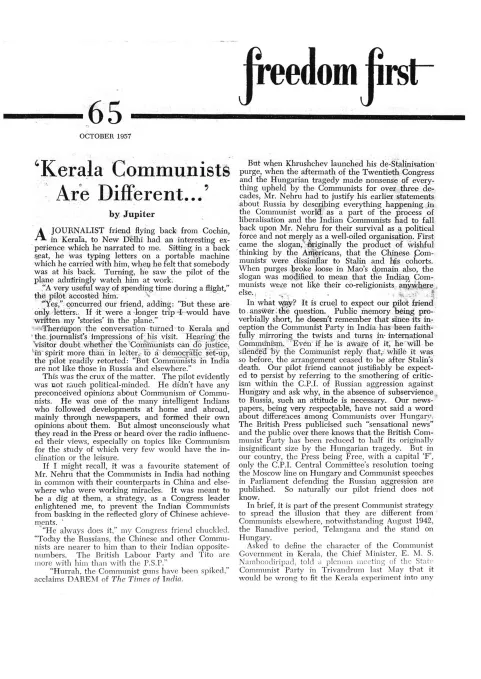
’Kerala Communists Are Different…’
By Jupiter
Writing as ‘Jupiter’, the author uses an anecdote about a journalist’s conversation with an airline pilot to explore the popular claim that ‘Kerala Communists are different’ from Communists elsewhere. The piece argues this is a deliberately cultivated Communist strategy rather than a fact, tracing how the CPI has mirrored every twist of international Communism (the de-Stalinisation purge, the Hungarian tragedy) while Nehru’s rhetorical distinction between Indian and other Communists gave the party cover. The essay continues (from page 2) with interviews of Congress leader Panampally Govinda Menon and comments on Chief Minister E. M. S. Namboodiripad’s own account of two competing reactions to Communist rule in Kerala, then resumes after ‘Our Vote on Hungary’ (page 8) with detail on Kerala ministers’ salaries, Law Minister V. R. Krishna Iyer’s plan for village courts, and a concluding question about where Congress democracy differs from Communist democracy in Kerala.
- Frames ‘Kerala Communists are different’ as a slogan manufactured by Communist strategy, not an empirical observation
- Notes the CPI has historically mirrored Soviet policy shifts (de-Stalinisation, Hungary) despite claiming independence from them
- Congress leader Panampally Govinda Menon is quoted comparing India’s two-party dynamic (Congress/Communists) to Canada’s Liberal-Conservative rivalry
- Distinguishes the ‘power-political approach’ to Communism (Govinda Menon, Hare Krishna Mahatab) from the ideological anti-Communist stance
- Reports Namboodiripad’s own description of two contrasting reactions to Kerala’s Communist government
- Details Kerala ministers’ actual salaries and allowances versus publicised austerity claims
- Describes Law Minister V. R. Krishna Iyer’s plan for elected village courts to speed up justice
Notes (Cooperative Farming; Bhoodan And Gramdan; Welfare State; Ill-Conceived Remarks; Dangerous Portent)
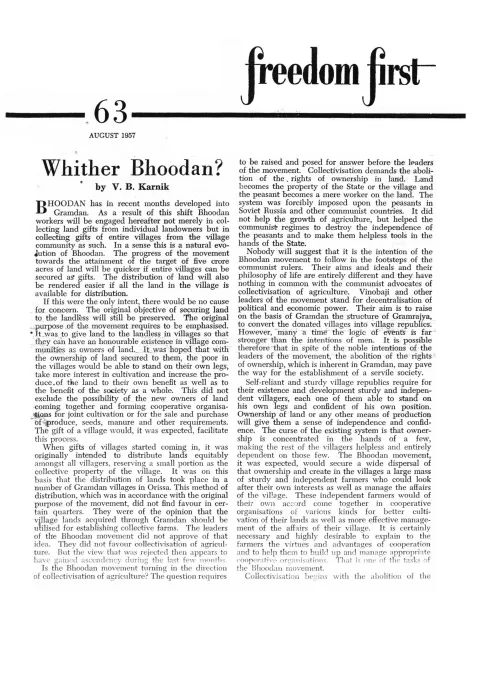
A set of five short unsigned editorial notes. ‘Cooperative Farming’ welcomes the government’s apparent retreat from Chinese-style collectivisation, citing Uttar Pradesh’s warning and the Planning Commission’s own unfavourable evaluation, and praises Nehru’s recent emphasis on voluntary, non-collectivised ‘service cooperatives’. ‘Bhoodan And Gramdan’ reports a Yelwal conference statement backing Vinoba Bhave’s land-gift movement and notes President Rajendra Prasad’s distinction between the two schemes. ‘Welfare State’ summarises a Bombay symposium at which B. R. Shenoy argued a welfare state should be a ‘minimum State’ rather than a garrison state, and K. M. Munshi warned against ‘equivocal slogans’ hiding a Marxian agenda. ‘Ill-Conceived Remarks’ defends Radio Ceylon against Information Minister Dr. Keskar’s criticism, arguing listeners, not ministers, should decide taste. ‘Dangerous Portent’ condemns communal violence between Hindu communities in Ramanathapuram district and a mob attack on the office of the magazine Sarita over an allegedly offensive poem.
- Welcomes apparent government rethink on Chinese-model cooperative farming after Uttar Pradesh and Planning Commission criticism
- Reports Nehru’s shift toward voluntary ‘service cooperatives’ rather than compulsory collectivisation
- Covers a Yelwal conference of Congress and other party leaders endorsing Vinoba Bhave’s Bhoodan and Gramdan movements
- President Rajendra Prasad distinguishes Bhoodan (voluntary land gift) from Gramdan (no private landed property at all)
- B. R. Shenoy argues a welfare state must be a ‘minimum State’ rather than a garrison or police state
- K. M. Munshi warns that ‘equivocal slogans’ about welfare conceal a ‘semantic Trojan horse carrying the Marxian dogma’
- Criticises Information Minister Dr. Keskar’s complaint about Radio Ceylon’s programming as paternalistic
- Reports Hindu-on-Hindu communal violence in Madras State and a mob attack on the Hindi magazine Sarita’s office over a poem
Ilya Ehrenburg Rebels
By James Critchlow
James Critchlow describes Ilya Ehrenburg’s essay ‘Lessons of Stendhal’ (published in the Moscow monthly Inostrannaya Literatura) as the strongest public challenge to Communist Party cultural dictatorship since Stalin’s rise. Ehrenburg uses Stendhal’s writing to attack the ‘cult of personality’ defence of Stalinism, to defend dissident Soviet writers like Vladimir Dudintsev accused of ‘distorting Soviet reality’, and to argue that state control inevitably corrupts art and culture. Critchlow situates the essay within the Khrushchev-era struggle over cultural control and notes its implicit comparison of the freedom enjoyed by scientists and writers in Tsarist Russia and America against the constraints of the contemporary Soviet Union.
- Ehrenburg’s article resurrects 19th-century French novelist Stendhal to mount a covert critique of Soviet cultural controls
- Uses Stendhal’s writing on tyranny to rebut the official Soviet line that Stalin-era abuses were a personal, not systemic, failing
- Defends dissident writer Vladimir Dudintsev and others accused of ‘distorting Soviet reality’
- Argues that government control of art crushes ‘the soul of the artist’ regardless of the ruler’s personal character
- Implicitly contrasts the intellectual freedom of Tsarist Russia and America with contemporary Soviet constraints
- The critic Tamantsev’s published rebuttal is described as comparatively weak and evasive
Hungarian Writers In India
A short unsigned news item reports on visits by three Hungarian writers to India in September 1957, on their way back from the international PEN conference in Tokyo. Paul Ignotus, a former Presidential Board member of the Hungarian Writers’ Association imprisoned for seven years by the Rakosi government, lectured in Calcutta and met Prime Minister Nehru in Delhi. George Paloczi-Horvath, a former Communist arrested and sentenced to 15 years’ hard labour before being released by the Imre Nagy government, and Dr. Paul Tabori, a London-based scriptwriter and chairman of the PEN Centre of Writers in Exile, also addressed meetings in Calcutta and planned further visits to Bombay and Delhi.
- Three Hungarian writers - Paul Ignotus, George Paloczi-Horvath, and Paul Tabori - visited Calcutta, Delhi and other Indian cities en route from the Tokyo PEN conference
- Paul Ignotus was imprisoned about 7 years by the Rakosi government and lectured at Calcutta University
- Ignotus met Prime Minister Nehru in Delhi and addressed the Asian Office of the Congress for Cultural Freedom
- George Paloczi-Horvath, once a Communist Party member, was sentenced to 15 years’ hard labour and released in 1954 by the Imre Nagy government
- Dr. Paul Tabori chairs the PEN Centre of Writers in Exile and is Secretary of the British Screen and Television Writers’ Association
Our Vote On Hungary
By V. B. Karnik
V. B. Karnik condemns India’s abstention on the UN resolution condemning Soviet suppression of the Hungarian revolution, arguing the government’s stated reasons (fear of foreclosing dialogue, hope of persuading Russia and Hungary) were specious given both countries had already rebuffed such hopes. He rejects the government’s comparison to the Suez crisis, noting England and France obeyed UN resolutions while Soviet Russia continued defying them. Karnik revisits the charge, first made by Jayaprakash Narayan, that India applied double standards by condemning lesser wrongs while excusing Soviet aggression, and argues that a clear condemnation - even if it would not immediately free Hungary - was a moral and historical obligation India failed to meet. The essay (continuing on page 9) concludes that India’s abstention undermines the credibility of the condemnation and that only the country’s special relationship with the USSR could have made a real difference, while welcoming India’s vote to keep the Hungarian question on the UN agenda.
- India abstained on a UN resolution condemning Soviet suppression of Hungary, despite the Special Committee’s unanimous report
- Karnik rejects Indian representative Arthur Lall’s argument that condemnation would be ‘unfriendly’ and counterproductive to dialogue
- Distinguishes India’s abstention from Burma’s vote, which supported the resolution despite an unsuccessful amendment
- Rejects the government’s Suez-crisis comparison since England and France complied with UN resolutions while the USSR did not
- Revives Jayaprakash Narayan’s accusation that India’s Hungary vote reflected a double standard favouring the Soviet Union
- Argues moral condemnation of injustice has intrinsic value even without immediate practical effect
- Welcomes India’s vote to keep the Hungarian question on the UN General Assembly’s agenda as a partial correction
Our Language Problem
By Adam Adil
Adam Adil surveys the renewed controversy over whether Hindi should replace English as India’s official language by 1965, following the Official Language Commission’s report. He summarises the dissenting notes of Commission members Dr. Suniti Kumar Chatterjee and Dr. P. Subbarayan, who argue the change should be deferred and English retained alongside Indian languages, and notes a joint memorandum from fifty MPs (including Congress members) seeking a 25-year postponement. Quoting C. Rajagopalachari’s balanced view favouring Hindi and English functioning jointly as official languages, Adil concludes that while Hindi should eventually become India’s national language, its advocates must proceed with patience and ‘least resistance’ toward non-Hindi speakers, while English’s continued importance to science and higher education should not be dismissed.
- Renewed dispute over the 1965 target date for replacing English with Hindi as India’s official language
- Commission dissenters Dr. S. K. Chatterjee and Dr. P. Subbarayan argue Hindi’s promotion has been ‘hasty’ and diverts funds resented by non-Hindi states
- Fifty MPs, including Congress members, submitted a memorandum seeking a 25-year postponement of the Hindi changeover
- C. Rajagopalachari (quoted from Hindustan Times) proposes Hindi and English jointly serve as the Union’s official language
- Adil argues Hindi’s advocates should show patience and ‘least resistance’ toward non-Hindi speaking regions
- Stresses English’s continuing value for science, technology, and India’s international standing
The Hindi Commission Report
By Kodanda Rao
Extracts from a press statement by Mr. Kodanda Rao criticize the majority Report of the Official Language Commission for its underlying assumption, drawn from Mahatma Gandhi’s view, that English is a ‘foreign’ language that alienates Indian children from their own land. Kodanda Rao argues language has no nationality and that the majority’s own recommendation to keep English for official purposes contradicts their professed aim of replacing it with Hindi. He contends Indians need not all learn Hindi to follow national affairs, since regional-language readers and international audiences alike consume news in their own languages, and that bilingualism (regional language plus English) better serves the public interest than the trilingualism the majority’s scheme would impose on non-Hindi areas.
- Kodanda Rao’s statement treats the Chatterji and Subbarayan dissenting minutes as together forming a ‘Minority Report’
- Criticizes the majority Commission’s reliance on Gandhi’s characterization of English as a ‘foreign’ language
- Argues language has no nationality, race, or sex, making the ‘foreign vs Indian language’ framing a ‘lamentable superstition’
- Notes the majority Report itself recommended no restriction on English for official Union purposes, undercutting its own premise
- Argues bilingualism (regional language plus English) avoids the evils of trilingualism (Hindi, English, and regional language) that would burden non-Hindi areas
- Concludes the majority’s own logic, if followed consistently, would have supported the minority position
Letters to the Editor
By G. G. Natu; K. S. Singh
Two readers’ letters. G. G. Natu praises the Christian Democratic Party’s election victory in West Germany as a rebuff to Soviet pressure and a vindication of Chancellor Adenauer’s stance on free elections for German reunification, contrasting this with the absence of any comparable choice for East Germans. K. S. Singh responds to an earlier column by Adam Adil, arguing India’s independent status logically demands an Indian language (not English) as the national language, and pressing Adil to clarify which regional language he believes should serve that role if not Hindi.
- G. G. Natu credits the Christian Democratic Party’s West German election win to economic prosperity and Adenauer’s foreign policy, framing it as a rebuff to Khrushchev
- Natu argues free elections in both parts of Germany are the only legitimate route to reunification, unlike Social Democrat proposals for NATO-free reunification
- K. S. Singh challenges Adam Adil’s earlier column (Freedom First, September 1957) for criticizing ‘Hindi fanatics’ without offering a clear alternative
- Singh argues that by the logic of India’s independent status, the national language must be an Indian language with cultural affinity to the country
- Singh accuses Adil of effectively wanting to retain English while not endorsing any Indian regional language as national language
With Many Voices
The issue’s closing ‘With Many Voices’ column, a compilation of short press quotations under a Tennyson epigraph. Contributors quoted include Dr. Ramaswamy Mudaliar (repeatedly, on wealth tax, Chambers of Commerce, and co-existence), Howard Fast, Salvador de Madariaga, Melvin J. Lasky, Nehru, John Foster Dulles, B. Ramakrishna Rao on Vinoba Bhave’s ‘spiritual communism’, J. B. Kripalani (on caste versus class and trade unionism), K. M. Munshi (repeating his ‘semantic Trojan horse’ warning), and B. R. Shenoy linking free enterprise to Dharma and the welfare state.
- A curated column of short quotations from Indian and international newspapers and public figures on communism, peace, and welfare-state politics
- Dr. Ramaswamy Mudaliar is quoted multiple times, on wealth tax, Chambers of Commerce, and rejecting co-existence with communism
- B. Ramakrishna Rao, Governor of Kerala, calls Vinobaji’s philosophy a kind of ‘spiritual communism’
- J. B. Kripalani argues India’s divisions are caste-based rather than class-based, and links trade union strength to an egalitarian social order
- B. R. Shenoy is quoted claiming ‘Free Enterprise is the rule of Dharma and is an essential attribute of a Welfare State’
- K. M. Munshi’s ‘semantic Trojan horse’ warning against equivocal welfare-state slogans is repeated from the Notes section
Generated by the v1.5 extraction pipeline. Awaiting editorial review.
Metadata and summary are AI-extracted from the source PDF and reviewed for editorial accuracy. The original work is available via the Read PDF tab above (where present); paragraph-level citation inside the PDF is deferred to a future engagement.