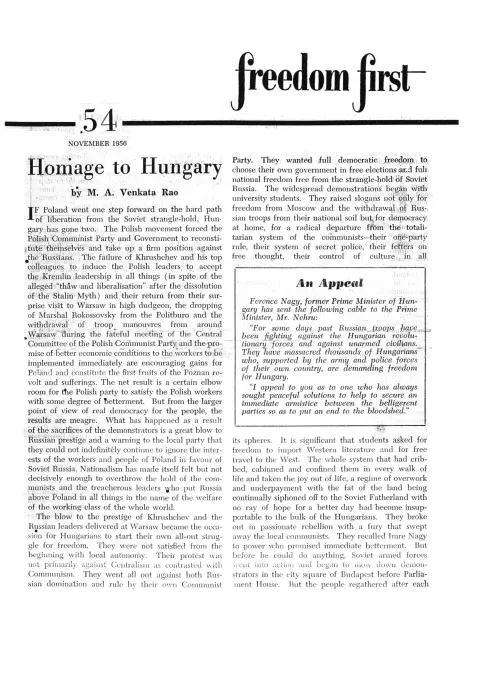
periodical issue
Freedom First
Edited, printed & published for the Democratic Research Service by V. B. Karnik at The Kanada Press, 109 Parsi Bazar Street, Bombay 1. · Bombay · 1957
12 pages
Freedom First
Summary
This is the November 1957 issue (No. 66) of Freedom First, the monthly journal of the Democratic Research Service / Indian Committee for Cultural Freedom, edited by V. B. Karnik and published in Bombay. The issue is dominated by anti-communist commentary occasioned by the fortieth anniversary of the Russian Revolution and the first anniversary of the Hungarian uprising: Karnik’s lead essay traces four decades of disillusionment with Soviet Russia from the Kronstadt suppression through the Moscow Trials to the crushing of Hungary; Melvin J. Lasky’s piece narrates the defection of East German Communist intellectual Alfred Kantorowicz; and an editorial ‘Notes’ section covers Milovan Djilas’s imprisonment in Yugoslavia, Stevan Dedijar’s critique of Soviet science, and alleged communist infiltration of the Indian National Congress’s Economic Review. Adam Adil contributes a report on factional strife inside the Polish United Workers’ Party a year after the October 1956 upheaval. The issue also carries a review by M. A. Venkata Rao of William Sargant’s Battle for the Mind, a contributed report on the West Bengal bank employees’ strike blaming Communist Party control of bank unions, R. S. Pandey’s report on apartheid and the Separate University Education Bill in South Africa, an I.C.C.F. News column on protest meetings and visiting Hungarian writers, and a closing miscellany of quoted press remarks (‘With Many Voices’).
Key points
-
V. B. Karnik’s lead essay, “A Dream Becomes A Nightmare,” marks the fortieth anniversary of the Bolshevik Revolution by tracing four decades of disillusionment with Soviet rule, from the Constituent Assembly’s dispersal and the Moscow Trials to Khrushchev’s secret speech and the crushing of Hungary, and locates the root of Soviet tyranny in Marxist-Leninist doctrine itself rather than in Stalin alone.
-
The unsigned Notes section reports Milovan Djilas’s further imprisonment for The New Class and Stevan Dedijar’s parallel persecution, and credits Freedom First’s own earlier warnings for the AICC’s dismissal of H. D. Malaviya from its Economic Review over alleged communist bias.
-
Melvin J. Lasky’s “No, I Could Stand It No Longer” uses East German writer Alfred Kantorowicz’s September 1957 flight to West Berlin to survey a broader gallery of Communist defections, from Bertrand Russell in 1920 to Arthur Koestler in 1938, and wonders how long new believers in Ghana, Ceylon and Kerala will take to reach their own breaking point.
-
Adam Adil’s “Polish Road To Socialism” reports that the gains of Poland’s October 1956 liberalisation are being rolled back under Gomulka’s own warnings to the Party’s liberal wing and the closure of independent papers such as Po Prostu.
-
M. A. Venkata Rao reviews William Sargant’s Battle for the Mind, framing Communist regimes’ scientific exploitation of psychological and physiological weakness, including police interrogation methods that produce false confessions, as more dangerous to human freedom than atomic weapons.
-
A contributed report argues the West Bengal bank employees’ strike was engineered by Communist-controlled union leadership seeking to rehabilitate the Party’s standing among organised labour after its July setbacks, naming AIBEA office-bearers as communists or fellow travellers.
-
R. S. Pandey’s “Segregation In South Africa” details the 1950 Group Areas Act’s displacement of over a million non-whites and the proposed Separate University Education Bill, contrasting South Africa’s trajectory with school desegregation enforcement at Little Rock.
-
The issue closes with an I.C.C.F. News report on a Bombay protest meeting against the South African bill and the Indian tour of Hungarian writers George Paloczi-Horvath and Paul Tabori, alongside a “With Many Voices” column of press quotations on Sputnik and Soviet policy.
Essays
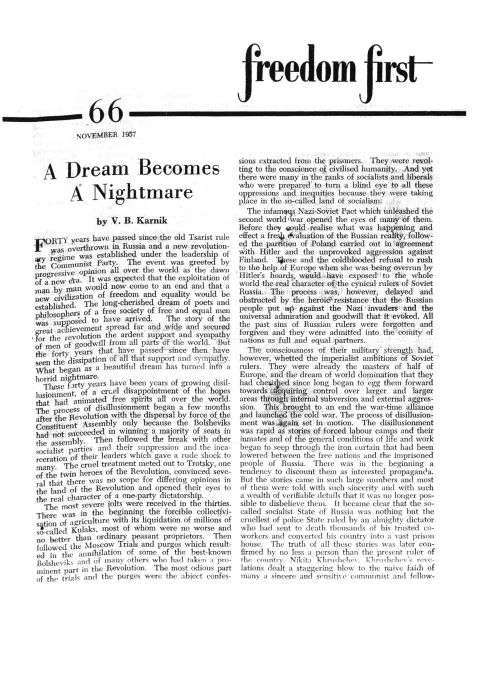
A Dream Becomes A Nightmare
By V. B. Karnik
V. B. Karnik’s lead essay marks the fortieth anniversary of the Bolshevik Revolution as a chronicle of progressive disillusionment. He traces the arc from the dispersal of the Constituent Assembly and the suppression of rival socialist parties, through forced collectivisation and the Moscow Trials of the 1930s, to the Nazi-Soviet Pact, and argues that the most recent shocks — Khrushchev’s secret-speech revelations and the crushing of the Hungarian revolution — have completed a process of disillusionment that began decades earlier. Karnik surveys defections from Communist parties in Britain, the United States, France, and behind the Iron Curtain, invoking Louis Fischer’s notion of each fellow-traveller’s personal ‘Kronstadt’ moment of final disillusionment. He contrasts the fading of old sympathisers with a new breed of admirers drawn to Soviet Russia purely by its military and technological power (citing Sputnik), and closes by locating the root of the Soviet police state not in Stalin alone but in the theories of Marx and Lenin themselves, which subordinated the individual to impersonal historical forces and thereby made a dictatorship over the proletariat inevitable.
- Frames the 40 years since 1917 as a story of a liberating dream curdling into a police-state nightmare.
- Traces disillusionment through the Constituent Assembly’s dispersal, suppression of rival socialists, Trotsky’s persecution, forced collectivisation, and the Moscow Trials.
- Argues the Nazi-Soviet Pact and invasion of Finland first exposed Soviet cynicism to fellow-travellers, but war-time heroism against Hitler delayed full reckoning.
- Cites Khrushchev’s secret speech and the suppression of the Hungarian revolution as the culminating shocks that ended residual naivety.
- Notes a new class of Soviet admirers attracted by military/industrial power (Sputnik) rather than by claims of liberty or equality.
- Locates the origin of Soviet tyranny in Marxist-Leninist doctrine itself, not merely in Stalin’s personal rule.
Notes (Milovan Djilas / Another Brave Voice / Insidious Infiltration / Literary Exchanges / Our Homage)
The unsigned ‘Notes’ department covers several short items: the further seven-year sentence given to Yugoslav dissident Milovan Djilas for his book The New Class, and the parallel persecution of his colleague Stevan Dedijar, whose Bulletin of the Atomic Scientists article argued that Soviet scientific achievement occurred despite, not because of, totalitarian controls on communication. A further note, ‘Insidious Infiltration,’ reports the All India Congress Committee’s dismissal of H. D. Malaviya from its Economic and Political Research Department for alleged communist bias, crediting Freedom First’s own earlier warnings. Other items address a P.E.N. Congress resolution on East-West literary translation and an editorial ‘Our Homage’ marking the anniversary of the Hungarian revolution.
- Reports Milovan Djilas’s additional seven-year jail term for The New Class and the Yugoslav government’s parallel restrictions on Stevan Dedijar.
- Quotes Dedijar’s Bulletin of the Atomic Scientists argument that Soviet scientific achievement is a puzzle only for those who forget the pre-revolutionary tradition of Lomonosov, Mendeleev, and others, and that repression exacts a hidden cost on research.
- Covers the AICC’s dismissal of H. D. Malaviya, editor of its Economic Review, over alleged communist-slanted articles, crediting the journal’s own earlier warnings.
- Notes a P.E.N. Congress resolution (Tokyo, September) calling for more East-West literary translation.
- Marks the anniversary of the Hungarian revolution as having dealt communism a mortal propaganda blow despite its military suppression.
”No, I Could Stand It No Longer”
By Melvin J. Lasky
Melvin J. Lasky uses the September 1957 flight of East German Communist intellectual Alfred Kantorowicz from East to West Berlin as the occasion for a meditation on the long, uneven process by which committed Communists lose their faith. Lasky recounts Kantorowicz’s biography — prewar Communist organiser, Spanish Civil War fighter, wartime U.S. emigre, postwar East German literary figure — and quotes at length Kantorowicz’s own radio broadcast explaining his twenty-six years of held-on hope and the final admission that he could no longer believe a better world could emerge from the ‘dregs’ of lawlessness and bureaucratic tyranny he had helped sustain. Lasky situates the defection within a broader gallery of intellectuals who broke with communism at different points — Bertrand Russell in 1920, Franz Borkenau in 1928, Arthur Koestler in 1938 — and closes wondering how many more decades will pass before others now embracing Marxism in Accra, Ceylon, or Kerala reach their own breaking point.
- Narrates Alfred Kantorowicz’s September 1957 flight from East to West Berlin as a case study in delayed disillusionment with communism.
- Quotes Kantorowicz’s own account of 26 years holding to the Communist dream before finally giving up ‘the last illusion’ after the Hungarian tragedy.
- Recalls Arthur Koestler’s earlier (1949) sketch of Kantorowicz as a warm-hearted but morally compromising comrade, from Koestler’s contribution to The God That Failed.
- Surveys a gallery of prior Communist/fellow-traveller defections at different historical moments — Bertrand Russell (1920), Franz Borkenau (1928), Arthur Koestler (1938), Julius Hay, Tibor Dery, and Peter Veres (1956).
- Closes by speculating that new believers are still being made in newly independent countries such as Ghana (Accra), Ceylon, and Kerala, who have yet to reach their own ‘Kronstadt.‘
Polish Road To Socialism
By Adam Adil
Adam Adil reports on the year following Poland’s October 1956 upheaval, arguing that the gains of that liberalisation are being surrendered under pressure from Moscow and from the reassertion of Party control. He details Gomulka’s warning to the Party’s ‘liberal wing’ that democratic freedom in Poland could only be granted ‘in proportion to Party strength,’ the denunciation of student and youth ‘revisionism’ by Politbureau member Jerzy Morawski, and the closure or purging of independent-minded newspapers such as Po Prostu and the dismissal of editors including Edda Werfel. Adil concludes that there can be no genuine liberalisation under a communist regime, since any real loosening of control threatens to exceed limits the Party can tolerate, forcing a reversion to Stalinist methods — reprising Arthur Koestler’s formulation that the only real choice is between relative freedom and total unfreedom.
- Reports that Polish gains from the October 1956 revolt against Stalinism are being rolled back under pressure from Russia and the Party’s own leadership.
- Describes Gomulka’s warning to the Communist Party’s liberal wing that democratic freedom is conditional on Party strength, and that ‘no party member can accept only one part of democratic centralism.’
- Details Jerzy Morawski’s denunciation of student/writer ‘revisionism’ as undermining the movement and drawing it back toward the bourgeoisie.
- Notes the dismissal of editors (e.g. Edda Werfel of Swiat) and forced closure of the youth weekly Po Prostu as part of tightening press control.
- Concludes there is no half-way house between communism and democracy, echoing Arthur Koestler’s alternative of ‘relative freedom and total unfreedom.‘
A physiology of conversion and brain-washing.
By M. A. Venkata Rao reviews William Sargant
M. A. Venkata Rao reviews William Sargant’s Battle for the Mind (William Heinemann, 1957), a study subtitled ‘A physiology of conversion and brain-washing.’ The review summarises Sargant’s argument that religious conversion, wartime neuroses, and Communist brainwashing share a common physiological mechanism, drawing on Pavlov’s conditioning experiments and cases from evangelical revivalism and African Voodoo ritual. Venkata Rao highlights Sargant’s account of how police interrogation techniques — sleep deprivation and sustained anxiety — can induce false confessions even among innocent people, and his scepticism toward Freudian psychoanalysis. The review frames the book’s significance in Cold War terms: the deliberate, scientific exploitation of psychological and physiological weaknesses by Communist regimes to remould entire populations into a ‘docile robot’ surpasses even nuclear weapons in its peril to human freedom.
- Reviews William Sargant’s Battle for the Mind, subtitled ‘A physiology of conversion and brain-washing.’
- Summarises Sargant’s use of Pavlov’s conditioning experiments to explain religious conversion, war neuroses, and communist brainwashing via a shared physiological mechanism.
- Describes Sargant’s account of police ‘third degree’ methods (sleep deprivation, sustained anxiety) producing false confessions even in innocent suspects.
- Notes Sargant’s scepticism of Freudian psychoanalysis, citing Freud’s own later doubts about his theories.
- Frames Communist regimes’ systematic use of psychological/physiological manipulation to remould populations as more dangerous than atomic and hydrogen weapons.
Essay 6
A contributed report examines the just-concluded West Bengal bank employees’ strike, arguing that the Bengal Provincial Bank Employees’ Association and the All India Bank Employees’ Association were both dominated by Communist Party members and fellow travellers who used the strike to serve party political ends rather than employees’ genuine interests. The piece names AIBEA office-bearers as communists or fellow travellers and situates the strike as a Communist Party attempt to rehabilitate itself among organised middle-class workers after the Party’s loss of standing over the Post and Telegraph and Central Government employees’ strike in July. It concludes that bank employees were used as ‘pawns’ in a political game and hopes they will now recognise ‘who are their friends and who are their enemies.’
- Argues the West Bengal bank strike was engineered by Communist-controlled union leadership (BPBEA and AIBEA) for party political ends.
- Names AIBEA’s president, general secretary, and most joint secretaries/treasurer as communists or fellow travellers.
- Frames the strike as an attempt by the Communist Party to rehabilitate its standing among organised labour after setbacks in the July Post and Telegraph/Central Government employees’ strike.
- Notes internal friction between the United Bank of India Employees’ Union leadership and the BPBEA/AIBEA leadership over an agreement signed by an ex-General Secretary.
- Concludes bank employees’ genuine interests were sacrificed to Communist Party political aims.
Ghetto Act
R. S. Pandey reports on the intensification of racial segregation in the Union of South Africa, describing the 1950 Group Areas Act (the ‘Ghetto Act’) that forcibly displaced over a million non-whites, including 22,000 Indians, and the newly proposed Separate University Education Bill, which would bar non-white students from white universities, place non-white institutions under direct government control, and, per remarks attributed to the Minister of Native Affairs Dr. Verwoerd, deliberately limit the education given to African students. Pandey cites South African critics of the policy, including a Johannesburg city councillor and the United Party leader in Johannesburg, and contrasts South Africa’s direction with the contemporaneous elimination of school segregation in the United States (referencing the Little Rock crisis), calling on the United Nations to enforce its Charter of Human Rights against South Africa.
- Describes the 1950 Group Areas Act (‘Ghetto Act’), which displaced over 1,000,000 non-whites including 22,000 Indians from their homes.
- Reports the proposed Separate University Education Bill, which would bar non-whites from white universities and place non-white education under strict government control.
- Cites the Minister of Native Affairs’s remarks questioning the value of teaching mathematics to Bantu children, taken as evidence of intentionally inferior education for non-whites.
- Notes South African critics of apartheid, including a Johannesburg city councillor and the United Party’s Johannesburg leader, and newspapers like the Star of South Africa and Rhodesia Herald.
- Contrasts South Africa’s segregationist trajectory with the U.S. Federal Court’s desegregation ruling and federal enforcement at Little Rock, and calls for UN action.
I.C.C.F. News
By MA Venkata Rao
The issue closes with ‘With Many Voices,’ a column of short quoted remarks culled from the contemporary press (Times of India, Hindustan Times, New York Times, and others) on Soviet satellites, Communist rhetoric, and world affairs, including several quips attributed to Prime Minister Nehru, alongside an ‘I.C.C.F. News’ report on Indian Committee for Cultural Freedom activities: a Bombay public meeting protesting South Africa’s Separate University Education Bill, and the visit of Hungarian writers George Paloczi-Horvath and Paul Tabori to Bombay, Delhi, and Calcutta to speak on the Hungarian Revolution.
- Compiles short press quotations on Sputnik, Soviet policy, and Communism from Nehru and others, October 1957.
- Reports an I.C.C.F. Bombay public meeting (18 October) protesting South Africa’s Separate University Education Bill, addressed by Prof. G. D. Parikh and others.
- Reports the visit of Hungarian writers George Paloczi-Horvath and Paul Tabori to Bombay, Delhi, and Calcutta to speak on the Hungarian Revolution.
- Notes receptions held by the Indian Merchants’ Chamber, Dadar Yuvak Sabha, the Screen Writers’ Association, and the Press Guild of Bombay in honour of the visiting writers.
Generated by the v1.5 extraction pipeline. Awaiting editorial review.
Review: Battle For The Mind by William Sargant
By M. A. Venkata Rao
No summary was extracted for this article. Listed for completeness.
West Bengal Bank Employees’ Strike
By (Contributed)
No summary was extracted for this article. Listed for completeness.
Segregation In South Africa
By R. S. Pandey
No summary was extracted for this article. Listed for completeness.
Metadata and summary are AI-extracted from the source PDF and reviewed for editorial accuracy. The original work is available via the Read PDF tab above (where present); paragraph-level citation inside the PDF is deferred to a future engagement.