periodical issue
Freedom First
Edited, printed & published for the Democratic Research Service by V. B. Karnik at The Kanada Press, 109 Parsi Bazar, Bombay 1. · Bombay · 1958
12 pages
Freedom First
Summary
This is issue No. 73 of Freedom First (June 1958), the monthly journal of the Indian Committee for Cultural Freedom published from Bombay. In the rendered pages, the issue opens with V. B. Karnik’s editorial-style piece “Face The Facts,” which attacks the National Development Council’s refusal to scale back the Second Five-Year Plan’s Rs. 4800 crore target despite the Planning Commission’s own warnings about resource shortfalls, rising deficit financing, and stalling employment growth. An unsigned “Notes” section comments on Nehru’s public criticism of the Communist Party of India and of Soviet and Chinese conduct, on the CPI’s retained Kerala assembly seat at Devicolam, on a constitutional lapse by the Governor of Orissa in the Mahtab ministry affair, and on the exploitation of municipal schoolchildren for staged welcomes to visiting dignitaries. Jayaprakash Narayan’s address “Towards A Fuller Democracy” (delivered in Bombay on 11 March 1958 under the Democratic Research Service) argues that parliamentary democracy, while the best form yet devised, is not full democracy, and sets out a Gandhian-Sarvodaya vision of vertically decentralised, village-based direct democracy (Gramdan) built from self-governing primary communities upward, as an alternative to the centralising tendencies of the welfare state, socialism, and communism alike. B. K. Desai’s “Tito And The Red Goliath” analyses the 1958 rupture between Tito’s Yugoslavia and Moscow (and Peking) over the Yugoslav Communist Party’s draft programme, which questioned Soviet ideological orthodoxy on peaceful roads to socialism and state power under socialism. The issue closes with a reader’s letter protesting Nehru’s and Krishna Menon’s public criticism of foreign powers as damaging to India’s international standing, and the regular “With Many Voices” column of quoted commentary from the Indian and international press on Nehru, Congress, and Cold War politics.
Key points
-
V. B. Karnik’s “Face The Facts” charges the National Development Council with retaining the Second Plan’s Rs. 4800 crore target despite the Planning Commission’s own finding that only Rs. 4360-4500 crores were realistically available, warning that deficit financing and stalling employment growth vindicate the Plan’s early critics.
-
The Notes section credits Nehru for openly criticising the CPI’s foreign-directed “thinking apparatus” and Soviet purges, reports the Communist candidate’s narrowed Devicolam by-election win in Kerala, and criticises the Governor of Orissa for improperly declining to follow constitutional procedure in the Mahtab ministry affair.
-
Jayaprakash Narayan’s address “Towards A Fuller Democracy” argues parliamentary democracy fails Lincoln’s test of government “by the people” since party machines crowd out independents, and sets out a Gandhian-Sarvodaya vision of vertically decentralised, village-based direct democracy built from Gramdan upward.
-
Narayan cites the Bhoodan-to-Gramdan movement as evidence of the voluntary “inner change” he advocates, and envisions a partyless, consensus-based democracy modelled on Quaker meetings and Athenian assemblies, ultimately toward a non-national Sarvodaya world order.
-
B. K. Desai’s “Tito And The Red Goliath” analyses the 1958 rupture between Tito’s Yugoslavia and Moscow over Yugoslavia’s draft programme, which denied Communist parties a monopoly on the path to socialism, while concluding that Titoism is “equally reprehensible” given Tito’s own treatment of dissidents Djilas and Dedijer.
Essays
Face The Facts
By V. B. Karnik
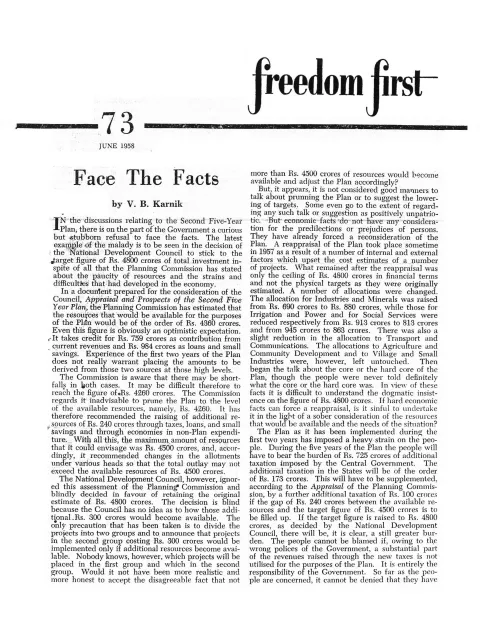
V. B. Karnik’s “Face The Facts” charges the Government and the National Development Council with refusing to confront the Planning Commission’s own findings that only about Rs. 4360-4500 crores of resources, not the Rs. 4800 crores officially retained, would be available for the Second Five-Year Plan. The piece traces the reallocation of funds among Plan heads (industries and minerals raised, irrigation, power and social services cut), the mounting burden of new taxation and deficit financing on ordinary people, and the failure of the Plan to generate anywhere near the promised additional employment. It concludes that the Government’s dogmatic insistence on the original target, in defiance of hard economic facts, will only deepen the strain on the population and vindicate the critics who warned against an over-ambitious Plan from the outset.
- The National Development Council kept the Rs. 4800 crore Plan target despite the Planning Commission’s own estimate that only Rs. 4360-4500 crores of resources were realistically available.
- The Planning Commission had recommended raising an additional Rs. 240 crores through taxes, loans, and small savings, and paring the outlay to Rs. 4500 crores.
- Allocations were reshuffled: Industries and Minerals raised from Rs. 690 to Rs. 880 crores; Irrigation and Power cut from Rs. 913 to Rs. 813 crores; Social Services cut from Rs. 945 to Rs. 810/863 crores.
- The public has already borne a ‘massive tax effort’ plus Rs. 917 crores of deficit financing over the Plan’s first three years, worsening living standards through inflation.
- Employment generation is falling far short of the original promise of 7.9 million non-agricultural and 1.6 million agricultural jobs; only about 6.5 million new non-agricultural jobs are now expected.
- Industrial strain is visible in closures among textile mills and slowdowns in engineering firms amid raw material shortages, rising unemployment, and public dissatisfaction.
- The author credits early critics of the Plan’s heavy-industry bias and neglect of agriculture and consumer goods, saying events have proven their warnings correct.
Notes (Mr. Nehru’s Criticism / Lesson Of Devicolam / A Bad Precedent / Exploitation Of School Children / I.C.C.F. News)
The unsigned ‘Notes’ section (editorial commentary, likely by the editor V. B. Karnik) covers several items: it praises Jawaharlal Nehru for openly criticising the Communist Party of India’s foreign-directed ‘thinking apparatus’ and for candid remarks on Soviet purges and pressure on Yugoslavia, while noting the CPI’s evasive explanation for suddenly reversing its friendly message to the Yugoslav Communist League. It comments on the Communist candidate’s narrowed but still decisive victory in the Devicolam by-election in Kerala, attributing communist gains partly to the failure of Congress and other parties to educate the electorate and to opportunistic alliances with communists in municipal elections. It criticises the Governor of Orissa for improperly declining the resignation of the Mahtab Ministry and denying the opposition its constitutional right to attempt to form a government. It commends the Bombay Municipal Corporation for ending the practice of lining up schoolchildren to welcome dignitaries, a practice the Indian Committee for Cultural Freedom and Freedom First had criticised as harmful and used by ‘fellow-travelling’ elements. A closing note records I.C.C.F. seminar and lecture activity in Poona and Bombay.
- Nehru publicly criticised CPI activities and international communist movement policies at the AICC meeting, prompting Communist retaliatory propaganda.
- The CPI reversed a friendly message to the Yugoslav Communist League into a critical one, timed suspiciously close to a Moscow radio broadcast on the same subject, undercutting its claim of independent judgment.
- Nehru also criticised Mao Zedong’s ‘let a hundred flowers blossom’ reversal and Soviet ‘rigidity’ and purges (Molotov, Malenkov, Kaganovich), and disapproved of pressure on Yugoslavia.
- The Communist candidate Mrs. Punnose retained the Devicolam seat in Kerala by a narrowed majority (about 7,098 votes, down from over 9,000), read as a sign of eroding but still real communist support.
- The Governor of Orissa was criticised for accepting Chief Minister Mahtab’s claim of a majority rather than following the constitutional procedure of calling on the opposition after a resignation.
- The Bombay Municipal Corporation, prompted by the Samyukt Maharashtra Samiti and Praja Socialist Party members, banned the political use of schoolchildren to welcome dignitaries, following earlier ICCF and Freedom First criticism.
- I.C.C.F. Poona held a seminar on ‘Bureaucracy under Communist Regime’; Dr. Raghuvira lectured in Bombay on ‘New Pattern of Economic Development’, introduced by V. B. Karnik.
Towards A Fuller Democracy
By Jayaprakash Narayan
In this address (delivered in Bombay on 11 March 1958), Jayaprakash Narayan explains that his criticism of parliamentary democracy does not make him an opponent of democracy or a supporter of authoritarianism; rather, he regards parliamentary democracy as the best form yet devised but as ‘inadequate democracy’ because it fails Lincoln’s test of government ‘by the people.’ He argues that party systems concentrate power in organised machines with money and propaganda, squeeze out independents and poor candidates, and leave ordinary voters unable to meaningfully judge complex issues (illustrating this with a U.S. survey in which 17% of respondents did not know who the President was). He contends that the welfare state, socialist state, and communist state all share a common trend toward centralisation, technocratic planning, and diminished individual responsibility for community life, which he sees as incompatible with genuine democracy. Narayan then lays out a Gandhian-Sarvodaya alternative built on inner transformation away from self-interest and cold-war-like competitiveness among individuals, toward a vertically decentralised order of self-governing primary (village-level) communities, federating upward through district and regional levels, with Delhi retaining only minimal powers (defence, currency). He cites Gramdan (villages collectively owning land through Bhoodan) as evidence such transformation is already occurring, and calls for a ‘partyless system’ reaching decisions by consensus, modeled loosely on Quaker meetings and Athenian direct democracy, alongside a philosophy of a stateless, non-national Sarvodaya world order.
- Narayan insists he is a critic of parliamentary democracy’s inadequacies, not an opponent of democracy, and rejects authoritarianism and totalitarianism outright.
- Using Lincoln’s definition of democracy, he argues no parliamentary democracy has achieved ‘government by the people’; party machines with money and organisation crowd out independents and poor candidates.
- He questions whether ordinary voters, especially in poorer or less-educated societies, can meaningfully judge complex political and international issues, citing a U.S. survey where 17% did not know the President’s name.
- He argues welfare states, socialist states, and communist states share a common drift toward centralisation and that citizens have become passive, ceding responsibility for community life to the State.
- He calls for an ‘inner change’ away from individual and group self-interest, framing daily social life as a kind of perpetual cold war that must end before democracy’s frontiers can expand.
- He proposes vertical decentralisation: self-governing primary (village) communities handling most needs directly, escalating powers upward only as necessary, with Delhi/the state retaining minimal functions like defence and currency.
- He cites the Bhoodan-to-Gramdan movement (villages collectively owning land) as an existing example of the voluntary transformation he advocates, eliminating land-related conflict in participating villages.
- He envisions a partyless, consensus-based direct democracy at the village level (comparing it to Quaker meetings and ancient Athenian assemblies) and ultimately a non-national, world-citizen Sarvodaya order.
Tito And The Red Goliath
By B. K. Desai
B. K. Desai’s ‘Tito And The Red Goliath’ examines the sharp 1958 rupture between Tito’s Yugoslavia and the Soviet Union (joined by Communist China) over the Yugoslav Communist Party’s new draft programme. The piece argues the rift was not accidental but rooted in Yugoslavia’s long-standing insistence on ideological independence from Moscow, tracing the history from the original 1948 Tito-Stalin split through a brief post-Stalin thaw to the renewed crisis triggered by Yugoslavia’s refusal to sign the 1957 Moscow Declaration. Desai summarises the programme’s radical claims: that capitalism is evolving toward socialism through state intervention without requiring revolution everywhere, that communist parties have no monopoly on the path to socialism, and that a socialist state’s bureaucracy can itself become an oppressive ‘drag on progress’ requiring a move toward ‘direct democracy.’ He details the furious Soviet (Khrushchev, Pospelov) and Chinese (People’s Daily) denunciations of the programme as ‘revisionism’ and Tito’s defiant refusal to retract, closing with Desai’s own view that Titoism is ‘equally reprehensible’ and Tito’s regime ‘as much dictatorial’ as the Kremlin’s, given its treatment of dissidents like Djilas and Dedijer.
- The article frames the 1958 Tito-Moscow rupture as history ‘repeating itself’ a decade after the original 1948 Tito-Stalin excommunication.
- Yugoslavia’s refusal to sign the November 1957 Moscow Declaration (which demanded ideological unity under Soviet leadership) precipitated the new crisis.
- The Yugoslav draft programme argues capitalism is absorbing socialist elements via state intervention and that revolution is not always a precondition for the transition to socialism.
- The programme denies communist parties a monopoly on leading the movement toward socialism, undermining Moscow’s claimed leadership of world revolution.
- It also argues a socialist state’s bureaucracy can become ‘a drag on progress’ and calls for cutting state power back toward ‘direct democracy’ — a direct challenge to Soviet statism.
- Khrushchev and Soviet theorist Peter N. Pospelov denounced the programme as ‘nonsense’ and ‘wrong statements’; China’s People’s Daily called it ‘out-and-out revisionism’ serving ‘U.S. imperialists.’
- Desai concludes that Titoism is not morally superior to Soviet communism, citing Tito’s own intolerance of dissidents Djilas and Dedijer, even while noting Tito sought rapprochement with Moscow out of practical necessity.
Generated by the v1.5 extraction pipeline. Awaiting editorial review.
Metadata and summary are AI-extracted from the source PDF and reviewed for editorial accuracy. The original work is available via the Read PDF tab above (where present); paragraph-level citation inside the PDF is deferred to a future engagement.