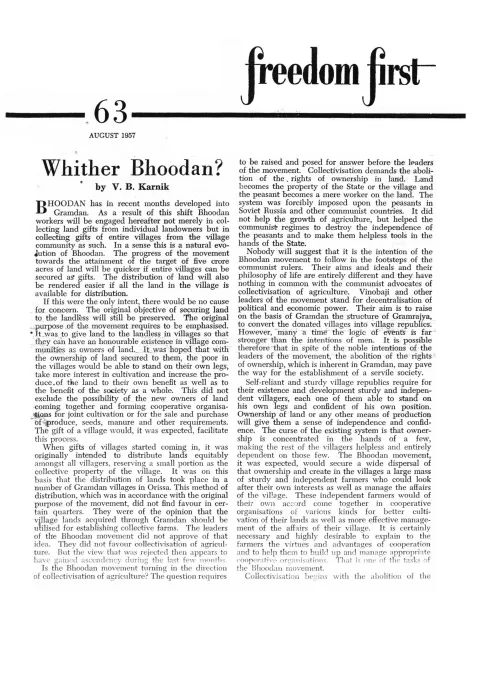
periodical issue
Freedom First
By "Atreya", M. R. Masani, Rev. T. Mascarenhas, Aziz Madni, Adam Adil, V.B.K.
Edited, printed & published for the Democratic Research Service by V. B. Karnik at The Kanada Press, 109 Parsi Bazar Street, Bombay 1. · Bombay · 1958
12 pages
Freedom First
Summary
This is issue No. 76 of Freedom First (September 1958), the monthly journal of the Democratic Research Service, edited and published by V. B. Karnik in Bombay. In the rendered pages, the issue opens with a lead essay by the pseudonymous “Atreya” dissecting the communist government of Kerala as a case study in propaganda mythmaking, followed by a Notes section covering parliamentary alarm over Kerala’s law-and-order situation, a rebuttal of the Communist Party’s cry of “autonomy,” the perennial food-grain shortage, and the politicisation of the upcoming Asian-African Writers’ Conference at Tashkent. M. R. Masani contributes a substantial essay, “Towards Economic Democracy,” arguing against Command Economy planning and for a mixed economy resting on free trade unions, free peasant proprietors, and free enterprise. Rev. T. Mascarenhas offers a philosophical essay, “The Light of Personality,” contrasting “individual” with “person” as categories for socialist thought. A Review section covers John Gunther’s Inside Russia Today, Barbara Ward’s The Interplay of East and West, and two Laski Institute pamphlets (D. R. Gadgil on the Planning Commission’s failures, and Frederic Ogden on U.S. voting behaviour). The issue closes with a leaked internal letter from 23 Bengal members of the Communist Party of India accusing the CPI leadership of behaving as a Soviet satellite over the Yugoslavia affair, and a note on Amal Kumar Ganguli’s resignation from the CPI in Bengal on similar grounds. The volume’s argumentative center, in the rendered pages, is anti-communist and pro-free-enterprise: exposing what the editors present as Soviet-aligned deception and centralised-planning failure in India, while advancing classical liberal alternatives (economic democracy, free trade unions, free enterprise) as the corrective.
Key points
-
Writing as “Atreya,” “Kerala—A Lesson In Legend Building” catalogues seven communist “legends” built around Kerala’s ministry, arguing state contracts channelled to party-controlled cooperatives constitute organised corruption and that killings of Congress and PSP workers by armed Communist jathas triggered Nehru’s condemnation.
-
The Notes section reports Parliamentary alarm over Kerala lawlessness, rebuts the CPI’s “autonomy” objection to Central inquiry by invoking Article 335, and highlights a 6.7 million ton food-grain deficit tied to historical under-investment in agriculture.
-
Further Notes frame the planned Tashkent Asian-African Writers’ Conference as communist-dominated, and welcome the Magsaysay Foundation’s inaugural award to Vinoba Bhave for his humility and critique of caste-based candidate selection.
-
M. R. Masani’s “Towards Economic Democracy” argues no Parliament can democratically control comprehensive economic planning, and defines economic democracy through the worker’s right to strike, the peasant’s right to own land, and the investor’s and consumer’s freedom of choice, resting on free trade unions, free peasant proprietors and free enterprise.
-
Rev. T. Mascarenhas’s “The Light Of Personality” argues, via Jacques Maritain’s distinction, that socialism needs the relational language of “person” rather than the merely enclosed “individual.”
-
The Review section covers John Gunther’s Inside Russia Today, Barbara Ward’s The Interplay of East and West, and D. R. Gadgil’s pamphlet arguing the Planning Commission overreached its advisory mandate into policy-making.
-
A leaked letter from 23 Bengal CPI members accuses the Party leadership of acting as a Soviet satellite on the Yugoslavia dispute, timing its cable reversal to a Soviet withdrawal and Moscow Radio broadcast, and a companion item reports Amal Kumar Ganguli’s resignation from the CPI over the same charge of subjugation to Moscow and Peking.
Essays
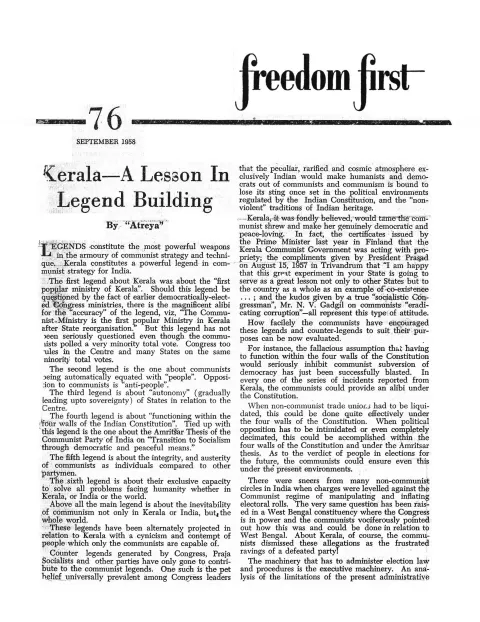
Kerala—A Lesson In Legend Building
By “Atreya”
Writing under the pseudonym “Atreya,” the author argues that “legends” are the chief weapon of communist strategy in India, and that Kerala under its Communist ministry has become the prime laboratory for such legend-building. The essay catalogues seven interlocking legends — that Kerala’s was the first popular ministry, that communists equal “the people,” that resistance to communism is anti-people, that greater state autonomy from the Centre is desirable, that communists work loyally within the four walls of the Constitution, that communist leaders are personally more austere and honest than other politicians, and that communism is historically inevitable. The piece details how the Communist Ministry channelled state contracts to party-controlled cooperatives as a form of organised corruption, describes the murders of Congress and PSP workers by armed Communist Party jathas, and interprets the Kerala government’s conduct toward the Centre as an attempt to project itself as a quasi-sovereign state in relations with New Delhi, with Nehru’s visit framed almost as a state visit between nations. The essay closes by citing a Communist Party Executive resolution and the CPI weekly New Age to argue that the Party sees Kerala as a base for exporting subversion to the rest of India, quoting E. M. S. Namboodiripad’s language as a deliberate warning rather than empty rhetoric.
- Identifies seven communist “legends” built around Kerala, from the “first popular ministry” claim to the inevitability of communism.
- Argues state contracts channelled to party-controlled cooperatives constitute a new, more organised form of corruption than any seen under Congress.
- Documents killings of Congress and PSP workers by armed Communist Party jathas as the trigger for Nehru’s public condemnation.
- Contends the Kerala Communist government projects itself as a quasi-sovereign state negotiating with the Union government rather than a constituent state.
- Cites the CPI’s own Trivandrum resolution and the Party weekly New Age as evidence the Kerala ministry is being defended as a base for national-level Left unity against Congress.
- Frames E. M. S. Namboodiripad’s rhetoric as a serious warning of continued communist advance, not bluster.
Notes (Alarming Picture; Hypocritical Cry; Perrenial Problem; Asian-African Writers’ Conference; Fitting Tribute; Some Home Truths)
The Notes section is a set of short, unsigned editorial items. “Alarming Picture” reports on two adjournment motions in Parliament highlighting lawlessness under Kerala’s Communist ministry, citing charges by Pradesh Congress Committee president K. A. Damodara Menon and independent observer B. G. Verghese that party cadres intimidate opponents and that “Government of the Party, by the Party and for the Party” has replaced government of the state. “Hypocritical Cry” rebuts the CPI’s opposition to a Central probe into Kerala on autonomy grounds, arguing communists are otherwise champions of centralised state power and that Article 335 gives the Union government both the right and the obligation to intervene when fundamental rights are threatened. “Perennial Problem” discusses a worsening food-grain deficit (6.7 million tons) and criticises the government’s historical over-emphasis on heavy industry over agriculture, quoting the Prime Minister’s admission that he had learned too late the primacy of agricultural production, and former Finance Minister C. D. Deshmukh’s charge about excessive spending on fertiliser factories versus steel plants. “Asian-African Writers’ Conference” warns that a planned Tashkent writers’ conference is a communist-orchestrated show, contrasting it with the 1956 Delhi conference where non-communist efforts (citing Humayun Kabir, Vatsyayan, and Padhye) prevented total communist capture, and quotes the All-India PEN Centre’s warning to Indian writers. “Fitting Tribute” welcomes the Ramon Magsaysay Foundation’s first award to Acharya Vinoba Bhave. “Some Home Truths” reports Vinoba Bhave’s Dhulia speech criticising the caste-based candidate selection practices of political parties and warning that borrowed European democratic institutions may need adaptation to Indian conditions.
- Parliament debated adjournment motions on Kerala lawlessness; observers including B. G. Verghese described a climate of insecurity and Party-state fusion.
- Rebuts CPI’s autonomy-based objection to a Central inquiry, invoking Article 335 as grounds for Union intervention.
- Highlights a 6.7 million ton food-grain deficit and criticises historical under-investment in agriculture relative to heavy industry.
- Frames the planned Asian-African Writers’ Conference at Tashkent as a communist-dominated successor to the 1956 Delhi conference.
- Notes the Magsaysay Foundation’s inaugural award to Vinoba Bhave as recognition of his humility and moral standing.
- Reports Vinoba Bhave’s critique of caste-based candidate selection by political parties and his call to adapt European-style democracy to Indian conditions.
Towards Economic Democracy
By M. R. Masani
M. R. Masani’s “Towards Economic Democracy” argues that democratic socialists cannot claim a totally planned Command Economy is compatible with individual freedom, because no Parliament has ever been shown able to democratically control far-reaching economic planning decisions — such as how many cattle to rear, what crops to sow, or how many trucks to license. Masani contends that once the state becomes the sole employer, sole trader, and sole trade union, political and economic liberty is lost regardless of constitutional safeguards, citing the Soviet Constitution’s “most democratic” paper guarantees against the brutal reality of Stalinist tyranny, and quoting British Labour figures Aneurin Bevan and R. H. S. Crossman on the dangers of concentrated state bureaucratic power. He defines “economic democracy” through the roles of worker (right to organise and strike), peasant (right to own and decide use of land), investor (right to invest or not), and consumer (freedom of market choice), arguing these rights are destroyed under communist central planning, as with forced Soviet and Chinese collectivisation of peasants. Masani insists this is not an argument for undiluted laissez-faire — the state has a legitimate but limited regulatory role — and closes by describing economic democracy as guaranteed by a system of checks and balances: free peasant proprietors, free trade unions, and free enterprise, competing to serve the community’s needs.
- Argues no Parliament, in Britain or elsewhere, has been shown capable of democratically controlling comprehensive economic planning decisions.
- Contends that once the State is the sole employer, trader, and trade union, political and economic freedom collapses regardless of paper constitutional guarantees.
- Cites the Soviet Constitution as ‘the most democratic on paper’ alongside the reality of Stalinist tyranny to argue power can only be checked by countervailing power.
- Quotes Aneurin Bevan and R. H. S. Crossman, British Labour figures, on the dangers that centralised state bureaucracy poses even to socialists’ own aims.
- Defines economic democracy through four roles: the worker’s right to strike, the peasant’s right to own land, the investor’s right to choose, and the consumer’s freedom of market choice.
- Rejects the idea that this argument favours undiluted laissez-faire, allowing the state a limited regulatory role to prevent anarchy, rapacity and injustice.
- Closes with a vision of economic democracy resting on free peasant proprietors, free trade unions, and competing free enterprises as a system of checks and balances.
The Light Of Personality
By Rev. T. Mascarenhas
Rev. T. Mascarenhas’s “The Light of Personality” argues that modern discourse errs by using ‘individual’ where it should use ‘person,’ since ‘individual’ connotes only separateness and enclosure while ‘person’ connotes relationship. Drawing on Jacques Maritain’s distinction between individuality and personality, Mascarenhas uses the analogy of an electric bulb (the individual unit) versus its light (the person’s existential, relational being) to argue that a personalist philosophy — recognising that a person’s rights and duties arise from existential relationships with family, community, and state — offers socialism a firmer foundation than the language of the ‘individual.’ He argues socialism’s legitimate concern for sufficiency of rights, jobs, and welfare is best understood not as enforcing an abstract ‘common good’ but as a network of shared relationships analogous to a family, where sharing rather than individual selfishness is the good, and closes by urging that ‘person,’ not ‘individual,’ become socialism’s operative term.
- Argues modern usage wrongly conflates ‘individual’ and ‘person,’ following Jacques Maritain’s critique of this confusion.
- Uses the analogy of an electric bulb (individual) and its light (personality) to illustrate that personhood is inherently relational, not merely enclosed.
- Contends a ‘personalist’ philosophy suits socialism better than individualist language, since duties and rights arise from existential relationships (family, community, state).
- Reframes socialism’s goal of ‘sufficiency’ as a shared familial good rather than an enforced abstract ‘common good.‘
Review: Inside Russia Today (John Gunther) / The Interplay of East and West (Barbara Ward)
By Aziz Madni; Adam Adil
The Review section carries four notices. Aziz Madni reviews John Gunther’s Inside Russia Today, praising its scope and Gunther’s vivid reportorial style while noting it is not a scholarly work, quoting Gunther’s lines on Moscow fashion and Soviet insularity about the outside world. Adam Adil reviews Barbara Ward’s The Interplay of East and West (the Sir Edward Memorial Lectures), summarising her argument that Asian nationalism, unlike its more destructive European counterpart, has fostered mutual sympathy, and her plea for the West to share prosperity with the East while noting India’s Five Year Plan approach as a democratic model of village-level self-help rather than forced collectivisation. V. B. K. reviews two Harold Laski Institute pamphlets: D. R. Gadgil’s Indian Planning and the Planning Commission, in which Gadgil — drawing on his experience chairing the Commission’s Panel of Economists — argues the Planning Commission has overstepped its advisory role into policy-making and recommends restructuring its composition and removing its executive functions; and Frederic Ogden’s Voting Behaviour in the United States, described as elementary but useful. Notes on I.C.C.F. and D.R.S. activities close the section, including a Madras public meeting addressed by C. Rajagopalachari among others, and a D.R.S. seminar on ‘Socialism Today.’
- Aziz Madni’s review praises Gunther’s Inside Russia Today for scope and vivid style while conceding it is not scholarly work.
- Adam Adil’s review of Barbara Ward’s Interplay of East and West summarises her argument that Asian nationalism has fostered international sympathy rather than conflict, and her call for the West to share prosperity with the East.
- V. B. K.’s review covers D. R. Gadgil’s pamphlet arguing the Planning Commission has failed by overreaching its advisory mandate into actual policy-making.
- Gadgil recommends changing the Commission’s composition (excluding the PM and Finance Minister) and stripping it of executive functions.
- A short pamphlet on U.S. voting behaviour by Frederic Ogden is also reviewed as elementary but useful.
- I.C.C.F. and D.R.S. news items report a Madras meeting featuring C. Rajagopalachari and a seminar titled ‘Socialism Today.‘
Indian Planning and the Planning Commission / Voting Behaviour in the United States (pamphlet reviews)
By V.B.K.
“C.P.I.—A Soviet Satellite” reproduces a cyclostyled letter written anonymously by 23 Bengal members of the Communist Party of India to the Party’s General Secretary. The letter lays out a timeline showing the CPI sent a goodwill cable to the Yugoslav League of Communists on March 19, 1958, then reversed itself and sent critical cables on April 19-20 only after the Soviet Communist Party withdrew its own acceptance of the Yugoslav invitation and Moscow Radio broadcast condemnatory material — circumstantial evidence, the writers argue, that CPI policy on Yugoslavia was dictated by Moscow rather than independently formed. The letter accuses the CPI leadership of behaving as a political satellite of the CPSU, demands to know whether the Party is genuinely independent, and challenges why the CPI never finds anything to criticise in the Soviet Union or China while claiming independent judgment. A postscript, written after news of Imre Nagy’s execution reached the writers (via Moscow, not Budapest), asks whether Party leadership will have the courage to condemn the execution, having previously kept silent when it should have spoken and spoken when it should have kept silent.
- A letter from 23 anonymous Bengal CPI members to the Party’s General Secretary lays out a dated timeline of CPI cables on the Yugoslavia dispute.
- The timeline shows CPI reversed its goodwill message to the Yugoslav League only after the Soviet party withdrew its own acceptance and Moscow Radio broadcast condemnation.
- The letter concludes this proves the CPI acts as a political satellite of the CPSU rather than an independent party.
- Writers challenge the CPI to explain why it never criticises the USSR or China despite claiming independent Marxist-Leninist judgment.
- A postscript raises the execution of Imre Nagy (news reaching the writers via Moscow) as a test of whether CPI leadership will show independence or complicit silence.
I.C.C.F. News / D.R.S. News
“A Resignation From Bengal” reports that Amal Kumar Ganguli, M.L.A., a prominent Bengal Communist Party member, resigned his Party membership over disagreement with CPI leadership on several issues: the anti-Congress slogan and cry for an alternative government, which he argued undermines national unity and helps reactionary forces; the attempted coalition with the PSP and Forward Bloc, which he called insincere and misleading; the corrosive effect of parliamentary politics on the Party’s revolutionary programme; and the Party’s negative, sectarian handling of refugee rehabilitation in West Bengal. Ganguli’s resignation statement further charges that the Party leadership has subjugated itself to the Communist parties of the USSR and China in the name of international working-class unity, citing the CPI’s blind support for the execution of Imre Nagy as proof of the Party’s political sterility, and states he can no longer reconcile himself with a Party policy he sees as failing to resolve the conflict between old social structures and socialism.
- Amal Kumar Ganguli, M.L.A., resigned CPI membership in Bengal over disagreement with Party leadership.
- Objects to the anti-Congress slogan as damaging to national unity and objectively helpful to reactionary forces.
- Calls the Party’s coalition attempts with PSP and Forward Bloc insincere and misleading to the public.
- Criticises the Party’s handling of refugee rehabilitation in West Bengal as a negative, sectarian policy against national interest.
- Charges CPI leadership with subjugating the Party to the USSR and Chinese Communist parties, citing its support for Imre Nagy’s execution as proof of its sterility.
Generated by the v1.5 extraction pipeline. Awaiting editorial review.
Metadata and summary are AI-extracted from the source PDF and reviewed for editorial accuracy. The original work is available via the Read PDF tab above (where present); paragraph-level citation inside the PDF is deferred to a future engagement.