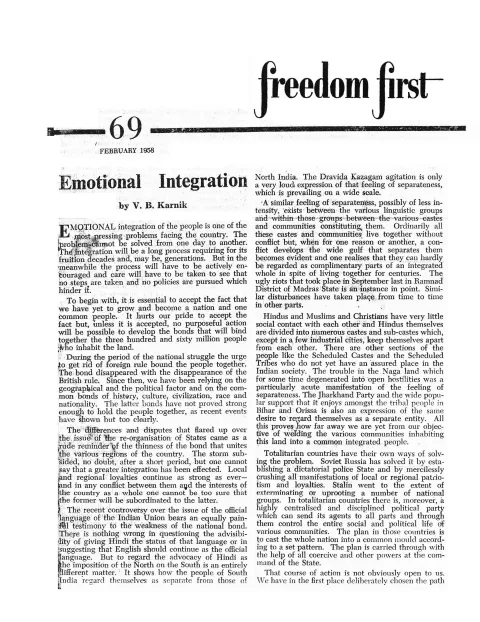
periodical issue
Freedom First
By J. B. H. Wadia, Atreya, Daniel Bell, Philip Spratt, Raymond Postgate
Edited, printed & published for the Democratic Research Service by V. B. Karnik at The Kanada Press, 109 Parsi Bazar Street, Bombay 1. · Bombay · 1958
12 pages
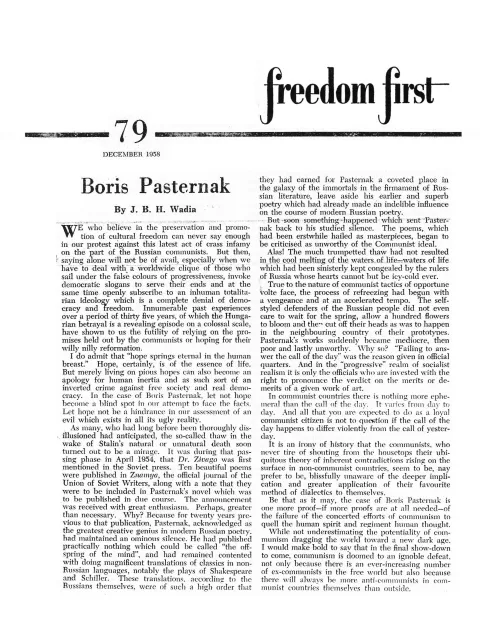
Freedom First
Summary
This is issue No. 79 (December 1958) of Freedom First, the monthly journal of the Democratic Research Service (Bombay), edited and published by V. B. Karnik. The issue is a Cold War-inflected miscellany of signed articles, editorial “Notes,” and a reader-quotes column, unified by anti-communist and pro-cultural-freedom polemic. Its center of gravity is the Boris Pasternak affair: J. B. H. Wadia’s lead essay denounces the Soviet persecution of Pasternak after his Nobel Prize and forced renunciation, and the issue closes with a joint statement by prominent Indian writers (Tarasankar Banerjee, Buddhadeva Bose, and others) alongside a separate statement by M. R. Masani, Sophia Wadia, J. B. H. Wadia, and other Bombay-based liberals protesting his treatment. A companion piece, “The Tashkent Writers’ Conference” by “Atreya,” recounts the fractious Indian delegation to the Soviet-hosted Afro-Asian Writers’ Conference at Tashkent, alleging communist manipulation of delegate selection and agenda. Daniel Bell reports from an international seminar in Vienna on workers’ participation in management, comparing co-determination in Germany/Austria, workers’ councils in Yugoslavia and Poland, and British trade-union resistance to the idea. Philip Spratt reviews new documentary evidence that German government funds financed the Bolsheviks in 1917, drawing a pointed contemporary parallel to Soviet subsidy of the Indian Communist Party. Raymond Postgate surveys new books on Soviet cultural life and British Communist intellectuals, arguing that a diet of Stalinist orthodoxy has left even sympathetic critics unable to think clearly. The editorial “Notes” section criticizes Nehru-era planning (“the disease of giganticism”), the Hindustan Steel project, the Krishna Menon defence-ministry controversy, and the spread of military dictatorship in Asia and Africa (the Sudan coup). “With Many Voices” collects short, often barbed quotations from the Indian press on Nehru, planning, and Soviet-Indian relations, plus a note on forthcoming Indian visits by Frode Jacobsen, Sidney Hook, and Arthur Koestler.
Key points
-
J. B. H. Wadia’s lead essay denounces the Soviet campaign to vilify Boris Pasternak after Doctor Zhivago’s publication and Nobel Prize, appeals to Indian writers’ associations to protest, and closes naming Pasternak “the skylark of Russian literature.”
-
Notes denounce Nehru’s Bhopal speech on the “disease of giganticism” in planning as welcome self-criticism, while a Parliamentary debate exposed over 45% cost overruns at the simultaneously-built Hindustan Steel plants.
-
Writing as “Atreya,” “The Tashkent Writers’ Conference” alleges the Indian delegation to the Soviet-hosted conference was packed with communist and pro-Soviet writers who bypassed Union Minister Humayun Kabir as leader, provoking resignations, and that a permanent Colombo bureau was voted in over Indian objections.
-
Daniel Bell reports from a Congress for Cultural Freedom seminar in Vienna on “Workers’ Participation in Management,” contrasting British trade unionists’ rejection of worker participation with German-Austrian co-determination and Yugoslav workers’-council systems, and citing Raymond Aron’s thesis of “the End of the Age of Ideology.”
-
A notice announces the December 1958 visits of Danish Social Democrat Frode Jacobsen, philosopher Sidney Hook, and novelist Arthur Koestler, author of Darkness at Noon.
-
Philip Spratt reviews newly available German archival documents indicating the Bolsheviks were financed mainly by German money in the six months before the October Revolution, and draws a contemporary parallel to Soviet subsidy of the Communist Party of India.
-
Raymond Postgate reviews The Soviet Cultural Scene 1956-1957 and Hyman Levy’s Jews and the National Question, arguing the post-Stalin cultural “thaw” was minor and that prolonged exposure to Stalinist orthodoxy has left even sympathetic British communist intellectuals unable to think clearly.
-
A joint statement of Indian writers including Tarasankar Banerjee and Buddhadeva Bose condemns Pasternak’s expulsion from the Soviet Writers’ Union, joined by a separate protest from M. R. Masani, Sophia Wadia and others noting the Nobel Physics prize to Soviet scientists was accepted without controversy.
-
The closing “With Many Voices” quotes P. C. Joshi calling the “slander campaign” against Kerala’s government the “greatest single danger to Indian democracy,” alongside Nehru’s own coinage of the “disease of gigantism.”
Essays
Boris Pasternak
By J. B. H. Wadia
J. B. H. Wadia’s lead essay is an impassioned protest against the Soviet campaign to vilify Boris Pasternak after Doctor Zhivago’s publication and his award of the Nobel Prize for Literature. Wadia traces the arc from the 1954 announcement of the novel’s forthcoming publication and initial acclaim, through the sudden official reversal that recast Pasternak’s work as unworthy of the ‘Communist ideal,’ and reads this as proof that the post-Stalin ‘thaw’ was illusory. He appeals to Indian writers’ associations, including near-communist organisations, to publicly protest Pasternak’s treatment, and quotes two lines from Doctor Zhivago on freedom and bondage. The essay ends by casting Pasternak as ‘the skylark of Russian literature,’ closing with a stanza from Shelley’s ‘Ode to a Skylark’ and an expression of confidence that Pasternak’s voice will outlast his persecutors.
- Wadia denounces the Soviet campaign against Pasternak as ‘this latest act of crass infamy’ by the Russian communists.
- He recounts the 1954 announcement in Znamya of Dr. Zhivago’s forthcoming publication and ten poems, followed by acclaim, then a sudden reversal branding the work unworthy of ‘the Communist ideal.’
- He calls the post-Stalin ‘thaw’ a mirage, arguing communist tactics move predetermined ‘from vilification to victimisation and from victimisation to alas! liquidation.’
- He appeals to Indian writers’ and poets’ associations, including near-communist organisations, to hold meetings and pass resolutions of protest.
- He quotes Pasternak’s Dr. Zhivago on freedom (‘A man who is not free will always idealise his bondage’) as an epitome of the novel’s philosophy.
- The essay closes by naming Pasternak ‘the skylark of Russian literature’ and quoting Shelley’s ‘Ode to a Skylark.‘
Notes (Disease Of Giganticism; Story Of Bungling; Defence Controversy; Democracy In Asia; And Now Economic Bandung!)
The unsigned editorial ‘Notes’ section covers four topics: Nehru’s speech in Bhopal denouncing the ‘disease of giganticism’ in development planning and his call for smaller, more locally responsive projects; a Parliamentary debate exposing cost overruns, delays, and mismanagement at the three simultaneously-built Hindustan Steel plants; the controversy over Defence Ministry transactions implicating V. K. Krishna Menon, calling for a high-level inquiry and separation of supply from defence; and the Sudan military coup as an instance of a broader trend toward military dictatorship displacing fragile democracies across Asia and Africa, followed by criticism of the planned Cairo ‘Economic Bandung’ conference as another communist-aligned front organisation.
- Nehru’s Bhopal speech denounced ‘the disease of giganticism’ in planning, criticizing large projects for failing to secure popular cooperation and for uprooting families.
- The editorial welcomes this as a possible shift ahead of the Third Five-Year Plan, favoring smaller projects with quicker returns.
- The Hindustan Steel debate revealed estimate overruns of over 45%, schedule slippage, and poor supervision across the three simultaneously built steel plants.
- The editorial argues gigantism itself, not just execution, caused the problem, since one giant organisation was created instead of three separate boards.
- The Defence Ministry controversy around Krishna Menon-era transactions is treated seriously, with a call for a high-level inquiry into supply/defence separation and underutilised factory capacity, while cautioning that the Minister’s personality should not block scrutiny.
- The Sudan coup is read as confirming a regional pattern (Pakistan, Iraq) of democratic collapse driven by internal instability rather than external causes.
- The Cairo Afro-Asian Economic Congress (‘Economic Bandung’) is criticized as another in a series of Soviet-aligned front conferences following the Afro-Asian Solidarity Conference and the Tashkent ‘Writers’ Bandung.‘
The Tashkent Writers’ Conference
By “Atreya”
Writing under the pseudonym ‘Atreya,’ this piece reconstructs the controversy surrounding India’s delegation to the Soviet-hosted Tashkent Conference of Afro-Asian Writers. It alleges that the Indian Preparatory Committee, formed under Mulk Raj Anand, Tarashanker Banerjee, and Jainendra Kumar Jain, was packed with communist and pro-Soviet writers who bypassed Union Minister Humayun Kabir as delegation leader in favour of the more pliable Banerjee, provoking the resignation of Jain and two other committee members. The article compiles press accounts (Times of India, Amrit Bazar Patrika, the pro-Soviet weekly Link) describing a conference where the agenda was altered to foreground political themes over literary ones, where two Indian delegates (Gopal Haldar and Sant Singh Sekhon) cooperated with the agenda revision without the delegation’s knowledge, and where a permanent Colombo-based bureau was voted into being over Indian delegation objections. It closes by noting the irony that despite Boris Pasternak’s direct relevance to the conference’s themes of literary freedom, neither the organisers nor the Indian delegation leader had much to say about his case.
- An Indian Preparatory Committee (Mulk Raj Anand, Tarashanker Banerjee, Jainendra Kumar Jain) organised the delegation to the Tashkent Afro-Asian Writers’ Conference; Jain and two others (R. S. Dinkar, V. R. Narala) resigned, alleging the committee was packed with communist and pro-communist writers.
- The dissenters charged that Tarashanker Banerjee was chosen as delegation leader specifically to bypass Union Minister Humayun Kabir, who was seen as less ‘pliable.’
- Multiple press sources (Times of India, Amrit Bazar Patrika, the pro-Soviet Link) are quoted describing mismanagement in delegate selection and a conference agenda that shifted from literary to overtly political themes.
- Two Indian delegates, Gopal Haldar and Sant Singh Sekhon, are named as having cooperated in revising the agenda ‘behind the collective back of the Indian delegation.’
- Mulk Raj Anand and Tara Shankar Banerjee had assured Indian writers and reportedly Prime Minister Nehru that the conference would be non-political, an assurance the article says was not honoured.
- The conference voted, over Indian objections, to create a permanent Colombo bureau; the Indian delegation was described as ‘bewildered and shocked.’
- The piece closes by noting that Soviet officials at a Moscow reception characterised Gandhi as a ‘bourgeois reactionary’ and Nehru as an instrument of Western imperialism, and remarks on the delegation’s near-silence on Boris Pasternak’s case.
Essay 4
Daniel Bell, American labour journalist and newly appointed Professor of Sociology at Columbia, reports on an international seminar on ‘Workers’ Participation in Management’ organised by the Congress for Cultural Freedom in Vienna (September 19-25). Surveying experiments across Europe — co-determination in Germany and Austria, workers’ councils in Yugoslavia and Poland, joint consultation in Britain, and worker-communal arrangements in Italy and India (the Tata enterprises) — Bell contrasts sharply differing national positions. British trade unionists (represented by Hugh Clegg) rejected worker participation in management as a confusion of roles, preferring an independent, adversarial union stance (‘democracy by consent’). German/Austrian co-determination was described as anomalous, since unions bargain nationally while works councils operate independently within plants. Yugoslav and Polish delegates defended their workers’-council systems despite acknowledged imperfections, disputing claims (from Professor Adolf Sturmthal) that the councils lacked real authority. Bell’s own paper, with Eric Trist and Paul Barton, argued that meaningful worker control belongs at the level of the job itself — pace, rhythm, production standards — rather than in macro-level bargaining, and that alienation would not be resolved merely by changing formal property relations, contra Marxist theory. He closes by praising the seminar’s freedom from dogmatism and citing Raymond Aron’s thesis of ‘the End of the Age of Ideology.’
- The Congress for Cultural Freedom convened an international seminar in Vienna on ‘Workers’ Participation in Management,’ drawing scholars, union officials, and journalists from twenty countries.
- Hugh Clegg (Nuffield College, Oxford) argued for British unions’ ‘democracy by consent’ via independent adversarial bargaining, rejecting ‘democracy through participation’ as a confusion of roles.
- German/Austrian co-determination law gives unions a co-equal voice on plant boards, but Bell calls this anomalous since union roots lie outside the plants themselves.
- Yugoslav delegates (A. Deleon, Dr. Pasich) defended workers’-council authority against Professor Adolf Sturmthal’s contention that councils lacked real power over key decisions.
- Polish workers’ councils, unlike Hungary’s, arose as a deliberate movement by young intellectuals in 1956, but have since been absorbed into government-dominated unions under Gomulka.
- Bell’s own paper (with Eric Trist and Paul Barton) argued worker control should focus on the job itself — pace, rhythm, production standards — rather than macro-level participation schemes.
- Bell cites Raymond Aron’s argument that this is ‘the End of the Age of Ideology,’ with old political dogmas losing explanatory purchase.
- Dr. Trist presented experiments on autonomous work groups in British coal mines and Indian textile mills as evidence for the viability of group-decision processes.
Visitors To India
An unsigned notice, ‘Visitors to India,’ announces three notable foreign visitors arriving in December 1958: Frode Jacobsen, the Danish Social Democrat and former anti-Nazi resistance leader, who will tour India studying village life; the American philosopher and political scientist Prof. Sidney Hook, visiting under a Ford Foundation fellowship to study oriental religions and philosophy and to lecture at several universities and a Philosophical Conference in Ahmedabad; and novelist Arthur Koestler, author of Darkness at Noon, who will spend time in Kerala and Bombay before returning to Delhi and Calcutta.
- Frode Jacobsen, Danish Social Democrat leader and former anti-Hitler resistance member, will visit Bombay and Delhi before continuing to Karachi.
- Prof. Sidney Hook will tour Calcutta, Banaras, Lucknow, Delhi, Ahmedabad, Aurangabad, Poona, and Madras on a Ford Foundation fellowship to study oriental religions and philosophy.
- Arthur Koestler, author of Darkness at Noon, will arrive in Bombay in late December, travel to Kerala, then return via Bombay, Delhi, and Calcutta.
Revolutions And Foreign Money
By Philip Spratt
Philip Spratt reviews newly available German archival documents (published in Germany and the Revolution in Russia, 1915-1918, ed. Z. A. B. Zeman) bearing on long-standing claims that Imperial Germany financed the Bolshevik Revolution. Drawing on the Times Literary Supplement’s review and Professor L. Schapiro’s rebuttal of a more skeptical reviewer, Spratt lays out evidence that Parvus arranged transfers of several million marks from the German Treasury to the Bolsheviks via various channels, that the Bolsheviks’ finances were desperate before May 1917 and suddenly flush afterward, and that German Foreign Minister Kuhlmann later stated in a memo intended for the Kaiser that Bolshevik success depended on German funding. Spratt concludes it is ‘almost certain’ the Bolsheviks were financed mainly by German money in the crucial six months before the October Revolution, and pivots to a contemporary warning: that Soviet Russia now subsidises the Communist Party of India ‘to a substantial extent,’ urging the Indian public to be more alert to this danger.
- New documents from captured German archives (ed. Z. A. B. Zeman) reopen the question of German financing of the Bolshevik Revolution.
- Parvus arranged for the German Treasury to allocate two million marks (later raised to five million) for revolutionary work in Russia via intermediaries including Lenin.
- German Foreign Minister Kuhlmann’s December 1917 statement, intended for the Kaiser, asserted that steady German funding enabled the Bolsheviks to build up Pravda and expand their base.
- Professor L. Schapiro’s review is said to prove, via intercepted telegrams and Soviet-published letters, that Lenin received money from German agents, contra a more skeptical TLS reviewer who dismissed Kuhlmann as unreliable.
- Spratt estimates at least two allocations of five million marks each (1915 and April 1917), equating 1917 marks to ‘much more than a crore of 1958 rupees.’
- Spratt concludes the Bolsheviks ‘ran mainly on German money’ in the six months before November 1917, and that without this money ‘the revolution would never have taken place.’
- The article closes by drawing a direct parallel to the present: that Russia subsidises the Communist Party of India, and the Indian public should be more alert to this danger.
Light On The Communist Scene
By Raymond Postgate
Raymond Postgate reviews two books illustrating the intellectual condition of committed communists and pro-Soviet writers in 1958. The first, The Soviet Cultural Scene 1956-1957 (essays from the journal Soviet Survey, ed. W. Z. Laqueur and G. Lichtheim), Postgate reads as evidence that the post-Stalin cultural ‘thaw’ was minor and largely illusory — Soviet sociology, he notes, barely exists, and official rhetoric remains crude and dogmatic even on subjects like Freudianism and Impressionist painting. The second, Professor Hymen Levy’s Jews and the National Question, is presented as a case study of a British Communist intellectual whose faith has been shaken by events but who still parrots naive Stalinist positions, including a claim that Madame Furtseva has defended a numerus clausus principle in the Soviet Civil Service. Postgate finds Levy’s reflections ‘weak’ and ‘ignorant’ despite his erudition, and closes (continuing onto page 12, not rendered here) with a comparison to Tibor Dery’s novel Niki.
- Postgate reviews The Soviet Cultural Scene 1956-1957 (ed. Laqueur and Lichtheim), a compilation of Soviet Survey essays on Soviet literature, arts, history, philosophy, and social science.
- He argues the post-Stalin cultural ‘thaw’ produced only a small, ephemeral renaissance, with continuing ideological cliches about Freudianism, art, and the West.
- He notes Soviet sociology ‘does not exist’ — no social surveys, no participant observation, no serious stratification studies.
- He reviews Professor Hymen Levy’s Jews and the National Question as a specimen of the intellectual damage caused by prolonged exposure to Stalinist orthodoxy.
- Levy is described as constructing ‘an imaginary secret history’ in which Stalin’s persecution of Jews resulted from American ‘provocation.’
- Postgate notes Levy claims Madame Furtseva has defended the numerus clausus principle in the Soviet Civil Service, while acknowledging continuing persecution of Jews in the USSR.
- Postgate invokes Earl Attlee’s remark to the late Professor Laski that silence and contemplation, not further apologetic writing, are what is presently required.
Indian Writers On Boris Pasternak
By Statement by Tarasankar Banerjee et al.; and by Madame Sophia Wadia, M. R. Masani et al.
Two companion statements protesting the Soviet treatment of Boris Pasternak following his Nobel Prize. The first, signed by a group of Indian writers including Tarasankar Banerjee, Buddhadeva Bose, Nihar Ranjan Ray, and others, calls Pasternak’s expulsion from the Soviet Writers’ Union proof that the post-20th-Congress cultural thaw is over, insists that Dr. Zhivago’s literary merit is for readers everywhere to judge, and appends a dissenting note from Dr. Nihar Ranjan Ray disputing that Pasternak is a ‘great’ writer while affirming the principle of freedom of the writer and artist. The second statement, signed by Sophia Wadia, M. R. Masani, A. A. Kanekar, K. P. Kulkarni, Gulabdas Broker, Ramanand Sagar, Ratanlal Joshi, and J. B. H. Wadia, protests the Soviet campaign of vilification, Pasternak’s expulsion from the Writers’ Union, and the pressure that forced him to decline the Nobel Prize, calling it evidence that literary judgment has been subordinated to political considerations.
- A group of Indian writers (Tarasankar Banerjee, Buddhadeva Bose, Nihar Ranjan Ray, Kazi Abdul Wadud, and others) issued a joint statement condemning Pasternak’s expulsion from the Soviet Writers’ Union.
- The statement argues the expulsion means a complete black-out from the literary scene and likely loss of his house and livelihood.
- It insists no verdict on a work of art by one person can be final, and that books must be accessible first to readers in the author’s own language.
- Dr. Nihar Ranjan Ray appends a dissent, disagreeing that Pasternak is ‘great’ or a ‘genius,’ while affirming the principle of freedom of the writer and artist.
- A second statement (Sophia Wadia, M. R. Masani, A. A. Kanekar, K. P. Kulkarni, Gulabdas Broker, Ramanand Sagar, Ratanlal Joshi, J. B. H. Wadia) protests the vilification campaign and Pasternak’s forced refusal of the Nobel Prize.
- This second statement notes the Nobel committee also awarded three Russian scientists the Physics prize (accepted without controversy), arguing this proves the literary award’s rejection was politically motivated.
With Many Voices
‘With Many Voices’ is a recurring column of short, pointed quotations culled from the Indian press, epigraphed with lines from Tennyson. This installment collects remarks on the ‘Stalemate State’ and ‘disease of giganticism’ in Indian planning, Nehru’s own use of that phrase, Giani Zail Singh’s comment on the emotional Indo-Soviet friendship, Professor Mahalanobis on Soviet aid without strings, K. A. Abbas on Indian communists’ ambivalence toward Nehru, and criticism of the slander campaign against the Kerala government (P. C. Joshi) alongside sardonic remarks from M. P. Vazifdar and John Scott. A subscription coupon and the issue’s colophon (edited/printed/published by V. B. Karnik for the Democratic Research Service) follow, along with the continuation of Postgate’s review discussing Tibor Dery’s novel Niki and the fate of Hungarian writers under the restored Kadar regime.
- The column quotes ‘Parasara’ in the Indian Express calling the Welfare State a ‘Stalemate State.’
- It quotes Prime Minister Nehru’s own description of ‘the disease of gigantism’ as ‘showing off and doing things that way.’
- Giani Zail Singh, M.P., is quoted describing Indo-Soviet friendship as ‘of an emotional nature.’
- Professor Mahalanobis is quoted arguing Russia can give aid ‘without strings’ since it is not directly interested in military objectives.
- K. A. Abbas is quoted on Indian communists tolerating Nehru chiefly for his foreign policy despite past denunciations of him as ‘a running dog of imperialism.’
- P. C. Joshi is quoted calling the slander campaign against the Kerala Government ‘the greatest single danger to Indian democracy today.’
- The continuation of Postgate’s review (from page 10) discusses Tibor Dery’s novel Niki and notes his imprisonment by the restored Kadar government despite international protest.
Generated by the v1.5 extraction pipeline. Awaiting editorial review.
Essay 9
No summary was extracted for this article. Listed for completeness.
Metadata and summary are AI-extracted from the source PDF and reviewed for editorial accuracy. The original work is available via the Read PDF tab above (where present); paragraph-level citation inside the PDF is deferred to a future engagement.