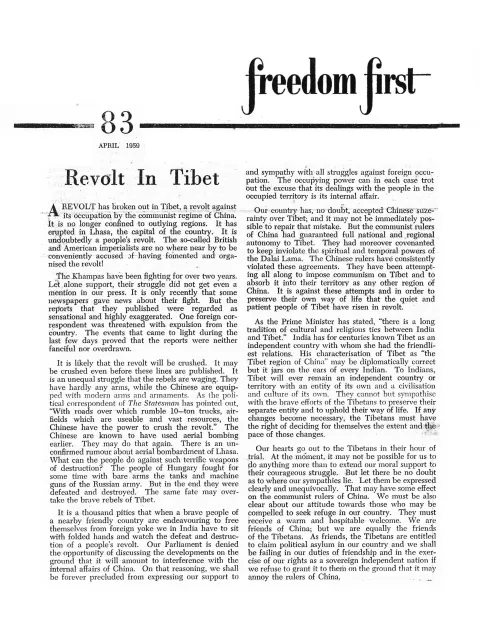
periodical issue
Freedom First
Edited by V. B. Karnik and printed at Inland Printers, 55 Gamdevi Road, Bombay 7 and published for the Democratic Research Service by B. K. Desai at 127 Mahatma Gandhi Road, Bombay 1 · Bombay · 1959
12 pages
Freedom First
Summary
Freedom First No. 84 (May 1959) is a monthly issue of the Bombay-based classical-liberal periodical edited by V. B. Karnik. The issue is dominated by the Tibetan crisis following the Dalai Lama’s flight to India in March 1959: multiple pieces attack China’s conduct under Panchsheel, defend India’s grant of asylum, and excoriate the Communist Party of India (CPI) for echoing Peking’s line. Contributors include V. B. Karnik on Panchsheel and Tibet, S. R. Mohan Das on the CPI’s history of subservience to Moscow/Peking, and unsigned correspondent reports on a Calcutta ‘Afro-Asian Solidarity’ front conference and on internal disarray in the Bombay Communist Party. The issue also carries comparative pieces critical of Soviet- and Nagpur-style agricultural collectivisation (M. A. Venkata Rao’s ‘Green Against Red’ and S. Kabysh’s factual survey of Soviet kolkhozes), an item on political prisoners in the USSR, an interview with Algerian nationalist leader Messali Hadj reproduced from The New Leader, and a closing miscellany of press quotations (‘With Many Voices’) on the Tibet question.
Key points
-
V. B. Karnik’s “Panchsheel And Tibet” argues the 1954 treaty was “born in sin” since India accepted Chinese suzerainty over Tibet in exchange for autonomy guarantees China had already broken, and warns Chinese ambition may extend to Nepal, Bhutan, Sikkim and Kashmir border areas.
-
A Committee for Solidarity with Tibet statement welcomes the Government of India’s asylum for the Dalai Lama, rejects Chinese claims he was abducted, and concludes independence, not autonomy, is the only solution.
-
Notes describe a deliberate, government-directed Chinese propaganda campaign against India over Tibet naming Indira Gandhi among its targets, and use Kerala’s new restrictive Education Act rules as evidence that communists in power become authoritarian regardless of their opposition-era conduct.
-
An unsigned correspondent’s report on the Bombay City Conference of the Communist Party documents falling membership and declining sales of its Marathi weekly Yugantar, alongside heated internal debate over the Nagy execution.
-
M. A. Venkata Rao’s “Green Against Red” contrasts Europe’s peasant-smallholder “Green” revolutionary tradition, exemplified by Denmark’s cooperative movement, with Leninist “Red” collectivism, arguing the Nagpur resolution abandons India’s earlier promise of smallholder land reform for a coercive Soviet-style path.
-
An unsigned correspondent’s account of the Calcutta Afro-Asian Solidarity conference describes non-communist delegates narrowly forcing the word “Tibet” into a resolution on imperialism over CPI objections, with the Women’s Conference session reportedly surrounded by male delegates to block a Tibet resolution.
-
S. R. Mohan Das argues the CPI’s Peking-aligned response to the Tibet crisis is consistent with its history as “an international conspiratorial movement,” tracing its support for Pakistan’s partition demand and its lockstep endorsement of every Kremlin policy shift.
-
Mironenko rebuts Khrushchev’s Twenty-first Congress claim that there are no Soviet political prisoners, showing the 1953, 1955 and 1957 amnesties each excluded key political-offence articles and estimating over a million political prisoners remain of the roughly five million at Stalin’s death.
-
Sal Tas’s interview with newly freed Algerian nationalist Messali Hadj has him criticising the FLN as externally financed and proposing an independent Algeria in a Commonwealth-style “France-Maghreb” community, while S. Kabysh’s factual survey documents rising compulsory work-day quotas on Soviet kolkhozes.
Essays
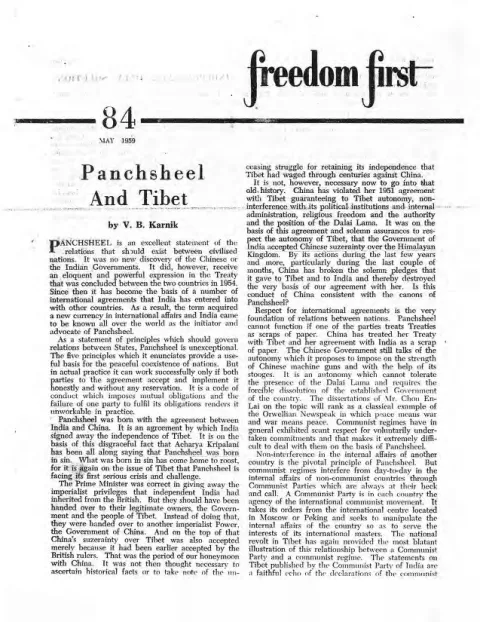
Panchsheel And Tibet
By V. B. Karnik
V. B. Karnik argues that Panchsheel, though sound in principle, was ‘born in sin’ because it rested on India’s 1954 acceptance of Chinese suzerainty over Tibet in exchange for a promise of Tibetan autonomy that China had already violated by 1959. He contends China’s suppression of the Tibetan revolt and dissolution of the Dalai Lama’s government make a mockery of non-interference, and that communist regimes are structurally incapable of honouring such agreements because local Communist Parties always answer to Moscow or Peking. He calls for continued Indian sympathy and material support for Tibetans despite the risk to Sino-Indian relations, and flags the wider threat to India’s Himalayan frontier (Nepal, Bhutan, Sikkim, the McMohan Line).
- Panchsheel was concluded in the 1954 Sino-Indian treaty in which India recognised Chinese suzerainty over Tibet in exchange for guarantees of Tibetan autonomy.
- China’s 1959 crackdown in Tibet is presented as a clear breach of the 1951 Sino-Tibetan agreement and the 1954 Panchsheel treaty.
- The author holds that Panchsheel binds only non-communist parties in practice, since communist regimes interfere in other states through their local Communist Parties.
- Acharya Kripalani’s charge that Panchsheel was ‘born in sin’ is endorsed by the author.
- India’s sympathy for Tibetan refugees is framed as natural given cultural, religious and border ties, while India’s own restraint (non-interference) is affirmed.
- The essay warns that Chinese ambitions may extend to Nepal, Bhutan, Sikkim and Kashmir border areas.
Independence, Only Solution
By The Committee for Solidarity with Tibet
An unsigned statement issued by the Committee for Solidarity with Tibet, welcoming the Government of India’s grant of asylum to the Dalai Lama and rebutting Chinese and Panchen Lama claims that the Dalai Lama was abducted or acting under duress. It argues the 1951 seventeen-point treaty was signed under duress and never honoured, concludes that full independence is the only solution consistent with Tibetan aspirations, and calls on India and other Asian nations to raise Tibet’s cause at the United Nations.
- The Committee praises the Government of India’s decision to grant asylum to the Dalai Lama and hopes no undue restrictions will be placed on him.
- It rejects Chinese/Panchen Lama claims that the Dalai Lama was abducted or coerced by rebels, citing his own statements at Tejpur and Mussoorie.
- It calls the Panchen Lama’s charge of Indian ‘expansionist ambitions’ a gross libel.
- It concludes the 1951 Sino-Tibetan treaty was signed under duress and its autonomy pledge was never honoured by China.
- It states independence, not autonomy, is the only solution and urges India to raise Tibet’s cause at the United Nations.
Notes (Chinese Campaign; Communists In Power)
This unsigned ‘Notes’ column comprises two items. ‘Chinese Campaign’ describes a deliberate, government-directed Chinese propaganda campaign against India over Tibet, naming Indira Gandhi and Vijayalakshmi Pandit among Indian leaders attacked by Chinese media and officials, and notes some Indian communists echoing Peking’s line. ‘Communists In Power’ uses new restrictive Kerala Education Act rules on students and teachers as an illustration of the general thesis that communists in power become the worst reactionaries and bureaucrats, regardless of their behaviour in opposition.
- Communist China’s propaganda campaign against India over Tibet is described as deliberate and government-orchestrated, involving Peking Radio, the New China News Agency, and named political leaders.
- Indian leaders named as targets of Chinese attacks include the Congress President, Mrs. Indira Gandhi, and Mrs. Vijayalakshmi Pandit.
- The Panchen Lama is described as a ‘puppet ruler’ installed by China in place of the Dalai Lama.
- The Kerala communist Ministry’s new Education Act rules restrict student and teacher political activity, illustrating the essay’s claim that communists in power become authoritarian.
- The CPI General Secretary, Ajoy Ghosh, is quoted admitting the Kerala rules were a ‘mistake’.
Crisis In The Communist Party
By (From A Correspondent)
A correspondent’s report on the Bombay City Conference of the Communist Party held the previous month, describing chronic organisational decline: falling active membership (from 2112 to 1960, with only 1660 paying dues), declining sales of the party’s Marathi weekly Yugantar, and growing ideological apathy among cadres. The report covers heated internal debate over the secret trial and execution of Imre Nagy, criticism of communist councillors S. S. Mirajkar and B. S. Dhume for poor performance in the Bombay Municipal Corporation, and the party’s charge that ‘right-wing’ PSP elements led by Asoka Mehta sympathisers obstructed progressive measures within the Samyukta Maharashtra Samiti.
- Bombay Communist Party membership fell from 2112 to 1960 (with only 1660 paying dues), reflecting declining organisational discipline.
- The party’s Marathi weekly Yugantar’s circulation dropped from 1300 to under 1200 copies a week.
- Delegates debated the secret trial and execution of Imre Nagy following the Hungarian uprising, with some demanding the CPI leadership condemn it.
- The Bombay Committee was criticised by the Central Executive for expressing views on Nagy before the Central Executive had set a party line.
- Communist councillors S. S. Mirajkar and B. S. Dhume were criticised for the party’s unsatisfactory record in the Bombay Municipal Corporation.
- The report accuses the ‘Ashok group’ inside the Bombay PSP of sabotaging unity within the Samyukta Maharashtra Samiti.
Green Against Red
By M. A. Venkata Rao
M. A. Venkata Rao surveys the early-twentieth-century European ‘Green’ (small-holder, peasant-based) revolutionary tradition — in Czechoslovakia under Masaryk, Hungary, Yugoslavia, and pre-revolutionary Russian populism — contrasting it with the ‘Red’ Leninist-Bolshevik trend that ultimately subordinated peasant aspirations to collectivisation. He argues the Green Revolution succeeded in Western Europe, especially Denmark, through smallholding plus cooperative structures, while it was crushed in Eastern Europe by Soviet-imposed collectivisation after 1945, which briefly collapsed in Poland and Hungary in 1956. Applying this frame to India, he argues Nehru’s Nagpur resolution on agricultural cooperation abandons the government’s earlier promise of a Green, smallholder-based land reform in favour of a coercive, Soviet-style collectivist ‘Red’ path, which he says forfeits the benefits of both individual freedom and technology.
- The essay frames a global ‘Green’ (peasant smallholder) versus ‘Red’ (Leninist collectivist) revolutionary contest across Central/Southeast Europe, Russia, and Denmark.
- The Czechs under Masaryk, Hungarians, and Yugoslavs are cited as national movements that fused smallholder land reform with cultural and literary revival.
- Lenin and Bolshevik social democrats are said to have viewed the independent peasant as an ‘incorrigible capitalist’ unsuited to collectivised agriculture.
- Denmark is presented as the clearest success of the Green Revolution, combining smallholding, cooperative societies, and the Folk High School educational movement.
- The Nagpur resolution’s ‘agricultural organisation pattern’ is characterised as a decisive and irreversible shift of India’s land economy toward Soviet-style collectivism.
- The author warns India risks repeating the Eastern European tragedy, but under compulsion of a ‘voluntarily accepted ideology’ rather than foreign troops.
A Front Conference In Calcutta
By (From A Correspondent)
A correspondent’s account of the Indian Conference of Afro-Asian Solidarity held in Calcutta in April 1959, describing it as a communist-dominated ‘front’ organisation managed by Romesh Chandra and packed with fellow-travelling delegates. The report focuses on repeated procedural battles over the ‘Tibetan nuisance’: an amendment to include Tibet in a resolution on imperialism and colonialism was fiercely, though narrowly, carried by a small group of non-communist delegates over communist objections, and the conference’s Women’s session was reportedly surrounded by male delegates to prevent a Tibet resolution from being introduced.
- The Indian Conference of Afro-Asian Solidarity in Calcutta was organised by Romesh Chandra and packed with communist and fellow-travelling delegates.
- A dozen non-communist delegates fought to include the word ‘Tibet’ in the conference’s resolution on imperialism and colonialism, against organiser resistance.
- The CPI reportedly objected to any resolution on Tibet at all; an agreed resolution referencing the 1951 Sino-Tibetan Agreement was eventually passed.
- Some Congress leaders, including Mayor Dr. Triguna Sen and President Rameshwari Nehru, were obliged to reference Tibet despite conference organisers’ reluctance.
- Pro-Tibet leaflets and posters circulated throughout Calcutta during the conference, leading to scuffles.
- The Women’s Conference session was allegedly surrounded by male delegates to stop a resolution on Tibet being introduced.
Tibet And Indian Communists
By S. R. Mohan Das
S. R. Mohan Das argues that the CPI’s delayed, fully Peking-aligned response to the Tibet crisis is entirely consistent with its history as an ‘international conspiratorial movement’ rather than a genuine political party. He traces this pattern through the CPI’s support for Pakistan’s partition demand in the 1940s, its denial of India’s 1947 independence under the Zhdanov line, its Telangana insurrection, and its lockstep endorsement of every Kremlin and Peking line shift (Hungary, de-Stalinisation, the fall of Malenkov/Molotov/Bulganin/Zhukov). He singles out the CPI’s borrowed ‘anti-imperialist’ framing of Tibet as feudal liberation, and criticises Indira Gandhi for echoing this line, while citing communist Anna Louise Strong’s argument that China needs Tibet’s water resources as a shield against nuclear attack.
- Mohan Das argues the CPI is ‘not a political party’ but an international conspiratorial movement serving Moscow/Peking interests.
- The CPI supported the Muslim League’s partition demand in the 1940s despite its anti-dismemberment stance elsewhere.
- The CPI denied India had achieved real independence in 1947, following the Zhdanov line, and subsequently launched the Telangana uprising.
- The essay lists the CPI’s uncritical endorsement of every Soviet leadership and policy shift: Hungary, Stalin’s denigration, Beria’s execution, and the ousting of Malenkov, Molotov, Bulganin, and Zhukov.
- Mrs. Indira Gandhi is criticised for echoing the communist framing of Tibet’s ‘feudal burden’ needing to be lifted by China.
- American communist Anna Louise Strong is quoted arguing China’s control of Tibet’s water sources is a strategic necessity against nuclear-armed rivals.
Are There Political Prisoners In USSR?
By Mironenko
Mironenko rebuts Khrushchev’s 1959 claim, made at the Twenty-first Congress and reported in Pravda, that there are no political prisoners in the USSR. The essay shows Soviet law simply relabels political offences as ‘counter-revolutionary’ or ‘especially dangerous state crimes,’ and reviews the 1953, 1955, and 1957 Soviet amnesties in detail to show that each systematically excluded prisoners convicted under the harshest political-offence articles (58-1a, 58-1c, 58-1d, and others). It estimates that although Stalin’s death in 1953 left roughly five million political prisoners in the USSR, more than one million remain in confinement after the three amnesties.
- Khrushchev’s Twenty-first Congress claim (reported in Pravda, January 28, 1959) that there are no political prisoners in the USSR is challenged as false.
- Soviet law relabels political crimes as ‘counter-revolutionary’ or ‘especially dangerous state crimes’ under the December 1958 statute, which the essay treats as evasive terminology rather than a substantive change.
- The 1953, 1955, and 1957 amnesties are each shown to have excluded prisoners convicted under key political articles (58-1a, 58-1c, 58-1d, and others).
- 300 students were convicted in 1957 for freely speaking with foreign students at the International Youth Congress in Moscow, offered as evidence political prosecutions continue.
- The essay estimates that of roughly five million political prisoners at the time of Stalin’s death in 1953, more than one million remain in confinement.
The Other Algeria
By Sal Tas
Sal Tas’s interview (reproduced from The New Leader) with Messali Hadj, the veteran Algerian nationalist leader recently freed under President de Gaulle’s amnesty after decades in exile and French prisons. Messali Hadj, founder of the Algerian Nationalist Movement (MNA) and longtime rival of the FLN, expresses cautious optimism about de Gaulle’s course, criticises the FLN as heterogeneous, externally financed, and lacking real leadership, and proposes an independent Algeria in close, Commonwealth-style association with France (a ‘France-Maghreb’ community) rather than the FLN’s revolutionary path.
- Messali Hadj, founder of Algerian nationalism, was freed after 40 years in exile and 25 years in French prisons under de Gaulle’s amnesty.
- He broke with the FLN, which grew out of a split within the nationalist movement he had built, and describes years of violent rivalry between the FLN and his own MNA.
- He characterises the FLN as ideologically heterogeneous, without a real chief, and dependent on external backers (Cairo, Moscow) who will ‘present the bill’ later.
- He proposes an independent Algeria collaborating closely with France within a Commonwealth-style ‘France-Maghreb’ community, alongside a round-table conference including the FLN.
- He calls de Gaulle’s pardon of 200 condemned rebels and release of thousands of prisoners a major, trust-building step, contrasting it with the Fourth Republic’s inaction.
Facts About Collective Farms In USSR
By S. Kabysh
S. Kabysh presents a detailed factual account of Soviet kolkhoz (collective farm) regulation from 1935 through 1957-58, tracing successive Central Committee and Council of People’s Commissars resolutions on compulsory work-day minimums, individual plot sizes, and wage systems, and citing statistics on the roughly 78,200 kolkhozes existing by late 1957, their average size, livestock, and income. The essay documents rising compulsory work-day quotas, punitive confiscation of private plots and livestock rights for rule violations, and the gradual, still-incomplete shift toward guaranteed monetary wages in place of piece-work payment.
- Kolkhoz regulations were first codified in February 1935 and repeatedly revised (1939, 1942, 1956) to raise compulsory work-day minimums for kolkhozniks.
- Individual plot sizes were capped at up to 0.25 hectares in recent years, with yields varying by region and climate.
- By late 1957 there were about 78,200 kolkhozes in the USSR, averaging 245 households and 1,695 hectares of communal land each.
- Wage rates per work-day unit varied significantly by region and crop type, with industrial-crop kolkhozes paying more.
- Since 1957 several kolkhozes have shifted to guaranteed monthly wages instead of piece-work payment, a trend the Party and government are said to be encouraging.
- Kolkhoz statutes permit fines and confiscation of private plots or livestock rights as punishment for rule violations.
With Many Voices
A closing miscellany of short press quotations from Indian and international newspapers (Indian Express, Amrita Bazar Patrika, Hindustan Times, Time Magazine, Free Press Journal, Swarajya, Mysindia) and public figures, including Cambodia’s Prince Norodom Sihanouk, all commenting on the Sino-Indian rift over Tibet, the credibility of Panchsheel, and the political character of the CPI, framed under an epigraph from Tennyson.
- Indian Express columnist D. R. Mankekar urges trust in Panchsheel while keeping ‘powder dry’ as the basic tenet of Indian foreign policy.
- Amrita Bazar Patrika declares India’s ‘honeymoon’ with China over and says a divorce must be prevented.
- Time Magazine predicts Tibet may become ‘Red China’s Algeria,’ a war that can be neither won nor lost.
- Prince Norodom Sihanouk of Cambodia is quoted on the limits of his country’s coexistence with China as a neighbour.
- Free Press Journal questions whether the CPI is patriotic, concluding it is ‘certainly not very intelligent.’
Generated by the v1.5 extraction pipeline. Awaiting editorial review.
Metadata and summary are AI-extracted from the source PDF and reviewed for editorial accuracy. The original work is available via the Read PDF tab above (where present); paragraph-level citation inside the PDF is deferred to a future engagement.