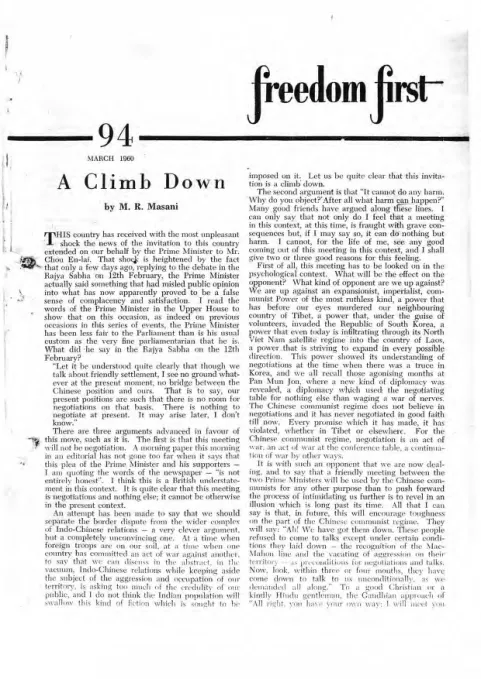
periodical issue
Freedom First
By V. B. Karnik, B. K. Desai, S. R. Mohan Das, S. P. Aiyar, B. K. Desai, Aziz Madni
published for the Democratic Research Service by B. K. Desai at 127 Mahatma Gandhi Road, Bombay 1 · Bombay · 1959
12 pages
Freedom First
Summary
This is issue No. 90 (November 1959) of Freedom First, the monthly journal of the Forum of Free Enterprise, edited by V. B. Karnik and published for the Democratic Research Service by B. K. Desai. The issue opens with Karnik’s lead essay urging the Praja Socialist Party, marking its silver jubilee, to abandon Marxist-tinged class politics and rigid socialist doctrine in favour of a broader, welfare-oriented national movement. An unsigned “Notes” section comments on Khrushchev’s U.S. visit, hostile Chinese conduct on the Ladakh/NEFA border (approvingly citing Nehru and reprinting a Hindustan Times editorial attacking V. K. Krishna Menon’s UN stance on Tibet), factional disputes among Kerala’s democratic parties, and the successful conclusion of India-Pakistan border talks. B. K. Desai analyses the Conservative Party’s decisive 1959 British election win as evidence that voters in an affluent, changed Britain have rejected doctrinaire socialism. S. R. Mohan Das examines how India’s “feudal-paternalistic” industrialising elite is likely to distort the labour movement under the Third Five-Year Plan, restricting trade unions to welfare functions rather than collective bargaining. S. P. Aiyar argues that democratic planning requires far more vigorous public information machinery, criticising the poor distribution of government publications and proposing concrete reforms (regional information services, a parliamentary research bureau, cabinet-rank status for the Information Minister). A Review section carries B. K. Desai’s appreciative review of Tibor Meray’s book on Imre Nagy and the 1956 Hungarian Revolution, and Aziz Madni’s review of R. H. S. Crossman’s The Charm of Politics. The issue closes with “With Many Voices,” a compilation of press quotations (mostly critical of Krishna Menon and the government’s China policy) attributed to various Indian politicians, editors and commentators, followed by the masthead/registration details.
Key points
-
V. B. Karnik’s “The Choice Before Praja Socialists” marks the PSP’s silver jubilee by urging it to abandon class politics and rigid socialist doctrine, invoking M. N. Roy’s dictum that the real choice is “between communism…and democracy,” not shades of socialism.
-
Notes voice scepticism that Khrushchev’s US visit will ease Cold War tensions, reprint a Hindustan Times editorial condemning Krishna Menon’s UN conduct on Tibet as “appeasement, craven, humiliating, wicked,” and report nine Indian policemen killed in a Chinese action in Ladakh.
-
B. K. Desai’s “The Significance Of Labour Defeat” reads the Conservatives’ decisive 1959 British election win as a rejection of doctrinaire socialism amid rising worker prosperity, contrasting Britain’s stagnation under nationalisation with West Germany’s free-enterprise prosperity.
-
S. R. Mohan Das’s “Labour And The Third Five-Year Plan” characterises India’s industrialising elite as “feudal and paternalistic,” warning trade unions risk being confined to welfare functions rather than genuine collective bargaining under the new Plan.
-
S. P. Aiyar’s “Democratic Planning And Publicity” criticises poor distribution of government publications and cites the Mundhra shares episode as symptomatic of unaccountable administration, proposing reforms including a parliamentary research bureau and cabinet rank for the Information Minister.
-
B. K. Desai reviews Tibor Meray’s account of Imre Nagy and the Hungarian Revolution, portraying Nagy as a tragic reform communist who “preferred death for his convictions,” while Aziz Madni reviews R. H. S. Crossman’s The Charm of Politics.
-
The closing “With Many Voices” quotes C. Rajagopalachari calling the UN’s handling of Tibet “indistinguishable from abetment of oppression” and R. K. Karanjia’s effusive praise of Krishna Menon.
Essays
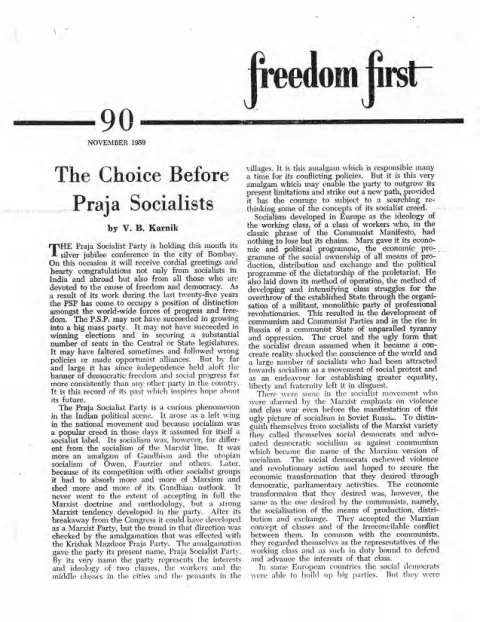
The Choice Before Praja Socialists
By V. B. Karnik
V. B. Karnik marks the Praja Socialist Party’s silver jubilee conference in Bombay by tracing its ideological drift from a Gandhian-utopian amalgam toward absorbing more Marxist elements, and argues that the party now faces a fundamental choice. He contends that doctrinaire socialism (nationalisation, class-based appeal) has lost its relevance in an era of rising worker prosperity and cites M. N. Roy’s formulation that the real political choice is between communism and democracy, not between varieties of socialism. Karnik urges the PSP to abandon class politics and rigid socialist creed in favour of becoming a broad people’s organisation emphasising democratic freedom, individual initiative and rational cooperative endeavour.
- The PSP’s socialism originated as an amalgam of Gandhism and utopian socialism (Owen, Fourier), later absorbing more Marxism.
- Karnik argues democratic/social-democratic socialism and communism share the same socio-economic theory and often the same programme of socialising production, distribution and exchange.
- He invokes M. N. Roy’s dictum that the real choice is ‘between communism (or socialism) and democracy,’ not between red and pink socialism.
- Capitalism in advanced countries has changed radically, giving workers a stake in society, undermining the socialist class-appeal concept.
- The British Labour Party’s electoral defeat is cited as a lesson for Indian socialists.
- Karnik urges the PSP to abandon class-party politics and instead organise as a national people’s movement centred on democratic freedom and individual initiative.
Notes
This unsigned editorial ‘Notes’ section covers several current-affairs topics: Khrushchev’s visit to the United States (skeptical about its likely impact on Cold War tensions and Soviet satellite states); a sharply critical piece on China’s ‘hostile and arrogant’ border conduct, endorsing Nehru’s position that negotiations must start from acceptance of the McMahon Line and criticising Chinese incursions into Ladakh and NEFA, including a deadly incident involving Indian policemen; a reprint of a Hindustan Times editorial titled ‘Degrading’ that condemns V. K. Krishna Menon’s conduct at the UN on the Tibet issue as craven appeasement; a note on democratic party disputes over seat allocation in Kerala, endorsing Mannath Padmanabhan’s proposal to select the best candidate irrespective of party label, and praising the Swatantra Party’s decision to stay out of the race; and a note welcoming the successful conclusion of India-Pakistan border talks and citing Pakistani President Ayub Khan’s call for joint defence arrangements.
- Skepticism that Khrushchev’s US visit will produce progress on major Cold War issues, though it may ease tensions somewhat.
- Strong criticism of Chinese ‘hostile and arrogant’ behaviour on the India-China border, alleging continued occupation of Ladakh and NEFA territory.
- Insistence that any border negotiations must begin from acceptance of the McMahon Line, with no discussion of its ‘existence or validity.’
- Reprints and endorses a Hindustan Times editorial (‘Degrading’) attacking Krishna Menon’s UN performance on Tibet as ‘appeasement, craven, humiliating, wicked.’
- Reports a deadly Chinese action in Ladakh resulting in the deaths of nine Indian policemen and the kidnapping of ten.
- Comments favourably on Mannath Padmanabhan’s proposal for cross-party seat allocation in Kerala to strengthen the anti-communist front.
- Welcomes the peaceful settlement of India-Pakistan border disputes and cites Ayub Khan’s call for joint defence cooperation.
The Significance Of Labour Defeat
By B. K. Desai
B. K. Desai analyses the British Conservative Party’s decisive 1959 general election victory as reflecting a broader popular rejection of doctrinaire socialism rather than merely a Conservative policy endorsement. He notes the Liberal Party’s surprising vote gains partly at Labour’s expense, and argues that post-war capitalism’s transformation—rising worker prosperity, greater social mobility, and the erosion of rigid class categories—has made the socialist ‘class concept’ outdated. Desai contrasts Britain’s stagnation under nationalisation with West Germany’s prosperity under free enterprise, and concludes that Labour must fundamentally reappraise its doctrine if it is to remain relevant, since British voters want ‘not socialism, but a progressive radical party less extreme than Labour.’
- The Conservatives won a third successive term with an increased majority, exceeding forecasts.
- The Liberal Party more than doubled its votes, apparently drawing support from Labour.
- Desai argues the result reflects definite popular rejection of Labour’s socialist programme, not just endorsement of Conservative policy.
- Rising working-class prosperity and social mobility have undermined the socialist ‘class concept’ and its appeal.
- West Germany’s free-enterprise-driven prosperity is contrasted favourably with Britain’s stagnation under nationalisation policies.
- Desai concludes British voters want a ‘progressive radical party less extreme than Labour,’ not socialism.
Labour And The Third Five-Year Plan
By S. R. Mohan Das
S. R. Mohan Das surveys how the massive proposed investment of the Third Five-Year Plan (Rs. 10,000 crores) will pressure India’s labour movement. He argues India’s ‘industrialising elite’ is ‘feudal and paternalistic,’ treating workers as ‘wards’ incapable of managing their own affairs — an attitude shared across Indian political groups (except Marxist parties) and embodied in the Trusteeship theory and ‘worker-participation in management’ concepts. He warns that under the new Plan, trade unions risk being confined to welfare and cooperative activities rather than genuine collective bargaining, citing Union Minister Gulzarilal Nanda’s 1956 INTUC speech that collective bargaining is valid only for a ‘capitalist society.’ The essay (continued on page 9, seen in full) further discusses the growing role of the State and public-sector employers in shaping the labour movement, and warns that the movement risks becoming ‘a distorted form… of State and party machines’ unless workers themselves resist this drift, concluding that ‘Labour needs its own Five-Year Plans to reject emancipation by proxies.’
- India’s industrialising elite is characterised as ‘feudal and paternalistic,’ treating workers as wards not capable of deciding what is good for them.
- All political groups in India except Marxist parties have accepted the paternalistic Trusteeship theory and worker-participation-in-management ideas.
- Union Minister Gulzarilal Nanda’s 1956 INTUC speech declared collective bargaining valid only for a ‘capitalist society,’ signalling a shift away from it under socialist planning.
- New ‘socialistic concepts’ (worker-directors, worker-management councils) aim to restrict unions to welfare, cooperative and productivity-boosting roles rather than adversarial bargaining.
- The growth of State-owned Public Sector industries as the largest employer is set to further shape (and constrain) the character of Indian trade unionism.
- Mohan Das warns the labour movement risks becoming a ‘distorted form’ serving as an instrument of State and party machines rather than workers’ own organisation.
- He concludes that labour must develop its own independent five-year planning to avoid ‘emancipation by proxies.‘
Democratic Planning And Publicity
By S. P. Aiyar
S. P. Aiyar argues that the theoretical debate over whether planning is compatible with democracy is settled, but that nation-wide planning inevitably increases state power, making it vital to keep the public genuinely informed. He surveys positive developments (university and press engagement with the Draft Plans) but criticises severe institutional failures in publicity: government publications are poorly distributed, the O&M administrative reform unit has achieved little, Parliamentary oversight of public enterprises is weak, and official reports are misleading through ‘suppressio veri’ — citing the Ministry of Transport and Communications’ 1955-56 report failing to mention Indian Airlines Corporation’s losses, and the ‘ugly episode of the Mundhra shares’ as symptomatic of unaccountable administrative ‘twilight regions.’ He closes with five concrete proposals (regional Information Service branches, a Lok Sabha Research Bureau, cabinet rank for the Information Minister, etc.), warning that without vigorous public education ‘freedom and democratic planning will be futile and public participation will be a sham’ and the ‘Phantom Public’ will persist.
- Aiyar considers the ‘planning vs. democracy’ debate essentially settled but stresses that planning inherently centralises state power, requiring strong constitutional safeguards.
- Universities, the press and pressure groups engaged substantially with the First and Second Five-Year Plan drafts, a positive sign for the Third Plan.
- Government publicity machinery is criticised as ineffective: Publications Division branches exist but are little known or used, even by teachers and university staff.
- The Estimates Committee reportedly found the O&M (Organisation and Methods) unit within the Planning Commission has done ‘nothing’ despite being tasked with administrative streamlining.
- Official reports are accused of ‘suppressio veri’ — e.g., the Ministry of Transport and Communications’ 1955-56 report omitting Indian Airlines Corporation’s substantial losses.
- The ‘Mundhra shares’ episode is cited as an index of the ‘complete absence of responsibility’ in administration.
- Aiyar proposes five specific reforms: city-level Information Service branches, a Lok Sabha-style parliamentary research bureau, cabinet rank for the Minister for Information and Broadcasting, and University Grants Commission coordination on research access.
- He warns that without public education, ‘all talk of freedom and democratic planning will be futile and public participation will be a sham.‘
Review: Thirteen Days that Shook the Kremlin (Imre Nagy and the Hungarian Revolution by Tibor Meray)
By B. R. Shenoy
This is the volume’s Review section, containing two book reviews. B. K. Desai reviews Tibor Meray’s ‘Imre Nagy and the Hungarian Revolution’ (Fredrick A. Praeger, New York), praising it as a sympathetic yet dispassionate account of Nagy’s tragic role in the thirteen days of the 1956 Hungarian Revolution. Desai details Nagy’s rise as a reform communist trusted by the people for his clean record and liberal 1953 tenure, his inability to control the Party apparatus or satisfy the pace of popular demands once installed as Premier, and his eventual failure and death for refusing to confess or recant. Separately, Aziz Madni reviews R. H. S. Crossman’s ‘The Charm of Politics’ (Hamish Hamilton, London), a collection of some thirty essays on political personalities and techniques, praising Crossman’s intellectual depth and insight while noting the book’s limits as a practical ‘guide to success in politics’ given Crossman’s own overly intellectual approach to power.
- Desai’s review covers Tibor Meray’s ‘Imre Nagy and the Hungarian Revolution’ (Praeger, $5.00, 290pp), written by a journalist who was Nagy’s close associate.
- Nagy is portrayed as a tragic figure: reinstated by popular pressure just before the Revolution but never able to control the Communist Party apparatus.
- Nagy’s initial inability to purge Stalinists and his intra-party manoeuvring frustrated a populace demanding a multi-party government and Soviet troop withdrawal.
- Nagy remained a confirmed Marxist-Leninist to the end, refusing to recant despite Soviet pressure during his internment, and ‘preferred death for his convictions.’
- Aziz Madni’s review of Crossman’s ‘The Charm of Politics’ praises its intellectual depth on around thirty political personalities but argues it is not a practical guide to political success, given Crossman’s own admitted lack of ruthlessness as a politician.
Review: The Charm of Politics (by R. H. S. Crossman)
By Aziz Madni
“With Many Voices” is a compilation of short press quotations from October 1959, mostly criticising V. K. Krishna Menon’s handling of the Tibet question at the UN and the government’s China policy, alongside a few quotations on other topics (Moscow’s atmosphere, Christianity in Russia, the Swatantra Party’s press impact). Contributors quoted include H. V. Kamath, the Indian Express, V. R. Krishna Iyer, S. A. Dange, C. Rajagopalachari, R. K. Karanjia, and Dr. K. Shridharani, among others, drawn from papers such as Current, Indian Express, Hindustan Times, Thought, Times of India, Amrita Bazar Patrika, and the Newsletter of the Congress for Cultural Freedom. The final visible column is cut off but continues criticism of Krishna Menon’s UN role. The page ends with the issue’s registration number and the masthead crediting V. B. Karnik as editor, printing at Inland Printers (Bombay), and publication for the Democratic Research Service by B. K. Desai.
- A compilation of ~15 short press quotations from October 1959 sources, mostly critical of Krishna Menon and Chinese/Indian border diplomacy.
- C. Rajagopalachari is quoted calling the UN handling of the Tibet question ‘indistinguishable from abetment of oppression.’
- S. A. Dange (Communist Group leader in Parliament) is quoted urging his ‘Communist Party friends in China’ to realise they are ‘pursuing a wrong line.’
- Gandhi is quoted (from 1946, via Louis Fischer) stating ‘Socialism is either dictatorship or arm-chair philosophy.’
- R. K. Karanjia’s open letter to Nehru praises Krishna Menon effusively as reflecting ‘your brilliant mind and noble heart in action.’
- Dr. K. Shridharani’s Amrita Bazar Patrika columns are quoted on economic ‘glorified shopkeepers’ and on the Swatantra Party ‘stealing newspaper space’ from Congress.
- The issue closes with registration number B-6354 and full masthead/publication credits.
Generated by the v1.5 extraction pipeline. Awaiting editorial review.
Metadata and summary are AI-extracted from the source PDF and reviewed for editorial accuracy. The original work is available via the Read PDF tab above (where present); paragraph-level citation inside the PDF is deferred to a future engagement.