periodical issue
Freedom First
By S. Sharangpani, G. L. Jain, Adam Adil, Dr. Miklos Tiszay, Raman Desai
Edited by V. B. Karnik and printed at Indian Printers, 55 Gamdevi Road, Bombay 7 and published for the Democratic Research Service ... 127, Mahatma Gandhi Road, Bombay 1 · Bombay · 1960
12 pages
Freedom First
Summary
Freedom First No. 96 (May 1960) is a monthly issue of the Bombay-based classical-liberal periodical, edited by V. B. Karnik and published for the Democratic Research Service. This issue’s argumentative center is anti-communism read through a series of contemporaneous international crises: the breakdown of the Nehru-Zhou Enlai border talks and the case for a harder Indian line on China; the Dalai Lama’s message to the Afro-Asian Convention on Tibet and G. L. Jain’s report on that convention; a report on apartheid-era repression in South Africa following the Sharpeville massacre; and pieces charting communism’s setbacks in Iraq and the human costs of Communist rule in Hungary (forced abortion policy) and Tibet. Shorter editorial ‘Notes’ cover Indian defence procurement scandals, press repression in Turkey, Syngman Rhee’s resignation in South Korea, and the peaceful creation of Maharashtra and Gujarat as linguistic states. The issue closes with ‘With Many Voices,’ a digest of press commentary from Indian and international papers, and a subscription notice.
Key points
-
V. B. Karnik’s “What Next?” argues the Nehru-Zhou Enlai talks failed because India demanded vacation of aggression while China denied any had occurred, proposing India consider severing diplomatic relations with China as a form of Gandhian non-cooperation.
-
Notes criticise Defence Minister Krishna Menon over the “jeep scandal” and 8,500 vehicles left to deteriorate for want of cover, and report the Menderes government’s crackdown on the press and opposition Republican Party in Turkey.
-
Further notes assess Syngman Rhee’s resignation after mass protests over electoral manipulation, and welcome the peaceful bifurcation of Bombay State into Maharashtra and Gujarat on 1 May.
-
The Dalai Lama’s message to the Afro-Asian Convention on Tibet describes Chinese policy as pursuing “extermination of religion and culture,” citing five million Chinese settlers already arrived in Eastern and North-Eastern Tibet with four million more planned.
-
S. Sharangpani’s “Crisis In South Africa” traces the Pass Laws as the immediate provocation for the Sharpeville shooting of 21 March 1960 and warns government intransigence is radicalising Africans toward Pan-Africanist militancy over the ANC’s inter-racial approach.
-
G. L. Jain reports on the Afro-Asian Convention on Tibet in New Delhi, where 89 delegates from 18 countries constituted a permanent Afro-Asian Council under Jayaprakash Narayan, who predicted communism would prove “a temporary aberration of the human mind.”
-
Adam Adil’s “Decline Of Communism In Iraq” credits General Kassem’s tacit encouragement of a rival communist faction and army tolerance of anti-communist riots with restoring confidence among businessmen and minorities who had earlier aligned with communists.
-
Dr. Miklos Tiszay’s “Planned Genocide In Hungary” reports Hungary’s natural population growth collapsed to 0.3 percent annually, attributing this to emigration, executions of freedom fighters, and a state-sanctioned abortion regime under which roughly 150,000 unborn children were aborted.
-
Raman Desai reviews Tibet Fights For Freedom, edited by Raja Hutheesing with a foreword by the Dalai Lama, framing Chinese rule over Tibet and other minority regions as pursuing Han racial conquest “worse than South African apartheid.”
-
The closing “With Many Voices” quotes Finance Minister Morarji Desai rebutting Zhou Enlai’s charge that India abetted the Tibetan revolt, and China’s Red Flag asserting communists must prepare for both peaceful and non-peaceful revolution.
Essays
What Next?
By V. B. Karnik
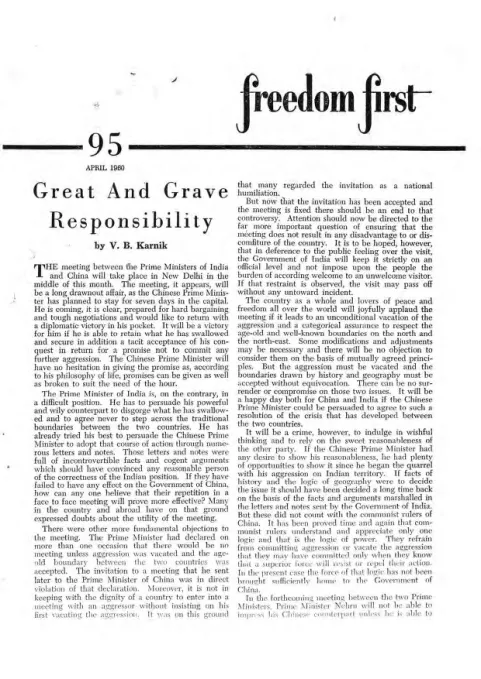
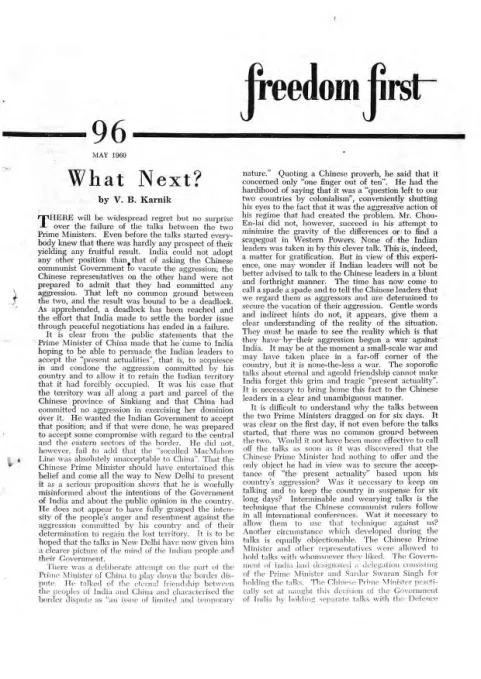
V. B. Karnik’s lead editorial ‘What Next?’ argues that the failure of the Nehru-Zhou Enlai talks on the Sino-Indian border was inevitable, since India could only ask China to vacate its aggression while China refused to admit any aggression had occurred. Karnik contends Zhou Enlai came to New Delhi hoping to secure Indian acquiescence in China’s ‘present actualities’ on the border, and criticizes India’s past softness, including its 1950 abandonment of Tibetan independence and the buffer role Tibet once played. He calls for a blunter Indian posture toward China, including consideration of severing diplomatic relations, framed as a Gandhian form of non-cooperation with an ‘evil-doer.’
- The India-China Prime Ministerial talks failed because there was no common ground: India demanded vacation of aggression, China denied any aggression occurred.
- Zhou Enlai argued the disputed territory was part of Chinese Sinkiang and offered compromise only on the central and eastern sectors, while rejecting the McMahon Line.
- Karnik argues India should stop indulging in ‘unreal talk’ of age-old Sino-Indian friendship and speak to China ‘in a blunt and forthright manner.’
- He criticizes India’s 1950 decision to give away Tibet’s independence and the buffer-state protection it once afforded.
- He proposes that if peaceful talks fail to yield results, India should consider severance of diplomatic relations with China as a form of Gandhian non-cooperation.
- He criticizes the decision to allow separate talks between the Chinese Prime Minister and Defence Minister Krishna Menon outside the official negotiating delegation.
Notes (Defence Scandals; Repression in Turkey)
No summary was extracted for this article. Listed for completeness.
Dr. Rhee’s Resignation
An unsigned editorial note, ‘Defence Scandals,’ criticizes Defence Minister Krishna Menon over the ‘jeep scandal’ settlement and reports of 8,500 vehicles and stores worth Rs. 57 lakhs left to deteriorate for want of cover, arguing Nehru has been unfair to the nation by repeatedly shielding Menon and should transfer the defence portfolio to more competent hands. A second note, ‘Repression in Turkey,’ reports on the Menderes government’s crackdown on the press and the opposition Republican Party ahead of a proposed ‘press police’ bill.
- The Defence Ministry under Krishna Menon is criticized for the ‘jeep scandal’ settlement and for allowing 8,500 vehicles (valued at Rs. 5 crores) and stores worth Rs. 57 lakhs to deteriorate from exposure.
- The Auditor-General’s and Public Accounts Committee’s reports are cited as having repeatedly flagged Defence Department irregularities.
- The note argues Nehru’s continued defence of Krishna Menon is itself a wrong done to the nation and calls for the Defence portfolio to be transferred.
- In Turkey, the ruling Democratic Party under the Menderes government has jailed journalists and editors and is reportedly drafting a bill to create a ‘press police’ empowered to shut down papers for up to fifteen days.
- The Turkish government has also established a Parliamentary Investigation Commission, staffed entirely by the ruling party, to probe the opposition Republican Party led by Ismet Inou, and has banned party political activity for three months.
Maharashtra and Gujarat
Two further unsigned Notes: ‘Dr. Rhee’s Resignation’ assesses the fall of South Korean President Syngman Rhee after mass protests against electoral manipulation and dictatorial tendencies during his last decade in office, framing it as the close of a sorry chapter for the Korean Republic. ‘Maharashtra and Gujarat’ welcomes the peaceful bifurcation of the bilingual Bombay State into the two new linguistic states, crediting a near-unanimous inter-state agreement on border issues and praising Chief Minister Yashvantrao Chavan’s administration while hoping for resolution of remaining Maharashtra-Mysore border questions.
- Syngman Rhee’s resignation is attributed to popular revolt against dictatorial tendencies, electoral manipulation in the March 15 elections, and withdrawal of U.S. sympathy for his regime.
- The note credits Rhee’s earlier leadership in Korea’s 1919 independence movement against Japan while condemning his later authoritarian turn.
- Maharashtra and Gujarat are welcomed as the two new States of the Indian Union, formed from the bifurcation of the bilingual Bombay State effective 1 May.
- The note credits a near-unanimous agreement between the two new states on bifurcation issues and hopes for a similar resolution of the Maharashtra-Mysore border dispute.
Oppression And Tyranny In Tibet (message of H.H. the Dalai Lama to the Afro-Asian Convention on Tibet)
This item reproduces the text of the Dalai Lama’s message to the Afro-Asian Convention on Tibet, held in New Delhi. The Dalai Lama describes Chinese rule in Tibet as a colonization campaign aimed at the extermination of Tibetan religion and culture, citing five million Chinese settlers already arrived in Eastern and North-Eastern Tibet with four million more planned, and appeals to Afro-Asian nations to mobilize public opinion and press support for Tibetan self-determination. He asserts Tibet’s full and complete sovereignty since the Thirteenth Dalai Lama’s declaration of independence, cites the 1914 negotiations and the Simla Conference as evidence Tibet negotiated as an equal power, and closes by thanking India for granting refuge.
- Five million Chinese settlers have reportedly arrived in Eastern and North-Eastern Tibet, with four million more planned for the U and Tshang provinces of Central Tibet.
- The Dalai Lama characterizes Chinese policy as pursuing ‘extermination of religion and culture and even the absorption of the Tibetan race.’
- He cites the Government of India’s Note to China of 12 February 1960 as endorsing Tibet’s historical claim to full sovereignty since 1914.
- He references the 1914 Simla Conference, where Tibetan and Chinese plenipotentiaries met on an equal footing and Tibetan credentials were accepted by the Chinese representative.
- He draws an explicit parallel between Tibet’s oppression and ‘social injustice as shown recently in South Africa.’
- He expresses gratitude to the Government and people of India for the refuge offered to Tibetan exiles.
Crisis In South Africa
By S. Sharangpani
S. Sharangpani’s ‘Crisis in South Africa’ surveys the roots of the Sharpeville crisis, describing South Africa’s demographic composition (9.3 million Africans, 2.9 million Europeans, 1.3 million coloured, roughly 4 lakh Asians out of 13.9 million total) and the apartheid legal architecture built since the Nationalist Party took power in 1948: the Mixed Marriages Act, Immorality Act, Group Areas Act, Separate Amenities Act, Industrial Conciliation Act, and Native Labour Act. The piece traces the Pass Laws as the immediate provocation for the Sharpeville shooting on 21 March and the subsequent crackdown, banning of the African National Congress and Pan-African Congress, and warns that the government’s intransigence is radicalizing Africans toward Pan-Africanist rather than the ANC’s inter-racial cooperation policy, raising the risk of an eventual racial war.
- South Africa’s population is given as 13.9 million: 9.3 million Africans, 2.9 million Europeans, 1.3 million coloured, and about 4 lakh Asians, with Africans holding only 13% of land despite being 68.8% of the population.
- Apartheid laws enacted since 1948 include the Mixed Marriages Act, Immorality Act, Group Areas Act, Separate Amenities Act, Industrial Conciliation Act, and Native Labour Act.
- The Pass Laws, requiring every African over sixteen to carry a pass, are identified as the immediate provocation for the Sharpeville shooting of 21 March 1960 and are described as the most hated instrument of control.
- Following the disturbances the government assumed emergency powers, banned the African National Congress and Pan-African Congress, and arrested Africans and some liberal whites.
- The opposition United Party is described as supporting the government’s basic policies, leaving no effective moderate challenge to white political supremacy.
- The author warns that government intransigence is strengthening Pan-Africanist militancy over the ANC’s inter-racial cooperation approach, risking an eventual mutual racial extermination.
Afro-Asian Convention On Tibet
By G. L. Jain
G. L. Jain’s ‘Afro-Asian Convention on Tibet’ reports on the New Delhi convention of 9-11 April 1960, attended by 89 delegates from 18 Asian and African countries (41 from India), which resolved to constitute a permanent Afro-Asian Council with Jayaprakash Narayan as its first President. The piece traces the convention’s origins to the March 1959 Tibetan uprising and the May 1959 All-India Tibet Convention in Calcutta, situates it within a longer history of Afro-Asian conferences (Bandung 1955 and its successors) many of which were shaped by communist-front organizing, and notes the convention’s limited resources compared to Soviet- and Chinese-backed rival bodies. It closes with the Dalai Lama’s and Narayan’s speeches to the convention.
- 89 delegates from 18 Asian and African countries, including 41 from India, met in New Delhi from 9-11 April 1960 to protest the subjugation of Tibet and colonialism generally.
- The delegates constituted a permanent Afro-Asian Council, electing Jayaprakash Narayan as its first President; its Bureau will be based in New Delhi.
- The convention traces its origin to the March 1959 Tibetan uprising, the Dalai Lama’s flight to India, and the All-India Tibet Convention held in Calcutta on 30-31 May 1959 under Narayan’s chairmanship.
- Jain situates the convention within a series of prior Afro-Asian gatherings (Bandung 1955, Asian Writers Conference 1956, Afro-Asian People’s Conference in Cairo 1957, etc.), many organized under communist front influence, arguing the New Delhi convention now competes with communists for ‘the soul of Asia and Africa.’
- The convention’s organizers, unlike their communist-backed rivals, lack comparable financial and political support from major powers.
- Jayaprakash Narayan is quoted summarizing that communism will prove ‘a temporary aberration of the human mind, a brief nightmare to be soon forgotten.‘
Decline Of Communism In Iraq
By Adam Adil
Adam Adil’s ‘Decline of Communism in Iraq’ (continuing beyond the rendered pages) reports that communist influence in Iraq is waning, crediting General Abdel Karim Kassem’s tacit encouragement of a rival faction under Dawood Sayegh to weaken the official Communist Party, alongside army and police tolerance of anti-communist riots and a poorly attended communist-sponsored peace parade in Baghdad. The piece frames this shift as yielding practical benefits: renewed confidence among businessmen, teachers, and army officers, and minorities such as Kurds and Christians abandoning their earlier alignment with communists.
- General Kassem is reported to be encouraging a dissident communist faction led by Dawood Sayegh, weakening the official Communist Party led by Zaki Khary and Abdul Kader Ismail.
- Anti-communist riots and a poorly attended communist-sponsored peace parade in Baghdad (a ‘couple of hundred’ attendees versus ‘thousands’ the prior year) are cited as evidence of the shift in political climate.
- The army and police are described as tacitly permissive of anti-communist violence while trying to prevent a full-scale civil clash.
- The decline of communist influence is credited with restoring confidence among businessmen, teachers, and army officers, and with Kurds and Christians abandoning earlier alignment with communists.
- Kassem is reported to have intervened via television broadcast to stop the riots after several communists were killed, while also staying the execution of six men convicted of attempting to assassinate him.
Planned Genocide In Hungary
By Dr. Miklos Tiszay
Dr. Miklos Tiszay’s ‘Planned Genocide in Hungary’ reports on Hungarian government population statistics showing a dramatic slowdown in natural population growth (0.3 percent annually, versus a normal 1.2 percent) and attributes it to mass emigration after the 1956 Revolution, execution of freedom fighters, and, most centrally, a state-sanctioned abortion regime authorized by Decree No. 1047/1956, under which some 150,000 unborn children are reported to have been aborted, with 5,000 abortions monthly in Budapest alone (three times the number of live births). The piece draws on Dr. Hirschler’s book ‘In the Defence of Womanhood’ and testimony from Hungarian obstetricians to argue the abortion policy is a deliberate mechanism of population and cost control that the medical profession has increasingly protested despite press censorship.
- Hungary’s population on 1 January 1960 was 9,977,870, with Budapest’s metropolitan area accounting for 1,807,000; annual natural increase has dropped to 0.3 percent, one quarter of the normal rate.
- The article cites licensed abortion of 150,000 unborn children as one of the causes decimating the Hungarian nation, alongside emigration, deportations, and execution of freedom fighters.
- Decree No. 1047/1956 (VI.3) of the Hungarian Council of Ministers is identified as the legal basis for the abortion policy; official abortion counts rose from 35,973 (1950) to 78,000 (1955) to 121,163 (1956).
- In Budapest, 5,000 abortions are reported monthly versus roughly 1,667 live births (55,804 abortions vs. 17,495 live births in 1957); the natural rate of increase fell from 5.1 per mille (1955) to 0.2 per mille (1957).
- Dr. Hirschler’s book ‘In the Defence of Womanhood’ is cited as documenting professional protest from obstetricians and gynaecologists against the abortion decree despite a national press blackout on such criticism.
- The article frames the abortion decree as economically motivated, quoting Hirschler’s criticism that it is justified by the state’s wish to avoid the ‘great burden’ lower living standards would otherwise require.
Tibet Fights For Freedom, A White Book,
A book review by Raman Desai covers ‘Tibet Fights For Freedom, A White Book,’ edited by Raja Hutheesing (Orient Longmans, 241 pages, Rs. 15). The review contrasts nominal Soviet recognition of constituent-republic autonomy with China’s refusal to recognize any autonomous federating units, framing Chinese rule over Tibet, Sinkiang, and other minority regions as pursuing a policy of Han racial and cultural conquest analogous to, and in the reviewer’s view worse than, apartheid. The review praises the book’s comprehensive documentation of the 1959 Tibetan revolt, compiled from newspaper reports, despatches, and Indian parliamentary statements, including a foreword by the Dalai Lama.
- The book under review, ‘Tibet Fights For Freedom, A White Book,’ is edited by Raja Hutheesing, published by Orient Longmans, 241 pages, priced at Rs. 15, with a foreword by the Dalai Lama.
- The reviewer argues China recognizes no federating units with autonomous existence, treating the Han, Manchu, Mongolian, Hui, and Tibetan peoples’ claimed ‘equality’ as a fiction, unlike the U.S.S.R.’s at least nominal recognition of constituent-republic autonomy.
- The review frames Chinese policy in Tibet as ‘genocide’ via transplantation of a foreign race (citing wholesale import of Han cadres and settlers) to change the character of the country, calling these methods worse than South African apartheid.
- The book is praised as an authentic, comprehensive account compiled from newspaper reports, despatches, and Indian Parliament statements, sufficient that a student ‘will not be necessary… to go beyond it for information about the revolt.’
- The reviewer credits the Indian Committee for Cultural Freedom with commissioning and publishing the book.
Review: Tibet Fights For Freedom, A White Book (ed. Raja Hutheesing)
By Raman Desai
‘With Many Voices’ is the issue’s recurring press-digest column, opening with an epigraph from Tennyson and collecting brief quoted commentary from Indian and international newspapers on the Sino-Indian talks and related events: ‘Dim’ in Current, Prem Bhatia in Times of India, D. R. Mankekar in Indian Express, Max Lerner in Indian Express, the New York Herald Tribune, the Chinese Communist Party organ Red Flag, and The Economist of London. The column is followed by a subscription notice for Freedom First.
- The column opens with an epigraph from Tennyson: ‘The deep / Moans round with many voices. Come, my friends, / ‘Tis not too late to seek a newer world.’
- Prem Bhatia (Times of India, 26 April) reports Finance Minister Morarji Desai’s rebuttal to Zhou Enlai’s charge that India had a hand in the Tibetan revolt, and notes the irony of communists objecting to India granting asylum to the Dalai Lama.
- D. R. Mankekar (Indian Express, 27 April) warns the Sino-Indian border could become ‘not only alive but also inflammable,’ risking Asia’s entanglement in a cold war that could liquidate the bloc of uncommitted non-communist nations.
- Max Lerner (Indian Express, 22 April) frames Krishna Menon as a symbol of India’s ‘soft line’ diplomacy toward China.
- The New York Herald Tribune (24 April) is quoted comparing Khrushchev to a figure trailing ‘the corpse of free Tibet… like an albatross.’
- Red Flag, organ of the Chinese Communist Party Central Committee (22 April), is quoted asserting communists must prepare for both peaceful and non-peaceful revolution toward a superior civilisation.
Generated by the v1.5 extraction pipeline. Awaiting editorial review.
Metadata and summary are AI-extracted from the source PDF and reviewed for editorial accuracy. The original work is available via the Read PDF tab above (where present); paragraph-level citation inside the PDF is deferred to a future engagement.