periodical issue
Freedom First
By S. V. Raju, MA Venkata Rao, Jayaprakash Narayan
published for the Democratic Research Service by B. K. Desai at 127 Mahatma Gandhi Road, Bombay 1 · Bombay · 1960
12 pages
Freedom First
Summary
This is the October 1960 issue of Freedom First, the monthly journal of the Democratic Research Service (Forum of Free Enterprise circle) edited by V. B. Karnik. The issue is dominated by domestic economic polemics against the Second and Third Five Year Plans alongside extensive foreign-affairs commentary on the Cold War. M. R. Masani opens with a parliamentary speech attacking the Nehru government’s planning priorities as tilted toward heavy industry at the expense of agriculture and consumer welfare, framing the debate as one between a ‘command economy’ and market-based development. M. A. Venkata Rao draws on Imre Nagy’s writings to argue that India’s Third Plan repeats the errors of Stalinist Hungary. Jayaprakash Narayan, writing as President of the Afro-Asian Council, calls for India to back Tibetan self-determination at the United Nations. S. V. Raju surveys the chaotic Congo crisis of 1960, and an unsigned contributed piece marks the twentieth anniversary of the Soviet annexation of the Baltic states. M. Devadas Kini reviews a book on Soviet territorial expansion across Eastern Europe. The issue closes with a ‘With Many Voices’ column of press quotations and a note from Masani (continued) on inflation and Parliament. Taken together, the rendered pages show a publication whose editorial through-line is anti-Soviet, anti-command-economy classical liberalism applied both to Indian planning and to international affairs.
Key points
-
M. R. Masani’s “Ways And Ways Of Planning” attacks Nehru’s Third Plan for concentrating economic and political power in the state, warning it removes all checks on authority.
-
S. V. Raju’s “Chaos In Congo” attributes the Congo’s post-independence collapse to entrenched tribalism and Belgian unpreparedness, contrasting it with Ghana’s comparatively stable transition.
-
M. A. Venkata Rao’s “A New Course For The Third Plan” uses Imre Nagy’s critique of Stalinist Hungarian planning to argue India’s Plan repeats the same over-industrialisation errors.
-
Jayaprakash Narayan’s “India And Tibet,” writing as President of the Afro-Asian Council, argues Tibet’s 1950 annexation was coercive and urges India to back Tibetan self-determination at the UN.
-
An unsigned contributed piece marks the twentieth anniversary of the Soviet annexation of the Baltic states, tracing the Molotov-Ribbentrop protocols and subsequent mass deportations.
-
M. Devadas Kini reviews Hawthorne Daniel’s “The Ordeal of the Captive Nations”, describing the Soviet pattern of staged coalition governments used to absorb Eastern Europe.
-
“With Many Voices” compiles press quotations on the UN General Assembly session, the Congo crisis, and Indian economic policy.
Essays
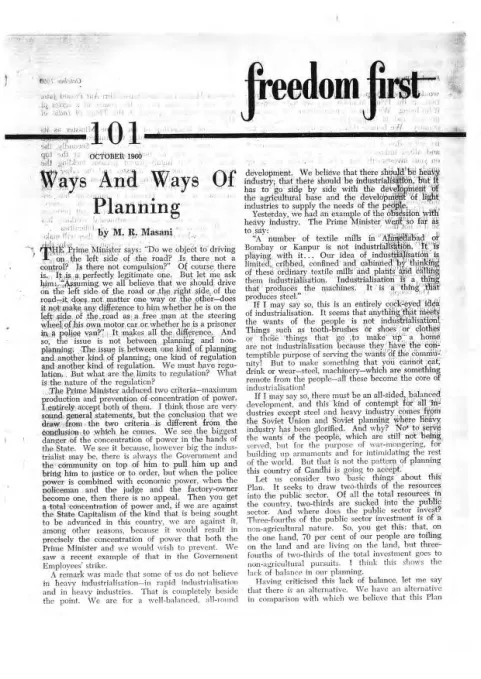
Ways And Ways Of Planning
By M. R. Masani
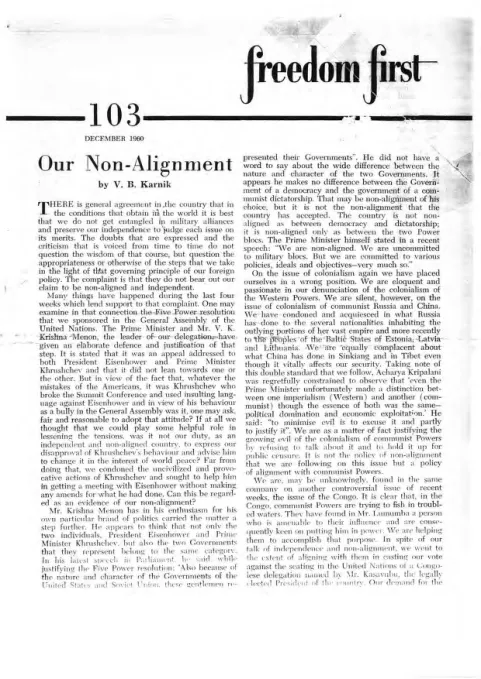
M. R. Masani’s ‘Ways And Ways Of Planning’ reproduces a parliamentary speech attacking Nehru’s approach to the Third Five Year Plan. Masani argues the real dispute is not planning versus no planning but which kind of planning and regulation; he warns that concentrating economic and political power in the state creates a ‘total concentration of power’ with no appeal once policeman, judge and factory-owner are the same authority. He criticizes the Plan’s bias toward heavy industry and the public sector (two-thirds of resources into the public sector, three-fourths of that into non-agricultural investment) despite 70% of the population living on the land. He proposes an alternative that would keep savings out of forced public-sector channels, let returns flow to agriculture and light industry, and argues inflation and currency depreciation under planning amount to a hidden tax that erodes ordinary people’s savings. He cites Jayaprakash Narayan’s critique that the Plan disempowers ordinary citizens and invokes the ‘ballot of the market place’ as a form of everyday economic democracy. Continued material on page 11 develops the inflation argument further, citing rupee depreciation figures and a speech possibly by Asoka Mehta referencing Graham Hutton’s ‘Inflation and Society’.
- Frames the debate as being between kinds of planning/regulation, not planning versus no planning
- Warns that combining economic and political power in the state removes all checks and appeal
- Criticizes the Third Plan for directing two-thirds of resources to the public sector and three-fourths of that to non-agricultural investment despite 70% of Indians living on the land
- Proposes an alternative plan of roughly Rs. 4000 crores in public spending, with about Rs. 2000 crores directed to agriculture
- Invokes market purchases as an everyday ‘economic ballot’ that supplements political democracy
- Continued section on inflation: cites a rupee-value drop and quotes a parliamentary colleague referencing Graham Hutton’s ‘Inflation and Society’
Chaos In Congo
By S. V. Raju
S. V. Raju’s ‘Chaos In Congo’ surveys the collapse of order in the newly independent Congo Republic in 1960, attributing the crisis to entrenched tribalism, Belgian failure to prepare Congolese for self-government, and the rapid unraveling of authority among Lumumba, Kasavubu, Mobutu and Katanga’s Moshe Tshombe. Raju contrasts the Congo’s disorder with Ghana’s relatively more stable transition under Kwame Nkrumah, questions whether democratic ideals alone can consolidate newly won independence, and details the scale of the UN’s stabilization operation, including its cost and troop strength, as competing Cold War interests exploit the vacuum left by Belgian withdrawal.
- Attributes Congo’s post-independence chaos primarily to entrenched tribalism (200 tribes, 38 languages) and lack of Belgian preparation for self-government
- Contrasts Congo with Ghana’s comparatively stable transition under a strong, ruthless Nkrumah
- Describes the fractured leadership picture: Lumumba, Kasavubu, Mobutu, and Katanga’s secession under Moshe Tshombe
- Details UN spending (over Rs. 10,00,000 a day) and troop strength (16,800) needed to maintain order
- Frames Congo as a proxy arena for Cold War rivalry between the Belgians/West and the Soviets
A New Course For The Third Plan
By M. A. Venkata Rao
M. A. Venkata Rao’s ‘A New Course For The Third Plan’ uses Imre Nagy’s 1955 book Imre Nagy On Communism, written in defence of Hungary’s post-Stalin ‘New Course’, as a lens for criticizing India’s Third Five Year Plan. Rao argues the similarities between the Hungarian and Indian planning patterns are close enough that Nagy’s critique of Rakosi-era Stalinist over-industrialization and neglect of agriculture applies directly to India: excessive stress on heavy industry, declining living standards despite promised gains, and forced collectivization pressures on agriculture. He reviews Nagy’s data showing Hungarian industrial production rising while living standards fell during the First Five-Year Plan, and Nagy’s insistence that heavy-industrial tempo must be tempered by actual economic conditions rather than ideological targets. Rao calls for a New Course for India’s Third Plan, urging around Rs. 4000 crores in public spending skewed toward agriculture and away from the current emphasis on heavy industry and forced cooperativisation, and cites Professor Oskar Lange’s writings critiquing the Soviet pattern.
- Uses Imre Nagy’s ‘New Course’ critique of Stalinist Hungarian planning as a template for critiquing India’s Third Plan
- Notes both plans share undue stress on heavy industry and neglect of agriculture and consumer goods
- Cites Hungarian data: industrial production index rose from 150 to 400 (1938=100) between 1950-54 while living standards fell
- Nagy opposed forced collectivisation tempo and allowed peasants to secede from collectives while maintaining a nominal long-term socialist goal
- Calls for an Indian ‘New Course’: roughly Rs. 4000 crores public spending, about Rs. 2000 crores to agriculture, and abandonment of obsession with agricultural cooperativisation
- Cites Professor Oskar Lange of Poland as having anticipated and endorsed Nagy’s ‘New Course’ arguments in a Calcutta Statistical Institute journal article
India And Tibet
By Jayaprakash Narayan
Jayaprakash Narayan, writing as President of the Afro-Asian Council announcing its decision to raise the Tibet issue at the UN General Assembly (alongside Malaya and Thailand), makes the case that Tibet’s political status is not a purely domestic Chinese matter. He cites the Legal Inquiry Committee (under the International Commission of Jurists) findings of human rights violations and genocide against Tibetans as a Buddhist people, argues Tibet was de facto independent from 1912 to 1950, that China’s 1950 invasion and the 1951 Seventeen-Point Agreement (repudiated by Tibet’s government in 1959) were coercive, and urges India not to treat Tibet as China’s internal affair, drawing an explicit parallel to apartheid South Africa. In the continued portion (page 10), he further argues India’s moral authority and independence would be worthless if foreign policy bent to great-power pressure, defends the UN’s moral authority even though China is not a member, and closes by urging a federal or confederal structure for newly independent Asian and African states to accommodate diverse societies.
- Announces the Afro-Asian Council’s decision to send Purshottam Trikamdas and J. J. Singh to the UN to raise the Tibet question, alongside Malaya and Thailand
- Cites the Legal Inquiry Committee (International Commission of Jurists) findings of genocide and human-rights violations against Tibetans
- Argues Tibet was de facto independent 1912-1950, was invaded in 1950, and had the 1951 Seventeen-Point Agreement forced upon it (repudiated by Tibet’s government in 1959)
- Draws an explicit analogy between China’s ‘domestic affair’ defense on Tibet and apartheid South Africa’s similar defense
- Continued: argues India’s independent foreign policy would be worthless if bent to great-power pleasure, and that moral issues cannot be waived just because China is not a UN member
- Closes by recommending federal/confederal structures of government for newly independent Asian and African states
Twentieth Anniversary Of An Aggression
By (Contributed)
This unsigned contributed piece marks the twentieth anniversary of the Soviet Union’s 1940 invasion and annexation of the Baltic states (Estonia, Latvia, Lithuania), tracing the 1939 Molotov-Ribbentrop secret protocols, the staged ‘elections’ and puppet governments used to legitimate annexation, and the subsequent mass deportations, executions and forced collectivization. It reproduces the concluding portion of a manifesto issued by the Baltic States’ Freedom Council calling on the Soviet Union to withdraw its military and administrative personnel and on free-world governments to support restoration of Baltic self-determination.
- Traces the 1939 Molotov-Ribbentrop secret protocols dividing Eastern Europe into Soviet and German spheres of influence
- Describes staged ‘elections’ and ‘People’s Diets’ used to manufacture consent for annexation into the USSR in August 1939
- Details mass deportations (48,471 people deported on June 13, 1941 alone) and executions under the ensuing Soviet regime
- Reproduces the concluding portion of the Baltic States’ Freedom Council manifesto demanding Soviet withdrawal and self-determination
Nothing To Lose But Chains
By M. Devadas Kini
M. Devadas Kini reviews Hawthorne Daniel’s book ‘The Ordeal of the Captive Nations’, narrating the Soviet Union’s systematic use of local communist minorities, staged coalition governments, and rigged elections to absorb Eastern Europe after World War II. The review covers the Baltic states’ 1939-40 annexation, the crushing of the Warsaw uprising and Poland’s postwar communization, the Soviet-imposed government in Czechoslovakia (including the annexation of Ruthenia), and similar patterns in Hungary, Romania, Bulgaria and Albania, arguing the common thread was Soviet military occupation enabling communist minorities to eliminate coalition partners ‘like slices of salami’ until one-party rule was consolidated.
- Reviews Hawthorne Daniel’s ‘The Ordeal of the Captive Nations’ (Doubleday, $4.50)
- Describes a repeated Soviet pattern: military occupation, staged coalition governments, then elimination of non-communist partners
- Covers Baltic annexation, Poland’s postwar communization and the Warsaw uprising’s betrayal, Czechoslovakia’s 1948 takeover including Ruthenia’s annexation
- Extends the pattern to Hungary, Romania, Bulgaria and Albania
- Closes with the claim that ‘the people get the government they deserve’ and that popular revolt (citing Poznan and the Hungarian Revolt) shows people will eventually gain freedom
With Many Voices
‘With Many Voices’ is the issue’s closing column of quoted excerpts from contemporary press and public figures on the 1960 UN General Assembly session, the Congo crisis, and Indian economic policy, including quotations from the Times of India, the Indian Express, the Economist (London), Jayaprakash Narayan, James Morris (Manchester Guardian Weekly), Mao Tse-tung (as quoted in the New Statesman), B. Shiva Rao (Swarajya), P. C. Joshi (Hindustan Times), and the National Herald.
- Compiles press quotations critical of Khrushchev’s UN diplomacy and the Congo situation
- Includes a Jayaprakash Narayan quote from the Indian Express on communists viewing neutrality as impossible (‘With us or against us’)
- Reproduces a Mao Tse-tung quotation (via New Statesman) on class-based maternal love under feudalism versus communism
- Includes B. Shiva Rao’s data on government-controlled newspapers (186 issued by the Central Government) and a National Herald quote contrasting socialism in capitalist countries with Indian planning
Generated by the v1.5 extraction pipeline. Awaiting editorial review.
Metadata and summary are AI-extracted from the source PDF and reviewed for editorial accuracy. The original work is available via the Read PDF tab above (where present); paragraph-level citation inside the PDF is deferred to a future engagement.