periodical issue
Freedom First
By B. K. Desai, Andrew R. Amar, Theophilius Okonkwo, Michael Ayih (Executive Committee, African Students Union in Moscow), V. B. Karnik, Aristides, Bertram D. Wolfe, Sidney Hook, Daniel Bell, William E. Bohn, Arthur Goldberg, Richard Walker
Edited by V. B. Karnik and printed at Indian Printers, 55 Gamdevi Road, Bombay 7 and published for the Democratic Research Service by B. K. Desai at 127 Mahatma Gandhi Road, Bombay 1. · Bombay · 1960
12 pages
Freedom First
Summary
This is issue No. 102 (November 1960) of Freedom First, the monthly journal of the Forum of Free Enterprise, edited by V. B. Karnik and published for the Democratic Research Service. The issue is dominated by Cold War concerns: B. K. Desai’s lead article dissects the failure of the 15th UN General Assembly session amid Khrushchev’s theatrics and Nehru’s perceived softness toward Soviet behaviour; an unsigned Notes section covers the Algerian war, press freedom in Ceylon, UN reform, Moscow’s Friendship University, and Nehru’s rebuke of the Times of India; an open letter from three African students in Moscow (Andrew Amar, Theophilius Okonkwo, Michael Ayih) catalogues racial discrimination and propaganda experienced by African students in the USSR; V. B. Karnik reviews Constantine FitzGibbon’s novel When The Kissing Had To Stop as a cautionary fantasy about a communist takeover of Britain, drawing an explicit warning for India; a pseudonymous column (‘Aristides’) continues a two-part discussion of free enterprise’s social obligations in India via the Forum’s 1957 Code of Conduct; a group of American intellectuals (Sidney Hook, Daniel Bell, Bertram Wolfe, and others) publish an open letter pressing Khrushchev on Chinese Communist bellicosity; and the issue closes with a ‘With Many Voices’ page of press quotations on Khrushchev, Nehru, and Krishna Menon. The volume’s argumentative centre is anti-communist, pro-free-enterprise commentary on world and Indian affairs, characteristic of the Forum of Free Enterprise’s classical-liberal orientation.
Key points
-
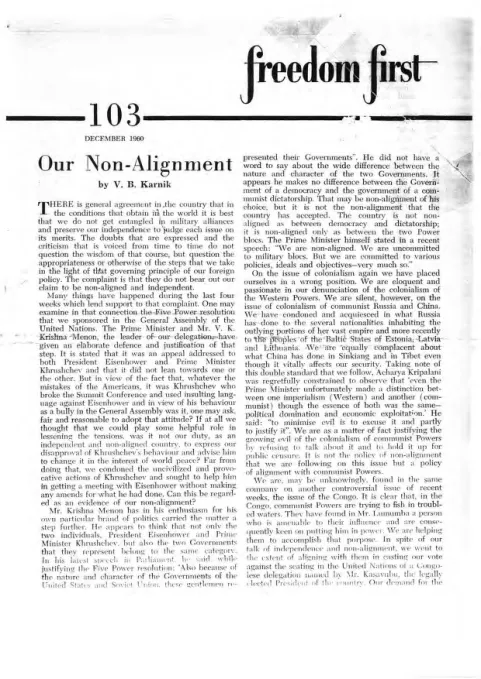
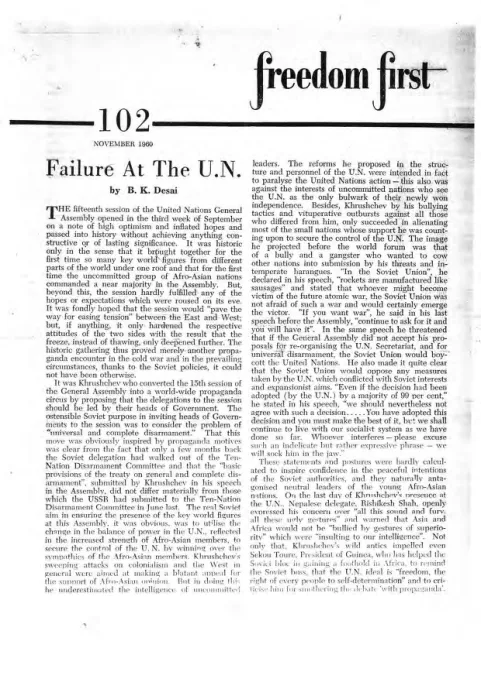
B. K. Desai’s “Failure At The U.N.” judges the 15th UN General Assembly session a failure, blaming Khrushchev’s propaganda tactics while also criticising Nehru’s and Krishna Menon’s asymmetric treatment of Soviet versus Western conduct.
-
Unsigned Notes cover French intellectuals’ defence of Algerian-war conscripts, Ceylon’s proposed press nationalisation, calls to restructure the UN, scepticism toward Moscow’s new “Friendship University,” and Nehru’s dismissive remark to the Times of India.
-
An open letter from three African students in Moscow (Andrew Amar, Theophilius Okonkwo, Michael Ayih) catalogues racial discrimination and harassment faced by African students in the Soviet Union.
-
V. B. Karnik reviews Constantine FitzGibbon’s novel “When The Kissing Had To Stop”, reading its fictional communist takeover of Britain as an explicit warning about India’s weaker institutional defences.
-
“Aristides“‘s “Free Enterprise And Democracy” argues Indian private enterprise has met its Plan investment targets despite socialist strictures and should embrace the Forum of Free Enterprise’s 1957 Code of Conduct.
-
An open letter to Khrushchev signed by American intellectuals including Sidney Hook and Daniel Bell presses him to reconcile his UN advocacy for Chinese admission with Chinese Communist bellicosity.
-
“With Many Voices” collects press quotations critical of Khrushchev’s UN conduct and of Nehru’s and Krishna Menon’s perceived leniency toward Soviet and Chinese communism.
Essays
Failure At The U.N.
By B. K. Desai
B. K. Desai argues that the 15th UN General Assembly session, despite convening an unprecedented number of world leaders, achieved nothing constructive and instead deepened Cold War divisions. He blames Khrushchev for turning the session into a ‘world-wide propaganda circus’ through bullying tactics, threats to boycott the UN, and proposals (a troika secretariat, disarmament) designed to paralyse the UN rather than reform it. Desai also criticises the West for failing to show statesmanship on Afro-Asian representation and admission of Communist China, and reserves sharp criticism for Nehru and Krishna Menon, arguing that Nehru’s public statements after returning from New York unfairly blamed the West while soft-pedaling Soviet misbehaviour, and that Krishna Menon’s advocacy for Chinese admission raised doubts about India’s genuine non-alignment.
- The 15th UN General Assembly (September 1960) is judged a failure that deepened East-West tension rather than easing it.
- Khrushchev is portrayed as converting the session into a propaganda circus, proposing a three-way troika secretariat and ‘universal and complete disarmament’ primarily to paralyse the UN.
- Khrushchev’s shoe-banging incident against the Philippine delegate and his bullying rhetoric alienated Afro-Asian nations rather than winning their sympathy.
- The West is faulted for failing to take the initiative on Afro-Asian representation in UN bodies and on the China question, ceding the initiative to Khrushchev.
- Nehru is criticised for blaming the West for Cold War tension in a US interview while showing excessive regard for Khrushchev’s ‘peaceful intentions’.
- Krishna Menon’s speech advocating Chinese Communist admission to the UN is called ‘very revealing’ and inconsistent with genuine non-alignment.
- The article questions whether Nehru’s and Menon’s professed neutrality is authentic given their asymmetric treatment of Soviet vs. Western conduct.
Notes (Echoes Of Algerian War; Freedom Of Press In Ceylon; Reconstruction Of U.N.O.; Friendship University; Ill-Tempered Abuse)
An unsigned Notes section covers four short items: French intellectuals’ (including Sartre and Simone de Beauvoir) support for conscripts refusing to serve in the Algerian war, and the French government’s retaliation against them; Ceylon’s proposed nationalisation of newspapers under a state-controlled corporation, which the piece condemns as disguised government control of the press; the prospective post-colonial restructuring of the UN Security Council and other organs to reflect the changed balance of power, alongside criticism of Khrushchev’s troika proposal as an attempt to destroy the UN via Hammarskjold’s ouster; and skepticism toward Moscow’s new ‘Friendship University’ for African, Asian and Latin American students, questioned as segregationist propaganda rather than genuine education. A final item criticises Nehru for telling the Times of India to ‘stew in its own juice’ over its criticism of Khrushchev, framing this as an affront to press freedom (continued on page 11).
- 121 French intellectuals, including Jean-Paul Sartre, Simone de Beauvoir, Andre Breton and Simone Signoret, signed a statement defending French conscripts who refuse to serve in Algeria.
- The French government retaliated by banning the signatories from state-supported theatre, cinema, radio and television.
- Ceylon’s plan to nationalise newspapers under a government-linked corporation is criticised as a disguised means of state control over the press.
- The structure of the United Nations, built 15 years earlier, is argued to require reconstruction to reflect the emergence of newly independent Asian and African states — but this is distinguished from Khrushchev’s troika proposal, which the piece says aims to destroy the UN’s functioning by tying each secretary to a nation-bloc.
- Khrushchev’s anger at Secretary-General Hammarskjold over the Congo affair is presented as retaliation for Hammarskjold following Security Council and General Assembly directives.
- Moscow’s newly launched ‘Friendship University’ for African, Asian and Latin American students is portrayed with skepticism: it segregates foreign students from Russian students and offers inferior standards, according to African students quoted.
- Nehru’s dismissive remark that the Times of India should ‘stew in its own juice’ over its criticism of Khrushchev is criticised as an affront to a free press in a democracy.
African Students And Soviet Russia
By Open letter signed by Andrew R. Amar (Uganda), Theophilius Okonkwo (Nigeria), Michael Ayih (Togo), Executive Committee of the African Students Union in Moscow
An open letter to all African governments, signed on behalf of the Executive Committee of the African Students Union in Moscow by three students (Andrew R. Amar of Uganda, Theophilius Okonkwo of Nigeria, and Michael Ayih of Togo), catalogues discrimination and mistreatment of African students in the Soviet Union. It recounts the case of S. Omor Okullo of Uganda, expelled and then smeared by Soviet propaganda after he criticised the USSR; the police harassment of Benjamin Omburo of Kenya for socialising with a Russian woman; instances of Soviet students being punished for association with foreigners; restrictions on marriage between Soviet citizens and Africans; and threatening letters from Komsomol-affiliated students. The letter also condemns the new segregated ‘Friendship University’ as an instrument of propaganda and racial separation, and warns African governments that Soviet communism poses a grave danger to true Africanism, urging vigilance against ideological infiltration while rejecting subservience to any foreign power, communist or otherwise.
- The letter is signed on behalf of the African Students Union’s Executive Committee in Moscow by representatives from Uganda, Nigeria and Togo, following secret deliberations among students from many African and Arab countries.
- It documents the case of S. Omor Okullo (Uganda), who was expelled from the USSR and then subjected to a Soviet smear campaign alleging failure in exams and ‘immorality’ after he criticised Soviet conduct.
- Benjamin Omburo of Kenya describes police harassment over socialising with a Russian woman, including forced detention and hostile treatment by Soviet police.
- Soviet citizens who marry or associate intimately with Africans face official obstruction, including denial of marriage licenses and forced departures.
- Ghanaian and Cameroonian students report threatening letters from Russian students affiliated with the communist youth organisation, Komsomol.
- The newly announced ‘Friendship University’ for African, Asian and Latin American students is criticised as a segregationist propaganda project rather than genuine higher education.
- The letter urges African governments to study communism, remain vigilant against its infiltration, and resist both colonialism and any new subservience to communist strategists.
A Frightening Fantasy
By V. B. Karnik
V. B. Karnik reviews Constantine FitzGibbon’s novel When The Kissing Had To Stop, describing it as a frighteningly plausible fantasy in which Britain, weakened by the ‘declension of will’ among its politicians and public, is gradually taken over by Soviet-backed communists in the near-future England of the late 1950s/1960s. Karnik summarises the plot in detail: an opportunistic Foreign Secretary, Rupert Page Gorman, is unwittingly used by Soviet agents as the instrument of Britain’s takeover after a Labour government embraces unilateral disarmament and dismantles Anglo-American defences; the Prime Minister dies suspiciously in Moscow; Page Gorman rises to power via a manufactured war scare before being discarded by his Soviet handlers in favour of a loyal British communist, O’Mahony. Karnik reads the novel as a broader parable of social and moral disintegration enabling authoritarian takeover, and explicitly warns that India, given its weaker institutional defences than Britain’s, is even more vulnerable to a similar ‘fantasy’ unfolding in reality.
- The novel imagines a communist takeover of Britain achieved not through invasion but through the ‘wrong policies and bungling self-seeking’ of persons in charge of government.
- Rupert Page Gorman, an opportunistic Foreign Secretary with no communist conviction, becomes the chief instrument of the Soviet takeover, later outwitted by his own Russian advisers.
- A Labour government under Leonard Braithwaite adopts unilateral disarmament and dismantles American bases and rocket/bomber defences against the advice of the Chiefs of Staff.
- Braithwaite dies in Moscow after his water is adulterated with vodka against medical advice, clearing the way for Page Gorman’s rise to Prime Minister via a manufactured China-America war scare.
- The King is forced to flee to Canada; only a small number of ‘earnest and conscious’ individuals resist, including an aristocratic landlord who continues the fight from the hills.
- Karnik frames the novel’s core theme as a general ‘declension of will’ across British social and political life — moral, marital, and civic — that precedes and enables the political takeover.
- Karnik explicitly extends the novel’s warning to India, arguing the ‘soil for the rise of dictatorship’ is more congenial there than in Britain, given India’s comparatively weaker reservoirs of institutional strength and democratic defence.
Free Enterprise And Democracy
By “Aristides”
Writing under the pseudonym ‘Aristides,’ continuing an article from Freedom First’s 100th issue, the author argues that free enterprise in India, though squeezed by the ‘socialistic pattern of society’ through exclusion, displacement and controls, has nonetheless delivered strong results — overfulfilling First and Second Plan investment targets and building indigenous industries like bicycle manufacturing. The author contends private enterprise must go further and accept a five-fold Code of Conduct — toward consumers, employees, investors, the State, and the community — as articulated by the Forum of Free Enterprise in January 1957, quoting its provisions at length on fair pricing, labour welfare, honest management, professional integrity, and civic responsibility. The essay closes by invoking Jayaprakash Narayan’s account of Gandhian voluntary activity and Vinoba Bhave’s Sarvodaya movement as models, arguing that private enterprise’s community service can supply the decentralised, pluralistic leadership that a democracy needs, distinct from party or state monopoly on leadership.
- Free enterprise in India has met or exceeded First and Second Five Year Plan private investment targets despite being squeezed by socialist policy.
- The essay quotes at length the Forum of Free Enterprise’s January 1957 Code of Conduct, covering obligations to consumers, employees, investors, the State, and the community.
- Honest business practices, fair wages, and support for stable trade unions are framed as social obligations distinct from mere legal compliance.
- The essay condemns hoarding, black-marketing, profiteering and tax evasion as anti-social and calls for their suppression by honest administration.
- It criticises the practice of political parties extracting funds from private enterprise for votes, urging enterprise instead to fund its own social service directly.
- The essay invokes Jayaprakash Narayan’s interpretation of Gandhian voluntary activity and Vinoba Bhave’s Sarvodaya movement as models for reducing dependence on the State.
- It argues that leadership in a ‘pluralistic society’ cannot come from a single monolithic party or the State, and that private enterprise’s community service can supply leadership at multiple social levels.
Two Questions To Mr. Khrushchev
By Open letter signed by Bertram D. Wolfe, Prof. Sidney Hook, Prof. Daniel Bell, Dr. William E. Bohn, Arthur Goldberg, Prof. Richard Walker
An open letter to Nikita Khrushchev, originally published in the New York Times and signed by a number of eminent Americans (including Bertram D. Wolfe, Sidney Hook, Daniel Bell, William E. Bohn, Arthur Goldberg, and Richard Walker), presses him on the contradiction between his UN advocacy for admitting Communist China and Communist China’s own bellicose public statements. The letter quotes Chinese Communist sources declaring war ‘inevitable’ under existing political systems and asserting that armed force will be used to ‘save succeeding generations’ beyond national borders. It asks Khrushchev two direct questions: whether he supports or disavows these official Chinese Communist statements, and if he repudiates them, how he can still justify advocating China’s UN admission.
- The open letter was published in the New York Times and signed by prominent American intellectuals, including Bertram D. Wolfe, Sidney Hook, Daniel Bell, William E. Bohn, Arthur Goldberg and Richard Walker.
- It recalls Khrushchev’s September 23, 1960 UN speech advocating Communist China’s admission and a broad disarmament plan.
- It quotes UN Charter provisions on refraining from the threat or use of force and reaffirming faith in human rights as the standard against which Chinese Communist statements should be judged.
- It cites Chinese Communist publications (Red Flag, People’s Daily) asserting that ‘war is inevitable’ under current political systems and that armed force beyond borders is natural for socialist self-defence.
- The letter poses two direct questions to Khrushchev: does he support or disavow these Chinese statements, and if he disavows them, how can he still justify advocating China’s UN admission.
With Many Voices
The closing page, ‘With Many Voices,’ collects short press quotations from various publications commenting on Khrushchev, Nehru, Krishna Menon and the UN session, framed by an epigraph from Tennyson. Quoted sources include The Spectator, Swiss Review of World Affairs, Current, Eastern Economist, New Age, Times of India, Eastern Economist, Radical Humanist, Indian Express and the Hindustan Times, most critical of Khrushchev’s bullying and of Nehru’s and Krishna Menon’s perceived leniency toward Soviet and Chinese communism. The page also carries a subscription notice for Freedom First and an advertisement for the magazine Encounter.
- The page compiles brief press quotations on Khrushchev’s UN conduct, Nehru’s diplomacy, and Krishna Menon’s positions from a range of Indian and international publications.
- Desmond Donnelly, M.P., in The Spectator, describes Khrushchev as having ‘the instincts of Palmerston, the background of the Inquisition and the training of Al Capone.’
- D. F. Karaka in Current is quoted twice criticising Nehru’s diplomacy, including the line ‘Mr. Nehru has no guts to oppose Mr. Khrushchev.’
- A Hindustan Times quote by ‘R. S.’ contrasts the peaceful decline of Western colonialism with the fate of Imre Nagy under Soviet-style ‘proletarian internationalism.’
- The Radical Humanist is quoted twice, criticising Krishna Menon’s continued role in government given India’s defense concerns.
- The page includes a subscription coupon for Freedom First (annual subscription Rs. 3) and an advertisement for the magazine Encounter, priced at Rs. 12 annually (Rs. 10 for ICCF members).
Generated by the v1.5 extraction pipeline. Awaiting editorial review.
Metadata and summary are AI-extracted from the source PDF and reviewed for editorial accuracy. The original work is available via the Read PDF tab above (where present); paragraph-level citation inside the PDF is deferred to a future engagement.