periodical issue
Freedom First
Edited by V. B. Karnik and printed at Inland Printers, 55 Gamdevi Road, Bombay 7 and published for the Democratic Research Service by B. K. Desai at 127 Mahatma Gandhi Road, Bombay 1. · Bombay · 1960
12 pages
Freedom First
Summary
This is issue No. 103 of Freedom First (December 1960), the monthly journal of the Democratic Research Service, edited by V. B. Karnik. The issue’s editorial condemns India’s non-alignment policy as selectively applied — critical of Western colonialism but silent on Soviet and Chinese actions in the Baltic states, Sinkiang, and Tibet, and partisan in favour of Lumumba during the Congo crisis. The Notes section surveys Algeria’s war for independence, India’s Congo diplomacy, UNESCO’s selective reporting on racism, repression during the Punjabi Suba agitation, and the Mauritania-Morocco dispute. M. R. Masani argues against corporate political donations as economically distortive and corrosive of shareholder rights and democratic accountability. M. A. Venkata Rao contends that Nehru’s Five Year Plans and agricultural cooperativisation are Marxist in substance despite Nehru’s denials of doctrinaire socialism. An interview with expelled African student S. Omor Okullo recounts racial discrimination against African students at Moscow University. M. Devadas Kini reviews two books on Hungarian writers under communism, tracing the arc from Stalinist orthodoy through the 1956 Hungarian Revolution. The issue closes with a press-clipping digest, ‘With Many Voices,’ on Nehru’s China policy.
Key points
-
V. B. Karnik’s editorial “Our Non-Alignment” argues India’s non-alignment collapses repeatedly into de facto alignment with the communist bloc, citing silence on Soviet and Chinese colonialism.
-
Unsigned Notes survey Algeria’s decisive war phase, India’s partisan tilt toward Lumumba in the Congo crisis, UNESCO’s selective racism coverage, mass arrests during the Punjabi Suba agitation, and the Mauritania-Morocco dispute.
-
M. R. Masani’s “Contributions To Political Funds” argues against corporate political donations as economically distortive and effectively coerced under a licence-permit economy.
-
M. A. Venkata Rao’s “Prime Minister’s Marxist Dogmas” contends Nehru’s Five Year Plans and cooperative-farming programme are Marxist in substance despite his denials.
-
An interview with expelled African student S. Omor Okullo, reprinted from U.S. News & World Report, recounts racial discrimination against African students at Moscow University.
-
M. Devadas Kini reviews two books on Hungarian writers under communism, tracing the arc from Stalinist orthodoxy through the 1956 Revolution.
-
The closing “With Many Voices” press digest criticises Nehru’s handling of Chinese incursions into Ladakh as understating the threat.
Essays
Our Non-Alignment
By V. B. Karnik
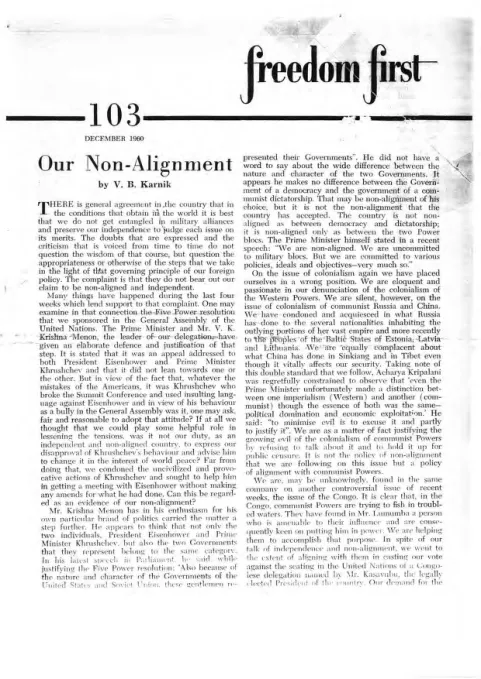
V. B. Karnik’s editorial argues that India’s professed non-alignment has repeatedly collapsed into de facto alignment with the communist bloc. He faults Krishna Menon’s Five Power UN resolution for equating the US and USSR as equivalent power blocs regardless of their democratic or dictatorial character, criticizes India’s silence on Soviet colonialism in the Baltic states and Chinese actions in Sinkiang and Tibet even as it denounces Western colonialism, and condemns India’s support for Lumumba and opposition to the Kasavubu delegation’s UN seating as a partisan tilt toward the communist-backed side in the Congo crisis.
- Argues India’s foreign policy is aligned as between the two power blocs even while calling itself non-aligned
- Criticizes the Five Power resolution sponsored at the UN and Krishna Menon’s defence of it
- Notes Acharya Kripalani’s criticism of the double standard applied to Western versus communist imperialism
- Condemns Indian silence on Soviet control of the Baltic states and Chinese actions in Sinkiang and Tibet
- Criticizes India’s support for Lumumba and opposition to seating Kasavubu’s Congolese delegation at the UN
- Cites Jayaprakash Narayan’s warning against imposing unitary government on newly independent African/Asian nations
Notes (New Moves on Algeria; India And The Congo; UNESCO Courier; Repression In The Punjab; Mauritania And Morocco)
An unsigned Notes section covering five topics: the decisive phase of the Algerian war and de Gaulle’s move toward a negotiated ‘Algerian Republic’; India’s partisan tilt toward Lumumba in the Congo crisis at the UN, contrasted with most African states’ abstention or opposition; UNESCO Courier’s issue on racism, criticized for omitting Soviet anti-Semitism and discrimination against African students in Moscow; the suppression of the Punjabi Suba movement in Punjab, including mass arrests and press censorship; and the dispute between newly independent Mauritania and Morocco over territorial claims.
- Algeria’s war is entering its decisive phase; de Gaulle plans a referendum on an ‘Algerian Republic’
- India’s vote against seating the Kasavubu delegation is criticized as partisan alignment with the Soviet bloc in the Congo dispute
- UNESCO Courier’s racism issue is faulted for omitting Soviet anti-Semitism and discrimination against African students in Moscow
- Punjab: over 40,000 arrests reported under the Preventive Detention Act amid the Punjabi Suba agitation, with press censorship
- Mauritania’s independence (Nov 28) is disputed by Morocco, which claims historical suzerainty; Tunisia backs Mauritania
Contributions To Political Funds
By M. R. Masani
M. R. Masani argues against permitting corporate contributions to political funds, then governed by a clause allowing directors to vote away up to Rs. 25,000 or five percent of net profits without shareholder sanction. He contends shareholders never contracted to have their invested capital diverted to political parties, that such donations divert funds from production and get passed on to consumers as a hidden cost, and that in a heavily controlled economy corporate ‘donations’ are effectively coerced by the licensing power of ministries, creating a quid pro quo dynamic that corrupts both business and politics. He cites Justice Chagla’s suggestion that court sanction be required before large donations and criticizes the ruling Congress party for using the funding issue to smear industrialists while itself being the main beneficiary of corporate largesse.
- Existing law (clause 293) lets company directors donate up to Rs. 25,000 or 5% of net profits to political parties without full shareholder sanction
- Masani argues shareholders never contracted for their capital to be used for political donations
- Corporate political donations divert funds from productive investment and get passed to consumers as a hidden cost, worsening inflation
- In a controlled economy dependent on licences and permits, ‘voluntary’ donations are effectively coerced by government pressure
- Justice Chagla proposed requiring court sanction before large political donations by companies
- Masani argues the Congress party, which most benefits from corporate contributions, is using the issue to attack industrialists
Prime Minister’s Marxist Dogmas
By M. A. Venkata Rao
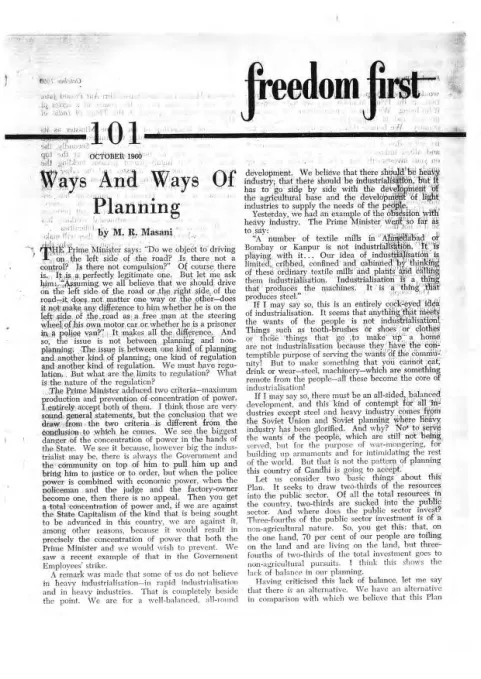
M. A. Venkata Rao argues that Nehru’s claim to be free of Marxist dogma is unconvincing given the substance of his economic policies. He identifies four strands of doctrinaire Marxism in Indian planning: the Industrial Policy Resolutions of 1948 and 1956 reserving key industries for state ownership as a path to full socialism; the emulation of Soviet-style heavy-industry-weighted Five Year Plans despite India lacking the USSR’s self-sufficiency motives; the Marxist premise (echoing Marx’s dismissal of human freedom as ‘bourgeois prejudice’) that mechanized centralized production must subordinate individual choice; and the Nagpur Congress resolution’s programme of cooperative/collective joint farming, which Venkata Rao likens to Soviet, Chinese, and East European collectivisation via ‘salami tactics,’ warning it entails elimination of large farmers and eventual coercion of smallholders into joint farms. The essay continues past the rendered pages (marked ‘Continued on page 11’).
- Argues Nehru’s denial of Marxist dogma is inconsistent with the substance of his Five Year Plans and Industrial Policy Resolutions
- Identifies the 1948 and 1956 Industrial Policy Resolutions as committing India to eventual full state ownership of the economy
- Compares India’s heavy-industry-weighted Plans to the Soviet model, arguing India lacks the USSR’s self-sufficiency rationale
- Cites Marx’s view of individual freedom as ‘bourgeois prejudice’ subordinated to mechanized, centrally planned production
- Describes the Nagpur Congress resolution’s cooperative/collective farming programme as modeled on Soviet, Chinese, and East European collectivisation ‘salami tactics’, warning of the elimination of large farmers and land-ceiling policies
Racial Discrimination In Soviet Russia (extracts from an interview with Mr. S. Omor Okullo, published in U.S. News & World Report)
An interview, reprinted from U.S. News & World Report, with S. Omor Okullo, a 26-year-old African student expelled by the Soviet government after protesting the treatment of African students at the University of Moscow. Okullo describes incidents including the beating of a Somali student for dancing with a Russian girl, racial slurs against African students, and pressure from Soviet authorities to align politically (including views on the U-2 incident). He recounts his expulsion, along with two other African students, on accusations of leading an ‘anti-Soviet group,’ and describes plans for a segregated ‘friendship university’ for foreign students, which he criticizes as comparable to the ideology (if not the practice) of apartheid in South Africa.
- Okullo, a Somali/African student on a UN scholarship, was expelled from Moscow University after protesting racial mistreatment of African students
- Describes a Somali student beaten unconscious by Russian students for dancing with a Russian girl, and racial slurs against African students
- Soviet teachers used classroom discussion to probe foreign students’ political loyalty, e.g. views on the U-2 incident
- Okullo and two other African students were expelled on accusations of leading an ‘anti-Soviet group’
- Describes plans for a segregated ‘friendship university’ to separate African/foreign students from Russian students, which he likens ideologically to South African apartheid
Intellectuals Vs The State
By M. Devadas Kini
M. Devadas Kini reviews two books — The Revolt of the Mind by Tamas Aczel and Tibor Meray, and Political Prisoner by Paul Ignotus — examining the fate of Hungarian intellectuals under communist rule, comparing them favourably to Orwell’s 1984 and Koestler’s Darkness at Noon. He traces the three categories of Hungarian writers under the regime (loyal ‘Moscovites,’ silenced dissenters, and coerced true-believers), profiles figures such as Tibor Dery and the Petofi Circle, and follows the arc from Stalinist orthodoxy through the post-Stalin Thaw, the Poznan revolt, and the 1956 Hungarian Revolution triggered partly by intellectual ferment. The piece (continued from page 8’s aside on the Prime Minister) closes by posing the question of whether totalitarian rule and intellectual freedom can ever coexist.
- Reviews The Revolt of the Mind (Aczel & Meray) and Political Prisoner (Ignotus), comparing them to 1984 and Darkness at Noon
- Describes three categories of Hungarian writers under communism: loyalist ‘Moscovites’, silenced dissenters, and party-line loyalists
- Profiles novelist Tibor Dery, his conflict with Minister of Culture Jozsef Revai over artistic freedom, and the Petofi Circle of dissident writers
- Traces the political Thaw after Stalin’s death, the Poznan revolt, and Imre Nagy’s rise and fall, leading to the 1956 Hungarian Revolution
- Closes by posing whether a totalitarian state and intellectual freedom can coexist
With Many Voices
A press-clippings digest titled ‘With Many Voices,’ quoting critical commentary from Indian newspapers and commentators on Nehru’s handling of the China border issue and foreign policy generally, including the Hindustan Times, Thought, Swarajya, Janata, and remarks by C. Rajagopalachari and A. D. Gorwala accusing Nehru of downplaying Chinese incursions into Ladakh and effectively favouring the communist bloc over the West despite professed non-alignment.
- Digest of press criticism of Nehru’s China policy from Hindustan Times, Thought, Swarajya, and Janata
- Criticizes Nehru for treating Chinese incursions in Ladakh (12,000 square miles) as ‘petty’ incidents within a ‘larger context’
- C. Rajagopalachari remarks he would not be surprised if the government borrowed money for development even from China
- A. D. Gorwala argues Indian foreign policy has convinced world opinion that India, in reality, favours the communist powers over freedom
Generated by the v1.5 extraction pipeline. Awaiting editorial review.
Metadata and summary are AI-extracted from the source PDF and reviewed for editorial accuracy. The original work is available via the Read PDF tab above (where present); paragraph-level citation inside the PDF is deferred to a future engagement.