periodical issue
Freedom First
By Jayaprakash Narayan, MA Venkata Rao
FREEDOM FIRST. Published on the first of each month. Maneckji Wadia Building, 4th Floor, 127 Mahatma Gandhi Road, Bombay 1. Published for the Democratic Research Service by B. K. Desai at 127 Mahatma Gandhi Road, Bombay 1; printed at Inland Printers, 55 Gamdevi Road, Bombay 7. · Bombay · 1961
12 pages
Freedom First
Summary
Freedom First No. 106 (March 1961) is a monthly issue of the classical-liberal periodical published by the Democratic Research Service, Bombay, and edited by V. B. Karnik. The issue opens with an editorial-style analysis of the Sino-Indian border report and its diplomatic fallout, followed by an unsigned Notes section commenting on the murder of Patrice Lumumba and the Congo crisis, the Communist Party of India’s equivocal resolution on Chinese aggression, communal riots in Jabalpur, and the death of Sol Levitas of The New Leader. Jayaprakash Narayan contributes a substantive essay on Panchayati Raj, arguing for real devolution of power, non-partisan village elections, and a coherent structure of participating democracy running from the gram sabha up to the Union level. M. A. Venkata Rao reviews and expounds J. K. Galbraith’s The Affluent Society, focusing on the imbalance between private affluence and public squalor and Galbraith’s case for a mixed economy. S. R. Mohan Das reflects on Lord Morrison’s Bombay lectures to contrast Britain’s non-doctrinaire, evolutionary democratic tradition with what he sees as India’s idealistic, a priori approach to democracy. A brief Review section covers two books, R. P. Masani’s Britain in India and A. K. Mukerji and Ram Singh’s Germany Today, and the issue closes with a page of quoted commentary (‘With Many Voices’) from public figures on Panchsheel, Kashmir, Tibet, and civil liberties, plus subscription and publisher information.
Key points
-
B. K. Desai’s “The Report & After” argues the joint India-China officials’ report vindicates India’s border claims and calls for India to abandon its wavering non-aligned posture.
-
Notes call Lumumba’s murder a “crime against humanity,” criticise the CPI’s evasive resolution on Chinese aggression, address the Jabalpur communal riots, and mourn Sol Levitas of The New Leader.
-
Jayaprakash Narayan’s essay on Panchayati Raj argues the institution should become the foundation of “participating democracy,” urging genuine devolution and non-partisan village elections.
-
M. A. Venkata Rao expounds J. K. Galbraith’s “The Affluent Society,” focusing on the imbalance between private affluence and public squalor and the case for a mixed economy.
-
S. R. Mohan Das’s “Some Reiterations In Democracy” contrasts Britain’s organically evolved, non-doctrinaire democracy with India’s synthetic, a priori idealism, drawing on Lord Morrison’s Bombay lectures.
-
The Review section covers R. P. Masani’s “Britain In India” and A. K. Mukerji and Ram Singh’s “Germany Today.”
-
“With Many Voices” compiles quotations on Panchsheel, the China border dispute, Tibet, and shrinking individual liberty.
Essays
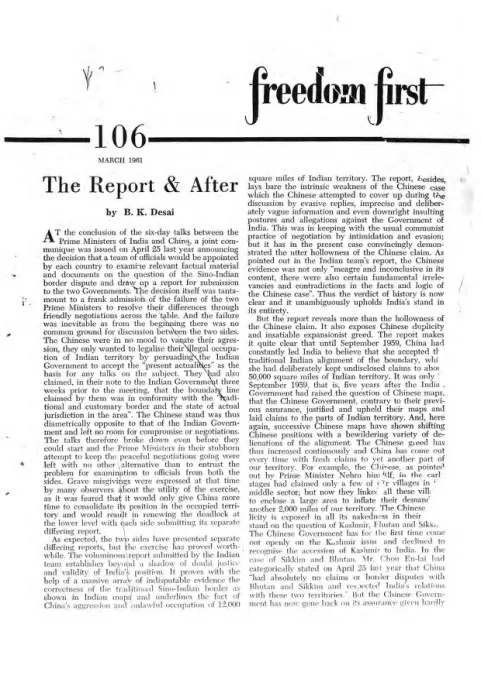
The Report & After
By B. K. Desai
B. K. Desai’s lead article examines the aftermath of the joint Indian-Chinese officials’ report on the Sino-Indian border dispute, commissioned after the failed 1960 Nehru-Zhou Enlai talks. Desai argues the report thoroughly vindicates India’s territorial claims and exposes the ‘hollowness’ and shifting nature of China’s case, while also faulting India’s own Panchsheel-era naivete for having failed to heed warnings about Chinese expansionism since 1950. The piece calls for India to abandon its wavering, non-aligned diplomatic posture and instead mount an active diplomatic offensive: recognizing Tibetan independence prior to 1950, championing the Tibetan cause at the United Nations, and building international opinion against China’s ‘aggression and unlawful occupation’ of Indian territory.
- The India-China officials’ report followed the April 1960 joint communique after failed Nehru-Zhou Enlai border talks.
- The report is described as proving India’s traditional boundary claims with ‘a massive array of indisputable evidence.’
- China is accused of concealing claims to roughly 50,000 square miles of Indian territory until September 1959, then repeatedly shifting its claimed alignment.
- The article argues the report incidentally supports the Dalai Lama’s claim that Tibet was independent and sovereign before 1950.
- Desai criticizes India’s Panchsheel-based foreign policy as naive and calls for a more assertive diplomatic and military posture.
- The piece urges India to back the UN resolution on Tibet and to shed its ‘one-sided’ non-alignment on the Sino-Soviet dispute.
Notes (A Grave Challenge; Tight-Rope Dancing; Jabalpur Riots; Sol Levitas)
The unsigned Notes section comments on four topical matters: the murder of Congolese leader Patrice Lumumba, which it calls a ‘crime against humanity’ requiring investigation while cautioning against outside powers (naming Belgium and Russia) exploiting the Congo crisis; the Communist Party of India’s resolution on Chinese border aggression, criticized as evasive ‘tight-rope dancing’ that refuses to call China’s actions aggression outright; communal riots in Jabalpur, attributed to rumor-mongering and a need for public education in communal harmony; and an obituary tribute to Sol Levitas, managing editor of The New Leader, praised as a stalwart of the anti-communist democratic-socialist tradition.
- Calls the killing of Patrice Lumumba and his associates ‘a crime against humanity’ regardless of political sympathies, demanding investigation and punishment.
- Criticizes Belgium’s continued ‘meddling’ in Congolese affairs and Russia’s efforts to discredit the UN Secretary-General over Congo policy.
- Welcomes a new Security Council resolution on the Congo as calling for ‘resolute action.’
- Characterizes the CPI’s resolution on the Sino-Indian border dispute as deliberately ambiguous, refusing to label Chinese conduct as aggression for fear of alienating either side.
- Notes the CPI resolution does concede acceptance of the McMahon Line and disapproves of Chinese negotiations with Pakistan over Kashmir boundary delimitation.
- Attributes the Jabalpur communal riots to rumor and a lack of public education among ‘educated and respectable’ sections of society, praising the Congress for condemning the violence.
- Mourns Sol Levitas of The New Leader as a Russian-emigre social democrat who spent his career combatting totalitarian communism.
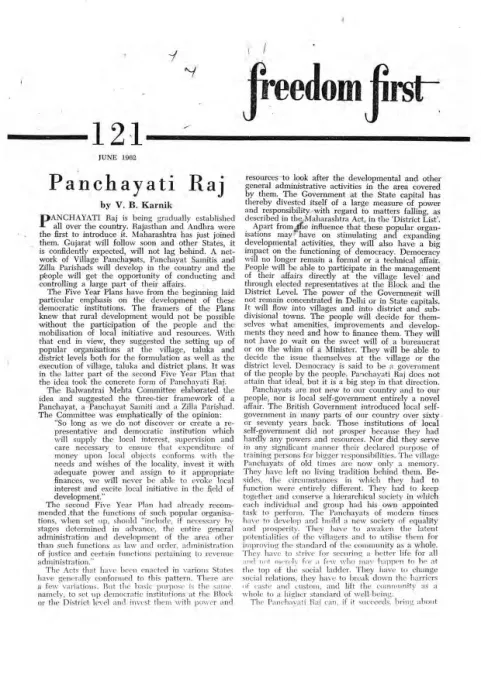
Panchayati Raj
By Jayaprakash Narayan
Jayaprakash Narayan’s essay on Panchayati Raj argues that the institution originated from an administrative need for public cooperation in development programmes rather than from a deliberate aim of deepening democracy, but that its logic is now driving it toward becoming the foundation of what he calls ‘participating democracy.’ He lays out conditions necessary for its success: popular education by non-partisan agencies; political parties refraining from converting local bodies into vehicles for their own power; genuine devolution of both authority and resources rather than a hollow structure; and, most controversially, the holding of panchayat elections without party political contests, since electoral contests would import factional divisions into what should be a village’s collective effort. He contrasts an ‘amorphous’ democracy of atomized individual voters, prone to concentrating power at the top, with an ‘organic’ tiered democracy built from the gram sabha upward, arguing the latter better disperses power and is only half-built in India (continued from page 6 to page 10, where he further distinguishes the two systems’ effects on elections, representation, and civil-service structure).
- Panchayati Raj began as an administrative device for securing cooperation with development programmes, not as a conscious democratic reform.
- Success requires non-partisan popular education by agencies including a proposed ‘All-India Voters’ Association’ and a joint centre involving Union ministries and rural service organisations.
- Political parties should place themselves under a ‘self-denying ordinance’ and avoid converting Panchayati Raj into a tool for gaining power.
- Argues for real devolution of resources (starting with land revenue) to village Panchayats and Samitis rather than a ‘make-belief’ structure.
- Advocates village panchayat elections be held without party political contests, since villages are ‘a much divided house’ along caste, class, and family lines.
- Distinguishes an ‘organic’ or participating democracy, built from the gram sabha upward with in-built structures, from an ‘amorphous’ or ‘inorganic’ democracy of individual voters that concentrates power at the top.
- Concludes that Panchayati Raj should not be terminated at the district level but extended upward toward New Delhi as a long-term goal.
Prof. Galbraith’s Social Economy
By M. A. Venkata Rao
M. A. Venkata Rao expounds John Kenneth Galbraith’s The Affluent Society, focusing on Galbraith’s central thesis of an imbalance between private affluence and public ‘squalor’ in America, illustrated by examples such as Los Angeles’s polluted air amid consumer abundance. Rao details Galbraith’s critique of the ‘conventional wisdom’ inherited from Ricardo, Malthus, and the Mills, his argument that private enterprise systematically neglects public services such as schools, health, and policing because no one has a direct stake in providing them, and his proposed remedies: higher and more flexible taxation, a cyclical graduated unemployment compensation scheme, expanded public spending on research pursued for its own sake, and a ‘mixed economy’ in which public and private provision cooperate rather than the state displacing private production for individual consumption (continued from page 8 to page 10, where Rao summarizes Galbraith’s case for permanent public expenditure on poverty relief and research funding).
- Galbraith’s key idea is ‘social balance’: America suffers an imbalance between lavish private affluence and neglected public services.
- Rao cites Galbraith’s description of Los Angeles as a ‘near classic study’ of unbreathable air amid factories, refineries, and consumer abundance.
- Galbraith attacks the ‘conventional wisdom’ of classical economics (Ricardo, Malthus, the Mills) as outmoded barriers to addressing modern imbalance.
- Public neglect arises because ancillary public services are ‘no man’s business concern’ under private enterprise, unlike marketed consumer goods.
- Galbraith’s proposed remedies include high taxation to fund social balance, a cyclical graduated unemployment compensation scheme, and large permanent public expenditure on research and on chronic urban and rural poverty.
- Rao stresses that Galbraith’s plan is explicitly not socialism: private enterprise continues to serve individual consumption, while the state expands public services in a genuinely mixed economy.
Some Reiterations In Democracy
By S. R. Mohan Das
S. R. Mohan Das reflects on Lord Morrison’s recent Bombay lectures to argue that Britain’s democracy grew organically over centuries through non-doctrinaire, evolutionary trial and error, whereas Indian democratic thought (including romanticized appeals to village panchayats as a democratic heritage) is essentially synthetic, abstract, and driven by a priori idealism imported from sources like the French Revolution. Das contrasts India’s emphasis on doctrine and mass mobilization with Britain’s pragmatic tolerance of conflict and vested interest, quotes Nehru’s remark on the Indian mind asking ‘what he should be’ rather than ‘what he should do,’ and closes (in the continuation on page 10) by praising Morrison’s ‘commonsense’ account of British institutions — including nationalisation of steel and civil-service reform — as a lesson in pragmatic, evolutionary democracy that India’s idealists have yet to absorb.
- Frames Lord Morrison’s Bombay lectures as illustrating Britain’s non-doctrinaire, gradually evolved democratic tradition.
- Argues Indian democratic attitudes are essentially synthetic and a priori, modeled on the passionate idealism of the French Revolution rather than pragmatic experience.
- Criticizes the invocation of village panchayats as proof of an authentic Indian democratic tradition as ‘the devil quoting the scripture.’
- Quotes Nehru’s remark that the Indian mind asks ‘what he should be’ rather than ‘what he should do,’ reading it as a symptom of doctrinaire idealism.
- Describes Britain’s nationalisation of steel under the Labour Party as a pragmatic move that changed ownership without doctrinaire disruption of function.
- Concludes that Indian idealists project fabricated characteristics onto ordinary Indians, and that shedding this idealism would improve democracy’s prospects in India.
Review (Britain In India, by R. P. Masani; Germany Today, by A. K. Mukerji and Ram Singh)
By V.B.K.
The Review section carries two brief unsigned (V.B.K.-initialed) book notices. The first reviews R. P. Masani’s Britain in India (Oxford University Press), a 350-year survey of British-Indian relations, praised for Masani’s balanced, eyewitness-informed account that avoids both the imperial-apologist and the wholly-condemnatory schools of thought, though the reviewer wishes it had engaged more with the economic aspects of British rule. The second reviews Germany Today by A. K. Mukerji and Ram Singh (Siddharth Publications), a set of articles by two Thought magazine editors following their visit to West Germany, describing the country’s postwar economic recovery and its anxieties over reunification and the Berlin dispute, and noting Ram Singh’s conclusion that a divided Germany endangers European and world peace.
- R. P. Masani’s Britain in India (Oxford University Press, pp. 278, Rs. 15) surveys 350 years of British-Indian relations from trade through empire to a peaceful transfer of power.
- The reviewer credits Masani’s personal proximity to Indian National Congress leaders with giving the book a ‘happy blend’ avoiding both apologist and wholly critical schools on British rule.
- The reviewer’s main criticism is that Masani gives insufficient attention to the economic aspects of the colonial relationship.
- Germany Today by A. K. Mukerji and Ram Singh (Siddharth Publications, pp. 104, Rs. 2.50) collects articles by two editors of the journal Thought following a visit to West Germany.
- The book describes West Germany’s postwar economic recovery and its resentment over national division and the Berlin dispute.
- Ram Singh’s stated conclusion: ‘Germany divided betokens disaster to Europe, Germany unreconciled is world peace bedevilled.‘
With Many Voices
The closing ‘With Many Voices’ page collects short quotations from public figures and newspapers on current affairs: Kashmir Premier Bakshi Ghulam Mohammed and President’s Address both praise Panchsheel’s role in easing Cold War tensions; the Hindustan Times criticizes the government’s optimism about resolving the China border dispute and separately laments growing dependence on government at the expense of individual liberty (quoting Maharashtra Governor Shri Prakash); Eric Stenton wryly comments on Khrushchev-Kennedy relations; Purshottam Trikamdas reports on V. K. Krishna Menon’s UN mission regarding Tibet; a columnist in Current criticizes Nehru’s democratic credentials and Soviet deference; Adlai Stevenson condemns political assassination at the UN; and Acharya Kripalani criticizes Congress leaders for mortgaging the future. The page also carries the issue’s masthead, subscription form, and an advertisement for V. B. Karnik’s book Indian Trade Unions: A Survey.
- Compiles brief quoted opinions from Indian and international public figures and newspapers on Panchsheel, the China border dispute, Tibet, Kashmir, and civil liberty.
- Shri Prakash, Governor of Maharashtra, is quoted lamenting growing individual dependence on government and shrinking economic liberty in India.
- Purshottam Trikamdas is quoted on V. K. Krishna Menon’s UN mission and its stance on Tibet’s status.
- Adlai Stevenson is quoted condemning political assassination without due process, naming African politicians, Hungarian patriots, and Tibetan nationalists.
- Acharya Kripalani is quoted criticizing Congress leaders for claiming to sacrifice the present generation for a future that ‘is already mortgaged.’
- The page includes the Freedom First masthead (Registered No. B-6354), a subscription form, and a publisher’s advertisement for Indian Trade Unions: A Survey by V. B. Karnik.
Generated by the v1.5 extraction pipeline. Awaiting editorial review.
Metadata and summary are AI-extracted from the source PDF and reviewed for editorial accuracy. The original work is available via the Read PDF tab above (where present); paragraph-level citation inside the PDF is deferred to a future engagement.