periodical issue
Freedom First
By A. Democrat, P. V. Thampy, M. R. Masani, Economicus, (Contributed), Saadi, V. B. Karnik
Published for the Democratic Research Service by B. K. Desai at 127 Mahatma Gandhi Road, Bombay 1 · Bombay · 1961
12 pages
Freedom First
Summary
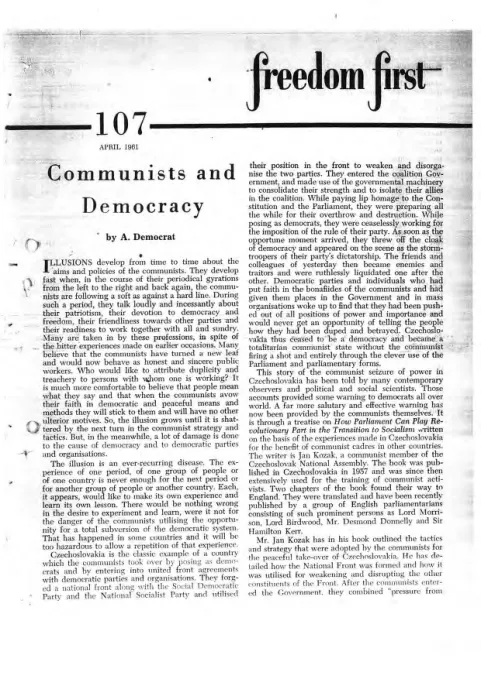
Issue No. 107 of Freedom First (April 1961) is a monthly periodical from the classical-liberal Bombay circle around the Forum of Free Enterprise and Swatantra Party, edited by V. B. Karnik and published by B. K. Desai for the Democratic Research Service. This issue opens with an unsigned analysis of the Czechoslovak communist takeover as a cautionary tale for Indian democrats, followed by a “Without Comment” column reprinting P. V. Thampy’s critique of Congress leaders fraternising with communist-sponsored cultural troupes in Kerala. M. R. Masani contributes a parliamentary speech framing the Central Budget as a fundamental choice between State-directed and free economic democracy. Economicus reviews the Central Budget 1961-62 in technical detail, an unsigned/contributed piece surveys famine conditions in China, Saadi writes on the integration of Muslims in India after Partition, V. B. Karnik reviews Selig Harrison’s book on India’s linguistic and regional fissiparous tendencies, and the issue closes with “With Many Voices,” a column of quoted extracts from other publications on communism, the Cold War, and Indian politics, plus the statutory ownership statement for Freedom First.
Key points
-
“A. Democrat“‘s “Communists and Democracy” uses Czechoslovakia’s coalition-entryism takeover as a warning that Indian communists’ parliamentary moderation is tactical, not sincere.
-
P. V. Thampy’s “Without Comment” piece criticises Congress leaders, including Nehru, for lending prestige to the communist-controlled Kerala People’s Arts Club.
-
M. R. Masani’s “Choice Before The Country” frames the 1961-62 Budget debate as a choice between a State-directed economy and “real economic democracy” based on market choice, criticising new excise duties and prestige spending.
-
“Economicus” offers a technical review of the Central Budget 1961-62, defending the tax structure while criticising the blanket cut in development rebate.
-
A contributed piece surveys deepening famine conditions in China, detailing emergency grain imports, drastically cut rice rations, and hunger riots.
-
“Saadi“‘s “The Place of Muslims In India” traces Muslim frustration to loss of political power under British rule and post-Partition leaderlessness, calling for economic inclusion.
-
V. B. Karnik reviews Selig Harrison’s “India: The Most Dangerous Decades,” crediting its warnings on regionalism while faulting it for underweighting India’s unifying factors.
-
“With Many Voices” closes with quotations on communism, the Cold War, and Indian politics.
Essays
Communists and Democracy
By A. Democrat
Writing under the pseudonym ‘A. Democrat,’ the author warns that illusions about communist intentions recur whenever communists soften their public tone, and uses Czechoslovakia as the paradigm case of a democracy destroyed from within. The communists entered a coalition government via a forged national front with Social Democrats and National Socialists, used control of the Ministry of the Interior to discredit rivals, and then discarded democratic pretense once positions of power were secured, converting the state to one-party rule without firing a shot. The essay draws on Jan Kozak’s treatise on parliamentary tactics for revolutionary transition, two chapters of which were translated into English by a group of British parliamentarians, and concludes that Indian communists’ current parliamentary moderation is a tactic, not a change of ultimate aim, since their own doctrine holds insurrectionary and parliamentary methods as complementary rather than exclusive.
- Communists’ periodic swings between soft and hard lines create recurring illusions among democrats about their sincerity.
- Czechoslovakia is presented as the classic case of communists seizing power through coalition entryism rather than open insurrection.
- Control of the Ministry of the Interior was used to discredit non-communist parties and prepare their overthrow.
- Jan Kozak’s book, written for communist cadre training, documents these tactics from the inside and was translated into English as a warning to Western parliamentarians.
- The essay argues Indian communists’ current parliamentary participation is a tactic subordinate to the long-term goal of one-party rule, not a genuine embrace of democracy.
Without Comment: Congress And Communists
By P. V. Thampy
Reprinted under the ‘Without Comment’ rubric, P. V. Thampy’s article from the pro-Congress Weekly Kerala criticises Congress leaders, including Pandit Nehru and Dr. Keskar, for lending prestige to communist-sponsored cultural troupes such as the Kerala People’s Arts Club (KPAC), whose plays were performed in Delhi. Thampy argues the Communist Party is exploiting these Congress associations to secure bookings and raise funds ahead of the general election, and notes the family connection between the KPAC’s patron and a Kerala Communist Party official as evidence that the Congress leaders were misinformed about the troupe’s political affiliation.
- The Kerala People’s Arts Club (KPAC), directly controlled by the Kerala State Committee of the Communist Party, performed plays in Delhi including ‘Ningal Annae Kommunist Akki’ before an audience including Nehru and Dr. Keskar.
- Thampy argues the Communist Party is using such Congress patronage to raise money and bookings ahead of elections.
- A family link is drawn between Sardar K. M. Panikker (who awarded the KPAC a prize via the Kerala Academy) and a secretary of the Kerala Communist Party.
- The piece implies Congress leaders were misled about the political character of the troupe they honoured.
Choice Before The Country
By M. R. Masani
In this extract from a speech delivered in Parliament on March 15, 1961, M. R. Masani frames the Budget debate as a fundamental choice between a State-directed command economy and ‘real economic democracy,’ in which the freedom of ordinary Indians to buy and sell in the market constitutes a daily ‘economic ballot’ more meaningful than a periodic vote. He invokes Jayaprakash Narayan’s complaint about the limits of parliamentary democracy and Gandhiji’s remark about distributing the Reserve Bank’s gold to the villages as evidence that decentralised economic power, not centralised planning, is the true liberal alternative. Masani then criticises the 1961-62 Budget as mischievous in three ways: new excise duties burden the poor and threaten industrial employment, wasteful non-developmental and prestige expenditure (such as a costly secondhand aircraft carrier and the fourth steel plant) crowds out productive investment, and the government’s own figures show inflationary pressure from a money supply rising faster than real income. He closes with a five-point program: cut civil expenditure, prioritise labour-intensive development, limit taxation, collect taxes honestly and efficiently, reduce capital outlay in the state sector, and replace foreign loans with foreign equity capital.
- Masani frames the Budget debate as a choice between a State-directed/communist-pattern economy and ‘real economic democracy’ based on individual consumer choice.
- He argues that everyday market transactions constitute a more meaningful ‘economic ballot’ than periodic elections, addressing Jayaprakash Narayan’s critique of parliamentary democracy’s limits.
- He criticises new excise duties (on power looms, metal sheets, diesel, newsprint) as harming the poor, industry, and the press.
- He attacks prestige and low-return development spending, citing the cost of a secondhand aircraft carrier and the fourth steel plant as examples of ‘megalomania.’
- He cites Reserve Bank and National Development Council figures to argue government policy is itself driving inflation despite official rhetoric against it.
- He proposes a five-point alternative: cut civil expenditure, favour labour-intensive projects, limit and rationalise taxation, curb tax evasion, cut state-sector capital outlay, and prefer foreign equity investment over foreign loans.
Central Budget 1961-62
By Economicus
Writing as ‘Economicus,’ the author offers a technical assessment of the Central Budget 1961-62, situating tax policy within the broader strategy of Indian economic development: reducing concentration of economic power, narrowing disparities, and financing Third Plan outlays. The essay defends the government against the charge that commodity taxation is inherently inflationary, arguing that whether prices rise depends on whether the money supply expands, not on the tax structure itself, while noting that reliance on commodity/customs and excise taxation (over direct taxation) means the burden falls widely, including on some articles of common consumption. It reviews the corporate tax changes, welcomes the restriction on entertainment expenditure but criticises the blanket cut in development rebate as insufficiently selective, endorses the Finance Minister’s rejection of an excess profits tax, and closes by examining the reasoning behind raising import duties on machinery, arguing higher duties are a poor tool for curbing excess capacity or aiding indigenous manufacturers.
- Frames the Budget’s tax proposals against the broader development goals of reducing economic concentration and narrowing disparities.
- Argues commodity taxation is not inherently inflationary; the real driver of inflation is expansion in money supply relative to national income.
- Notes only a small nominal sum (Rs. 3 crores) of new taxation comes from direct taxes versus Rs. 59.37 crores from commodity taxation (customs and excise).
- Criticises the blanket reduction in development rebate as less desirable than a selective approach targeting producers’ and capital goods industries, as originally proposed by the Taxation Enquiry Commission.
- Supports the Finance Minister’s rejection of a Member’s proposal to reimpose excess profits tax.
- Questions the logic of raising import duty on machinery from 10 to 15 percent as protection for indigenous industry, arguing it is not an effective way to discourage excess capacity.
Famine Conditions In China
By (Contributed)
This contributed, unsigned article surveys the deepening famine conditions in mainland China as of early 1961, drawing on Chinese official announcements, refugee reports in Hong Kong, and foreign press dispatches. It documents large emergency grain and fertiliser purchases from Australia and Canada paid mostly in scarce hard currency, official admissions that roughly half of China’s arable land was hit by natural calamities in 1960, and a Communist Party communique acknowledging 70 million dissatisfied citizens and instances of sabotage. The piece details the promotion of substitute foods such as chlorella pond-weed and ‘artificial meat,’ drastic cuts to daily rice rations, reports of hunger riots and killings of local cadres in Yunnan and Anhwei provinces, rising food-parcel traffic from Hong Kong refugees to mainland relatives, and the regime’s partial retreat toward ‘private enterprise’ — restoring private plots and permitting small free markets — as an emergency concession to peasants.
- China purchased large quantities of wheat, flour and barley from Australia and Canada, plus fertiliser, mostly for scarce cash, the first time China has had to import food on this scale.
- Chinese officials admitted about half the country’s 1,600 million mow of arable land was affected by natural calamities in 1960, with 300-400 million mow producing nothing.
- A Communist Party communique acknowledged roughly 70 million dissatisfied people and instances of law-breaking and sabotage among officials and the population.
- Daily rice rations were cut from 6.6 oz to 4.4 oz; substitute foods like chlorella pond-weed and ‘artificial meat’ with a ‘mud taste’ were promoted for human consumption.
- Reports describe hunger riots, plundered food depots, and killings of communist cadres in provinces including Yunnan and Anhwei.
- The regime restored private plots (about 5 percent of commune land) and permitted small free markets as a temporary concession to boost production.
The Place of Muslims In India
By Saadi
Writing under the pseudonym ‘Saadi,’ the author examines the position of Muslims in India nearly fifteen years after Partition, prompted by remarks from Mrs. Indira Gandhi (as Chairman of the AICC’s National Integration Committee) on the Jabalpur riots. The essay argues that the largest minority’s frustration predates Partition, rooted in loss of political power under British rule and the ‘divide and rule’ policy, and that the Muslim League’s emergence gave that frustration a political outlet culminating in the demand for Pakistan. After Partition, the essay contends, Muslims who remained in India were left leaderless and were slow to be emotionally integrated, citing Hindu distrust from the pre-Partition Muslim League agitation and Calcutta violence, alongside genuine economic, social and educational marginalisation and disputes over Urdu’s status. The essay concludes optimistically that most Indian Muslims have ceased looking to Pakistan, citing net Hindu migration from Pakistan exceeding Muslim migration to it, and calls for practical measures — economic inclusion, constitutional safeguards, and ending official indifference of the kind seen in the AICC’s own Fact Finding Committee report on the Jabalpur riots — to complete integration.
- Mrs. Indira Gandhi’s remarks on the Jabalpur riots, noting communal tension pre-dated the riots and Muslims became incidental victims, frame the essay’s opening.
- Muslim frustration is traced to loss of political power under British rule, compounded by British ‘divide and rule’ policy and the community’s initial refusal to take advantage of English education and new professions.
- The essay argues Partition left Muslims in India ‘absolutely leaderless’ and that Pakistan proved no solution to the grievances that produced the demand for a separate state.
- Barriers to post-Partition integration include Hindu distrust rooted in memories of Muslim League agitation, the Calcutta holocaust, and Razakar atrocities in Hyderabad, plus real economic, social and educational discrimination and the disputed status of Urdu.
- The essay concludes Indian Muslims have largely ceased looking to Pakistan for support, citing greater net Hindu migration from Pakistan than Muslim migration to it as evidence of relative security in India.
- It calls for equitable economic opportunity, enforcement of constitutional minority safeguards, and an end to official indifference, criticising the AICC’s own Fact Finding Committee findings on the Jabalpur riots.
Dangerous Decades (review of India: The Most Dangerous Decades by Selig S. Harrison)
By V. B. Karnik
V. B. Karnik reviews Selig Harrison’s book ‘India: The Most Dangerous Decades’ (Oxford University Press, Rs. 20.00), which argues that the decades following the first post-Independence decade of confidence will be the most perilous for India’s survival as a nation and a democracy, as linguistic regionalism, caste lobbies, and economic competition between states intensify centrifugal pressure. Karnik summarises Harrison’s thesis that this could force the abandonment of democracy in favour of authoritarian forms, and credits Harrison’s research while faulting him for failing to weigh unifying factors — a shared pre-British civilizational heritage, the political unity established under British rule, all-India infrastructure (railways, posts, telegraphs), and a growing pan-Indian class of politicians, administrators and thinkers — and for offering no solution despite diagnosing the disease. Karnik uses the linguistic reorganisation of Maharashtra as a counter-example showing separatist tendencies subsiding once addressed, and argues that Harrison’s feared ‘nationalist in a hurry,’ who would suppress regional claims by force, poses the real danger to democracy that Harrison identifies but does not adequately address.
- The book under review is Selig Harrison’s ‘India: The Most Dangerous Decades’ (Oxford University Press, Rs. 20.00).
- Harrison’s thesis: the decades following Independence’s first ‘decade of confidence’ will be the most dangerous, driven by linguistic regionalism, caste lobbies, and inter-state economic competition.
- Harrison predicts these centrifugal pulls could force ‘the abandonment of democracy… and the adoption of a series of authoritarian forms’ rather than national disintegration outright.
- Karnik credits Harrison’s research but argues he underweights unifying factors: shared civilizational heritage, British-era political unity, all-India infrastructure, and a growing pan-Indian elite.
- Karnik cites Maharashtra’s linguistic reorganisation as evidence that addressing regional grievances promptly defuses separatist tendencies rather than fueling them.
- Karnik warns that the ‘nationalist in a hurry’ who would suppress regional claims by force is himself a real danger to democracy, a point he feels Harrison identifies but does not resolve.
With Many Voices
The closing ‘With Many Voices’ column, prefaced with an epigraph from Tennyson, gathers short quoted extracts from a range of contemporary sources on communism, the Cold War, and Indian politics: an exchange between a Communist and a Praja-Socialist MLA in the Maharashtra Assembly on Chinese aggression, Swatantra’s argument that economic planning and parliamentary democracy cannot coexist, Chester Bowles on the clash between individual dignity and the state, Morarji Desai on India’s aid dependence, Adlai Stevenson on the historical laws governing empires, P. C. Joshi accusing the Jan Sangh of exploiting Madhya Pradesh riots, T. P. Ramanathan on investigating Lumumba’s and Imre Nagy’s murders, Khrushchev on rockets, ‘Tenax’ on Peking’s diplomacy, Sudhir Ghosh on Indo-Soviet aircraft agreements, and Senator James O. Eastland on Lincoln and Soviet propaganda spending. The issue closes with the statutory ownership statement for Freedom First, naming B. K. Desai as printer and publisher and V. B. Karnik as editor, published for the Democratic Research Service.
- The column compiles brief quotations from Indian Express, Link, The New Leader, Thought, American Embassy News Letter, New Age, Swarajya, the New York Times Weekly Review, and Bulletin (Munich), among others.
- A Maharashtra Assembly exchange has a Communist MLA (Bardhan) claim communists are patriotic, challenged by a Praja-Socialist MLA (Warty) over Chinese aggression, with a communist member (Patkar) replying ‘They are not aggressors.’
- Chester Bowles is quoted framing the ideological struggle as one between belief in individual dignity and belief that man exists to serve the state.
- Morarji Desai is quoted stating India gets only 8% of its requirements from the USSR versus about 50% from the USA.
- The statutory statement records Freedom First’s ownership: published monthly from Bombay, printed and published by B. K. Desai, edited by V. B. Karnik, owned by the Democratic Research Service.
Generated by the v1.5 extraction pipeline. Awaiting editorial review.
Metadata and summary are AI-extracted from the source PDF and reviewed for editorial accuracy. The original work is available via the Read PDF tab above (where present); paragraph-level citation inside the PDF is deferred to a future engagement.