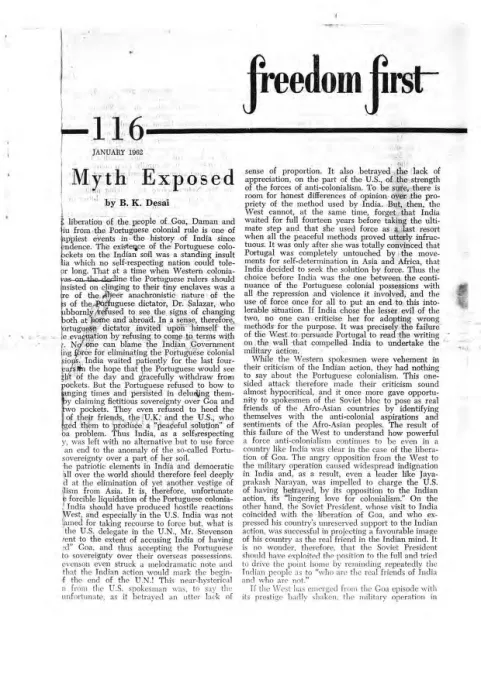
periodical issue
Freedom First
published for the Democratic Research Service by B. K. Desai at 127 Mahatma Gandhi Road, Bombay 1 · Bombay · 1961
12 pages
Freedom First
Summary
Freedom First No. 114 (November 1961) is dominated by the North Bombay parliamentary contest between Acharya J. B. Kripalani and Defence Minister V. K. Krishna Menon, framed by the magazine as a proxy battle between democracy and communist influence within the Congress. An unsigned lead editorial, “Kripalani Vs. Menon,” makes the case against Menon’s record and communist sympathies, followed by Kripalani’s own address to voters, “Why I Contest From North Bombay?”, explaining his Gandhian rationale for standing and his objections to Menon’s conduct as Defence Minister and his handling of foreign policy. Beyond the election, the issue carries international commentary: Tibor Meray’s “The Forgotten People” mourns the fifth anniversary of the 1956 Hungarian Revolution and the world’s waning attention to it; S. Sharangpani’s “Nasser And Nkrumah” compares the two leaders’ pan-nationalist ambitions and domestic authoritarianism; and M. A. Venkata Rao’s “Rethinking U.N. Policy In The Congo” argues that the UN’s Congo strategy has neglected the economic realities of Katanga’s mining wealth and proposes a negotiated settlement with Tshombe. Recurring departments — “Notes,” “Without Comment,” and “With Many Voices” — compile short editorial items and press clippings on communist infiltration of the Congress, Sino-Indian and Sino-Nepalese border developments, Soviet nuclear testing, and reactions (domestic and international) to the Kripalani-Menon contest.
Key points
-
An unsigned lead editorial, “Kripalani Vs. Menon,” frames the North Bombay parliamentary contest as a referendum on democracy versus communist influence, contrasting Kripalani’s Gandhian record with Menon’s alleged pro-Soviet sympathies.
-
Tibor Meray’s “The Forgotten People” mourns the fifth anniversary of the 1956 Hungarian Revolution and the world’s fading attention to continued repression there.
-
Acharya J. B. Kripalani’s own address to North Bombay voters grounds his candidacy in Gandhian principle, criticising Menon’s softness toward China and mismanagement of Defence.
-
S. Sharangpani’s “Nasser And Nkrumah” compares the two leaders’ pan-nationalist ambitions, tracing the collapse of Nasser’s United Arab Republic and Nkrumah’s slide into authoritarian rule in Ghana.
-
M. A. Venkata Rao’s “Rethinking U.N. Policy In The Congo” argues the UN has neglected Katanga’s economic realities and proposes a negotiated settlement with Tshombe rather than destroying his economic order by force.
-
A “Without Comment” digest reports Communist Party defections to Congress in Warangal and a three-part history of Chinese pressure on India via Tibet and the Sino-Nepalese highway agreement.
-
“Notes” and “With Many Voices” compile quotations on the North Bombay election, including K. M. Munshi calling Menon a “Trojan Horse” and Kennedy’s line on being “neither Red nor dead.”
Essays
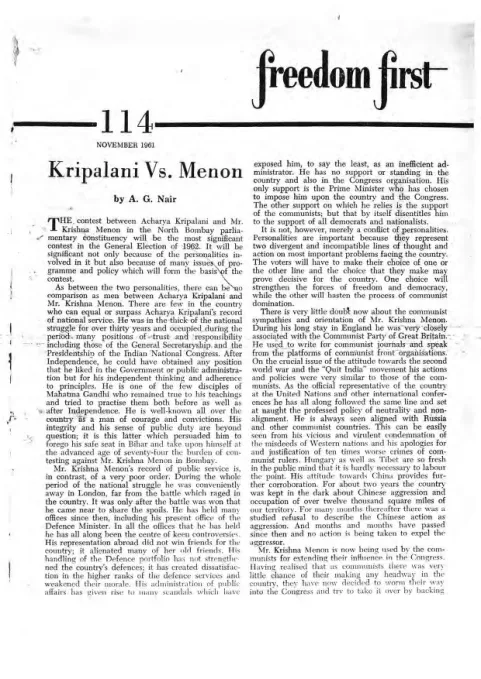
Kripalani Vs. Menon
By A. G. Nair
The unsigned lead editorial (byline “by A. G. Nair” appears under the title) frames the North Bombay contest between Acharya Kripalani and Krishna Menon as the most significant contest of the 1962 general election, arguing there is no comparison between the two men: Kripalani a lifelong Gandhian nationalist of unimpeachable integrity, Menon a poor administrator with a record of scandal, communist sympathy, and alignment with Russia against Western democracies. The piece argues Menon’s candidacy is being pushed by the Congress leadership over the objections of many Congressmen and is being actively supported by the Communist Party, which sees him as a vehicle for infiltrating Congress. It closes by casting the election as a referendum on whether India will remain a democracy or drift toward communism, non-alignment or Soviet-Chinese alignment, and clean administration or corrupt bureaucratic centralism.
- Frames the North Bombay contest as the most significant of the 1962 general election, both for personalities and for policy.
- Contrasts Kripalani’s record of national service and Gandhian discipline with Menon’s record as an absentee during the freedom struggle and a controversial Defence Minister.
- Alleges Menon’s long stay in England produced close ties to the Communist Party of Great Britain and a pro-Soviet, anti-Western orientation reflected in his UN positions.
- Cites Menon’s muted response to the Chinese occupation of 12,500 square miles of Indian territory as evidence of misplaced threat perception (blaming Pakistan instead).
- Describes the Communist Party’s strategy of backing Menon to infiltrate the Congress from within, since direct communist gains have stalled.
- Presents Kripalani as the unifying candidate of the Praja Socialist Party, Jan Sangh, Swatantra Party and non-party citizens.
- Casts the election choice as one between democracy and communism, neutral versus aligned foreign policy, and clean versus corrupt administration.
The Forgotten People
By Tibor Meray
Tibor Meray’s “The Forgotten People” reflects on the fifth anniversary of the 1956 Hungarian Revolution, contrasting the worldwide burst of sympathy and outrage in 1956 with the silence and indifference that greeted its anniversary in 1961. Meray argues that superficial improvements reported by Western tourists (better-stocked shops, cafes, relaxed appearances) mask a regime that is gradually eroding the concessions wrested from it by the suppressed revolution, while political prisoners including Professor István Bibó remain jailed. He invokes the myth of Sisyphus (via Camus) to describe Hungary’s plight: having failed to win independence and now facing indifference even from potential allies, the only dignity left to Hungarians is that they have not, through silence, become complicit in their own enslavement.
- Marks the fifth anniversary of the 1956 Hungarian Revolution and notes the contrast between the global outpouring of sympathy in 1956 and the silence in 1961.
- Cites Acharya Kripalani’s 1958 condemnation of Imre Nagy’s execution as ‘a calculated affront to the liberty and dignity of mankind.’
- Argues that Western tourists’ impressions of Hungarian well-being are superficial and conceal ongoing repression, confiscated peasant lands, and consumer shortages.
- Notes that intellectuals and journalists including Professor Istvan Bibo remain imprisoned five years after the revolution.
- Compares Hungary’s post-revolution condition to the myth of Sisyphus, per Albert Camus, as both tragedy and significance.
- Concludes that Hungarians’ only remaining hope is that free peoples abroad do not become ‘accomplices of the crime of enslaving the Hungarian people’ through silence.
Essay 3
The “Notes” department covers three items: the German-Marxist philosopher Ernst Bloch’s decision not to return to East Germany after the Berlin Wall went up, explaining in a letter to the East Berlin Academy of Sciences that he could no longer accept the repression of independent thought under the Ulbricht regime; a condemnation of Soviet nuclear testing, including the threatened 50-megaton bomb, as a ‘terrorising tactic’ defying a UN resolution passed 75-10; and a brief item flagging ‘The Council of National Studies’ as a new communist front organisation associated with Dr. A. V. Baliga and inaugurated by the Prime Minister.
- Reports philosopher Ernst Bloch’s refusal to return to East Germany from a Tubingen visit, citing repression after August 13 (the Berlin Wall).
- Notes Bloch’s prior discharge from Karl Marx University, Leipzig, and forbiddance from publishing or travel after his pupil Wolfgang Harich was imprisoned.
- Condemns Soviet resumption of atomic testing, including a threatened 50-megaton bomb, as violating a prior test-ban agreement.
- Cites a UN Political Committee resolution (75-10) appealing to Khrushchev to halt the tests, opposed only by the Soviet bloc and Cuba.
- Flags ‘The Council of National Studies’ as a new communist front organisation, associating Dr. A. V. Baliga with it and noting the Prime Minister inaugurated it.
Why I Contest From North Bombay?
By Acharya J. B. Kripalani
In this address to North Bombay voters, Acharya J. B. Kripalani explains his decision to contest against Krishna Menon as an act of conscience rooted in Gandhian principles rather than personal or party ambition, describing his lifelong commitment to Gandhiji’s philosophy of self-purification, non-exploitation, and constructive work through the Gandhi Ashram in Uttar Pradesh. He argues that unemployment and rural poverty have worsened rather than improved under the Congress government’s planning, quoting former Congress President Dhebar’s admission that ‘the rich have grown richer and the poor poorer.’ Kripalani defends his acceptance of support from otherwise-opposed parties (Praja Socialist, Jan Sangh, Swatantra) as analogous to Gandhiji’s own practice of accepting help from disparate groups for causes of common concern, and states his central objection to Menon is not personal but concerns his perceived softness toward Communist China, his mismanagement of Defence Ministry affairs (including army morale and the jeep scandal), and his friendliness toward the Communist Party of India, which he argues threatens to subvert the Congress from within.
- Grounds his candidacy in Gandhian philosophy of self-purification, non-exploitation, and constructive work rather than personal ambition.
- Cites his production of Rs. 2 crores of khadi annually through the Gandhi Ashram, Uttar Pradesh, employing 4,000 organisers and 25,000 craftsmen.
- Quotes former Congress President Dhebar’s admission that under Swaraj ‘the rich have grown richer and the poor poorer.’
- Defends accepting help from ideologically disparate parties (Praja Socialist, Jan Sangh, Swatantra) as consistent with Gandhiji’s practice of accepting cooperation from all for causes of common concern.
- Criticises Krishna Menon’s handling of Communist China’s occupation of 12,500 square miles of Indian territory versus his greater vigilance on Pakistan.
- References the jeep negotiations scandal and army morale problems as evidence of Menon’s poor administration of Defence.
- Argues Menon is friendly to the Communist Party of India, which never criticises him, and that this friendliness helps communists penetrate the Congress from within.
- States his opposition is one of principles, not personal animus, and that he considers himself still helping the Prime Minister and the Congress.
Nasser And Nkrumah
By S. Sharangpani
S. Sharangpani compares Gamal Abdel Nasser and Kwame Nkrumah as leaders whose ambitions transcend their own countries: Nasser as self-styled leader of Arab unity, Nkrumah as would-be liberator of a united Africa. The essay argues both leaders’ anti-Western, anti-imperialist rhetoric led them into alignment with communist sympathies, and traces the collapse of Nasser’s Pan-Arab project after Syria’s 1961 secession from the United Arab Republic, alongside Nkrumah’s increasingly authoritarian rule in Ghana — including preventive detention laws, a personality cult (Osagyefo), a collapsing cocoa-dependent economy, and mass arrests of opposition leaders. The piece concludes that both men’s claims to continental leadership are undermined by their failure to secure durable loyalty even within their own countries, with Nkrumah now living in fear of his own people and Nasser’s Pan-Arabism dealt ‘a deadly blow’ by the Syrian breakaway.
- Compares Nasser’s Pan-Arabism and Nkrumah’s Pan-Africanism as parallel projects of aggressive, personality-driven leadership beyond their national borders.
- Notes both leaders’ anti-Western orientation drove them toward alignment with, or exploitation by, communist powers.
- Traces the 1958 formation and 1961 collapse of the United Arab Republic (Egypt-Syria union) as the central failure of Nasser’s Pan-Arab ambitions.
- Describes Nkrumah’s 1959 ‘democratic centralist’ state model, Preventive Detention Act, and cult of personality (Osagyefo, the Messiah).
- Documents Ghana’s economic crisis from falling cocoa prices, resulting austerity measures, and a wave of strikes met with further repression.
- Concludes Nkrumah now fears his own people, heavily guarded and absent from public view, while Nasser’s authority, though still popular in Egypt, has been damaged regionally by Syria’s secession.
Rethinking U.N. Policy In The Congo
By M. A. Venkata Rao
M. A. Venkata Rao argues that the United Nations’ Congo policy has reached a deadlock because it has neglected the economic dimension of the crisis, particularly the vast mining wealth of Tshombe’s breakaway Katanga province developed over 25 years by Belgian, British and other foreign interests. While endorsing the UN’s goal of a unitary Congo and Nehru’s contribution in backing the use of force, the essay contends that destroying Tshombe and the economic order he protects would be a ‘communist’ method of destruction-first, and instead proposes negotiating a treaty guaranteeing the continuity of existing economic enterprises under the political supremacy of a new Congo government, with mine royalties, guaranteed places for Tshombe’s provincial government, and a gradual transfer of shares to Africans over ten to twenty years.
- Argues the UN’s Congo strategy has neglected the economic reality of Katanga’s mineral wealth, which produces about twenty million pounds sterling annual profit.
- Criticises Lumumba’s shifting alliances (American businessmen, UN, Ghana, other African states, then Russia and its satellites) as having driven the West to back Kasavubu.
- Endorses the principle of a unitary Congo state and credits Nehru’s support for the use of UN force, including six Canberras.
- Proposes negotiations with Tshombe and his foreign backers for a treaty guaranteeing continuity of economic enterprises under the new Congo government’s political authority.
- Recommends mine royalties to the new government, guaranteed provincial government roles for Tshombe’s allies (or a five-year federal transition), and gradual transfer of mining shares to Africans over ten to twenty years.
Without Comment
By MA Venkata Rao
The “Without Comment” department reprints press items without editorial commentary: warnings from former RBI Governor Benegal Rama Rao about communist infiltration of the Congress; reports of Communist Party defections to the Congress in Warangal district and of Red sympathisers Dr. A. V. Baliga and Mulk Raj Anand joining Congress ahead of Krishna Menon’s election campaign; a three-part ‘Price of Panchsheel’ series on Chinese pressure on India via Tibet and the Sino-Nepalese highway agreement, including an account of the Nehru government suppressing a 1953 Tibet Committee and later Himalayan Border Conference; consumer shortages in communist Eastern Europe; and Nehru’s criticism of moneyed Congress donors alongside a report on the party’s new decentralized election-fund structure.
- Reprints Benegal Rama Rao’s warning that Communist Party infiltration of Congress threatens to produce a totalitarian slide if unopposed.
- Reports Communist Party defections to Congress in Warangal district, once a Telangana insurgency stronghold.
- Flags Dr. A. V. Baliga and author Mulk Raj Anand, both described as Red sympathisers, joining Congress ahead of Krishna Menon’s North Bombay campaign.
- Recounts a three-part ‘Price of Panchsheel’ history: the 1950 invasion of Tibet, the Nehru government’s 1953 suppression of a Tibet Committee (led by Munshi Ahmed Din, Shri Gurupadaswami, and Prof. Tilak Raj Chadda), and the 1961 Sino-Nepalese highway and boundary agreements extending Chinese influence toward the Indian border.
- Documents consumer shortages (food, refrigerators) in Czechoslovakia, Hungary and Bulgaria as evidence of hardship in communist countries.
- Reports Nehru’s criticism of Congress accepting donations from donors without faith in party principles, and describes a new decentralised, state-level election fund-raising structure.
With Many Voices
“With Many Voices” collects short quotations from the international and Indian press, most concerning the North Bombay election and Cold War themes. Domestic quotes range from K. M. Munshi and S. Natarajan denouncing Krishna Menon as a ‘Trojan Horse’ more dangerous than an avowed communist, to Sanjiva Reddy noting the irony of the Congress declining to call China an aggressor. International quotes include Senator Barry Goldwater calling Nehru a ‘wishy-washy neutral,’ A. M. Rosenthal criticising Nehru’s reluctance to speak plainly on Hungary, and President Kennedy’s line ‘If we can be purposeful, we shall be neither Red nor dead, but alive and free.’ The page is torn/obscured at the right margin, cutting off the final continued item on Congress election-fund financing.
- Collects press quotations largely concerning the Kripalani-Menon contest and broader Cold War themes.
- K. M. Munshi: ‘Every vote cast for Mr. Menon is a vote for Chinese occupation in this country.’
- S. Natarajan contrasts Kripalani as ‘pre-eminently a Congressman’ with Menon as ‘a communist’ whatever label he goes by.
- Sanjiva Reddy notes the irony that communists, despite China’s occupation of 12,000 square miles of Indian territory, still refuse to call China an aggressor while urging force to recover Goa.
- Senator Barry Goldwater is quoted from the US Senate calling Nehru a ‘wishy-washy neutral’ unsuited even to the Hammarskjold post.
- President Kennedy is quoted: ‘If we can be purposeful, we shall be neither Red nor dead, but alive and free.’
- The final column continues an item (from page 11) on Congress fund-raising and jeep/loudspeaker procurement for the coming election, cut off by page damage.
Generated by the v1.5 extraction pipeline. Awaiting editorial review.
Notes (Choice of Freedom; Terrorising Tactics; Another Front Organisation)
No summary was extracted for this article. Listed for completeness.
Metadata and summary are AI-extracted from the source PDF and reviewed for editorial accuracy. The original work is available via the Read PDF tab above (where present); paragraph-level citation inside the PDF is deferred to a future engagement.