periodical issue
Freedom First
published for the Democratic Research Service by B. K. Desai at 127 Mahatma Gandhi Road, Bombay 1 · Bombay · 1962
12 pages
Freedom First
Summary
Freedom First issue 116 (January 1962) is dominated by Cold War anxieties refracted through Indian foreign policy. The lead pieces defend India’s December 1961 military liberation of Goa against Western criticism while using the episode to indict Nehru’s own “non-violence” rhetoric as exposed hypocrisy, and print in full Jayaprakash Narayan’s anguished statement reconciling his pacifism with support for the Goa action. Surrounding essays survey Communist advances and threats across the world stage — guerrilla war in South Vietnam, Soviet subversion in Guinea, the U.N.’s military intervention against Katanga in the Congo, and a sharp critique of Nehru’s credulity toward Soviet intentions — while shorter items (a press-digest column, a letter on a transport strike in Ahmedabad, and a page of quoted opinion) round out the issue with domestic and editorial commentary.
Key points
-
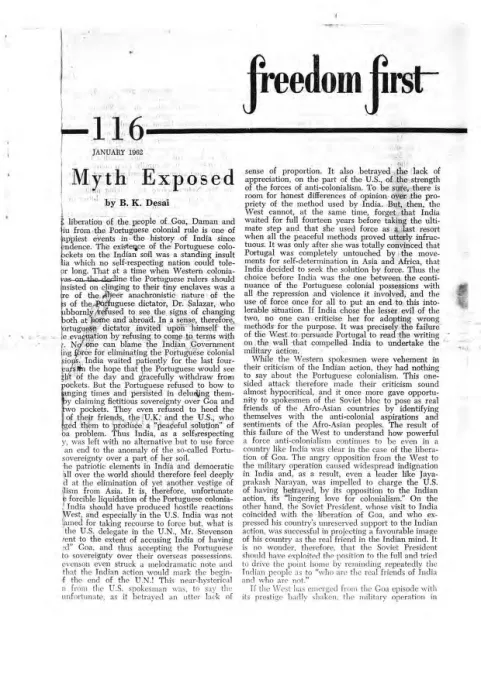
B. K. Desai’s “Myth Exposed” defends India’s December 1961 military liberation of Goa as the justified end of fourteen years of failed peaceful appeals, arguing it shattered the Western myth of Nehru as a pure apostle of non-violence.
-
Jayaprakash Narayan’s “A Plea For Positive Non-Violent Action” reproduces his statement on Goa, mourning that force was needed while faulting non-violent leaders, himself included, for neglecting active engagement.
-
P. G. Honey’s “Guerrilla War In South Vietnam” traces the Viet Cong insurgency’s origins to the 1954 Geneva partition and describes Diem’s countermeasures against communist infiltration.
-
M. A. Venkata Rao’s “Illusion About Russian Foreign Policy” attacks Nehru’s belief that Soviet and Chinese communism are more nationalist than internationalist, citing Stalin’s broken postwar promises.
-
Adam Adil’s “United Nations & Congo” questions the legitimacy of UN military force against Katanga’s secession, arguing Tshombe enjoys genuine popular support.
-
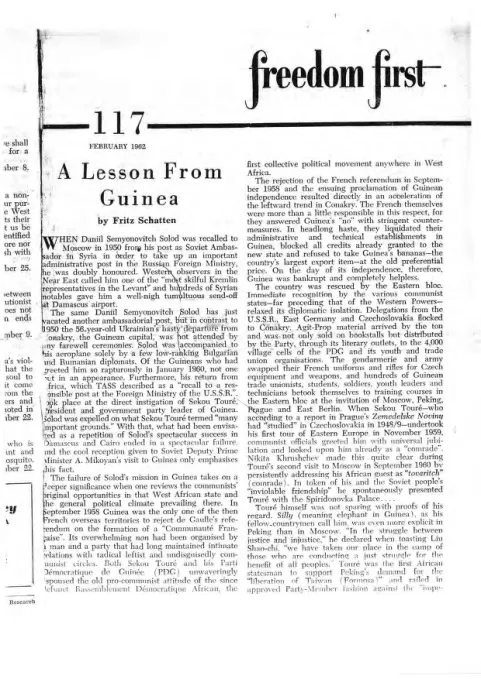
A contributed piece on “Communist Conspiracy In Guinea” recounts President Sekou Toure’s expulsion of the Soviet ambassador after uncovering an alleged subversive plot.
-
A “Without Comment” digest and press-clipping cluster note CPI general secretary Ajoy Ghosh’s pledge of support for Krishna Menon’s candidacy and his contradictory statements on Chinese aggression.
-
A reader’s letter on an Ahmedabad transport strike is offered as a cautionary tale about nationalisation, and “With Many Voices” closes with quotations mocking Nehru’s inconsistency on non-violence and force.
Essays
Myth Exposed
By B. K. Desai
B. K. Desai’s “Myth Exposed” defends India’s December 1961 military liberation of Goa, Daman and Diu from Portuguese rule as the justified end to a fourteen-year policy of patient, peaceful appeals that Portugal’s dictator Salazar refused to answer. The essay accuses Western critics — Britain and the United States chief among them — of hypocrisy for condemning India’s use of force while ignoring the intolerable and anachronistic nature of Portuguese colonialism itself, and argues the episode exposed Krishna Menon’s political opportunism in timing the operation for electoral advantage. Its central charge is that the Goa operation shattered the Western-built myth of Nehru as a pure apostle of non-violence, revealing his policy of “negotiating to the bitter end” as empty moralizing with no relevance to real politics — a lesson the author says should also govern India’s approach to the Sino-Indian border dispute, where similar peaceful appeals have equally failed.
- India waited fourteen years for Portugal to negotiate Goa’s status peacefully before resorting to force in December 1961.
- Western nations (Britain, the U.S.) that criticized India’s use of force are charged with hypocrisy for tolerating Portuguese colonialism.
- The author accuses Krishna Menon of timing the Goa operation to boost his own electoral prospects amid criticism over the Chinese border issue.
- Nehru’s reputation as an apostle of non-violence is described as a myth, since the Goa action shows he was willing to use force when peaceful methods failed.
- The Soviet Union used the episode to present itself as a friend of Afro-Asian anti-colonial sentiment, embarrassing the West further.
- The essay argues the same lesson — that peaceful negotiation alone is futile against an intransigent adversary — applies to the Sino-Indian dispute.
A Plea For Positive Non-Violent Action
By Jayaprakash Narayan
This item reproduces in full a statement by Jayaprakash Narayan on the liberation of Goa. Narayan, a committed pacifist who regards violence as immoral even in a good cause, expresses sorrow that India resorted to force but places the blame for that outcome on the West’s fourteen years of failure to press Portugal toward a peaceful resolution, and even more on India’s own non-violent movement (himself included) for having turned away from the international disputes it might have helped resolve through active non-violent means such as Shanti Sena, Bhoodan and Gramdan. He argues that non-violent leadership requires action, not passive waiting on governments, and that India’s people, more than any other, are equipped for that task.
- Narayan welcomes the end of the last vestige of colonialism from Indian soil but mourns that his country had to use force to achieve it.
- He argues Britain and the U.S., as NATO powers, betrayed their professed anti-colonial ideals by failing to compel Portugal to negotiate over fourteen years.
- He refuses to blame Nehru or the Government of India alone, instead faulting non-violent leaders like himself and the Shanti Sena for turning their backs on international disputes.
- He calls for renewed heart-searching among India’s non-violent movement and for positive, active non-violent leadership rather than passive waiting for governments to act.
- He states that India’s people are uniquely fitted in the world for the task of positive non-violent action.
Guerrilla War In South Vietnam
By P. G. Honey
P. G. Honey’s “Guerrilla War In South Vietnam” explains the origins and escalation of the Viet Cong insurgency against President Ngo Dinh Diem’s government, tracing it to the 1954 Geneva Conference’s division of Vietnam and the failure to hold the promised 1956 reunification elections. It describes how North Vietnamese Communists infiltrated agents and supplies southward through Laos and Cambodia from 1957 onward, using classic guerrilla tactics — terrorizing villages, assassinating headmen, and expanding outward like “an oil stain” — to destabilize the countryside, and details Diem’s countermeasures, including the regular army, the Civil Guard, village militia (Tu-Ve), Agrovilles, land reform, and rural cooperatives, while noting that the guerrillas’ momentum continued to threaten the survival of South Vietnam as a non-Communist state.
- The division of Vietnam at the 1954 Geneva Conference and the failure to hold 1956 reunification elections set the stage for the insurgency.
- North Vietnamese Communists infiltrated agents and supplies into South Vietnam via Laos and Cambodia from 1957 onward using the route later known as the Ho Chi Minh trail.
- Viet Cong tactics involve terrorizing isolated villages and expanding their controlled territory outward like an oil stain.
- President Diem’s government relies on three forces — the regular army, the Bao-An (Civil Guard), and the Tu-Ve village militia — with the Viet Cong holding a persistent tactical advantage.
- Diem’s government has paired military resistance with civil measures: Agrovilles, land reform, and rural cooperative societies to weaken the Viet Cong’s appeal.
- The author frames the outcome of the conflict as consequential for whether Communism expands through South and Southeast Asia.
Illusion About Russian Foreign Policy
By M. A. Venkata Rao
M. A. Venkata Rao’s “Illusion About Russian Foreign Policy” attacks Nehru’s interpretation of Soviet and Chinese Communism as more nationalist than internationalist, arguing this naive appraisal ignores the doctrinal commitment of Marxism-Leninism to world revolution, as evidenced by Stalin’s post-war betrayal of wartime promises, the Sovietization of Eastern Europe, and China’s actions in Tibet and Ladakh. The essay quotes at length from Michael Brecher’s biography of Nehru to show the Prime Minister’s overly sympathetic reading of Soviet intentions, and contends that the Cold War is the inevitable outcome of Kremlin policies aimed at world conquest for communism, not a state of mutual blame as Nehru suggests.
- The Prime Minister’s view that Chinese and Russian communism are essentially nationalist rather than internationalist is characterized as a dangerous illusion.
- Stalin’s broken promises after World War II and the Sovietization of Poland, Romania, Bulgaria, Hungary and Czechoslovakia (1945-48) are cited as evidence of Soviet expansionist intent.
- The essay quotes Stalin’s own writings on world revolution as a “lever for the further disintegration of imperialism” to rebut Nehru’s benign interpretation.
- Nehru’s 1958 remarks to biographer Michael Brecher expressing trust in eventual Soviet withdrawal from Eastern Europe are presented as naive given China’s subsequent invasion of Tibet.
- The author argues the Cold War is the inevitable result of aggressive Kremlin policy, not a matter for which both sides are equally to blame as Nehru suggests.
- The essay links this critique to fears about a shift toward toughness at the 22nd Communist Party Congress under Khrushchev.
United Nations & Congo
By Adam Adil
Adam Adil’s “United Nations & Congo” examines the U.N.’s use of military force against Katanga’s secession from the Congo, questioning whether the U.N. has the right to impose a political solution by arms while denying Katanga’s own claim to self-determination. The essay surveys the divided motives of Western powers — Britain, France and Belgium’s financial stakes in Katanga’s mineral wealth (via Union Miniere) versus the United States’ backing of the central Adoula government — and argues that Katanga’s continued resistance shows genuine popular support for Tshombe, concluding that Congo’s unity should be pursued through persuasion and shared prosperity rather than force.
- The essay questions the legitimacy of U.N. military action against Katanga on grounds of self-determination.
- Britain, France and Belgium are said to oppose ending Katanga’s secession for financial reasons tied to the Union Miniere mining concern’s dividends and Katangese copper, cobalt and other mineral wealth.
- The United States is described as backing the U.N.’s campaign to force Katanga into union with the Adoula government, viewing Tshombe as a threat to Congo’s stability.
- The revolt of Katangese people (except the Baluba tribe) against U.N. action is cited as evidence that Tshombe enjoys genuine popular support, not merely mercenary backing.
- The essay attributes much of the blame for Congo’s post-independence chaos to Patrice Lumumba’s handling of the transition from Belgian rule.
- The author advocates persuasion and shared economic benefit, not military coercion, as the path to a unified and stable Congo.
Communist Conspiracy In Guinea
By (Contributed)
This contributed piece, “Communist Conspiracy In Guinea”, recounts the November-December 1961 crisis in which Guinea’s President Sekou Toure expelled the Soviet ambassador after uncovering what the government described as a Communist-backed subversive plot involving the Guinean Teachers’ Union, following student riots and harsh prison sentences for union leaders. It profiles the expelled ambassador Daniel Solod’s long career cultivating Communist influence across the Middle East and Africa, framing Guinea’s turn against Soviet interference as a notable reversal given the country’s previously close ties to Communist doctrine since independence.
- Guinea’s High Court sentenced five Teachers’ Union leaders to prison terms in November 1961 for allegedly distributing subversive material.
- Student protests against the sentences led to school closures and further unrest, which President Sekou Toure’s government characterized as part of a Communist counter-revolutionary plot.
- Toure’s government expelled Soviet Ambassador Daniel Solod in December 1961, alleging a subversive network reaching from an Eastern bloc embassy in Conakry.
- The essay profiles Solod’s career history in the Middle East (Beirut, Cairo) as evidence of a broader Soviet strategy to use Guinea as a bridgehead for Communist penetration of West Africa.
- The episode is presented as a watershed in Soviet-Guinean relations given Guinea’s prior status as a close Communist partner among newly independent African states.
Without Comment
The “Without Comment” column reprints without editorial elaboration a series of press clippings from December 1961: Fidel Castro’s public declaration of himself as a lifelong Marxist-Leninist (Christian Science Monitor), commentary questioning whether Indonesia might move against Western New Guinea as India did in Goa and reviewing the Dutch record on self-government there (Statesman), and a report that Indian Communist Party general secretary Ajoy Ghosh denied Chinese aggression on the northern border while a party colleague offered a contradictory line (undated wire item).
- Castro is quoted declaring “I am a Marxist-Leninist and will be one until the day I die” and praising Lenin and the Bolshevik revolution.
- A Statesman piece from December 22 weighs whether Indonesia’s claims to Western New Guinea parallel India’s action in Goa, concluding the parallel is weaker given the distinct ethnic character of the Papuan population.
- The column notes Dutch moves toward self-government in Western New Guinea via an elected New Guinea Council inaugurated in April 1961.
- A wire report records CPI general secretary Ajoy Ghosh stating China had not committed aggression on India’s northern border, contradicted by colleague Dr. Z.A. Ahmed’s more critical remarks on the same day.
Indian Communists & Menon / Two Red Voices / India’s Double Standard (news-clipping digest)
A cluster of short press-reprint items on page 10 — “Indian Communists & Menon,” “Two Red Voices,” and “India’s Double Standard” — report that CPI general secretary Ajoy Ghosh pledged party support to V. K. Krishna Menon’s Lok Sabha candidacy, note the embarrassment of Ghosh contradicting himself and a party colleague on the same day over whether China had committed aggression against India, and describe India’s abstention from a U.N. General Assembly debate criticizing Chinese repression in Tibet as evidence of a double standard given India’s own criticism of Portugal over Goa.
- CPI general secretary Ajoy Ghosh pledged the Communist Party’s electoral support for V. K. Krishna Menon in the North Bombay Lok Sabha constituency.
- Ghosh publicly reversed himself within the same press conference on whether China had committed aggression on India’s northern border.
- The Soviet delegate at the U.N. reportedly equated Indian criticism of Chinese repression in Tibet with U.S. criticism of Indian action in Goa.
- India abstained from a U.N. General Assembly debate on a Malayan resolution condemning human rights violations in Tibet despite a strong case built by the International Commission of Jurists.
Letter to the Editor: Consequences of Nationalisation
By An Observer
A “Letter to the Editor” signed “An Observer” (Ahmedabad, November 30) recounts a four-hour strike by drivers of the Ahmedabad Municipal Transport Service in November 1961, arguing the strike — triggered by a dispute between transport administration and police over bus parking — exposed collusion between the nationalised undertaking’s management and its Congress-affiliated trade union (INTUC), used to pressure police into permitting unauthorized parking. The letter treats the episode as a cautionary instance of the dangers of nationalisation, where citizens lose the protections a government-run industry is meant to secure.
- Ahmedabad Municipal Transport Service drivers struck for four hours on November 16, 1961 after police complaints about illegal bus parking.
- The letter argues the strike resulted from collusion between the nationalised transport administration and its INTUC-affiliated union to pressure the police.
- It notes the same political party (Congress) controls both the Municipal Corporation and the drivers’ union, creating a conflict of interest.
- The author concludes the episode is a cautionary tale about nationalisation stripping citizens of the freedoms and protections it was meant to provide.
With Many Voices
The closing “With Many Voices” column collects short quoted excerpts from Indian and international commentators on the Goa episode, Krishna Menon, and Cold War hypocrisy, drawn from sources including the Indian Express, Swarajya, Time magazine, and Khrushchev’s remarks to Hindu. Recurring themes are criticism of Nehru’s perceived double standard on non-violence and force, skepticism of Krishna Menon’s political durability, and mockery of Western and Indian claims to consistent moral positions on colonialism and communism.
- Prof. Sidney Hook is quoted arguing anti-communism is a necessary but not sufficient condition for liberalism.
- Frank Moraes is quoted multiple times criticizing both Krishna Menon’s political durability and Nehru’s self-contradictory stance on violence and non-violence.
- Khrushchev is quoted joking that a communist Kennedy would give the two leaders “a common language”.
- Time magazine likens Nehru to a man trampled by an elephant (China) who instead goes after a mosquito (a smaller irritant), implicitly referencing Goa versus the China threat.
Generated by the v1.5 extraction pipeline. Awaiting editorial review.
Metadata and summary are AI-extracted from the source PDF and reviewed for editorial accuracy. The original work is available via the Read PDF tab above (where present); paragraph-level citation inside the PDF is deferred to a future engagement.