periodical issue
Freedom First
Published for the Democratic Research Service by B. K. Desai at 127 Mahatma Gandhi Road, Bombay 1. Edited by V. B. Karnik and printed at Inland Printers, 55 Gamdevi Road, Bombay 7. [Front matter box:] FREEDOM FIRST, Published on the first of each month. Annual Subscription: Rs. 3. Single Copy: 25 nP. Maneckji Wadia Building, 4th Floor, 127 Mahatma Gandhi Road, Bombay 1. · Bombay · 1962
12 pages
Freedom First
Summary
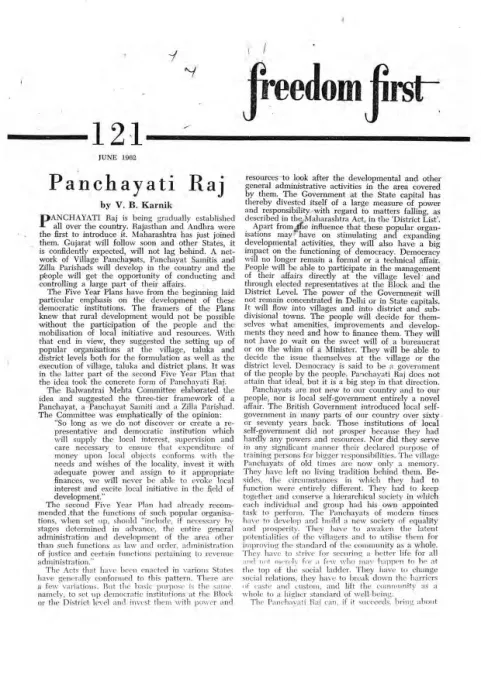
This June 1962 issue of Freedom First (No. 121), edited by V. B. Karnik and published in Bombay for the Democratic Research Service, is anchored by Karnik’s own lead essay on the newly-introduced Panchayati Raj system, weighing its democratic promise against the risk of capture by monied and factional interests at the village level. The issue’s other pieces track the classical-liberal magazine’s recurring preoccupations: anxiety over Communist strategy and Sino-Soviet conduct (an unsigned report on the Communist-organised World Youth Festival planned for Helsinki, and M. A. Venkata Rao’s essay unpacking Lenin’s doctrine of ‘revolutionary defeatism’ as a lens on the Indian Communist Party’s equivocation over the China border dispute), domestic trade-union politics (S. R. Mohan Das on the Hind Mazdoor Sabha’s convention and its rivalry with INTUC and AITUC), and a mix of shorter editorial ‘Notes,’ a book review of a study on ex-Nazis in post-war Germany, a ‘Without Comment’ page of press clippings on Soviet arms deals and Chinese border provocations, and a closing page of quotations (‘With Many Voices’).
Key points
-
V. B. Karnik’s lead essay on Panchayati Raj weighs its democratic promise against the risk of capture by monied or casteist local interests, urging consensus-based rather than contested village elections.
-
Notes welcome Dr. Radhakrishnan’s election as President, condemn Djilas’s secret trial in Yugoslavia, and question the secrecy surrounding India’s reported MIG jet deal with the Soviet Union.
-
An unsigned report traces troubled preparations for the Communist-organised World Youth Festival planned for Helsinki, describing it as an instrument of international communist policy over Finnish objections.
-
S. R. Mohan Das’s report on the Hind Mazdoor Sabha’s Coimbatore convention traces the union federation’s decline from nearly 900,000 to roughly 250,000 members since the 1950 Bombay textile strike.
-
V. B. K. reviews T. H. Tetens’s “The New Germany and the Old Nazis”, judging its claims about a revived Nazi presence in West Germany likely one-sided but useful for balance.
-
M. A. Venkata Rao’s “Revolutionary Defeatism” applies Lenin’s doctrine of welcoming one’s own government’s defeat to warn that Indian Communists would ideologically favour Indian military defeat in a future clash with China.
-
A “Without Comment” digest covers delayed Soviet generator deliveries, Chinese firing on an Indian policeman at Kalimpong, and rising Soviet executions.
-
“With Many Voices” closes with Khrushchev mocking “pants-less Communism” and Frank Moraes criticising Nehru’s economic thinking as decades out of date.
Essays
Panchayati Raj
By V. B. Karnik
V. B. Karnik’s lead article surveys the rollout of Panchayati Raj across India following the Balwantrai Mehta Committee’s recommendations, describing the three-tier structure of Village Panchayats, Panchayat Samitis, and Zilla Parishads and its roots in the Second and Third Five Year Plans. Karnik argues the reform could genuinely decentralise power away from Delhi and state capitals and let villagers manage their own development, but warns at length that panchayats can just as easily be captured by entrenched, monied, or casteist local interests, becoming instruments of factional oppression rather than democratic self-rule. He closes (in the continuation on page 11) by urging that village panchayat elections be avoided altogether in favour of consensus-based selection, citing Jayaprakash Narayan’s advocacy of this method, and cautions political parties against injecting factional contests into local bodies.
- Panchayati Raj had already been introduced in Rajasthan and Andhra, with Maharashtra just joining and Gujarat expected to follow.
- The three-tier framework (Panchayat, Panchayat Samiti, Zilla Parishad) originates in the Balwantrai Mehta Committee’s report.
- Karnik frames Panchayati Raj as a potential ‘veritable revolution in the countryside’ that could make democracy real and stable rather than formal.
- He warns that panchayats can be captured by monied people, caste loyalties, and small coteries, becoming tools of self-aggrandisement or oppression of minorities.
- He calls popular education the most effective guarantee against this degeneration, since good laws and institutions are not sufficient by themselves.
- Political parties are warned against splitting rural areas into rival factions through contested local-body elections.
- The continuation urges avoiding village-level elections in favour of selection by common consent or consensus, crediting Jayaprakash Narayan with recommending this method.
Notes (Welcome; Man of Courage and Convictions; MIG Deal; Boneless Wonder; “Complete Distortion”)
The ‘Notes’ section is a set of short unsigned editorial comments. It welcomes the election of Dr. Sarvapalli Radhakrishnan as President and Dr. Zakir Hussain as Vice-President of India, praising both as eminent philosopher-educationists. It condemns the secret trial and eight-year sentence given to Milovan Djilas in Yugoslavia for writing and attempting to publish ‘Conversations with Stalin,’ framing it as an affront to free expression. A note on the ‘MIG Deal’ questions the mystery and secrecy surrounding India’s reported move to buy Soviet MIG fighter jets, suspicious of dependence on a communist supplier. ‘Boneless Wonder’ discusses H. V. Kamath’s attack on the Government’s inaction against Chinese border aggression, partly endorsing his anger while noting the government’s greater worry about Pakistan versus China. ‘Complete Distortion’ criticises former Ambassador K. P. S. Menon’s remarks suggesting Soviet Republics were not held together ‘simply by force,’ arguing Communist Party control is itself a major coercive factor.
- Welcomes Dr. Radhakrishnan as President and Dr. Zakir Hussain as Vice-President as outstanding philosopher-educationists.
- Condemns Milovan Djilas’s secret trial and over eight-year sentence for writing ‘Conversations with Stalin.’
- Raises suspicion about the secrecy of a reported Indian deal to buy Soviet MIG jet fighters and India’s growing dependence on a communist arms supplier.
- Discusses H. V. Kamath’s ‘boneless wonder’ charge against the Indian government’s handling of Chinese border aggression.
- Criticises the Defence Minister for treating the China threat as less serious than the Pakistan threat.
- Pushes back on K. P. S. Menon’s claim that Soviet Republics were not held together ‘simply by force,’ pointing to Communist Party control as coercive.
Communist World Youth Festival
By (Contributed)
An unsigned, contributed report traces the troubled preparations for the Eighth World Festival of Youth and Students, planned for Helsinki in summer 1962, drawing a parallel to the contentious Seventh Festival held in Vienna in 1959. The piece argues the Festivals are not genuine friendship gatherings but instruments of Communist international policy, organised by the World Federation of Democratic Youth (WFDY) and the International Union of Students (IUS), both based in the Soviet bloc. It documents the Finnish government’s and Finnish youth organisations’ (SYL and the Council of Finnish Youth Organisations) strong opposition to hosting the Festival, the International Preparatory Committee’s disregard for that opposition, and statements by Soviet delegation chairman Peter Reshetov on why Helsinki’s proximity to the USSR made it a convenient site. The article concludes that the Festival will be ‘just another mass manifestation’ of Communist and pro-Communist youth, held in Finland against the will of Finnish youth and the public.
- The Eighth World Festival of Youth and Students is planned for Helsinki in summer 1962, following the contentious Seventh Festival in Vienna (1959).
- The Festivals are organised by two communist-dominated international bodies: the World Federation of Democratic Youth (Budapest) and the International Union of Students (Prague).
- Finnish youth organisations (SYL, the Council of Finnish Youth Organisations) and the Finnish government expressed strong, documented opposition to hosting the event.
- The International Preparatory Committee is described as disregarding Finnish national youth organisations and dealing directly with the Finnish government instead.
- Soviet delegation chairman Peter Reshetov argued Helsinki’s proximity to the USSR made travel easier for Soviet-bloc delegations.
- The article frames the Festival as Communist international propaganda rather than a genuine gathering of world youth.
The Hind Mazdoor Sabha Convention
By S. R. Mohan Das
S. R. Mohan Das reports on the Hind Mazdoor Sabha’s (HMS) annual convention held in Coimbatore in early May, using it as an occasion to trace the union federation’s history and decline. Formed by Socialists after Communists captured the AITUC and Congress spun off INTUC, HMS once claimed nearly 900,000 members but has fallen to roughly 250,000, weakened by the 1950 Bombay textile strike defeat, the Lohia group’s split from the Praja Socialist Party, and the fallout from the 1960 Central Government employees’ general strike. The essay diagnoses HMS’s core problems as failure to consolidate earlier strength, weak organisational apparatus with excessive local autonomy for individual union leaders, and a persistent ‘doctrinaire’ idealism that produces impulsive, adventurist actions rather than steady institution-building. The piece (continued from page 7 onto page 8) proposes concrete remedies: consolidating unions with stronger organisational bases, greater cooperation with non-HMS unions, and strengthening the national headquarters.
- HMS’s convention was held in Coimbatore, Tamilnad, in the first week of May 1962.
- HMS was founded by Socialists after the Communist capture of AITUC and the Congress Party’s creation of INTUC, with M. N. Roy’s followers’ unions also joining.
- Membership peaked near 900,000 but has fallen to about 250,000 today, starting with the disastrous 1950 Bombay textile strike.
- The Lohia group’s split from the Praja Socialist Party and the failed 1960 Central Government employees’ strike further weakened HMS.
- The essay attributes HMS weakness to failure to consolidate strength, weak central organisational control over affiliated unions, and dominance of abstract doctrinaire idealism over practical union-building.
- Proposed remedies include consolidating unions with better administration and finances, cooperating with non-HMS unions, and strengthening the national headquarters.
Review: The New Germany and the Old Nazis (T. H. Tetens, Secker & Warburg, London, 21s.)
By V. B. K.
A review, signed ‘V. B. K.’ (V. B. Karnik), of T. H. Tetens’s book ‘The New Germany and the Old Nazis’ (Secker & Warburg). The reviewer describes the book’s thesis that former Nazis have returned to positions of power and prestige in West Germany and that the idea of a new Germany committed to democracy and racial equality is a myth, noting Tetens’s documentation of antisemitic incidents and quotations from Professor Friedrich von der Hoydte suggesting Germans are not genuine democrats at heart. The review is measured rather than fully endorsing: it grants the incidents described likely occurred but questions whether they represent isolated eruptions or a genuine trend toward a revived Nazi-style dictatorship, concluding the picture is ‘very likely one-sided and highly exaggerated’ but still useful as a counterweight.
- The book argues ex-Nazis have returned to positions of power in West Germany and that post-war German democracy is a myth.
- Tetens documents antisemitic incidents and cites Professor Friedrich von der Hoydte describing Germans as good democrats ‘as a matter of course’ but not genuinely committed to democracy.
- The reviewer grants such incidents likely occurred but questions whether they indicate a broad trend rather than isolated eruptions.
- The review concludes the book’s picture is probably one-sided and exaggerated but useful for balance.
Revolutionary Defeatism
By M. A. Venkata Rao
M. A. Venkata Rao examines Lenin’s doctrine of ‘revolutionary defeatism’ — the strategy of welcoming one’s own government’s military defeat to hasten domestic revolution — tracing it from the Bolshevik Revolution and the Brest-Litovsk Treaty through Stalin’s writings, and applies it as a lens for understanding the Indian Communist Party’s equivocal, pro-Chinese stance in the Sino-Indian border dispute. He argues Communist ideology has no room for nationalism or patriotism, only ‘proletarian internationalism,’ and warns that in any future India-China clash, Indian Communists’ ideological commitments would lead them to hope for India’s military defeat, using resulting confusion to advance revolution.
- Venkata Rao argues Communist theory, per Marx/Engels/Lenin, functions less as a consistent scientific body of thought and more as an ‘arsenal of war weapons’ adapted for tactical use.
- He explains Lenin’s doctrine of ‘revolutionary defeatism’: converting a state’s war into civil war by hoping for one’s own government’s defeat.
- The Brest-Litovsk Treaty and Lenin’s actions during the Russian Revolution are cited as the doctrine’s historical precedent, with a quoted passage from Stalin endorsing it.
- Venkata Rao applies this doctrine to warn that the Indian Communist Party’s ambiguous position on the China border dispute stems from ideological commitment to the international communist bloc over Indian nationalism.
- He argues Indian Communists would, in a future clash with China, ideologically favour Indian military defeat to hasten revolution, and calls on the public to counteract such attitudes.
Without Comment (press clippings: Delay in Delivery of Soviet Generators; Foreign Stooges?; Indian Hurt in Chinese Firing; Chinese Nationals in India; Mischievous Work by Chinese Embassy; Bonuses in Russia Order of the Day; In Russia Today More and More Executions)
The ‘Without Comment’ page reproduces short press clippings without editorial commentary, on topics including delays in Soviet delivery of power generators to India, a Democratic Journalist article accusing the Indian press of being ‘foreign stooges,’ an Indian policeman injured by firing from inside the Chinese trade agency at Kalimpong, the presence of Chinese nationals in Delhi and government moves to deport some for anti-Indian activity, Chinese Embassy propaganda in the periodical ‘China Today’ being confiscated by the Indian government, Soviet wage/bonus incentive policy contradicting Communist theory of need-based reward, and a documented rise in Soviet executions and expansion of capital-punishment categories from 1947 to 1962.
- Soviet delivery delays on power generators threaten a shortfall of nearly 500,000 kW under India’s Third Plan.
- The Prague-published ‘Democratic Journalist’ accused the Indian press of representing foreign rather than national interests; the piece rebuts this ironically by noting no such press freedom exists behind the Iron Curtain.
- An Indian police officer was injured by firing from inside the Chinese trade agency at Kalimpong.
- 278 Chinese nationals were reported residing in Delhi, with several asked to leave or deported for anti-Indian activities in 1961-62.
- The Indian government protested and moved to confiscate the Chinese Embassy periodical ‘China Today’ for publishing material challenging India’s territorial integrity.
- A U.S. News & World Report item traces the expansion of Soviet capital punishment categories from abolition in 1947 to covering bribery, assault on a policeman, and rape by 1962.
With Many Voices (quotations column)
The closing ‘With Many Voices’ page (page 12) collects short quotations from public figures and press sources, prefaced by lines from Tennyson. Quotations include Milovan Djilas on Stalin’s continuing hold on Soviet society, V. K. Krishna Menon warning against ‘Mir Kassims and Mir Jaffars amidst us,’ Khrushchev on the absurdity of egalitarian poverty (‘pants-less Communism’), Morarji Desai on Communist ‘fellow-travellers,’ Dr. B. C. Roy on private versus public sector distinctions having little meaning to the Indian public, and Frank Moraes criticising Nehru’s economic thinking as decades out of date. The page also carries a subscription form for Freedom First and an advertisement for the book ‘M. N. Roy and Radical Humanism’ by G. P. Bhattacharya.
- Djilas is quoted from ‘Conversations with Stalin’ on Stalin’s continued influence on Soviet society despite denunciation.
- Krishna Menon warns of ‘Mir Kassims and Mir Jaffars amidst us’ (a reference to historical Indian collaborators with colonial powers).
- Khrushchev is quoted mocking egalitarian poverty as ‘pants-less Communism.’
- Morarji Desai discusses Communist ‘fellow-travellers’ who are unaware they are being used, including within his own party.
- Frank Moraes criticises Nehru and his followers as being ‘at least three decades behind the times’ economically and politically.
- The page includes a Freedom First subscription coupon and an advertisement for ‘M. N. Roy and Radical Humanism’ by G. P. Bhattacharya (Rs. 3, Popular Book Depot, Bombay).
Generated by the v1.5 extraction pipeline. Awaiting editorial review.
Metadata and summary are AI-extracted from the source PDF and reviewed for editorial accuracy. The original work is available via the Read PDF tab above (where present); paragraph-level citation inside the PDF is deferred to a future engagement.