periodical issue
Freedom First
Democratic Research Service, 127, Mahatma Gandhi Road, Bombay 1 · Bombay · 1962
12 pages
Freedom First
Summary
This December 1962 issue of Freedom First appeared weeks after the Sino-Indian border war and is dominated by that shock. In the rendered pages, M. R. Masani opens with ‘A Democracy At War,’ contrasting Britain’s wartime unity-in-freedom with totalitarian unity, then turns the same lens on Nehru’s government, accusing it of having suppressed from Parliament the truth about Chinese incursions since the mid-1950s and of pursuing a policy of appeasement (Panchsheel, the 1954 pact, and the refusal to heed warnings) that culminated in the October 1962 invasion; he surveys the fractured opposition’s response and Nehru’s own admissions of having been ‘out of touch with reality.’ M. A. Venkata Rao contributes an essay on the Iron Curtain as an instrument of psychological ‘mind-control’ in the USSR, arguing that a global federation and mobilised world opinion, not unilateral disarmament gestures, are the real route to peace. Two wire/agency pieces address the wider Cold War contest with communism: a report on whether Chiang Kai-shek will use the India-China war as an opening to invade the mainland, and a note on the scale of capital punishment for economic crimes in Khrushchev’s USSR. Malayan Prime Minister Tunku Abdul Rahman’s radio address frames the India-China conflict as a clash of ideologies rather than a Sino-Indian quarrel, drawing on his own experience negotiating with the Malayan communist leader Chin Peng. N. C. Zamindar’s ‘Some Thoughts on Defence’ criticises Nehru’s claimed modernising and historical credentials given India’s ill-equipped army, and calls for an ideological defence of India grounded in Dharma and Gandhian courage rather than appeasement. A signed review (A.R.) assesses Donald S. Zagoria’s ‘The Sino-Soviet Conflict 1956-1961.’ The issue closes with ‘With Many Voices,’ a compilation of press quotations on the war, Krishna Menon’s resignation as Defence Minister, and India’s loss of strategic credulity, alongside the magazine’s subscription form and masthead.
Key points
-
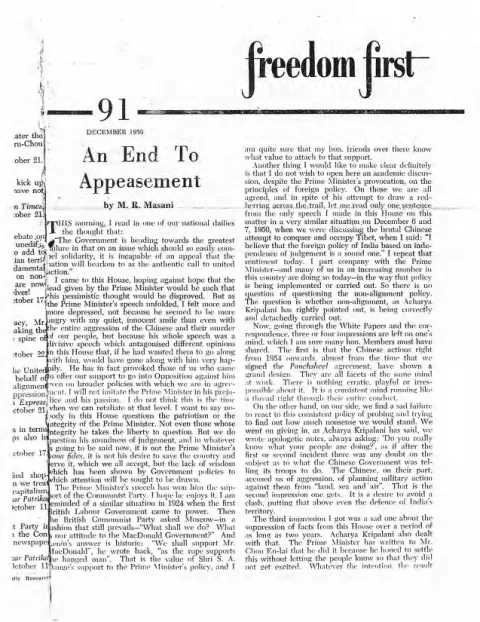
M. R. Masani’s “A Democracy At War” accuses the Nehru government of suppressing evidence of Chinese incursions from Parliament since 1954 and surveys the fractured opposition’s divergent wartime positions.
-
M. A. Venkata Rao’s “The Iron Curtain And World Peace” frames the Curtain as psychological “mind-control,” proposing world federation and mobilised opinion, not unilateral gestures, as the true route to peace.
-
An unsigned report assesses whether Chiang Kai-shek will exploit the Sino-Indian war to invade the mainland, concluding U.S. treaty restraints make this unlikely despite his readiness.
-
A short item reports 194 executions in the Soviet Union over twelve months, most for economic crimes, reading it as anxiety over the command economy’s inefficiency.
-
Tunku Abdul Rahman’s radio address frames the India-China war as an ideological contest between communism and democracy, announcing a Malayan “Save Democracy Fund” for India.
-
N. C. Zamindar’s “Some Thoughts On Defence” criticises Nehru’s claimed modernising credentials given India’s ill-equipped army, calling for an ideological defence grounded in Dharma and Gandhian courage.
-
A review of Donald S. Zagoria’s “The Sino-Soviet Conflict 1956-1961” praises its evenhanded account of the widening Moscow-Peking rift, judging Khrushchev’s caution favourably against Mao’s “revolutionary hubris.”
Essays
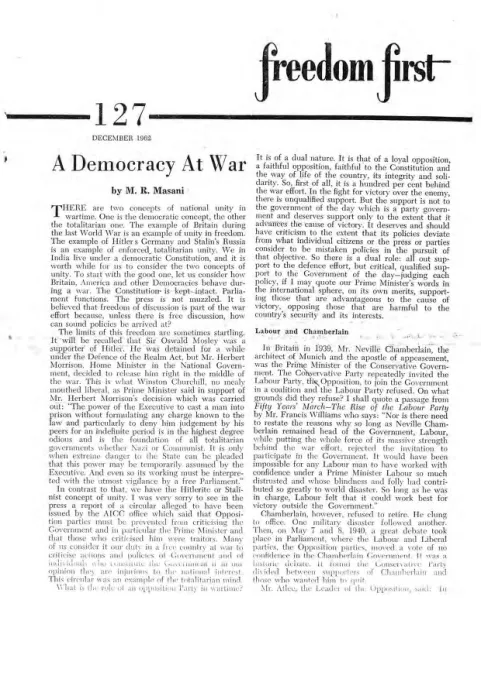
A Democracy At War
By M. R. Masani
Masani contrasts democratic and totalitarian concepts of wartime national unity, using Britain’s conduct in World War II (including Churchill’s defence of due process for the detained fascist Oswald Mosley, and the 1940 parliamentary revolt that toppled Chamberlain) as a model of loyal-but-critical opposition. He then argues India’s Nehru government inverted this model: it suppressed evidence of Chinese incursions in Ladakh from 1954 onward, dismissed repeated parliamentary warnings in 1950 about the strategic consequences of losing Tibet, and signed the 1954 Panchsheel pact despite prior knowledge of Chinese intentions, culminating in the 1962 debacle. The essay closes by surveying the ‘wide gulf’ between Nehru and Parliament, the Chief Ministers, and the opposition parties in the war’s aftermath, and setting out the varying positions of the Praja Socialist Party, the Socialist Party, the Jan Sangh, the Communist Party, and the Swatantra Party on prosecution of the war.
- Distinguishes the democratic concept of wartime unity (loyal, critical opposition) from the totalitarian concept (enforced silence), citing Britain 1939-40 as exemplar.
- Cites the 1940 Norway Debate and Chamberlain’s resignation as proof that a mature democracy can change leadership mid-crisis.
- Accuses the Government of concealing Chinese military incursions into Ladakh (from 1954) and Aksai Chin (1958) from Parliament for years.
- Argues repeated 1950 parliamentary warnings about Tibet’s fall foreshadowing an attack on India were dismissed as alarmist.
- Reports Nehru’s own admission in Parliament (25 October 1962) of being ‘out of touch with reality,’ followed by a partial retraction on 11 December.
- Surveys opposition parties’ divergent responses: Swatantra Party demands arming with best available weapons and ending non-alignment; Praja Socialist Party’s ‘No Negotiations Week’; Socialist Party (Lohia) moves a no-confidence motion; Jan Sangh position roughly aligned with PSP.
- Notes Congress holds only 45% electoral support, meaning opposition parties collectively represent a similar share but remain fragmented and under-represented in Parliament.
The Iron Curtain And World Peace
By MA Venkata Rao
Venkata Rao argues that the Iron Curtain functions as a system of psychological ‘mind-control’ over Soviet subjects, sealing them off from world opinion and manufacturing an ‘ersatz’ consciousness sustained by total state control of economic life. He contrasts the warm Western reception given to Rajagopalachari’s disarmament delegation with the flat, stage-managed reception given to a Gandhi Peace Foundation delegation in Moscow, and argues that genuine progress toward disarmament and world peace requires piercing this informational blockade — through world federation schemes, banned-bombing agreements, and mobilised global public opinion — rather than unilateral Western gestures that ignore the Curtain’s existence. The essay closes with a short unrelated item, ‘Sri Aurobindo on Chinese Design’ (dated 11 November 1950), reproducing Aurobindo’s warning that Mao’s absorption of Tibet was a strategic step toward threatening India.
- Frames the Iron Curtain as a ‘mind-control’ apparatus sustained by total centralisation of economic power over livelihoods.
- Contrasts the international reception of Rajagopalachari’s disarmament delegation (Washington, London) with the muted reception of a delegation to Moscow.
- Cites the fates of Lysenko and Pasternak as evidence the Khrushchev ‘thaw’ has not bridged the gulf between free and communist worlds.
- Proposes that world federation, a world court, and mobilised global opinion — not unilateral test-ban gestures — are the true route to breaking the Curtain.
- Includes a reprinted 1950 Sri Aurobindo item warning that China’s absorption of Tibet was a strategic prelude to threatening India.
Sri Aurobindo On Chinese Design
An unsigned agency-style report (drawn from U.S. News & World Report, per the closing credit) assesses whether Chiang Kai-shek will exploit the Sino-Indian war to invade the Chinese mainland. It concludes Chiang is militarily and psychologically ‘ready’ and has stepped up infiltration, sabotage, and commando activity, but remains constrained by lack of U.S. backing, treaty obligations requiring joint agreement on the use of force, and insufficient amphibious capability to hold a beachhead against Red Army resistance; most Western experts view an actual restoration as a myth or an irresponsible dream, though Chiang is counting on Cold War crises in South-East Asia to loosen U.S. restraints on him.
- Nationalist infiltration and commando activity into the mainland has increased markedly since 1957.
- Chiang’s Army numbers 430,000 with 25,000 marines trained for assault landings; the Air Force has 400 jets and 1,000 pilots.
- U.S. treaty obligations require joint agreement before any use of force against the mainland, and Washington shows no sign of consenting.
- Nationalist forces could land 6,000-15,000 men initially but lack the shipping to resupply or reinforce a sustained invasion.
- Chiang hopes escalating conflicts in South Vietnam, and the India-China war, will loosen the U.S. ‘leash’ on Formosa.
Will Chiang Attack Chinese Mainland?
By U. S. News & World Report
A short item, credited to Intelligence Digest, reports that 194 people were sentenced to death and shot in the Soviet Union over the preceding twelve months, 187 of them for economic crimes such as currency hoarding, black marketeering, and falsifying state planning reports. It argues Khrushchev has abandoned even the pretence of liberalising capital punishment established after Stalin’s 1947 reform, and reads the surge in executions as a symptom of Soviet anxiety that private economic activity exposes the relative inefficiency of the command economy.
- 194 executions in twelve months, 187 for economic crimes including currency hoarding and black marketeering.
- A show trial in the Kirghiz SSR sentenced nine people to death, including the Republic’s Minister for Planning.
- Frames severe economic-crime sentencing as proof capitalism’s relative efficiency threatens Soviet ideological legitimacy.
- Notes roughly twenty death sentences a month are being handed down as ‘plan discipline’ enforcement intensifies under Khrushchev.
Ideological Warfare In Russia
By Intelligence Digest
The printed English text of a radio address by Tunku Abdul Rahman, Prime Minister of Malaya, delivered 10 November 1962. He recounts his own pre-independence negotiations with Malayan communist guerrilla leader Chin Peng, arguing from experience that communism ‘will tolerate no other ideology,’ and applies this lesson to India’s shock at Chinese aggression despite years of Indian diplomatic sympathy toward Beijing (recognition of Mao’s government, silence over the occupation of Tibet). He frames the India-China border war not as a Sino-Indian quarrel but as a contest between the ideologies of communism and democracy, warns other Asian leaders against assuming they can appease communist neighbours, and calls on Malayans to send financial and material aid to India through a ‘Save Democracy Fund’ committee he has set up.
- Recounts personal negotiations with communist leader Chin Peng before Malayan independence and the eventual guerrilla war on the Thai-Malayan border.
- Argues India was blindsided because it had championed Communist China’s cause at the UN and tolerated the occupation of Tibet without protest.
- Frames the border war as an ideological contest between communism and democracy rather than a Sino-Indian dispute.
- Warns that a successful humiliation of India would be a psychological/propaganda victory for China across Asia, not merely a territorial one.
- Announces a Malayan ‘Save Democracy Fund’ committee, chaired by himself, to raise money and material aid for India.
Some Thoughts On Defence
By N. C. Zamindar
N. C. Zamindar’s essay challenges Nehru’s self-presentation as a ‘prophet of modernization,’ arguing that under his stewardship Indian jawans on the eastern front lacked even automatic rifles while Russian-supplied helicopters proved useless, and that Nehru’s much-touted ‘historical perspective’ failed to draw the obvious lessons — documented by historians like Jadunath Sarkar — about why India was historically conquered by better-armed invaders. Zamindar calls for India’s defence to be grounded not merely in modern weaponry but in an ‘ideological defence’ rooted in Dharma and the fighting example of Gandhi (invoking a wartime pamphlet, ‘Gandhi in Arms’), arguing the sacrifices of soldiers must serve the preservation of India’s civilisational heritage rather than the comforts of air-conditioned bureaucratic offices.
- Criticises Nehru’s claimed ‘historical perspective’ given the poor state of India’s defence forces on the eastern front (automatic rifles lacking, Russian helicopters ineffective).
- Cites historian Jadunath Sarkar’s ‘Military History of India’ on the technical/military superiority that let foreign invaders conquer India.
- Quotes Nehru’s own ‘Discovery of India’ acknowledging the superiority of foreign-trained armies and Britain’s ‘fifth column’ inside Indian administration and princely armies.
- Argues India lacks a clearly articulated ideological defence to match communism, proposing the ‘message of the Gita and Gandhiji’ and the supremacy of Dharma.
- Invokes a wartime pamphlet titled ‘Gandhi in Arms’ to argue Gandhi himself would not have counselled appeasement in this crisis.
Review: The Sino-Soviet Conflict 1956-1961 (by Donald S. Zagoria)
By A.R.
A signed book review (A.R.) of Donald S. Zagoria’s ‘The Sino-Soviet Conflict 1956-1961’ (Princeton University Press / Oxford University Press, 1962, 50s.), praising its careful, evidence-driven chronicle of the widening ideological rift between Moscow and Beijing since de-Stalinisation, its analysis of the 1956-57 shift in China’s posture from ‘liberal’ to militant, and its evenhandedness in showing Khrushchev emerging with more credit than Mao. The reviewer notes minor gaps — a fuller treatment of the U-2 incident’s effect on Sino-Soviet thinking — and endorses Zagoria’s cautious conclusion that the West should remain strong and confident rather than try to exploit the split, since smaller communist and non-aligned states are likeliest to benefit from having two rival patrons to court.
- Reviews Donald S. Zagoria’s ‘The Sino-Soviet Conflict 1956-1961’ (Princeton/Oxford University Press, 1962, 50 shillings).
- Praises the book’s careful documentation of doctrinal, historical, and national roots of the Sino-Soviet split, though notes some repetitiveness.
- Highlights the book’s account of China’s shift from a ‘liberal’/rightist posture in 1956 to a more militant, Trotskyist-inflected stance after 1957.
- Notes the book judges Khrushchev’s caution favourably against Mao’s ‘revolutionary hubris.’
- Flags a minor factual quibble: the review suggests fuller treatment was needed of the 1960 U-2 incident’s effect on Sino-Soviet relations, and corrects that this event preceded, not followed, the failed Summit conference.
- Endorses Zagoria’s conclusion that the West should stay strong and confident, letting the Sino-Soviet split work itself out, with smaller powers likely to benefit most.
With Many Voices
No summary was extracted for this article. Listed for completeness.
Generated by the v1.5 extraction pipeline. Awaiting editorial review.
Metadata and summary are AI-extracted from the source PDF and reviewed for editorial accuracy. The original work is available via the Read PDF tab above (where present); paragraph-level citation inside the PDF is deferred to a future engagement.