periodical issue
Freedom First
By M. R. Masani, Zbigniew Brzezinski, Robert S. Elegant, A. G. Noorani, M. A. Venkata Rao, M. Devadas Kini, Patrick Henry
Edited by Ramesh Desai and printed at Inland Printers, 33 Sandhurst Road, Bombay 7, and published for the Democratic Research Service, 127 Mahatma Gandhi Road, Bombay 1 · Bombay · 1963
12 pages
Freedom First
Summary
Freedom First No. 129 (February 1963) is dominated by the aftermath of the 1962 India-China border war, appearing barely two months after the ceasefire. M. R. Masani’s lead editorial column argues against negotiating with China on the Colombo Proposals while Chinese troops still hold captured territory, framing acceptance as a betrayal of Parliament’s unanimous 14th November resolution. A second unsigned editorial, “Cabinet and Parliament”, criticises Nehru for treating Parliamentary debate on foreign policy as a courtesy rather than a binding check on Cabinet power. Zbigniew Brzezinski contributes a specially written piece analysing the shift in the global balance of power after the Cuban missile crisis and its implications for Sino-Soviet relations and Asia. Robert S. Elegant’s “As Others See Us” reprint is a sharply critical outside view of Nehru’s foreign policy and India’s claim to non-aligned leadership. A. G. Noorani examines a Government of India study defending the proposal to fold the Attorney-General’s office into the Law Ministry, arguing the study’s own evidence undercuts its conclusions. M. A. Venkata Rao surveys Communist unconventional-warfare tactics (from Telangana and Kerala to NEFA) and proposes a national volunteer frontier guard. M. Devadas Kini surveys rival theories of Chinese intentions and argues for a Western military alliance rather than mere aid. The issue also reprints Patrick Henry’s 1775 “Give Me Liberty or Give Me Death” speech as implicitly prophetic of India’s situation, and closes with the recurring “With Many Voices” column of press quotations on the China crisis and non-alignment.
Key points
-
M. R. Masani’s “When Not To Negotiate” opposes any negotiation with China before full withdrawal from territory held since 1947/1950, invoking Parliament’s unanimous 14 November resolution and Rajaji’s warning that the Colombo Proposals would make India a permanent satellite of China.
-
An unsigned editorial criticises Nehru’s claim that government need not constantly refer back to Parliament, warning that a Cabinet answerable only to a regimented majority risks becoming ‘a disguised dictatorship.’
-
Zbigniew Brzezinski’s contribution analyses the Cuban missile crisis as a decisive setback for Soviet claims of a shifted balance of power, and frames China’s attack on India as part of a bid for regional primacy that would isolate India from its neighbours.
-
Robert S. Elegant’s “As Others See Us” reprint dismantles the ‘myth’ of Nehru’s India as a major independent force in world affairs, citing his foreign-policy inconsistencies and arguing Indian diplomacy has actually abetted Communist gains in Indochina.
-
A. G. Noorani’s piece critiques a government study defending the proposal to fold the Attorney-General’s office into the Law Ministry, arguing the Constituent Assembly deliberately rejected such a merger and that the office’s independence protects impartial legal advice.
-
M. A. Venkata Rao’s piece reads the Chinese NEFA offensive as following the classic pattern of Communist unconventional warfare seen in Telangana and Kerala, and proposes a 50,000-strong volunteer frontier guard for propaganda counter-work and vigilance.
-
M. Devadas Kini’s piece surveys rival theories of Chinese intentions and concludes China’s aim is simply to dominate Asia, arguing India needs a sustained Western military alliance rather than temporary aid.
-
The issue reprints Patrick Henry’s 1775 ‘Give me liberty or give me death’ speech as, in the editors’ framing, prophetic of India’s predicament vis-a-vis China, and closes with a ‘With Many Voices’ column quoting Frank Moraes’s criticism of the Colombo Formula as favouring the aggressor.
Essays
abject abandonment
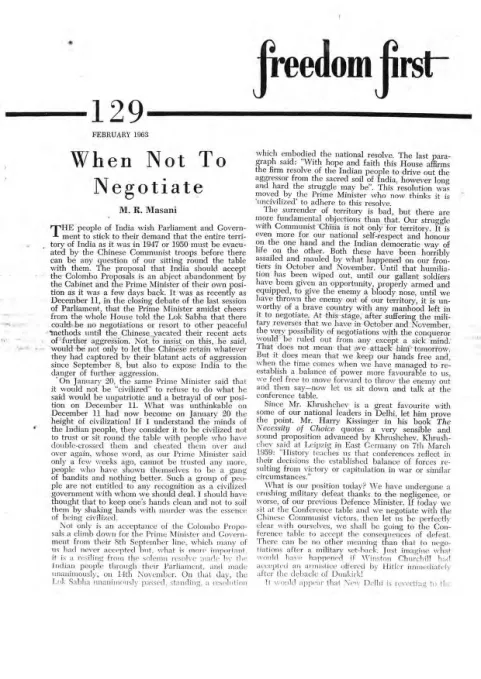
M. R. Masani argues that India must not resile from Parliament’s unanimous 14 November 1962 resolution to expel Chinese forces from all territory held since 1947/1950, calling acceptance of the Colombo Proposals an “abject abandonment” by the Cabinet and Prime Minister of their own prior position. He contends the struggle with China is about national self-respect as much as territory, and that negotiating from a position of recent military defeat would mean accepting the consequences of defeat. He invokes Rajaji’s warning (in Swarajya) that accepting Colombo’s terms would make India a permanent satellite of China, akin to Poland or Hungary vis-a-vis Russia, and closes by quoting Khrushchev’s own dictum that conference outcomes merely ratify the balance of power established by force.
- Masani opposes any negotiation with China before evacuation of all territory held as of 1947/1950, per Parliament’s unanimous 14 November resolution.
- He accuses the Prime Minister of reversing his own 20 January position that refusing to negotiate would be ‘uncivilized’, calling this a climbdown.
- He frames the conflict as being about national self-respect and India’s democratic way of life, not merely territory.
- He cites Rajaji’s Swarajya article warning that accepting the Colombo terms would make India a permanent satellite of China.
- He quotes Khrushchev (via Kissinger’s The Necessity of Choice) that conference outcomes reflect the balance of power from victory or capitulation in war.
- He warns that repeating a mistake, unlike making it once, would be unforgivable by history.
When Not To Negotiate
By M. R. Masani
This unsigned editorial criticises Nehru’s statement in Parliament (24 January) that government ‘does not function by constant references to Parliament’ but acts on broad directions given by it. The piece argues this is dangerous precisely because it concerns live negotiations with an enemy still occupying Indian soil, and insists that a Cabinet drawn entirely from a regimented majority party must remain answerable to a genuine, functioning Opposition, not merely tolerate Parliament as a formality. It warns that a Parliament which abdicates its right to decide even on foreign-policy details risks becoming a disguised dictatorship.
- Nehru told Parliament on 24 January that government acts on broad directions from Parliament rather than constant reference to it.
- The editorial argues this view is especially dangerous applied to ongoing negotiations with China while Chinese troops remain on Indian soil.
- It stresses that the Cabinet, drawn from a regimented majority party, needs a functioning Opposition to keep foreign policy honest.
- It warns that majority rule does not sanctify a decision as right or good.
- It cautions that a Parliament that abdicates real decision-making power risks a ‘dictatorship in a democracy with only its outward forms preserved’.
Balance Of Power After Cuba
By Zbigniew Brzezinski
Zbigniew Brzezinski, writing specially for Freedom First as Director of the Russian Institute at Columbia University, analyses how the Cuban missile crisis marks a new phase in American-Soviet relations. He argues Khrushchev’s climbdown decisively refuted the Soviet claim of a shifted balance of power, and traces how Khrushchev’s strategy of ‘peaceful coexistence’ combined subtle revolutionary stimulation abroad with periodic threats of war, applied both to Berlin and Cuba. He lays out three alternatives now facing Soviet leadership — an immediate revolutionary programme aligned with Chinese demands, opting out of the revolutionary project altogether, or (the likeliest) continued domestic development paired with heavier investment in strategic weapons, especially ICBMs and Polaris-equivalents, possibly punctuated by a dramatic space-technology demonstration to restore prestige. He predicts a more complex, pluralistic pattern of world politics emerging, with a politically unifying Europe and a rising Japan reducing America’s singular Cold War role, and China contesting India for regional primacy in Asia — with the Chinese attack on India serving the larger purpose of establishing China as Asia’s dominant power, isolating India from its neighbours and pressuring South-East Asian states into China’s orbit.
- Brzezinski argues the Cuban crisis decisively refuted the Soviet claim that the balance of power had shifted in its favour.
- He describes Khrushchev’s pre-Cuba strategy of ‘peaceful coexistence’ as combining subtle revolutionary stimulation with periodic war threats over Berlin and Cuba.
- He outlines three post-Cuba Soviet alternatives: adopting an immediate Chinese-style revolutionary programme, abandoning the revolutionary project (as European socialists once did), or — the likeliest — continued domestic development plus heavier strategic-weapons investment (ICBMs, Polaris-equivalents), potentially with a dramatic space-technology demonstration.
- He predicts a quiescent phase in Soviet international politics following the setback.
- He forecasts a more pluralistic world order: a politically united Europe reducing dependence on America, and Japan’s rising political as well as economic importance in Asia.
- He frames the Chinese attack on India as part of a struggle for regional political primacy in Asia, aimed at isolating India from its neighbours and pressuring South-East Asian states into China’s orbit (‘China’s Finland’).
- He argues neither the Soviet Union nor China actually wants a pluralistic world, but that the underlying community of interest between the West and India will likely be expressed more through shared policy than formal alliance.
The Myth Of India
By Robert S. Elegant
Robert S. Elegant, in an “As Others See Us” reprint from the New Leader (a US Social Democratic journal), dismantles what he calls the ‘myth of India’ as a major force in international affairs under Nehru, arguing the Chinese invasion exposed Nehru’s foreign policy as reactive expediency rather than principled non-alignment — citing his snubbing of Israel, silence on Tibet, opposition to action on Indochina, and selective condemnation of Suez versus Hungary. He argues India’s influence has in fact abetted rather than hindered Chinese advances elsewhere in Asia, that Nehru is ‘almost incapable of abstract thinking on foreign affairs’, and that despite $4 billion in foreign aid, India’s stagnant agricultural yields mean aid is consumed by subsistence needs rather than long-term development. He characterises China’s actual motive for invading and then offering a cease-fire as consistent with classical Chinese strategy — puncturing Nehru’s pretensions to Afro-Asian leadership and restoring China’s ‘rightful’ frontiers — while cautioning that the US should proceed from a realistic appraisal of India’s capacities rather than expecting miracles.
- Elegant argues the Chinese invasion has punctured the ‘myth’ that Nehru’s India is a major independent force in international affairs.
- He cites Nehru’s foreign-policy inconsistencies (snubbing Israel, permitting Chinese control of Tibet, blocking action on Indochina, condemning Suez while excusing Hungary) as evidence of pure expediency rather than principle.
- He claims Indian diplomatic conduct (in International Control Commissions and embassies) has actually assisted Communist gains in Indochina.
- He states India has received at least $4 billion in foreign aid with continuing assistance of $1 billion/year, but stagnant per-acre agricultural yield since 1946 means aid funds subsistence, not development.
- He frames the Chinese cease-fire as classical Chinese strategy — ‘fight a while, then talk a while’ — intended to humiliate India’s Afro-Asian leadership pretensions without over-extending Chinese resources.
- He argues Nehru remains an autocrat domestically despite his socialist convictions, noting Indian press only began criticizing his foreign policy in 1959 after the Dalai Lama’s flight.
The Attorney-General
By A. G. Noorani
A. G. Noorani critiques a Government of India publication, “Study of the History, Nature and Working of the Office of the Attorney-General”, which was produced to defend a proposed constitutional amendment allowing the Law Minister to double as Attorney-General, effectively abolishing the office’s independence. Noorani argues the study’s own historical account — tracing the office to its English model and to the Government of India Act, 1935 precedent of the Advocate-General — actually undercuts its recommendation, since the Constituent Assembly deliberately rejected amendments (by Naziruddin Ahmed and Prof. Shibbanlal Saxena) that would have folded the Attorney-General into the Cabinet. He catalogues the study’s stated grounds for change (no reserved departments remain, private practice by the Attorney-General is undesirable) as either factually distorted or an insult to the Constituent Assembly’s Drafting Committee, and cites Viscount Simon and Sir Hartley Shawcross on why the Attorney-General’s independence from Cabinet deliberations is valuable precisely because it preserves an impartial perspective when advising on contested legal questions.
- The government’s ‘Study’ was produced to justify a proposed Presidential Order allowing the Law Minister to also serve as Attorney-General.
- Noorani notes the study bases the office on the English model but then, inconsistently, argues India should not follow the English practice of the Attorney-General sitting in Cabinet.
- He highlights that the Constituent Assembly explicitly rejected amendments by Naziruddin Ahmed and Prof. Shibbanlal Saxena that would have merged the Attorney-General into the Cabinet.
- He quotes Sir Arthur B. Keith that Law Officers of the Crown are ‘normally not included in the Cabinet’.
- He cites Viscount Simon and Sir Hartley Shawcross’s view that Cabinet inclusion would compromise the Attorney-General’s independence and impartiality when giving legal advice.
- He concludes the ‘Study’ is not an impartial study but ‘an eloquent locus classicus’ of partisanship favoring the Law Ministry.
Volunteer Guards For Frontier Areas
By M. A. Venkata Rao
M. A. Venkata Rao surveys the pattern of Communist unconventional warfare — as seen in Korea, Malaya, the Philippines, Indochina, and India’s own experience in Hyderabad-Telangana (1948-50) and Kerala — to explain the Chinese offensive in NEFA as following a recognizable staged pattern: first establishing a ‘continuous land frontier’ or Yenan-style base of operations, then softening the target area through propaganda and goodwill-building among rural populations, followed by introduction of guerrilla bands, and finally full-scale invasion by regular or irregular forces. He warns that NEFA, North UP, Nepal and Sikkim have effectively become China’s new ‘Yenan’ in India, and that pro-Chinese Communist sympathisers among Indian and Nepalese cadres could still hamper Indian military operations. He proposes a national volunteer frontier guard of some 50,000 people, stationed along the borders, engaged in adult education, propaganda counter-work, and community vigilance, as an informal complement to Home Guards, CID, police, military and commando units to prevent rural populations from falling under Communist control.
- Venkata Rao frames the Chinese NEFA offensive as following the established pattern of Communist unconventional warfare seen in Korea, Malaya, the Philippines, Indochina, Telangana and Kerala.
- Stalin reportedly pointed Indian communists toward Yenan’s model of a land-locked base bordering a communist country, for their Telangana campaign.
- The staged pattern: (1) seek geographic contiguity with a communist country/‘Yenan’; (2) soften the area via propaganda and goodwill; (3) introduce armed guerrilla bands; (4) bring in regular armies or locally-built forces.
- China’s Yenan in India is now NEFA, North UP, and to some extent Nepal and Sikkim, with pro-Chinese sympathies among some Indian, Nepalese and Chinese cadres.
- He recounts the Telangana revolt (1948-50) and Kerala Communist party’s parallel rural administration as concrete precedents he personally studied.
- He proposes a 50,000-strong national volunteer frontier guard for adult education, counter-propaganda, vigilance and reporting of strangers, paid only expenses, to supplement Home Guards, CID, police, military and commando units.
Why Not A Military Alliance?
By M. Devadas Kini
M. Devadas Kini surveys seven competing theories of what Communist China ‘is upto’ in its aggression against India — ranging from securing the Aksai Chin road, to coveting Assam’s oil, Burma’s rice bowl, forcing India into the Western camp, straining Indian democracy’s economic development, humiliating and isolating India, or simply diverting attention from domestic economic troubles. He concludes China’s real aim is broader: to dominate Asia, and that recognising this aggressive, expansionist reality is the necessary first step. Given that India cannot afford the cost of matching China militarily on its own (already ~30% of the budget, projected to double), he argues the only viable path is a military alliance with Western powers — distinct from mere aid, since alliance provides sustained commitment insulated from changes in the aiding country’s administration — covering all countries threatened by Communist China, with political and economic content promoting democratic government without interference in internal affairs.
- Kini catalogues seven rival ‘Sinologist’ theories for Chinese motives, from limited territorial aims (Aksai Chin) to broader ambitions (Assam’s oil, Burma’s rice bowl, humiliating India, diverting domestic discontent).
- He concludes China’s aim is simply to dominate Asia, following Mao’s dictum that power comes from the barrel of a gun.
- He notes India already spends ~30% of its budget (2.5% of national income) on defence, with the Finance Minister indicating this may need to double.
- He argues military alliance (unlike temporary aid) provides sustained defence commitment insulated from changes of administration in the aiding country.
- He rejects the objection that alliance would make India a Western ‘satellite’, citing UK, France and other NATO members as counter-examples, and Pakistan’s SEATO/CENTO membership not preventing its overtures to China.
- He calls for an alliance encompassing all states threatened by China, with democratic and economic-development content, not just military terms.
Give Me Liberty Or Give Me Death
By Patrick Henry (speech, reprinted)
This is a reprint of Patrick Henry’s March 1775 speech against British rule, presented with an editorial framing note describing the parallels between the American colonies’ predicament and India’s situation facing China as ‘strangely prophetic’. The full text of the classic ‘Give me liberty or give me death’ address is reproduced, arguing against further supplication and for immediate armed resistance, since delay would not bring greater strength and ‘the next gale that sweeps from the north will bring to our ears the clash of resounding arms’.
- The piece is a full reprint of Patrick Henry’s 1775 speech against the British Government, framed by the editors as prophetic of India’s 1963 situation vis-a-vis China.
- Henry argues that further petition and hope for reconciliation are illusions and that armed resistance is the only remaining option.
- He rejects the argument that the colonies are too weak, asserting that delay would not bring greater relative strength.
- The speech closes with the famous declaration ending in ‘give me liberty or give me death’.
With Many Voices
The recurring ‘With Many Voices’ column compiles short press quotations from January 1963 on the China crisis, non-alignment and world affairs, from figures including Senator Thomas Dodd, President Kennedy, V. K. Krishna Menon, Harold Macmillan, Khrushchev, Mao Tse-tung, Frank Moraes, Nehru, Balraj Sahni and others, drawn from Time, Hindustan Times, Blitz, Statesman, Hindu, Indian Express, Opinion and other outlets. The page closes with the magazine’s subscription form addressed to readers, published by the Democratic Research Service, 127 Mahatma Gandhi Road, Bombay.
- The column gathers dated press quotations (all January 1963) on the China border crisis, non-alignment, and Cold War politics.
- Quoted figures include Senator Thomas Dodd, President Kennedy, V. K. Krishna Menon, Harold Macmillan, Khrushchev, Mao Tse-tung, Frank Moraes, Nehru, Dewan Chamanlal, Asoka Mehta and Balraj Sahni.
- Frank Moraes is quoted criticising the Colombo Formula as favouring the aggressor over its victim.
- The page carries the Freedom First subscription form, listing an annual subscription of Rs. 3.00.
Generated by the v1.5 extraction pipeline. Awaiting editorial review.
Essay 9
No summary was extracted for this article. Listed for completeness.
Metadata and summary are AI-extracted from the source PDF and reviewed for editorial accuracy. The original work is available via the Read PDF tab above (where present); paragraph-level citation inside the PDF is deferred to a future engagement.