periodical issue
Freedom First
By M. R. Pai
Published for the Democratic Research Service by Adam Adil at 127 Mahatma Gandhi Road, Bombay 1. Printed at Inland Printers, 55 Gamdevi Road, Bombay 7. Editorial/subscription address: Freedom First, Maneckji Wadia Building, 4th Floor, 127 Mahatma Gandhi Road, Bombay 1. · Bombay · 1963
12 pages
Freedom First
Summary
Freedom First No. 133 (June 1963), the classical-liberal monthly published by the Democratic Research Service in Bombay and edited by Raman Desai, is dominated by the Congress Party’s stinging defeats in the Amroha and Farrukhabad by-elections, read here as a rebuke of Nehru’s domestic and foreign policies. V. B. Karnik frames the victories of Acharya Kripalani and Dr. Lohia as a direct challenge to Nehru, and a press-reactions roundup collects reactions from the Hindustan Times, Indian Express, The Statesman, The Hindu, The Times of India, and Patriot. The issue’s other pieces extend the magazine’s running critique of Congress governance and Nehruvian non-alignment: M. R. Pai surveys corruption in public life via the Dalmia-Jain and Malaviya-Sirajuddin affairs; an unsigned foreign-affairs piece (signed R.K.D.) and Adam Adil’s essay on the Sino-Soviet conflict both argue that Nehru’s foreign policy is confused and too indulgent of Communist powers; M. A. Venkata Rao critiques the philosophical basis claimed for India’s ‘panchsheel’ foreign policy; Rama Swarup Sabherwal reports on South Vietnam’s Strategic Hamlet programme; Raman Desai writes on press suppression of news around the Vivian Bose Commission report; and Aamir Ali reviews Solzhenitsyn’s One Day in the Life of Ivan Denisovich. The issue closes with ‘With Many Voices,’ a compilation of contemporary quotations on politics, non-alignment, and communism.
Key points
-
V. B. Karnik’s “A Challenge To Mr. Nehru” reads Acharya Kripalani’s and Dr. Lohia’s by-election wins at Amroha and Farrukhabad as a direct popular rebuke of Nehru, noting Congress ran a covertly communal campaign and that Communists actively campaigned for Congress against Kripalani.
-
A press-reactions digest, “Amroha And Farrukhabad,” collects newspaper reactions ranging from the Indian Express calling the Amroha result a “resounding slap” at Nehru to Patriot dissenting that the results were a win for reactionary, communal and capitalist forces.
-
Raman Desai’s “Suppression Of News” argues Indian newspapers gave the damning Vivian Bose Commission report on the Dalmia-Jain group only cursory coverage while giving a rebuttal from one of the accused disproportionate space, warning that commercial capture threatens the press’s inherited moral standing.
-
Rama Swarup Sabherwal describes South Vietnam’s Strategic Hamlet Scheme, launched March 1962, as a counter-insurgency and nation-building programme meant to deny the Viet Cong a rural base while decentralising local administration.
-
M. R. Pai’s “Corruption In Public Life” surveys the Dalmia-Jain and Malaviya-Sirajuddin scandals, criticises Nehru for accepting a commemorative volume from a businessman under Bose Commission investigation, and calls for simplified company law and reduced state discretion as the real check on corruption.
-
An unsigned editorial, “Tortuous Foreign Policy,” criticises Nehru for praising Nasser’s Arab Unity declaration while treating Israel coldly and Malaysia’s Tunku Abdul Rahman lukewarmly, arguing fifteen years of non-alignment have alienated India’s natural democratic allies.
-
Adam Adil’s “Sino-Soviet Conflict” argues the China-USSR rift is a “family quarrel” within a still-united Communist bloc driven by personal rivalry between Mao and Khrushchev, not doctrine, and warns that Western hopes of exploiting the split are illusory.
-
M. A. Venkata Rao’s “India’s Tradition In Foreign Policy” rejects Nehru’s panchsheel as rooted in Indian spiritual tradition, arguing the true classical tradition is Chanakya’s realist mandala system of calculated alliances and vigilance.
-
Aamir Ali reviews Alexander Solzhenitsyn’s “One Day in the Life of Ivan Denisovich,” praising its unmelodramatic realism and situating its publication as a landmark of Khrushchev-era liberalisation.
-
The issue closes with “With Many Voices,” quoting Nehru calling communists “100 per cent patriots” and Dr. Lohia defining communism as “Socialism, minus democracy, plus centralization, plus civil war, plus Russia.”
Essays
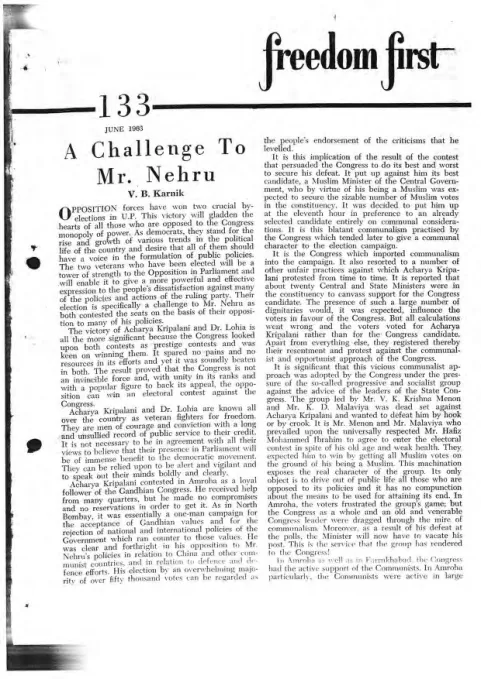
A Challenge To Mr. Nehru
By V. B. Karnik
V. B. Karnik’s lead article argues that the Opposition’s wins in the Amroha and Farrukhabad by-elections — Acharya Kripalani’s defeat of a sitting Union Minister, and Dr. Ram Manohar Lohia’s defeat of a former Central Minister — amount to a direct popular rebuke of Prime Minister Nehru’s policies, since both contests were fought explicitly on opposition to those policies. Karnik details how the Congress resorted to communal tactics in Amroha, fielding a Muslim minister at the last minute to try to capture the Muslim vote, and notes active Communist support for the Congress campaign against Kripalani. He frames the results as proof the Congress is not invincible and as a warning that the electorate is growing critical of Congress policy, closing by asking whether Nehru will now change course or let discontent accumulate. A postscript notes M. R. Masani’s added by-election win in Rajkot, and a ‘Famous Last Words’ sidebar mocks a Gujarat Congress leader’s shock at his defeat.
- Kripalani won Amroha by over fifty thousand votes and Lohia won Farrukhabad, both against sitting/former Central Ministers
- Both by-elections were treated by Congress as prestige contests and fought with heavy ministerial campaigning
- The Congress ran a covertly communal campaign in Amroha, fielding Hafiz Mohammed Ibrahim, a Muslim minister, at the eleventh hour to draw the Muslim vote
- Communists actively campaigned for the Congress against Kripalani in Amroha
- Karnik reads the results as the electorate’s endorsement of the opposition’s criticisms of Nehru’s China, defence, and other policies
- A postscript reports M. R. Masani’s third successive Congress defeat, this time at Rajkot
Amroha And Farrukhabad,
A press-reactions digest, ‘Amroha And Farrukhabad,’ collects and quotes editorial reaction from major Indian newspapers to the Congress’s by-election defeats, continued from page 2 to page 11 of the issue. The Hindustan Times blames Congress party leadership for turning the contests into a referendum on Nehru’s national policies; the Indian Express calls the Amroha result a rebuke to the Prime Minister for lending his prestige to a degrading, communally-tinged contest; The Statesman and The Hindu read the results as evidence that voters are moving past communal and parochial lines, welcoming Kripalani and Lohia as a livelier opposition in Parliament; The Times of India cautions against over-reading the results as a national mandate; and Patriot strikes a dissenting note, framing the wins as a victory for reactionary, communal, and capitalist forces (the Jana Sangh and Swatantra) rather than a democratic gain.
- Hindustan Times: blame for the Congress defeats lies with party leadership, which made the contests a referendum on Nehru’s national policies
- Indian Express: calls the Amroha result a ‘resounding slap’ rebuking Nehru for allowing his prestige to be used in a degrading, communally-charged contest
- The Statesman: notes the excessive, externally-stoked excitement in both contests but sees hope that voters are moving beyond communal/parochial politics
- The Hindu and Times of India: welcome Kripalani and Lohia’s return to the Lok Sabha as strengthening the Opposition, while Times of India warns against reading too much national significance into the results
- Patriot dissents, framing the results as a dangerous win for the communalism of the Jana Sangh and the capitalist/feudal influence of Swatantra, not a democratic advance
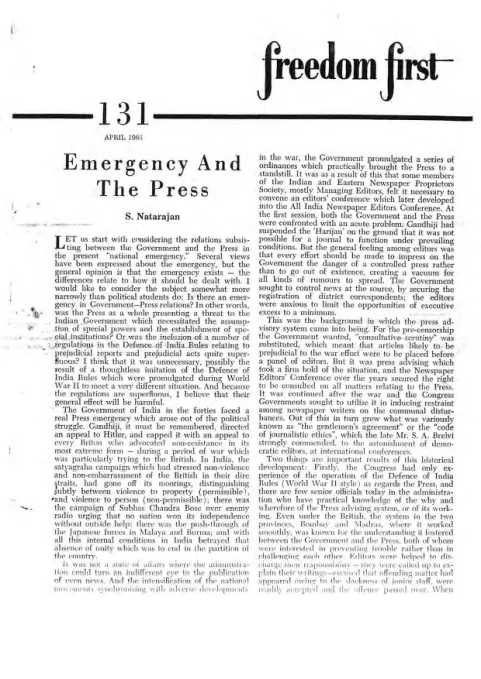
Suppression Of News
By Raman Desai
Raman Desai’s ‘Suppression Of News’ argues that the primary duty of a free press is to state facts objectively, and examines two recent cases of alleged news suppression in the Indian press: the muting of a defamation case involving a Church dignitary, and, more significantly, the thin coverage most newspapers gave to the Vivian Bose Commission’s damning report on the Dalmia-Jain group of companies compared to the extensive space given to a rebuttal from one of the accused. Desai contrasts this with Nehru’s own recent criticism of newspaper owners and the loss of the individualist, mission-driven editor (naming Annie Besant, Natarajan, Chintamani, Motilal Ghosh, Horniman, and Pandit M.S.M. Sharma of Patna’s Searchlight as exemplars), and closes by warning that a press captured by the commercial interests of its owners risks losing the moral prestige it inherited from the freedom movement.
- Argues the core duty of a newspaper is to state facts and present news objectively, with suppression of news as the ‘primary crime’
- Cites suppression of a Church dignitary’s name in a defamation case as a minor instance
- Argues major Indian newspapers gave the damning Vivian Bose Commission report on the Dalmia-Jain business group only cursory coverage while giving a rebuttal by one of the accused disproportionate space
- Frames this asymmetry as evidence that newspaper owners’ own commercial interests can compromise press objectivity
- Contrasts today’s ‘polished paper, perfect proof-reading’ editors with the eccentric, mission-driven editors of the freedom-movement generation
- Warns that the Indian press’s historically high public standing, inherited from the freedom struggle, could be lost if commercial capture continues
Strategic Hamlets Of South Viet Nam
By Rama Swarup Sabherwal
Rama Swarup Sabherwal describes South Vietnam’s Strategic Hamlet Scheme, launched in March 1962, as a counter-insurgency and nation-building programme centred on the hamlet as the country’s basic social unit. The article explains how hamlets are fortified with watch-towers, moats, and self-defence corps to deny the Viet Cong a base for recruitment and sabotage, while also serving a political function — decentralised local administration and an end to arbitrary arrests — meant to build democracy under wartime conditions. Sabherwal presents the scheme optimistically as a model that could allow South Vietnam to modernize and democratize simultaneously, with implications reaching beyond its own borders.
- The Strategic Hamlet Scheme, begun March 1962, treats the hamlet as the basic unit of South Vietnamese society and of counter-insurgency strategy
- Hamlets are fortified with watch-towers, earthworks, and bamboo-spear-lined moats and progress from ‘secure hamlet’ (defended by regular forces) to genuinely ‘strategic’ (self-defended)
- The scheme aims to deny the Viet Cong its traditional base for subversion, recruitment, and hit-and-run tactics among the rural population
- Politically, the scheme promises local self-administration and an end to arbitrary arrests, along with clemency for former Viet Cong sympathisers
- Sabherwal frames the wartime conditions as paradoxically favourable for building democracy in an underdeveloped country
- The article closes on an expansive claim that the hamlet-building effort will have consequences reaching beyond Vietnam’s own frontier
Corruption In Public Life
By M. R. Pai
M. R. Pai’s ‘Corruption In Public Life’ surveys what he sees as a post-Independence decay in public morality, anchored in two contemporary scandals: the Vivian Bose Commission’s findings on malpractice in the Dalmia-Jain business group, and the Malaviya-Sirajuddin affair involving a Union Minister arranging election funds from a firm with which his ministry had dealings. Pai argues that excessive government control and licensing have created a new profession of ‘contact men’ and influence-peddlers, and criticizes instances such as Nehru’s acceptance of a commemorative volume from a businessman under investigation by the Bose Commission. He calls for simplifying company law and reducing the discretionary power of the state as the real check on corruption, warning that the emerging alignment between vocal Congress-Left politicians and big business is a dangerous new pattern.
- Frames rising corruption as a symptom of confused values in the post-Independence, post-freedom-movement era
- The Vivian Bose Commission’s report on the Dalmia-Jain firms is cited as a damning revelation of business malpractice
- Criticizes the Malaviya-Sirajuddin affair: Minister K. D. Malaviya arranged Rs. 10,000 in election funds from a firm his ministry dealt with
- Notes Nehru accepted an ‘Abhinandan Granth’ from Shanti Prasad Jain, then under Bose Commission investigation, as improper
- Argues that complex licensing and controls create a profession of ‘contact men’ and influence-peddlers rather than reducing corruption
- Calls for simpler company law for private firms and reduced discretionary state power as the real remedy
- Warns of a dangerous new alignment between the Congress ‘Left’ (Malaviya, Harvani) and big business interests
Tortuous Foreign Policy
By M. R. Pai
An unsigned editorial, ‘Tortuous Foreign Policy’ (signed R.K.D. at its close), continues the corruption piece’s theme on page 6 before turning to criticize Nehru’s foreign policy as incoherent: it praises the Arab Unity declaration and President Nasser despite Egypt’s arming of rebels and hostility to Israel and Jordan, while India is described as cold toward Israel and lukewarm toward Malaysia’s Tunku Abdul Rahman, one of the few Asian leaders to have backed India during the China war. The piece argues that fifteen years of non-alignment have alienated India’s natural democratic allies in South and South East Asia, and calls for a fresh opposition foreign policy grounded in an alliance of democracies against Communist imperialism.
- Criticizes Nehru for praising President Nasser’s Arab Unity declaration despite Egypt’s open hostility toward Israel and Jordan
- Argues Israel, built up through international goodwill after the two World Wars, is treated coldly by Indian foreign policy compared with the Arab states
- Notes India’s lukewarm response to Malaysia’s Tunku Abdul Rahman, described as one of the few Asian leaders who backed India during the China war
- Contends India’s pro-Chinese, pro-Communist tilt has cost it moral standing among South and South East Asian democracies over fifteen years
- Calls on Opposition parties to articulate a fresh foreign policy based on alliance among democracies against Communist imperialism
Sino-Soviet Conflict
By Adam Adil
Adam Adil’s ‘Sino-Soviet Conflict’ argues that the much-discussed rift between China and the USSR is real but overstated as a ‘family quarrel’ within a still-united Communist bloc, and warns against any Western hope that it will help India’s case against Chinese aggression. Adil surveys the material and doctrinal limits of Chinese independence from Moscow — China lacks the economic and nuclear resources to act independently and the two states remain aligned against India and the free world, with Russia endorsing Chinese characterizations of India during the border dispute. He identifies the conflict’s real source as personal rivalry between Mao and Khrushchev over leadership of the communist bloc rather than doctrinal difference, and concludes that Western policies of ‘soft-line’ compromise with Moscow to isolate Peking are illusory and dangerous.
- Argues the Sino-Soviet conflict is real but is a ‘family quarrel,’ not a split that divides the communist world into two camps
- China lacks the economic resources, nuclear weapons, and material means to pursue an independent world strategy separate from Russia
- Russia gave India only nominal, reluctant military aid (MIG planes) during the China war while endorsing China’s characterization of India as merely ‘friendly’ rather than allied
- Identifies the conflict’s real driver as personal rivalry between Mao and Khrushchev over primacy in the world communist movement, per Boris Souvarine and James Burnham
- Lists four doctrinal flashpoints per Zbigniew Brzezinski (war in the transition to communism, peaceful coexistence, anti-colonial strategy, nuclear-weapon sharing, and stages of domestic communism)
- Concludes that any Western ‘soft-line’ policy hoping to isolate Peking from Moscow is illusory and would only strengthen communism against the free world
Without Comment
No summary was extracted for this article. Listed for completeness.
India’s Tradition In Foreign Policy
By M. A. Venkata Rao
M. A. Venkata Rao’s ‘India’s Tradition In Foreign Policy’ rejects the claim that Nehru’s panchsheel is a natural outgrowth of Indian spiritual tradition, arguing panchsheel borrows only a superficial resemblance from the Buddhist ethical code of the same name and shares its fatal flaw with the Locarno and Kellogg Pacts and the League of Nations: an absence of any sanction to enforce good behaviour among nations. He counters that the actual classical Indian tradition of statecraft, running back to Chanakya (misleadingly called Kautilya) and the Mauryan empire, is built instead on the realist concept of mandala — balance of power through calculated alliances, permanent vigilance toward neighbours, and deep distrust as policy — and that Chinese aggression against India has proved the disaster of ignoring this realist tradition in favour of panchsheel’s naive trust.
- Argues panchsheel resembles Buddhist monastic ethics (ahimsa, asteya, aparigraha, kshanti, kshama) only superficially, not a real basis for foreign policy
- The fatal flaw of panchsheel, like the Locarno Pact, Kellogg Pact, and League of Nations Covenant, is the absence of any enforceable sanction
- Locates the true classical Indian foreign-policy tradition in Chanakya’s era (misnamed ‘Kautilya’), roughly 2300 years old, going back to the time of Alexander and the first Mauryan emperor Chandragupta
- Chanakya’s central concept is mandala — a realist balance-of-power system built on vigilance, calculated alliances, and treating neighbours as potential enemies
- Cites Dr. Zimmer’s ‘The Great Philosophies of India’ as emphasizing the realist, non-mystical dimension of Indian political tradition
- Concludes Chinese aggression against India proved conclusively the diplomatic and psychological error of panchsheel’s naive trust-based approach
Review: One Day In the Life of Ivan Denisovich (by Alexander Solzhenitsyn, translated by Ralph Parker, Victor Gollancz Ltd.)
By Aamir Ali
Aamir Ali reviews Alexander Solzhenitsyn’s ‘One Day in the Life of Ivan Denisovich’ (translated by Ralph Parker, Victor Gollancz), describing it as a largely autobiographical account, drawing on Solzhenitsyn’s own eight years in Soviet labour camps, of a single day in the life of prisoner Ivan Denisovich Shukhov in a special camp in Kazakhstan. Ali praises the novel’s unmelodramatic realism — its impression not of cruelty but of appalling futility and human waste — and its avoidance of didactic tirades, noting the inevitable but not unjustified comparisons to Dostoevsky, and situates the book’s publication as a significant, if perhaps unsustainable, moment of Khrushchev-era liberalization following the 20th Party Congress.
- The novel is judged largely autobiographical, given Solzhenitsyn’s own eight years in Arctic and ‘special’ political labour camps
- Ivan Denisovich Shukhov is serving a ten-year sentence on a flimsy, unjustified wartime collaboration charge
- Ali highlights the book’s realistic, non-melodramatic tone and its central impression of futility and waste rather than overt cruelty
- Notes the comparison to Dostoevsky as largely justified rather than an unwarranted marketing device
- Frames the novel’s publication as a landmark of the post-20th-Congress liberalization under Khrushchev, though one Ali suspects may not continue
Amroha And Farrukhabad: Reactions of the Press
‘With Many Voices’ is a closing compilation of contemporary quotations from politicians, editors, and commentators on non-alignment, communism, and Indian and world politics, drawn from newspapers and journals dated in May 1963. Quoted figures include G. L. Mehta on the primacy of national balance of power, Khrushchev on party discipline over art, Walter Lippmann on Khrushchev’s dilemma, Nehru calling communists ‘100 per cent patriots,’ Dr. Lohia’s definition of communism, and Bhupesh Gupta vowing to fight any dilution of non-alignment ‘not only by talk but otherwise.’ The page also carries a subscription coupon for Freedom First.
- Collects short quotations from May 1963 on Indian and world politics, non-alignment, and communism
- Includes G. L. Mehta on balance of power, Lord Home on Western nuclear deterrence, and Walter Lippmann on Khrushchev’s dilemma over liberalizing without risking regime collapse
- Nehru is quoted calling the communists ‘100 per cent patriots’
- Dr. Rammanohar Lohia is quoted defining communism as ‘Socialism, minus democracy, plus centralization, plus civil war, plus Russia’
- D. Sanjivayya (Congress President) argues the CPI is no longer a threat, with the real challenge from ‘right reaction’
- Bhupesh Gupta pledges to resist any subversion of non-alignment ‘not in Parliament, but outside, and not only by talk but otherwise’
Generated by the v1.5 extraction pipeline. Awaiting editorial review.
Metadata and summary are AI-extracted from the source PDF and reviewed for editorial accuracy. The original work is available via the Read PDF tab above (where present); paragraph-level citation inside the PDF is deferred to a future engagement.