periodical issue
Freedom First
By V. B. Karnik, Raman Desai, Yogindra Trivedi, Peter Ritner, M. D. Kini
published for the Democratic Research Service by Adam Adil at 127 Mahatma Gandhi Road, Bombay 1 · Bombay · 1963
12 pages
Freedom First
Summary
Freedom First No. 134 (July 1963) is a monthly issue of the Bombay-based classical-liberal magazine published by the Democratic Research Service. The issue’s political spine is the aftermath of three opposition by-election victories (Amroha, Farrukhabad, and Rajkot, the last won by Swatantra’s Minoo Masani), which frame the lead essay’s argument that a fractured non-Congress opposition must find at least tactical unity against Congress maladministration and Chinese aggression. Around this core sit pieces on domestic fiscal policy (the new Compulsory Deposit Scheme), international affairs (U.N. finances, the U.S. Clay Report on foreign aid, Soviet space-programme secrecy, arms sales to South Africa), a polemic against CPI leader S. A. Dange’s justification of Congress’s China policy, a report on reforms to the British Press Council, and two recurring miscellany columns of aggregated press quotations (“Without Comment” and “With Many Voices”).
Key points
-
V. B. Karnik’s “The Opposition And Its Task” argues that although by-election wins in Amroha, Farrukhabad and Rajkot have fuelled demand for a united opposition, full merger is unrealistic; he calls instead for ad hoc electoral cooperation among parties against Congress’s corrupt, weak administration.
-
Raman Desai’s “U.N. Finances” surveys the United Nations’ financial crisis, detailing the Soviet Bloc’s, France’s and Belgium’s refusal to pay Congo and Gaza peacekeeping costs, and urges India to press for enforcement of Assembly payment rules against defaulters.
-
Yogindra Trivedi’s “Compulsory Deposit Scheme” examines the new Act’s mechanics and constitutional validity, flagging the absence of any appellate authority and a timing lacuna, and concludes its administrative burden outweighs its dubious social benefit.
-
Peter Ritner’s “The Battle Of Clay’s Cliches” defends the U.S. Clay Report’s aim of fostering pluralist, entrepreneurial societies through aid, proposing that assistance shift from mega infrastructure projects toward small, closely supervised private ventures concentrated on pivotal states like India, Brazil and Nigeria.
-
M. D. Kini’s “Mr. Dange And China” dissects CPI leader S. A. Dange’s pamphlet defending Congress’s China policy, arguing Dange’s support was survival tactics justified in Marxist rather than nationalist terms, and highlighting his disclosure that India had reportedly considered surrendering the Aksai Chin road.
-
An unsigned report on the “British Press Council” covers its adoption of a revised constitution with a lay chairman and trimmed objectives following the 1961-62 Royal Commission on the Press, with an accompanying editorial questioning whether the reform risks drifting toward censorship.
-
The “Without Comment” column reprints items on Communist-bloc arms sales to apartheid South Africa and alleged Soviet secrecy over cosmonaut deaths, plus a note on Chinese propaganda urging patients to rely on “revolutionary optimism” over medicine.
-
The issue closes with “With Many Voices,” compiling reactions to Minoo Masani’s Rajkot win and three separate Arthur Koestler quotations from Encounter on Bertrand Russell and British decline.
Essays
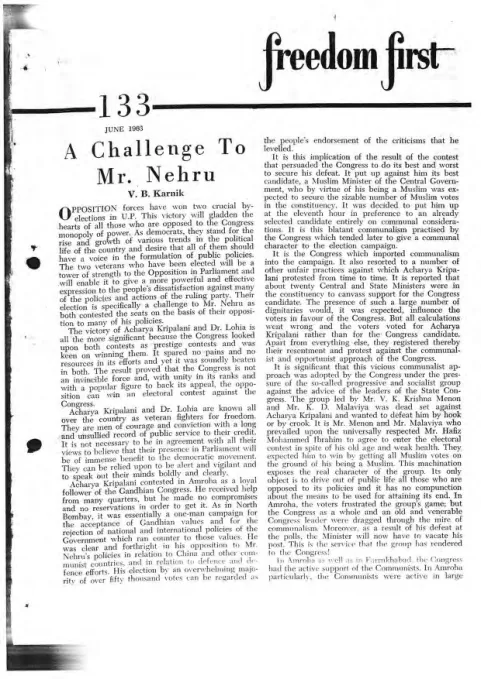
The Opposition And Its Task
By V. B. Karnik
V. B. Karnik argues that although opposition parties across India have won a string of striking by-election victories, hopes for a genuine united opposition front are unrealistic given how jealously each party guards its own identity, singling out the Praja Socialist Party’s refusal to cooperate with the Jan Sangh or Swatantra. He contends that the old Left-Right categories have lost meaning in the face of Chinese aggression and Congress’s corrupt, weak administration, and that democrats of all stripes should unite on that basis. Short of full unity, Karnik urges opposition parties to at least avoid internecine quarrels and pursue electoral adjustments ahead of the next general election, arguing that a credible opposition would educate the public, restore faith in peaceful change, and check Congress’s complacency.
- By-election wins in Amroha, Farrukhabad, and Rajkot have fuelled public demand for a united opposition front against Congress.
- Karnik judges full opposition unity unrealistic because parties are too attached to their own programmes and rivalries, citing the Praja Socialist Party’s refusal to work with the Jan Sangh or Swatantra.
- He argues Left/Right labels are obsolete in the face of the shared threats of Chinese Communism and Congress misrule.
- Congress’s corrupt and weak administration, not ideology, is identified as the real spur behind opposition sentiment.
- Failing outright unity, Karnik calls for opposition parties to avoid vote-splitting quarrels and coordinate electorally before the next general election.
- He frames electoral competition as valuable in itself: it educates voters, builds their confidence, and proves a non-Congress candidate can win.
U.N. Finances
By Raman Desai
Raman Desai surveys the United Nations’ financial crisis eighteen years after its founding, explaining the 1962 World Court ruling that peacekeeping costs in the Congo and Middle East are valid Assembly-authorised expenditure, non-payment of which can cost a member its Assembly vote. He details the Soviet Bloc’s, France’s, and Belgium’s refusal to pay their share of Congo and Gaza peacekeeping costs, producing a $104 million deficit in 1962 and a further $140 million expected by the end of 1963, and reports the Soviet Union’s 22 May notice that it would not pay for several UN items, including the Korea commission and the Congo Cemetery. Desai closes by urging Nehru’s India, given its clean record on dues, to press for enforcement of Assembly rules against defaulters rather than deferring to the Soviet Bloc.
- The UN’s membership stood at 110 in 1963, eighteen years after its founding.
- The World Court ruled in 1962 that Congo and Middle East peacekeeping costs are valid Assembly expenditure, non-payment of which for two years can cost a member its Assembly vote.
- The Soviet Bloc, France, and Belgium refused to pay their share of Congo/Gaza costs, producing a $104 million deficit in 1962 and a further ~$140 million expected by end-1963.
- On 22 May the Soviet Union gave notice it would not pay for several specific budget items, including the Korea commission and war-dead cemetery costs.
- Desai calls on India, given Nehru’s clean record on dues, to press for enforcement of Assembly payment rules rather than accommodate the Soviet Bloc’s ‘tortuous ways’.
Compulsory Deposit Scheme
By Yogindra Trivedi
Yogindra Trivedi examines the newly passed Compulsory Deposit Scheme Act, noting that the Finance Minister justified it as an emergency saving measure and that the Bombay High Court had already upheld its constitutional validity in Radheshyam Makharlal vs. Union of India. Trivedi walks through the six categories of persons liable (from Rs. 1500+ salaried employees to large sales-tax and property holders), the mechanics of deposit, interest, and five-year repayment, and flags several drafting flaws: no appellate authority to check arbitrary exercise of power by the administering authorities, a repayment procedure left to unspecified departmental discretion, and a timing lacuna that could force assessees to deposit for a year before their own income is even known. He concludes the Act’s administrative burden is disproportionate to its dubious social benefit, and that widening tax net at the cost of harassing honest earners is inferior to more vigorous enforcement against tax evasion.
- The Compulsory Deposit Scheme Act was defended by the Finance Minister as an emergency saving measure, in the lineage of other ‘temporary’ tax provisions that became permanent.
- The Bombay High Court, in Radheshyam Makharlal vs. Union of India, held the scheme does not violate the Article 19(1)(f) right to property.
- Six categories of persons are liable: land revenue payers, income-tax payers, urban immovable-property holders, salaried employees earning Rs. 1500+/year, sales-tax assessees with turnover over Rs. 15,000, and others specified later.
- Deposits earn 4% annual interest and are repaid five years after the deposit year, with limited provision for early repayment only at the authority’s discretion.
- Trivedi flags the absence of any appellate authority over the administering authority’s decisions, forcing aggrieved citizens to the High Court under Article 226.
- He identifies a timing lacuna: the deposit for surcharge deduction must be made before financial-year end, before an assessee’s actual annual income is even ascertainable.
- He judges the Act’s administrative cost and evasion risk disproportionate to its social benefit, preferring stronger enforcement against tax evasion over widening the compulsory net.
The Battle Of Clay’s Cliches
By Peter Ritner
Peter Ritner reviews the U.S. State Department’s ‘Clay Report’ on foreign aid, arguing that despite its literary crudeness it rightly identifies the promotion of pluralist, middle-class, entrepreneurial societies as the correct aim of American aid policy, since dispersed economic power is safer and more resilient than centralised, politically directed economies. He proposes redirecting aid away from vast ‘infra-structure’ mega-projects and toward thousands of small-scale, closely supervised private ventures, akin to development banks embedded in local business life. Citing Galbraith’s point that good development plans require good government to execute them, Ritner argues aid should be concentrated on a handful of pivotal states — naming India, Brazil, and Nigeria as candidates — rather than dispersed across ninety-five countries and territories, and rebuts the idea that reduced aid enthusiasm reflects xenophobia rather than legitimate doubts about programme design.
- The Clay Report drew criticism from ‘forward-looking’ American commentators despite being, in Ritner’s view, a useful acknowledgment of longstanding troubling questions about aid policy.
- Ritner defends the Report’s premise that fostering pluralist, entrepreneurial, middle-class societies is a sound and evidence-based aim of aid, safer than centralized, politically controlled economies.
- He proposes shifting aid from huge ‘infra-structure’ projects toward thousands of small, closely supervised private ventures via development-bank-like institutions embedded locally.
- Quoting Galbraith, he stresses aid cannot substitute for good government execution, and criticizes indiscriminate spending across ninety-five countries.
- He proposes concentrating the bulk of U.S. aid on a few pivotal states with self-modernizing potential: India in Asia, Brazil in Latin America, and Nigeria in Africa.
- He argues concern about the nature of aid programmes is not equivalent to isolationism, and that the U.S. should stop treating aid mainly as a Cold War weapon against Russia and China.
Mr. Dange And China
By M. D. Kini
M. D. Kini dissects CPI leader S. A. Dange’s pamphlet ‘Neither Revisionism Nor Dogmatism Is Our Guide,’ written in reply to a Chinese attack on the CPI’s stance following the October 1962 border war. Kini argues Dange’s support for Nehru’s government was born of necessity rather than principle — the CPI would have been politically destroyed had it not backed India after the Chinese invasion — and shows Dange justifying this support in explicitly Marxist-Leninist rather than nationalist terms, arguing India’s ‘non-alignment’ and ‘peace’ orientation, not patriotism, obliges CPI support. Kini highlights Dange’s startling disclosure that the Indian government reportedly considered surrendering Aksai Chin to China before relations soured, and concludes the episode again demonstrates that the CPI remains, at bottom, a conspiratorial arm of world Communism rather than a heretical but independent party.
- Dange’s pamphlet responds to a ‘People’s Daily’ editorial attacking CPI policy on the border war.
- Kini argues CPI support for Nehru’s government after October 1962 was survival tactics, not patriotism, since opposing India post-invasion would have been suicidal for the Party.
- Dange justifies CPI’s China stance using Marxism-Leninism (India’s non-alignment and ‘peace and socialism’ commitments), not nationalist loyalty to India.
- Dange discloses that the Indian government reportedly considered surrendering the Aksai Chin road to China shortly before the invasion.
- Kini concludes Dange’s reply confirms the CPI is fundamentally a tool of world Communist strategy rather than an independent, patriotic party.
British Press Council
An unsigned report, reprinting and analysing a Times of London account (19 June 1963), covers the British Press Council’s adoption of a revised constitution implementing the 1961-62 Royal Commission on the Press’s recommendations: a lay chairman, a lay membership capped at 20 per cent, and a trimmed, more specific list of five objectives (down from seven), including sharper wording on monopoly reporting. An accompanying editorial, ‘Correctors Of The Press,’ is skeptical, calling the reform a partial ‘sop’ to regulation advocates and questioning whether a hybrid body with a paid independent chairman and reduced journalist representation can function without drifting toward becoming a censorship mechanism, concluding that public opinion, not a regulatory council, remains the real safeguard against press excess.
- The British Press Council adopted a new constitution following the 1961-62 Royal Commission on the Press: lay chairman, up to 20% lay membership, and five (down from seven) core objectives.
- New objectives include reporting publicly on developments toward press concentration/monopoly and continuing to consider public complaints against press conduct.
- Journalistic/managerial representation is cut from 25 to 20 members to make room for lay representatives, with several press bodies nominating members.
- An accompanying editorial argues the reforms are a partial concession to regulation advocates and voices skepticism that a hybrid lay/press body with a paid chairman can avoid becoming an instrument of censorship.
- The piece notes the reform connects to an earlier Freedom First article, ‘Emergency and the Press’ by Mr. S. Natarajan (April 1963).
Without Comment (compilation: ‘Communists Supply Arms To South Africa’, ‘One-Way Trips To Space’, ‘Marxist Doctrine — As Medicament’)
The recurring ‘Without Comment’ column reprints, without editorializing beyond framing, two press items: a Swiss Press Review report (14 June 1963) on Communist bloc states (notably Czechoslovakia and East Germany) supplying arms to apartheid South Africa even as Western nations tighten export bans, and a piece on Soviet secrecy around ‘one-way trips to space,’ alleging that several cosmonauts, including Pyotr Ivanovich Dolgov and one named Andreyev, died in botched space missions that were concealed or only partially admitted years later via Izvestia. A short unsigned item, ‘Marxist Doctrine — As Medicament,’ reports Chinese Communist Party propaganda urging tubercular and other patients to rely on ‘revolutionary optimism’ rather than scarce medicine and doctors.
- A Swiss Press Review excerpt reports Communist bloc states, especially Czechoslovakia and East Germany, filling the gap left by declining Western arms sales to apartheid South Africa.
- The item argues this Communist arms trade, motivated by profit rather than ideology, undercuts the international anti-apartheid arms boycott campaign the Soviet bloc otherwise professes to support.
- A second item, ‘One-Way Trips to Space,’ alleges Soviet secrecy has concealed multiple cosmonaut deaths, naming Pyotr Ivanovich Dolgov (died 11 October 1960) and one Andreyev, with Izvestia only partially confirming losses in January 1963.
- A short filler item reports Chinese Communist Party propaganda urging patients, amid medicine shortages, to treat illness (including tuberculosis) through ‘revolutionary optimism’ rather than drugs.
With Many Voices
The ‘With Many Voices’ column compiles short press quotations from June and July 1963 commenting on Indian politics and Anglo-American affairs, centered on reactions to Swatantra leader Minoo Masani’s and other opposition figures’ recent by-election wins. Quoted commentators include John Strachey on India’s forced Western alignment, Peter Wiles and Michael Oakeshott on ideology and conservatism, Jayaprakash Narayan and Nandan Kagal on the significance of the Rajkot result, Ram Manohar Lohia on party dynamism, and Arthur Koestler (three separate quotations from Encounter) on Bertrand Russell, British decline, and the English character.
- The column aggregates short, unglossed quotations from named commentators across Indian and British publications, dated May-July 1963.
- Several quotations (Link, Times of India, New Age) interpret Minoo Masani’s Rajkot by-election win as evidence of Congress’s declining integrity and growing public perceptiveness.
- Nandan Kagal (Times of India) characterizes the Kripalani-Masani-Lohia opposition trio as an ‘odd-looking trimurti’ with divergent aims.
- Arthur Koestler is quoted three times from Encounter (July 1963) on Bertrand Russell, British national decline, and English character.
- Ram Manohar Lohia is quoted arguing the Jan Sangh, Communist Party, and Socialists are the only parties not fixated on stability.
Generated by the v1.5 extraction pipeline. Awaiting editorial review.
Metadata and summary are AI-extracted from the source PDF and reviewed for editorial accuracy. The original work is available via the Read PDF tab above (where present); paragraph-level citation inside the PDF is deferred to a future engagement.