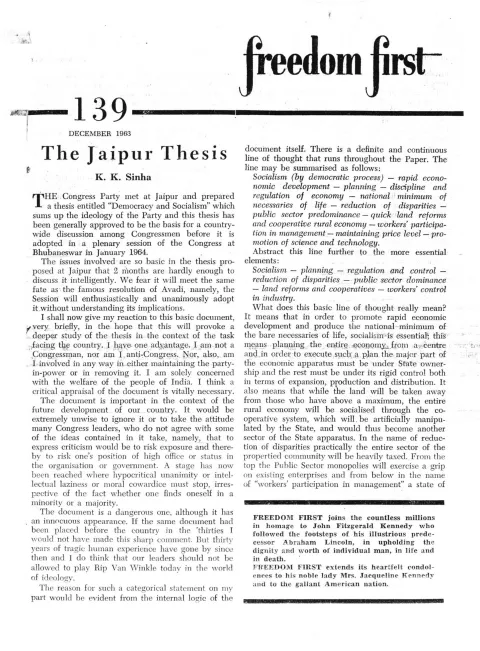
periodical issue
Freedom First
By Saadi, Raman Desai, A. G. Mulgaonkar, S. R. Mohan Das, A. G. Noorani
Registered No. B-6354. FREEDOM FIRST. Published on the first of each month. Annual Subscription: Rs. 3. Single Copy: 25 nP. Maneckji Wadia Building, 4th Floor, 127 Mahatma Gandhi Road, Bombay 1. Edited by Raman Desai and printed at Inland Printers, 55 Gamdevi Road, Bombay 7 and published for the Democratic Research Service by Adam Adil at 127 Mahatma Gandhi Road, Bombay 1. · Bombay · 1964
12 pages
Freedom First
Summary
Freedom First No. 141 (February 1964) is a monthly issue of the Bombay-based classical-liberal periodical, opening with an unsigned editorial-style piece (bylined “Saadi”) assessing the 68th Plenary Session of the Congress at Bhubaneshwar and its ambivalent socialist resolution, followed by essays on the Israel-Arab dispute over Jordan river waters, ministerial corruption in India and the case for an Ombudsman, Maharashtra’s revised prohibition policy, and a lengthy critique of columnist N. J. Nanporia’s shifting positions on Sino-Indian border policy. The issue closes with two recurring quotation features, “Without Comment” (a reprinted item on the US 7th Fleet in Asian waters) and “With Many Voices” (miscellany of quotations from public figures). The throughline across the contributions is a sceptical, classical-liberal scrutiny of the Congress government’s economic and foreign policy drift, paired with calls for institutional remedies (an Ombudsman law, firmer China policy) rather than moral exhortation alone.
Key points
-
An unsigned piece bylined “Saadi,” “Bhubaneshwar — Its Achievements And Failures,” reviews the Congress’s 68th Plenary socialism resolution as vaguer and more pious than its 1931 Karachi statement, crediting it with affirming labour’s dignity while faulting it for evading mass poverty, bureaucratic stranglehold and corruption.
-
Raman Desai’s “Israel And Arab States” traces the Arab-Israeli dispute to the 1922 Palestine Mandate, argues Nasser exploits anti-Israel sentiment to distract from domestic economic failure, and urges India to recognise Israel’s right to exist despite its non-aligned foreign policy.
-
A. G. Mulgaonkar’s “Ministerial Corruption” criticises Nehru’s selective use of Lord Denning’s report to shield the Kairon affair, distinguishes political from official corruption, and calls for legislation requiring ministers to disclose personal and family assets.
-
S. R. Mohan Das’s “New Prohibition Policy” examines Maharashtra’s relaxed liquor policy under V. P. Naik, arguing prohibition has become a Gandhian “sacred cow” rather than an effective response to alcoholism, and recommends a UK-style graduated approach over blanket bans.
-
A. G. Noorani’s “New Delhi And China” methodically documents columnist N. J. Nanporia’s reversal from uncompromising toughness on China to accepting the Colombo Proposals and later downplaying the border dispute, concluding the shift reflects either lack of candour or genuine confusion.
-
The issue’s “Without Comment” and “With Many Voices” columns round out the issue with reprinted items on the US Seventh Fleet in Asian waters and miscellaneous quotations from public figures.
Essays
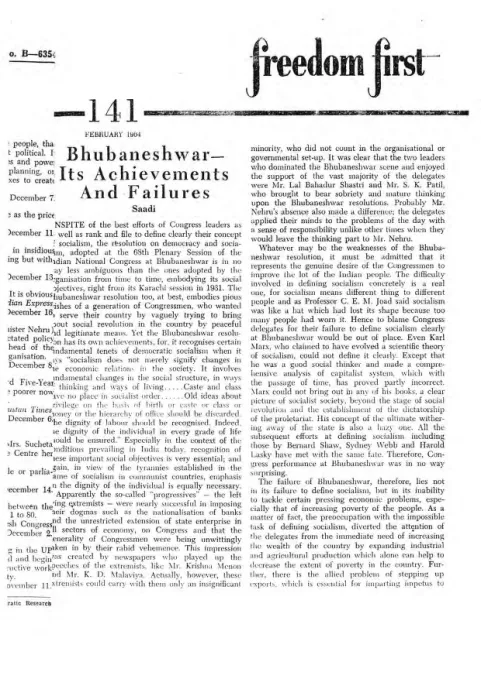
Bhubaneshwar—Its Achievements And Failures
By Saadi
This unsigned lead piece, bylined “Saadi,” reviews the socialism resolution passed at the Congress’s 68th Plenary Session at Bhubaneshwar in December 1963. It argues that the resolution’s vague, pious language on “democratic socialism” reflects the party’s persistent ideological confusion rather than any real advance, but credits it with affirming the dignity of labour and the individual against tyrannies committed in socialism’s name elsewhere. The piece contends that Congress cannot fairly be blamed for failing to define socialism precisely, since even Karl Marx never did so clearly, but faults Bhubaneshwar for evading India’s real economic problems: mass poverty, low national production, bureaucratic stranglehold, and unchecked corruption. It closes by calling Bhubaneshwar an important but insufficient milestone that leaves the deeper structural failures of Congress governance untouched.
- The Bhubaneshwar resolution on socialism is judged vaguer and more pious than earlier Congress statements dating to the 1931 Karachi session.
- Lal Bahadur Shastri and S. K. Patil are credited with bringing ‘sobriety and mature thinking’ to the session, partly due to Nehru’s absence and illness.
- The article defends Congress from the charge of failing to define socialism, noting even Marx could not define it precisely.
- The real failure of Bhubaneshwar, per the piece, is its inability to address rising poverty, industrial and agricultural stagnation, and export growth.
- Corruption and the ‘stranglehold of bureaucracy’ are named as serious unaddressed problems.
- The resolution’s rhetoric on the dignity of labour and against caste privilege is treated as a genuine, if limited, achievement.
Israel And Arab States
By Raman Desai
Raman Desai’s essay traces the Arab-Israeli dispute back to the 1922 Palestine Mandate and the 1948 British withdrawal, describing the demographic and territorial background of Israel and the Arab states before turning to the immediate controversy: an Arab summit’s January 1964 objection to Israel’s plan to draw water from the Jordan river and Lake Kinneret to irrigate the Negev desert. Desai portrays Egypt’s Nasser as using anti-Israel sentiment to distract from domestic economic failure under Arab socialism, and argues that Jordan and Syria’s own unilateral diversions of the Yarmak river undercut Arab complaints against Israel. The essay closes with a direct argument that India’s nonaligned foreign policy should not prevent it from morally recognizing Israel’s right to exist, invoking Jewish historical suffering and India’s own tradition of offering refuge to persecuted minorities.
- Frames the Arab states as residuary legatees of the Ottoman Empire and traces the Israel-Jordan partition to the 1922 Palestine Mandate.
- Describes Nasser’s use of anti-Israel agitation to compensate for the Yemen war and domestic economic stagnation under Arab socialism.
- Details the 1964 Arab summit decision to unite militarily against Israel’s Jordan River diversion project for the Negev.
- Points out that Jordan and Syria have themselves unilaterally diverted the Yarmak river, undercutting their objection to Israel’s plans.
- Criticises India’s foreign policy for being reticent on the issue and argues India’s history of sheltering persecuted peoples (Christians, Jews, Parsis) should inform a more sympathetic stance toward Israel.
- References the Holocaust and West Germany’s small remaining Jewish population as part of the moral case for support.
Ministerial Corruption
By A. G. Mulgaonkar
A. G. Mulgaonkar’s essay confronts ministerial corruption directly, opening with a critique of how Nehru’s government selectively quoted Lord Denning’s report to excuse rather than confront corrupt ministers (referencing the Kairon affair). Mulgaonkar distinguishes political corruption among ministers from official corruption among bureaucrats, arguing both must be tackled but that ministers, as more visible and more powerful, deserve at least as much scrutiny as civil servants. He surveys British precedent (J. H. Thomas, Belcher) where ministers were forced from office for lesser offences, and calls for Indian ministers to be legally required to disclose personal and family assets. The piece ends with a demand for a specific enforcement mechanism: an inquiry to be automatically triggered whenever a minister is shown to have received a payment in exchange for a favour.
- Opens by criticising Nehru’s selective quotation of Lord Denning’s report to shield ministers accused of corruption, citing the Kairon affair.
- Distinguishes ‘political’ corruption (ministers) from ‘official’ corruption (bureaucrats) as requiring different remedies but equal seriousness.
- Cites British precedents (J. H. Thomas, Belcher) of ministers forced from office over corruption or conflicts of interest.
- Calls for legislation requiring ministers to declare their own and their dependents’ assets.
- Argues that the mere fact of a payment made to procure a favour should be sufficient grounds to trigger an inquiry.
- Criticises Congress dominance since 1947 for eroding institutional accountability and constitutional norms, citing Goa and retrospective legislation as examples.
New Prohibition Policy
By S. R. Mohan Das
S. R. Mohan Das examines Maharashtra Chief Minister V. P. Naik’s relaxation of the state’s prohibition policy, noting opposition from Morarji Desai, Gulzarilal Nanda, and the Maharashtra INTUC. The essay argues both the acclaim for and condemnation of the relaxation rest on shallow, emotional grounds rather than serious analysis, since morality cannot be legislated and alcoholism is a psychological and sociological problem prohibition alone cannot solve. Drawing on the experience of the US, UK, France and Finland, the piece recommends a more graduated approach modeled on the UK’s promotion of tea shops and food-paired drinking over blanket bans, while cautioning the state government against treating liquor licensing as a revenue-raising opportunity.
- Reports on Maharashtra CM V. P. Naik’s revision of prohibition policy and the backlash from Morarji Desai, Gulzarilal Nanda, and Maharashtra INTUC.
- Argues prohibition has become a ‘sacred cow’ symbol of Gandhian legacy in Congress rather than an effective policy.
- Draws on US, UK, French and Finnish experience to argue blanket prohibition fails against alcoholism as a psychological/sociological problem.
- Cites Lloyd George’s UK approach of promoting tea shops and food-paired drinking over rigid bans as a preferable model.
- Warns the state government against exploiting new liquor licensing as a revenue source, urging strict alcohol-content controls (3.5%) instead.
- Notes a countervailing finding: women in Bombay reportedly support continuing prohibition despite its acknowledged ineffectiveness against chronic drinkers.
New Delhi And China
By A. G. Noorani
A. G. Noorani’s essay is a sustained critique of columnist N. J. Nanporia’s commentary on Sino-Indian relations, collected in his book ‘The Sino-Indian Dispute.’ Noorani traces how Nanporia, writing through the 1962 war and its aftermath, correctly predicted a Chinese ceasefire and consistently urged toughness and rejection of negotiations in his earlier articles, only to reverse himself by 1963-64, first advocating acceptance of the Colombo Proposals he had earlier warned served Chinese interests, and finally by January 1964 downplaying the border dispute altogether in favour of courting French recognition of China. Noorani methodically documents Nanporia’s self-contradictions using the columnist’s own words across different dates, concluding that the reversal reflects either a lack of candour or a genuine confusion of mind, and faulting Nanporia for never explaining or acknowledging his shifting positions to his readers.
- Reviews N. J. Nanporia’s book collecting his Times of India columns on the Sino-Indian dispute (Sept 1962-June 1963).
- Notes Nanporia correctly predicted the Chinese ceasefire and, at the time, argued for uncompromising toughness and against any negotiation with China.
- Documents Nanporia’s later, contradictory advocacy for accepting the Colombo Proposals, which he had earlier warned favoured Chinese interests.
- Traces a further reversal by January 1964, where Nanporia treats the border dispute as a mere ‘incident’ next to France’s diplomatic recognition of China.
- Argues Nanporia’s shift is unexplained and undefended to his own readers despite his confident, unapologetic tone.
- Concludes that Nanporia’s contradictions reflect either lack of candour or genuine confusion, not a reasoned change of view.
Generated by the v1.5 extraction pipeline. Awaiting editorial review.
Metadata and summary are AI-extracted from the source PDF and reviewed for editorial accuracy. The original work is available via the Read PDF tab above (where present); paragraph-level citation inside the PDF is deferred to a future engagement.