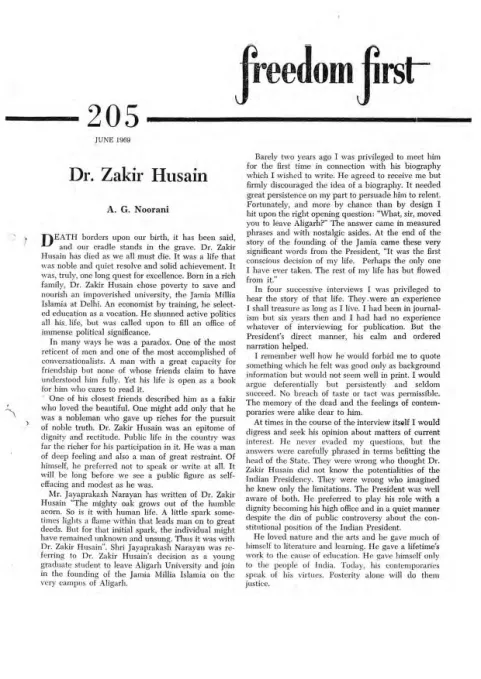
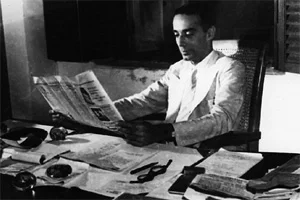
periodical issue
Freedom First
By Purshottam Trikamdas, Y. N. Sukthankar, Robert Conquest, Surendra Mohan, Rohit Dave, Victor Frank
Edited by RAMAN DESAI and printed at Inland Printers, 55 Gamdevi Road, Bombay 7 and published for the Democratic Research Service by Raman Desai at 127 Mahatma Gandhi Road, Bombay 1. · Bombay · 1964
12 pages
Freedom First
Summary
Freedom First No. 146 (July 1964) is dominated by the death of Jawaharlal Nehru on 27 May 1964, opening with two personal tributes — Purshottam Trikamdas’s memoir of his encounters with Nehru from 1917 to the mid-1950s, and Y. N. Sukthankar’s portrait of Nehru as an administrator — before moving to the magazine’s regular mix of Cold War commentary, domestic economic critique, and civil-liberties reporting. Robert Conquest’s ‘The Fog Of Peace’ (adapted from a BBC broadcast) argues against relaxing vigilance toward the Soviet Union even amid talk of détente, disputing sentimental or one-sided readings of Soviet demography and politics. Surendra Mohan responds to an earlier Freedom First piece by V. B. Karnik on whether Indian democratic parties should seek ‘consensus,’ Rohit Dave critiques the Finance Minister’s budget concessions and the black market’s distortion of credit policy, and Victor Frank reports on the Soviet trial and internal exile of poet Joseph Brodsky as a test case for dissent under Khrushchev. The issue closes with the ‘With Many Voices’ quotations column, several entries of which react to Nehru’s death.
Key points
-
Purshottam Trikamdas’s memoir “Jawaharlal Nehru As I Knew Him” offers a candid, unsentimental account spanning 1917 to the mid-1950s, recalling Nehru’s 1957 admission of responsibility for SEATO’s formation and his troubling idolisation of V. K. Krishna Menon, while concluding “with the end of his life, an era has ended.”
-
Y. N. Sukthankar’s “Nehru The Administrator” praises Nehru’s prompt, non-dictatorial working style and credits him as the intellectual force behind key features of the Five-Year Plans, closing with Churchill’s remark that Nehru had “conquered the three great enemies of mankind.”
-
Robert Conquest’s “The Fog Of Peace,” adapted from a BBC broadcast, argues against relaxing vigilance toward the Soviet Union even amid talk of détente, using Soviet census data to argue Stalin’s purges, not just the war, explain the USSR’s postwar gender imbalance.
-
Surendra Mohan’s “Consensus Or Conformity?” rebuts V. B. Karnik’s earlier article, arguing consensus and conflict are intertwined and that manufacturing artificial unity risks leaving rising social conflicts unchannelled.
-
Rohit Dave’s “The Budget Concessions” criticises the Finance Minister’s budget as ineffective against black-market lending at 18-24% interest and the Reserve Bank’s restrictive credit policy, calling for a comprehensive economic strategy rather than piecemeal tinkering.
-
Victor Frank’s “The Case Of Joseph Brodsky” recounts the Leningrad trial and internal exile of the 24-year-old poet for “parasitism,” highlighting Soviet writers’ unprecedented public petition on his behalf as a sign of new dissent under Khrushchev.
-
The closing “With Many Voices” column, reacting to Nehru’s death, opens with C. Rajagopalachari’s tribute in Swarajya and includes Asoka Mehta’s chariot metaphor of heavy industry and agriculture as the “two wheels” of development.
Essays
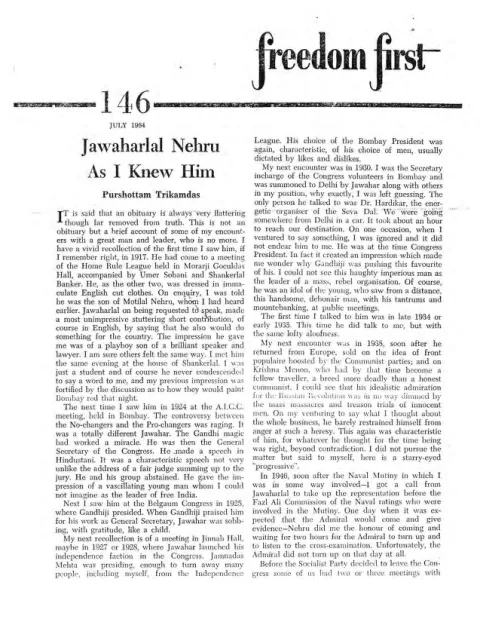
Jawaharlal Nehru As I Knew Him
By Purshottam Trikamdas
Purshottam Trikamdas offers a personal, deliberately unsentimental memoir of Jawaharlal Nehru, tracing encounters from a 1917 Home Rule League meeting in Bombay (where the young Nehru struck him as an unimpressive, stammering ‘playboy son’ of a brilliant lawyer) through the 1924 and 1925 Congress sessions, the independence-faction launch of 1927-28, and later official dealings — including Nehru’s request that Trikamdas represent India at the U.N. in 1954, disputes over SEATO and non-alignment in 1957, and Nehru’s assistance with the Tibet Enquiry Committee. Trikamdas is candid about Nehru’s flaws (aloofness, temper, an idolisation of V. K. Krishna Menon that Trikamdas found troubling) alongside genuine respect for his intellect, concluding that ‘in his demise, we have lost a great intellectual leader’ and that ‘with the end of his life, an era has ended.’
- First saw Nehru in 1917 at a Home Rule League meeting in Bombay and found him an unimpressive, stuttering speaker
- Describes Nehru’s transformation by 1924-25 into a Congress leader under Gandhi’s influence
- Recounts being asked by Nehru in 1954 to serve as a UN delegate, with Nehru explaining a theory of India as a ‘double broker’ between the US and USSR
- Details a 1957 exchange in which Nehru admitted responsibility for SEATO’s formation due to non-alignment leaving South-East Asian states insecure
- Describes Nehru’s help facilitating the Tibet Enquiry Committee’s access to Tibetan refugee camps, and his anger at Foreign Secretary Dutt’s caution
- Notes Nehru’s deep loyalty to and admiration for Krishna Menon, which Trikamdas found excessive and dangerous
Nehru The Administrator
By Y. N. Sukthankar
Y. N. Sukthankar, who served under Nehru, offers a tribute focused specifically on Nehru’s qualities as an administrator rather than as a politician. He describes Nehru’s prodigious capacity for work, his punctual and substantive replies to official correspondence, his insistence that officers not delay matters by digging up old files, and his open, non-dictatorial style at meetings and conferences despite a public image to the contrary. Sukthankar credits Nehru as the intellectual force behind key features of the Five-Year Plans and describes his warmth toward the poor and marginalized, citing an anecdote of Nehru’s tenderness toward two Adivasi girls at Rourkela. The piece closes by invoking Churchill’s remark that Nehru had ‘conquered the three great enemies of mankind — fear, hatred and jealousy.’
- Focuses on Nehru’s rarely-discussed role and habits as an administrator, based on Sukthankar’s years serving under him and hosting him at Raj Bhavans in Orissa
- Describes Nehru as prompt and thorough in disposing of official correspondence, disliking unnecessary delay or excessive secrecy in government papers
- Argues Nehru’s image as domineering was inaccurate: he listened patiently, argued his views but never imposed them at conferences
- Credits Nehru as chief inspiration behind Five-Year Plan features such as social justice provisions and machine-building industry
- Recounts an anecdote of Nehru’s warmth toward two Adivasi girls at Rourkela, cheering them as they ate
- Advocates future publication of Nehru’s official communications and letters to Chief Ministers as valuable historical material
- Closes with Churchill’s description of Nehru as having conquered ‘fear, hatred and jealousy’
The Fog Of Peace
By Robert Conquest
Robert Conquest, adapting a BBC Third Programme talk from January 1964, argues against the fashionable relaxation of vigilance toward the Soviet Union even as prospects for detente appear to improve. He contends that goodwill cannot precede clear-eyed realism, and that accusations of ‘cold war,’ ‘anti-Communism,’ or ‘right-wing’ bias are often used to suppress legitimate factual criticism of Soviet affairs. Using Soviet census data, he disputes the popular claim that the USSR’s post-war gender demographic gap is simply ‘the result of the war,’ arguing the fuller explanation implicates Stalin’s purges. He distinguishes political liberty as the central axis of judgment (rather than left/right or capitalist/socialist divisions), criticizes selective Western outrage over injustice (citing the Ili-Kazakh massacre and suppressed nationalities in Central Asia and the Baltics as underreported relative to Western colonialism), and closes by arguing that détente is compatible with — indeed depends on — clear, undoped realism about Soviet conduct, closing with a rejection of the Nazi-Soviet pact’s historical rehabilitation in Soviet Party history.
- Argues that maintaining vigilance and clarity about Soviet realities is not opposed to peace but a precondition for a durable one
- Distinguishes two senses of ‘cold war’: the literal armed truce since 1945, versus its use as a slur against factual reporting on the USSR unwelcome to Soviet authorities
- Uses 1959 Soviet census age-group data to argue the USSR’s gender imbalance among men aged 40-45 in 1945 reflects Stalin’s purges as much as wartime deaths, not simply ‘the war’
- Frames the essential political division as democrat versus authoritarian, not left versus right, and states political liberty is his primary criterion
- Criticizes selective moral outrage that focuses on Western colonial or client-state abuses (e.g., Greece) while ignoring Soviet and Chinese suppression of minorities, citing the Ili-Kazakh massacre as a ‘Chinese Sharpeville’
- Notes Khrushchev’s own inconsistency: supporting China’s claim to Formosa while denying East Germans self-determination
- Criticizes the 1962 revised Soviet Party History’s justification of the 1939 Nazi-Soviet pact as a ‘truly monstrous proposal’ involving Britain, calling this an official lie
- Concludes that welcoming detente does not require suppressing accurate reporting or avoiding controversy with Russia over facts
Consensus Or Conformity?
By Surendra Mohan
Surendra Mohan responds to V. B. Karnik’s March 1964 Freedom First article ‘Consensus or Conflict?’, arguing that Karnik misconceives Indian democratic politics by treating consensus and conflict as opposed rather than intertwined. Mohan contends that broad national consensus already exists on aims like secularism, democracy, and economic prosperity, and on major issues such as the China war, Goa’s accession, and Kashmir, but that democracy inherently requires the expression and mediation of social conflicts through party competition, not their suppression through manufactured unity. He also disputes Karnik’s reading of Asoka Mehta’s argument within the Praja Socialist Party (PSP) about opposition politics.
- Argues consensus and conflict are ‘delicately intertwined,’ and democracy is neither pure division nor pure conformity
- Notes existing broad consensus in India on secularism, democracy, economic prosperity, and social welfare, and on issues like the China invasion, Goa’s accession, and Kashmir
- Warns that manufacturing artificial political consensus risks leaving rising social conflicts unchannelled, creating a vacuum exploitable by disruptive forces
- Disputes Karnik’s account of Asoka Mehta’s argument regarding the PSP’s opposition role and consolidation of socialist forces within and outside Congress
The Budget Concessions
By Rohit Dave
Rohit Dave critiques the Finance Minister’s recent budget concessions as ineffective given the deeper structural problems of the economy. He argues that stock markets remain weak because internal corporate resources cannot substitute for broader investor participation, and that the real distortions lie in the prevalence of black-market lending (with interest rates of 18-24%), the Reserve Bank’s restrictive credit policy that starves legitimate commercial activity of funds, and a fundamental clash of values between the Government’s redistributive aims and industrialists’ demand for high risk-adjusted returns. Dave concludes that piecemeal budget concessions cannot resolve the stalemate without a comprehensive, enforceable economic strategy.
- Argues budget concessions failed to move stock markets because they do not address the black market’s distorting effect on capital
- Identifies black-market interest rates of 18-24% as a major source of economic distortion, fueled by tax evasion, hoarding, and misused export incentives
- Criticizes the Reserve Bank’s credit policy for starving legitimate commercial activity of funds while failing to fully curb hoarding via black money
- Frames the core problem as a clash between the Government’s policy of curbing concentrated wealth and industrialists’ demand for returns that price in high risk
- Calls for a comprehensive, enforceable economic strategy rather than marginal budget tinkering
The Case Of Joseph Brodsky
By Victor Frank
Victor Frank recounts the case of Joseph Brodsky, the 24-year-old Russian poet sentenced by a Leningrad court on 13 March 1964 to five years’ internal deportation with hard labour for ‘parasitism’ (earning too little money). Frank narrates the campaign against Brodsky orchestrated by a former KGB officer named Lerner, describes the smear campaign, arrest, and trial, and highlights the courage of prominent Soviet writers and intellectuals who publicized a petition on Brodsky’s behalf — itself an unprecedented act of dissent under Khrushchev, eight years after the denunciation of Stalin’s crimes.
- Brodsky, 24, was sentenced on 13 March 1964 by a Leningrad court to five years’ deportation with hard labour for ‘parasitism’
- A former KGB officer named Lerner led a smear and harassment campaign against Brodsky beginning with a scurrilous 1963 newspaper attack
- Brodsky’s earlier 1962 association with Shakhmatov (charged with ‘anarcho-individualism’ and mysticism) was used against him despite the case having been dropped
- Prominent Soviet writers and intellectuals took the unprecedented step of publicizing a petition defending Brodsky, criticizing abuse of defence counsel in the press
- Frank frames the case as revealing both continued repression under Khrushchev and a new willingness among some Soviet intellectuals to publicly defend victims of the state
With Many Voices
‘With Many Voices’ is the issue’s closing quotations column, gathering short excerpts from Indian and international press and public statements from early-to-mid June 1964, many of them reacting to Nehru’s death. It includes C. Rajagopalachari’s tribute in Swarajya, remarks by Sri Prakasa, Nanda, Asoka Mehta, M. R. Masani, Lal Bahadur Shastri, and others, alongside wry or satirical items on inflation, LIC policies, Cold War diplomacy, and a UK divorce case ruling.
- Opens with C. Rajagopalachari’s personal tribute to Nehru in Swarajya (6 June 1964): ‘Shri Nehru has suddenly departed from our midst and I remain alive to hear the sad news from Delhi’
- Includes Lal Bahadur Shastri’s remark on collective wisdom (Times of India, 24 June) amid speculation about Nehru’s successor
- Includes M. R. Masani’s call (11 June) for sounder economic priorities favouring agriculture over heavy industry
- Includes Asoka Mehta’s chariot metaphor for heavy industry and agriculture as the ‘two wheels’ of economic development
- Includes commentary on Nehru as ‘an unsolved enigma’ (Times of India) and observations on non-alignment’s influence on Cuban revolutionaries
Generated by the v1.5 extraction pipeline. Awaiting editorial review.
Metadata and summary are AI-extracted from the source PDF and reviewed for editorial accuracy. The original work is available via the Read PDF tab above (where present); paragraph-level citation inside the PDF is deferred to a future engagement.