periodical issue
Freedom First
By A. G. Mulgaonkar, V. B. Karnik, N. S. Ranganath Rao, RAMAN DESAI, S. NATARAJAN, LEONARD SCHAPIRO
Edited by Raman Desai and printed at Inland Printers, 55 Gamdevi Road, Bombay 7 and published for the Democratic Research Service by Raman Desai at 127 Mahatma Gandhi Road, Bombay 1. · Bombay · 1964
12 pages
Freedom First
Summary
Freedom First No. 150 (November 1964) is a Bombay-published classical-liberal periodical issue opening with A. G. Mulgaonkar’s constitutional-history essay on parliamentary privilege, tracing the doctrine from Speaker Lenthall’s 1642 defiance of Charles I through the contemporary Keshav Singh case, in which the U.P. Vidhan Sabha’s contempt powers clashed with the Allahabad High Court and prompted a Presidential Reference to the Supreme Court under Article 143(1) of the Constitution. V. B. Karnik analyses Khrushchev’s October 1964 removal as a ‘palace revolution’ within the Soviet leadership, arguing it changes little in substance but may open a rapprochement with China. N. S. Ranganath Rao continues a two-part critique of India’s obscenity law, arguing the inherited Hicklin test is vague, ignores authorial intent, and needs reform. A Reviews section covers three books: A. G. Noorani’s study of the Kashmir question, Charles Heimsath’s history of Indian nationalism and Hindu social reform, and an anthology of contemporary Soviet writing, Half-Way to the Moon. The issue closes with ‘With Many Voices,’ a page of topical quotations from public figures (Ayub Khan, Lal Bahadur Shastri, Chou En-lai, and others) on Cold War and subcontinental politics, and the standard imprint naming Raman Desai as editor.
Key points
-
V. B. Karnik’s “Plus Ca Change—” analyses Khrushchev’s October 1964 removal as a “palace revolution” engineered by a small circle of Communist Party leaders, with Kosygin taking the premiership and Brezhnev the party secretaryship, and warns a resulting Sino-Soviet rapprochement could reduce Russian willingness to support India against China.
-
A. G. Mulgaonkar’s essay traces parliamentary privilege from Speaker Lenthall’s 1642 defiance of Charles I through the Keshav Singh affair, in which the U.P. Vidhan Sabha’s contempt powers clashed with the Allahabad High Court, prompting a Presidential Reference to the Supreme Court.
-
N. S. Ranganath Rao’s second installment on “Obscenity: Literature And Law” argues India’s Hicklin-derived obscenity test wrongly ignores authorial intent and judges books by isolated passages, and calls for admitting expert literary evidence as England’s 1959 Obscene Publications Act does.
-
Raman Desai reviews A. G. Noorani’s “The Kashmir Question,” crediting its treatment of the U.N. Commission resolutions while criticising its disorganisation, and argues India should keep seeking agreement with Pakistan on frontier defence against China even at some sacrifice.
-
S. Natarajan reviews Charles H. Heimsath’s “Indian Nationalism and Hindu Social Reform,” praising its account of how the reform movement fed into nationalism while disputing R. C. Majumdar’s thesis that 19th-century Hindus and Muslims lived in “water-tight” cultural compartments.
-
Leonard Schapiro reviews the anthology “Half-way to the Moon: New Writing from Russia,” singling out Alexander Solzhenitsyn’s “Matryona’s Home” as its masterpiece and describing how Viktor Nekrasov’s honest travelogue of the West reportedly led Khrushchev to suggest his expulsion from the Party.
Essays
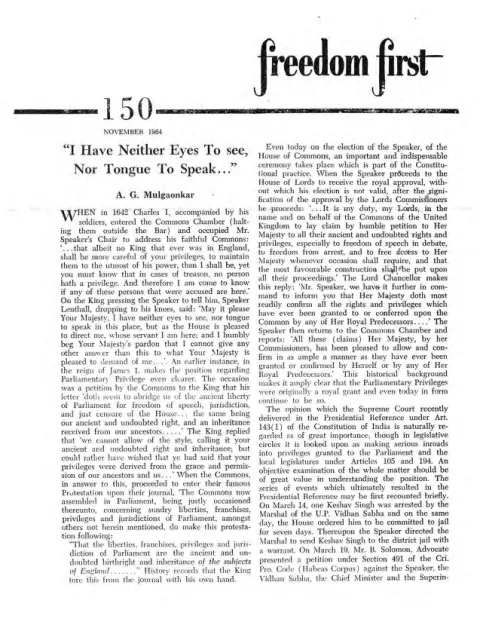
”I Have Neither Eyes To See, Nor Tongue To Speak…”
By A. G. Mulgaonkar
No summary was extracted for this article. Listed for completeness.
Plus Ca Change—
A. G. Mulgaonkar traces the doctrine of parliamentary privilege from its English origins — Speaker Lenthall’s refusal to betray the Five Members to Charles I in 1642, the Commons’ Protestation of that era, and a line of English case law (Brass Crosby’s case, Stockdale v. Hansard-adjacent precedents, Bradlaugh’s case) — through to its transplantation into Indian constitutional practice under Articles 105, 194, and 143(1). The essay recounts in detail the Keshav Singh affair: his arrest by the U.P. Vidhan Sabha’s Marshal for contempt, the Allahabad High Court’s grant of bail and a full-bench order restraining the Speaker from executing warrants against two judges, and the resulting five-question Presidential Reference to the Supreme Court on whether the legislature’s privileges under Article 194(3) trump fundamental rights and the High Court’s Article 226 jurisdiction. The essay is signalled as continuing beyond this rendered chunk (‘to be continued’).
- Opens with the 1642 confrontation between Charles I and Speaker Lenthall as the foundational precedent for parliamentary privilege against royal (and by extension executive) intrusion.
- Recounts the Commons’ 1642 Protestation asserting privilege as an ancient and undoubted birthright, torn from the journal by the King himself.
- Describes the modern ceremonial confirmation of Commons privileges by the Lord Chancellor on behalf of the monarch as evidence that privilege, though a royal grant in form, functions as an entrenched constitutional practice.
- Narrates the Keshav Singh case in procedural detail: arrest by the U.P. Vidhan Sabha, a habeas corpus petition, an Allahabad High Court bench of 28 judges restraining the Speaker, and warrants issued against two High Court judges and an advocate.
- Surveys English case law (Brass Crosby, Bradlaugh’s case, Stephen J.’s judgment) on whether courts can review internal parliamentary proceedings.
- Frames the central constitutional question as whether Article 194(3) privileges are subordinate to fundamental rights and to High Court review under Article 226.
- Notes the Supreme Court’s Presidential Reference framed five specific questions about competence, contempt, and jurisdiction arising from the standoff.
- The essay is marked as continuing past the rendered pages (‘to be continued’).
A Palace Revolution
By V. B. Karnik
V. B. Karnik describes Khrushchev’s removal from the posts of Prime Minister and First Secretary as a ‘palace revolution’ engineered by a small circle of top Communist Party leaders, with Kosygin and Brezhnev dividing the vacated posts between them. Karnik argues the change was conducted relatively civilly by Soviet standards (Khrushchev was allowed to defend himself and was not purged outright), but that it signals no fundamental shift in Soviet domestic policy, since power remains concentrated among a handful of leaders. He reads Brezhnev’s early statements as hinting at a coming attempt to repair the Sino-Soviet rift, since Khrushchev’s handling of the China dispute — which had brought relations to the point of near-excommunication — is identified as the underlying reason for his ouster. The essay closes by warning that a Sino-Soviet rapprochement could threaten Indian security interests, since Russia may become less willing to support India against the Chinese threat.
- Characterises Khrushchev’s fall as a ‘palace revolution’ decided by a handful of top Communist Party leaders without public consultation.
- Notes Kosygin took the premiership and Brezhnev the party first secretaryship.
- Observes the transition was unusually civil by Soviet historical standards — Khrushchev was allowed to attend and defend himself, and was not liquidated as Stalin-era rivals had been.
- Argues no major change in internal Soviet policy is likely, since the new leadership publicly affirmed continuity of the line adopted since 1956.
- Identifies Khrushchev’s mishandling of the Sino-Soviet split, which risked China’s total break from the world communist movement, as his real offense.
- Warns that a Sino-Soviet rapprochement following the change could reduce Russian willingness to aid India against Chinese threats and could embolden Chinese expansionism in Asia.
Obscenity: Literature And Law (II)
By N. S. Ranganath Rao
In the second installment of a two-part essay, N. S. Ranganath Rao argues that India’s obscenity law, inherited from English jurisprudence via the Hicklin test (R. v. Hicklin), is defective because it emphasizes the tendency of material to deprave and corrupt rather than the intention of its creator, and because Indian courts have repeatedly judged books obscene based on isolated passages rather than the work as a whole. He contrasts this with England’s 1959 Obscene Publications Act, which considers the author’s purpose, and calls for Indian law to admit expert literary evidence and adopt a purpose-relevant standard so that genuine literary and scientific work is not penalized alongside commercial pornography. The essay’s stated aim is a law that suppresses ‘dirt for dirt’s sake’ while minimally interfering with genuine creative and scientific expression; concrete reform proposals are promised in a further installment.
- Rejects the comparison of obscenity law to narcotics law, arguing obscenity is not an addictive compulsion and easy accessibility, not suppression, drives its ‘trade’.
- Traces the Hicklin test’s origin to English ecclesiastical notions of sin and argues it was never suited to a more liberal, less censorious modern society.
- Criticises Indian courts for judging obscenity by isolated words or passages rather than a work’s overall character and purpose, citing the Lady Chatterley’s Lover judgment’s own tension on this point.
- Notes Sections 292-293 IPC impose near-strict liability on publishers/sellers regardless of intent, which the author considers unduly harsh.
- Contrasts the Hicklin approach with England’s Obscene Publications Act of 1959, which makes the author’s purpose a relevant consideration.
- Calls for wider admission of expert evidence on literary and artistic merit, noting Indian courts have already begun departing from the old English refusal to admit such evidence.
- States the law must serve a ‘two-fold purpose’: minimal interference with genuine expression alongside efficient suppression of commercial pornography, and promises further reform suggestions in the next installment.
Reviews: The Kashmir Question (by A. G. Noorani, P. C. Manaktala & Sons, Rs. 8.50)
By RAMAN DESAI
Raman Desai reviews A. G. Noorani’s ‘The Kashmir Question’ (Manaktalas, Rs. 8.50), finding it a useful but hurriedly assembled review of the documentary and legal case for Kashmir’s accession to India. The review credits the book’s treatment of the U.N. Commission resolutions and the ceasefire agreement but criticizes its organisation, citing a confused passage between pages 53 and 56 and an editorial slip regarding the 1951 Kashmir Constituent Assembly elections. Desai closes with his own assessment of the Kashmir dispute, arguing India should keep seeking agreement with Pakistan on frontier defence against China even at some sacrifice, while treating Kashmir as part of a larger package that includes the treatment of minorities in an Islamic Pakistan.
- The book presents documents on Kashmir’s accession ‘objectively, without apportioning blame,’ according to its stated aim, though the review finds it reads more like unfinished notes than a polished White Paper.
- Highlights the book’s treatment of U.N. Commission resolutions of August 1948 and January 1949 as claiming binding force on India and Pakistan.
- Criticises confused chronological ordering, especially between pages 53-56, and disputes a passage characterising 1951 Kashmir Constituent Assembly election results as ‘farcical.’
- Argues that despite Pakistan’s rigidity, India should keep pursuing agreement with Pakistan on frontier defence against China, even at some cost.
- Recommends treating the Kashmir question as part of a broader package deal including protections for minorities under Pakistan’s Islamic Republic.
Reviews: Indian Nationalism and Hindu Social Reform (by Charles H. Heimsath, Oxford University Press, Rs. 27.50)
By S. NATARAJAN
S. Natarajan reviews Charles H. Heimsath’s ‘Indian Nationalism and Hindu Social Reform’ (Oxford University Press, Rs. 27.50), calling it a significant addition to the scarce literature on the Indian social reform movement. The review praises Heimsath’s account of how the reform movement contributed to Indian nationalism — including the argument that Governor-General Lord Bentinck’s early social legislation and A. O. Hume’s founding of Congress both drew on the same reformist current — while noting the author’s own acknowledged neglect of Muslim Indian social reform. Natarajan critiques Heimsath’s acceptance of the ‘two streams’ (Hindu and Western) framework for understanding Indian culture, arguing that R. C. Majumdar’s water-tight-compartments thesis about 19th century Hindu-Muslim relations is a political interpretation not borne out by the facts, since common ground existed at the lower social level and reformist attitudes (such as Raja Ram Mohun Roy’s critique of idolatry) had roots partly in Islamic influence.
- Calls the scarcity of material on the Indian Social Reform Movement itself notable, making Heimsath’s book a valuable addition despite its flaws.
- Notes Heimsath’s own acknowledgment that his book neglects the Muslim Indian community’s parallel reform developments.
- Highlights Heimsath’s argument that early social legislation under Lord Bentinck and Hume’s founding of Congress both descend from a shared liberal reformist tradition in British administration.
- Disputes R. C. Majumdar’s thesis (accepted by Heimsath) that 19th-century Hindus and Muslims lived in two water-tight cultural compartments, calling it a political rather than factual interpretation.
- Notes Heimsath identifies commonsense, justice and humanity — more than any inherent quality of Indian society — as underlying British-influenced reformist expectations, and separately flags Edmund Burke’s overlooked influence on Indian reformers.
- Observes that reformers’ rejection of untouchability and communalism was often a personally costly, isolating stance within their own communities.
Half-way to the Moon: New Writing from Russia
Leonard Schapiro reviews ‘Half-way to the Moon: New Writing from Russia’ (edited by Patricia Blake and Max Hayward, Weidenfeld and Nicolson, 1964), an anthology of 18 poems and five long stories originally drawn largely from Encounter magazine. He praises the collection, and especially W. H. Auden’s two poem translations, for restoring language purified from the ‘destructive force’ of official Soviet cant and propaganda, and singles out Alexander Solzhenitsyn’s ‘Matryona’s Home’ as the collection’s masterpiece, urging readers to seek it out even if they read nothing else in the book. He also discusses Viktor Nekrasov’s Italy/U.S. travelogue, which reportedly so alarmed Khrushchev that he suggested Nekrasov be expelled from the Party for describing the West honestly rather than as wholly decadent.
- The anthology (18 poems, five long stories/‘Novellen’) was mostly first published in Encounter magazine.
- Praises the collection as restoring the Russian literary tradition, purifying language from party cant, propaganda usage, and the ‘destructive force of the official lie.’
- Highlights W. H. Auden’s two poem translations as superlative, accurate refashionings that read as poems in their own right.
- Calls Alexander Solzhenitsyn’s ‘Matryona’s Home’ the masterpiece of the collection, worth the book’s price alone.
- Describes Viktor Nekrasov’s travelogue of Italy and the United States, whose honest, non-propagandistic descriptions of the West reportedly led Khrushchev to suggest Nekrasov’s expulsion from the Communist Party.
Generated by the v1.5 extraction pipeline. Awaiting editorial review.
Metadata and summary are AI-extracted from the source PDF and reviewed for editorial accuracy. The original work is available via the Read PDF tab above (where present); paragraph-level citation inside the PDF is deferred to a future engagement.