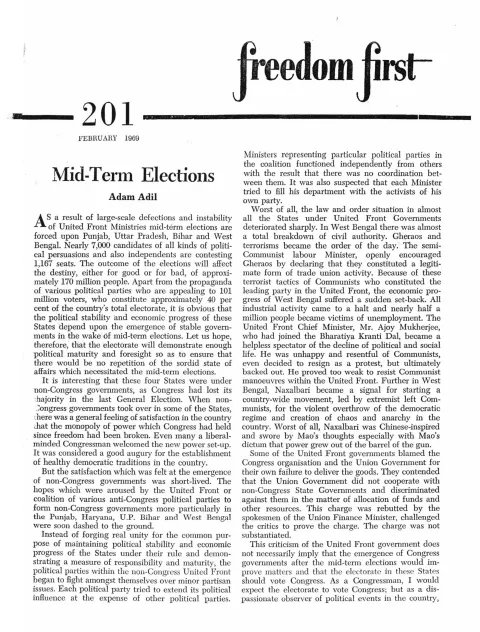
periodical issue
Freedom First
By M. R. Pai
Printed at Inland Printers, 55 Gamdevi Road, Bombay 7 and Edited and published for the Democratic Research Service by V. B. Karnik at 127 Mahatma Gandhi Road, Bombay 1. · Bombay · 1968
12 pages
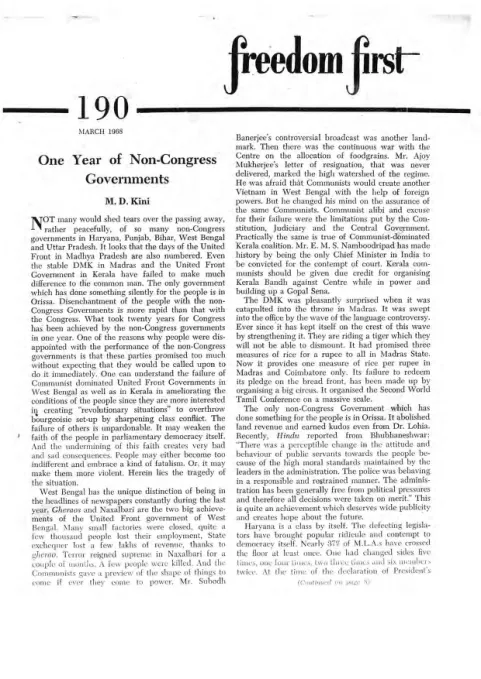
Freedom First
Summary
Freedom First issue 190 (March 1968) is a monthly opinion periodical edited and published by V. B. Karnik for the Democratic Research Service in Bombay. The issue is organised around the collapse of non-Congress coalition governments across North India, India’s foreign-policy balancing act after the ‘little summit’ with Soviet Premier Kosygin and Yugoslav President Tito in New Delhi, and a running critique of economists and politicians who trade professional independence for proximity to power. Contributors include M. D. Kini, the pseudonymous ‘Emdeeke’ and ‘Atreya’, M. R. Pai, Adam Adil, R. Srinivasan, and book reviewers V. B. Patankar and Achyut Gandhi, alongside the unsigned editorial ‘Notes’ and a closing page of topical quotations (‘With Many Voices’).
Key points
-
M. D. Kini’s “One Year Of Non-Congress Governments” surveys the coalition governments across North India, singling out West Bengal’s gheraos and Naxalbari violence and Kerala’s contempt-of-court conviction of Chief Minister E. M. S. Namboodiripad as failures, while praising Orissa’s abolition of land revenue as the sole real gain for ordinary people.
-
Writing as “Emdeeke,” the satirical column “Of Cabbages And Kings” mocks the proliferation of Indian political parties and Bombay street politics, including Bal Thackeray’s promise to have Shiv Sena “sainiks” slap litterers clean.
-
The unsigned “Notes” section argues United Front coalitions collapsed from internal disunity rather than Congress subversion, and defends India’s acceptance of the ICJ’s Rann of Kutch arbitration award against M. C. Chagla’s call for rejection on political grounds.
-
Writing as “Atreya,” “‘Little Summit’ In New Delhi” analyses the January 1968 meeting among Kosygin, Tito and Indira Gandhi, arguing the Tashkent Agreement had permanently shifted Kashmir diplomacy from the West to the Soviet Union.
-
M. R. Pai’s “The Image Of The Indian Economist” argues the profession’s standing has fallen through careerism and political malleability, crediting B. R. Shenoy as the sole prophetic dissenter on the Second Plan Panel of Economists.
-
Adam Adil’s “Withdrawal Of British Forces” examines Britain’s 1968 decision to pull troops from east of Suez, noting Malaysia and Singapore’s moves toward a NATO-style defence pact with Australia and New Zealand to fill the vacuum.
-
R. Srinivasan reviews a volume on “Higher Education In India” edited by A. B. Shah, praising Edward Shils’s contribution while arguing education is too important to be left solely to academics.
-
V. B. Patankar reviews Keith Buchanan’s “The South East Asian World,” highlighting its concept of Southeast Asia as a “predeveloped region” whose progress was retarded by colonialism.
-
Writing as “Achyut Gandhi,” a review of S. Vijayanand Bharathi’s “Can Indira Accept This Challenge?” credits the book as a bold, objective survey of Indian politics since Independence, singling out its critical chapter on Nehru’s “unscientific” dreams.
-
The closing “With Many Voices” column quotes Gulzarilal Nanda asserting that planning “never helps the peasants” and S. A. Dange threatening millowners who close mills with imprisonment.
Essays
One Year of Non-Congress Governments
By M. D. Kini
M. D. Kini surveys the first year of non-Congress United Front and coalition governments in Haryana, Punjab, Bihar, West Bengal, Uttar Pradesh, Madhya Pradesh, Kerala, Madras and Orissa, arguing that most have failed to improve on Congress rule and have instead accelerated public disenchantment with parliamentary democracy itself. He singles out West Bengal’s gheraos and the Naxalbari violence, the Communist-led Kerala coalition’s contempt-of-court conviction of Chief Minister E. M. S. Namboodiripad, the DMK’s unmet rice-price pledges in Madras, and rampant legislative defections in Haryana, while praising Orissa’s United Front government (which abolished land revenue) as the sole exception delivering real gains for ordinary people.
- Non-Congress governments in Haryana, Punjab, Bihar, West Bengal and Uttar Pradesh have fallen or are close to falling after roughly one year in office.
- West Bengal’s United Front presided over gheraos, factory closures, and the Naxalbari uprising, with Communists using ‘revolutionary situations’ rhetoric rather than governance.
- Kerala’s Communist-led coalition organised a Kerala Bandh and a Gopal Sena while its Chief Minister E. M. S. Namboodiripad was convicted for contempt of court.
- The DMK government in Madras failed to deliver its promised subsidized rice and compensated with a large-scale Second World Tamil Conference instead.
- Orissa’s non-Congress government is credited as the only one to have delivered concrete benefits, including abolition of land revenue and a Hindu newspaper report of improved police and administrative conduct.
- Haryana is depicted as especially dysfunctional, with about 37% of MLAs having defected at least once.
Of Cabbages And Kings
By Emdeeke
Writing under the pseudonym ‘Emdeeke’, this satirical column mocks the proliferation of Indian political parties compared to the American and British two-party systems, invoking a ‘Perkins Law of Anglo-Saxon Politics’ from a Harold Perkin piece in the Guardian. It moves into anecdotes about Bombay street life during a George Fernandes-led agitation, aggressive labour-union tactics against bank officers, Shiv Sena leader Bal Thackeray’s promises to clean up Bombay by force, and the columnist’s own disenchanted, half-serious survey of which party (Shiv Sena, Swatantra, Jan Sangh, Congress) deserves a municipal vote — concluding wryly that disenfranchisement has solved the dilemma for him.
- The column jokes that India’s many political parties reflect a form of ‘more democratic’ voting but risk driving the country toward polarisation and an eventual two-party system.
- Anecdotes describe a B.E.S.T. strike and bank employee unions using intimidation, which the columnist reads as labour leaders ‘masquerading’ for political ends.
- Bal Thackeray and the Shiv Sena are described as promising to keep Bombay clean by having sainiks slap litterers, which the author finds ‘disconcerting’.
- The columnist surveys Shiv Sena, Swatantra, and Jan Sangh as municipal-election options and finds fault with each, ultimately noting he has no vote and so no problem.
Notes (Need of the Hour; Kutch Award)
The unsigned editorial ‘Notes’ opens with ‘Need of the Hour’, arguing that the various non-Congress United Front governments were held together only by anti-Congress sentiment and were bound to collapse from internal disunity rather than Congress subversion; it criticises both the non-Congress parties for allying opportunistically with Communists of all stripes and the Congress for failing to purge corrupt elements or build coalitions with likeminded groups. A second item, ‘Kutch Award’, defends India’s acceptance of the International Court of Justice’s Rann of Kutch arbitration award as the only honourable course consistent with India’s prior commitment to arbitration, criticising M. C. Chagla for urging rejection of the award on political rather than judicial grounds.
- The editorial holds that anti-Congress hatred alone could not sustain diverse United Front coalitions, and that internal disunity, not external subversion, caused their collapse.
- It warns that repeated cycles of United Front collapse followed by President’s Rule risk discrediting democracy itself.
- It urges the Congress to purge corrupt members and build alliances with likeminded parties rather than claim a monopoly on power.
- On the Rann of Kutch award, the editorial argues India is bound by its prior agreement to arbitration and must accept the ICJ’s decision even though it went partly against India.
- M. C. Chagla is criticised by name for advising rejection of the award on political grounds despite his stature as a former Chief Justice and Union minister.
‘Little Summit’ In New Delhi
By “Atreya”
Writing as ‘Atreya’, this piece analyses the January 1968 Republic Day ‘little summit’ in New Delhi among Soviet Premier Kosygin, Yugoslav President Tito, and Prime Minister Indira Gandhi. The author argues the meeting was substantive rather than ceremonial, driven by Mrs. Gandhi’s own initiative, and surveys its main themes: India’s weak bargaining position on the Suez closure and West Asian crisis given its close alignment with Soviet and Arab positions; the Tashkent Agreement’s effect of shifting Kashmir diplomacy from the West to the USSR; the stagnation of Indian economic policy under Soviet-patterned planning; and Peking’s denunciation of the summit as an anti-China, pro-US-imperialism conspiracy. The piece closes by noting strains in the Soviet-Indian relationship, including Soviet anger over defections and the West Bengal ministry’s dismissal.
- The New Delhi meeting between Kosygin, Tito and Indira Gandhi is read as a substantive diplomatic event rather than mere Republic Day ceremony, initiated at Mrs. Gandhi’s urging.
- India’s alignment with Soviet, Yugoslav and Arab positions on West Asia left it unable to contribute anything beyond a ‘chorus of claque’ on the Suez Canal closure.
- The Tashkent Agreement is described as having permanently transferred diplomatic initiative on Kashmir from the West to the Soviet Union.
- Soviet-patterned economic planning in India is criticised as a source of continued economic stagnation, expected to be a major topic of the talks.
- Peking characterised the summit as ‘international scheming by a number of accomplices and running dogs of U.S. imperialism’ aimed at China.
- The joint communique commits India and the USSR to continued exchange of views and reaffirms support for Cambodia’s sovereignty and neutrality per the 1954 Geneva Agreements.
The Image Of The Indian Economist
By M. R. Pai
M. R. Pai argues that the public image of the Indian economist has fallen alongside that of the Indian politician, citing Prof. C. N. Vakil’s own plea at the Golden Jubilee Conference of the Indian Economic Association for economists to police their professional standards. Pai traces the fall to careerism, political malleability, and eagerness for government patronage, using the Second Five Year Plan’s Panel of Economists (where only B. R. Shenoy dissented, prophetically) as an example of economists who fail to hold firm views independent of political pressure. He also criticises a recent industrial-licensing report for improperly invoking ‘Marwari’, ‘Gujarati’ and ‘Parsi Capital’ in official policy analysis, and a pamphlet-style ‘report of four economists’ on bank nationalisation for masquerading ideological advocacy as neutral research.
- Pai contends the Indian economist’s public standing has fallen as much as the Indian politician’s, quoting Prof. C. N. Vakil’s call for the profession to police its own standards.
- Economists who endorsed the Second Plan and later criticised it once public opinion turned are cited as evidence of professional capitulation to political pressure.
- B. R. Shenoy is credited as the sole dissenting voice on the Second Plan Panel of Economists, a dissent that proved prophetic.
- A recent industrial-licensing report is criticised for using communal categories like ‘Marwari Capital’ and ‘Gujarati Capital’, which Pai calls a ‘deplorable lapse’.
- A report by four economists on bank nationalisation is described as an ideological pamphlet dressed up as neutral research.
- Pai closes by urging economists to adopt a code of conduct and assert independence or face public ‘wrath… for dereliction of their duty’.
Withdrawal Of British Forces
By Adam Adil
Adam Adil examines Britain’s 1968 decision to withdraw its military forces from bases east of Suez (Singapore, the Persian Gulf, retaining only Hong Kong at reduced strength), framing it as a sequel to the 1947 decolonisation of India, Burma and Ceylon and driven by unsustainable defence costs (roughly $2.4 billion) amid Britain’s declining status as, in Chancellor Roy Jenkins’s words, no longer ‘a superpower’. The article assesses the resulting power vacuum in Malaysia/Singapore and the Persian Gulf oil states, noting Singapore and Malaysia’s moves toward a NATO-style defence pact with Australia and New Zealand and Singapore’s tilt toward Japan, while judging the Gulf states less vulnerable given their independent economic base, and closes by urging continued US and allied vigilance against communist infiltration in the vacated regions.
- Britain will withdraw 35,000 troops from Singapore and 6,000 from Persian Gulf areas by 1971, retaining only 10,000 in Hong Kong.
- The withdrawal is attributed to unsustainable financial cost, cited at nearly $2.4 billion, and Britain’s declining superpower status.
- Malaysia and Singapore are reported to be organising a NATO-style defence agreement with Australia and New Zealand to offset the British pull-back.
- Singapore’s Prime Minister Lee Kuan Yew is quoted on moving closer to Japan ‘to develop my own muscles’.
- Persian Gulf oil states (Iran, Saudi Arabia, Kuwait, Bahrain) are judged less at risk than Southeast Asia because they did not depend on British troops for economic stability.
- Britain’s broader defence burden is detailed: 429,000 men in uniform, 52,000 troops on the Rhine, and cancellation of a $1 billion F-111 aircraft order to cut costs.
- The article calls for US and allied safeguards against communist infiltration in the regions vacated by British forces.
Higher Education In India (review of ‘Education, Scientific Policy and Underdeveloped Countries’ and ‘Climbing a Wall of Glass’, ed. A. B. Shah)
By R. Srinivasan
R. Srinivasan reviews an edited volume on higher education in India (edited by A. B. Shah, Lalvani, Bombay 1967), originally a special issue of Quest supplemented with additional essays. Srinivasan praises pieces by Edward Shils (rescued from an old Encounter file) while offering mixed verdicts on contributions by Professor Kamat (worried about ‘casteism’ entering university classification), Principal Dhabolkar (on channelling student unrest), Professor Hulbe (seen as repetitive of earlier work), Professor Taylor (on examination reform), and V. V. John (judged ‘inconsequential’). He closes by arguing higher education is too important to be left solely to academics and regretting the book’s lack of an index.
- The reviewed volume, edited by A. B. Shah, began as a special issue of Quest and was expanded with about half a dozen additional essays.
- Edward Shils’s contribution, rescued from an old Encounter file, is singled out as a highlight.
- Srinivasan disagrees with Professor Kamat’s worry that ‘casteism’ could enter university classification schemes (major/minor institutions), though he finds the analysis worthwhile.
- V. V. John’s essay is judged ‘inconsequential’ and one the volume would have lost nothing by excluding.
- Srinivasan argues education is too important to be left solely to educationists, criticising the volume for including no non-academic contributors despite claiming a broad stake for businessmen, bankers and political leaders.
- The absence of an index is flagged as a serious practical shortcoming.
Reviews: The South East Asian World (review of Prof. Keith Buchanan’s book)
By V. B. Patankar
V. B. Patankar reviews Prof. Keith Buchanan’s ‘The South East Asian World’ (G. Bell & Sons, London, 1967), praising its depth of scholarship, original viewpoint and panoramic coverage of the region’s life, politics and problems. The review highlights Buchanan’s concept of Southeast Asia as a ‘predeveloped region’ whose progress was retarded by colonialism, his identification of three converging geopolitical forces (emergent-nation struggles for identity, the influence of Asian communism, and Western/US attempts to counter it), and the book’s attractive illustrative plates on regional life, art, architecture and agriculture.
- Buchanan’s book is praised for depth of scholarship and a panoramic, original view of Southeast Asia’s politics and society.
- The term ‘predeveloped region’ is used to describe Southeast Asia’s developed societies whose progress was stifled by Western colonialism.
- Three converging geopolitical forces are identified: emergent-nation struggles for identity, Asian communist influence, and Western/US counter-efforts.
- The review notes the book’s attractive illustrative plates depicting regional life, art, architecture and agriculture as enhancing its value.
Reviews: Can Indira Accept This Challenge? (review of S. Vijayanand Bharathi’s book)
By Achyut Gandhi
Writing as ‘Achyut Gandhi’, this review of S. Vijayanand Bharathi’s 500-page ‘Can Indira Accept This Challenge?’ (Vora & Co., Bombay, Rs. 20) credits the book as a bold, largely objective and non-partisan attempt to survey Indian politics since Independence, covering the Congress party’s inner workings, the role of religion, Nehru’s legacy and decisions, Shastri’s brief tenure, and a detailed chapter on India’s defence posture following the 1962 China war. The reviewer singles out the chapter on Nehru as appropriately critical of his ‘unscientific’ dreams, praises the defence chapter as essential reading, but notes the book poses its title question about Indira Gandhi’s leadership without presuming to answer it.
- The book is described as a bold, over-500-page attempt to survey Indian political problems since Independence.
- It is praised as objective and scrupulously non-partisan, giving an ‘unbiased picture’ of Indian political life.
- The chapter on Jawaharlal Nehru is described as critical of his ‘unscientific’ policy dreams while upholding his bold and sound decisions.
- The chapter on ‘Defence of India’ addresses the 1962 Chinese invasion and the question ‘Defence against whom?’, which the reviewer calls essential reading, including abroad.
- The book poses but does not answer its titular question about whether Indira Gandhi can meet the challenges of leadership.
With Many Voices (quotations column)
The closing page ‘With Many Voices’ compiles topical quotations from newspapers, magazines, and public figures on international and domestic politics, including remarks by J. K. Galbraith on planning and technology, Gulzarilal Nanda on planning’s effect on peasants, S. A. Dange threatening millowners, Frank Moraes on India’s political-economic climate, Lee Kuan Yew on Asia’s fate resting with major powers, and a Marxist-party-in-Kerala barb from M. Sivaram.
- The page assembles dated quotations from The Economist, Time, US News & World Report, The Hindu, The Indian Express and other outlets between December 1967 and February 1968.
- J. K. Galbraith is quoted comparing democratic socialism and ‘vintage capitalism’ as both victims of modern technology and organisation.
- Gulzarilal Nanda is quoted asserting that planning ‘never helps the peasants but creates difficulties’.
- S. A. Dange is quoted threatening millowners who close mills with imprisonment and hard labour.
- M. Sivaram is quoted describing Kerala’s Marxist party as ‘the most prosperous capitalist enterprise in the State’.
- The page also carries a subscription coupon for Freedom First addressed to the Democratic Research Service, Bombay.
Generated by the v1.5 extraction pipeline. Awaiting editorial review.
Metadata and summary are AI-extracted from the source PDF and reviewed for editorial accuracy. The original work is available via the Read PDF tab above (where present); paragraph-level citation inside the PDF is deferred to a future engagement.