periodical issue
Freedom First
By V. B. Karnik, A Special Correspondent, M. R. Masani, M.P., G. L. Mehta, (Contributed), Mr. Vedamurthy, Mr. Sridhara Murthy, Mr. M. D. Kini, V. B. Karnik
Printed at Inland Printers, 55 Gamdevi Road, Bombay 7 and Edited and published for the Democratic Research Service by V. B. Karnik of 127 Mahatma Gandhi Road, Bombay 1. · Bombay · 1968
12 pages
Freedom First
Summary
Freedom First No. 192 (May 1968) is a monthly issue of the classical-liberal periodical published by the Democratic Research Service, Bombay. The issue opens with V. B. Karnik protesting the Maharashtra government’s order externing the Christian missionary Fr. Vincent Ferrer from the Nasik district, arguing the action violates natural justice since no charges were disclosed or tested. A Special Correspondent surveys the disappointing results of the first and second UNCTAD conferences and India’s weak export performance. M. R. Masani, M.P., lays out the arguments for and against India signing the Nuclear Non-Proliferation Treaty, concluding that non-signature would isolate India politically without real compensating benefit. G. L. Mehta pays tribute to the assassinated Martin Luther King, tracing his debt to Gandhian satyagraha. A short notice announces the newly established Leslie Sawhny Programme of Training for Democracy. An unsigned contributed piece reviews 1967 as ‘Another Year of Cultural Revolution’ in China, describing Mao’s failed efforts to restore order after the Red Guard violence. A review by V.B.K. covers A. R. Antulay’s book critiquing the Mahajan Commission’s report on the Maharashtra-Mysore-Kerala boundary dispute. The issue closes with an exchange of reader letters on D.M.K.-era Madras politics (‘Towards Understanding Madras Politics’), a ‘Without Comment’ item on Communist parties reprinted from Swarajya, and the regular ‘With Many Voices’ page of quoted excerpts from the press.
Key points
-
V. B. Karnik’s “Unjust and Unfair” protests the Maharashtra government’s externment order against missionary Fr. Vincent Ferrer, who ran welfare work benefiting over 10,000 Nasik-district farmers for seventeen years, arguing vague undisclosed charges of “conversions” violate natural justice.
-
A Special Correspondent’s “Exports After UNCTAD” argues both the 1964 and 1968 UNCTAD conferences failed to resolve major trade issues, noting India’s exports were just 4.5% of national income in 1966-67 against 40% for the Netherlands, and calls for developing countries to prioritise their own export promotion.
-
M. R. Masani’s piece on the “Nuclear Non-Proliferation Treaty” supports India’s non-nuclear stance while rebutting arguments against signing the NPT, warning that refusal would isolate India alongside Albania, Cuba and North Korea and forfeit US nuclear fuel supply and goodwill.
-
G. L. Mehta’s tribute “Fearless Warrior Of Peace” honours the assassinated Martin Luther King, tracing his explicit debt to Gandhian satyagraha through Thoreau back to the Bhagavad Gita.
-
A notice announces the newly established Leslie Sawhny Programme of Training for Democracy, a five-year initiative chaired by N. A. Palkhivala with M. R. Masani as Honorary Secretary, to train political workers and party cadres in democratic principles.
-
An unsigned review of 1967 as “another year of cultural revolution” in China describes the PLA’s emergence as the only institution able to restore order, Lin Piao’s rise as Mao’s presumed successor, and the sustained vilification of President Liu Shao-ch’i as “China’s Khrushchev.”
-
A review signed V.B.K. of A. R. Antulay’s critique of the Mahajan Commission’s Maharashtra-Mysore-Kerala boundary report argues Justice Mahajan applied inconsistent linguistic-majority standards, favouring Mysore’s claim to Kasargod while denying comparable Marathi-majority claims to Belgaum.
-
The “Towards Understanding Madras Politics” exchange continues, with readers Vedamurthy and Sridhara Murthy defending the DMK government against M. D. Kini’s earlier criticism, before the editor closes the debate for reasons of space.
-
A “Without Comment” item reprinted from Swarajya argues Communist parties cannot be treated as ordinary democratic parties since subversion is their “first love,” and calls on the Madras and Central Congress governments to free themselves from Communist influence.
-
The closing “With Many Voices” column quotes Philip Toynbee calling the lie “the worst feature of Soviet society” and notes posters in Calcutta calling for “armed revolution, here and now.”
Essays
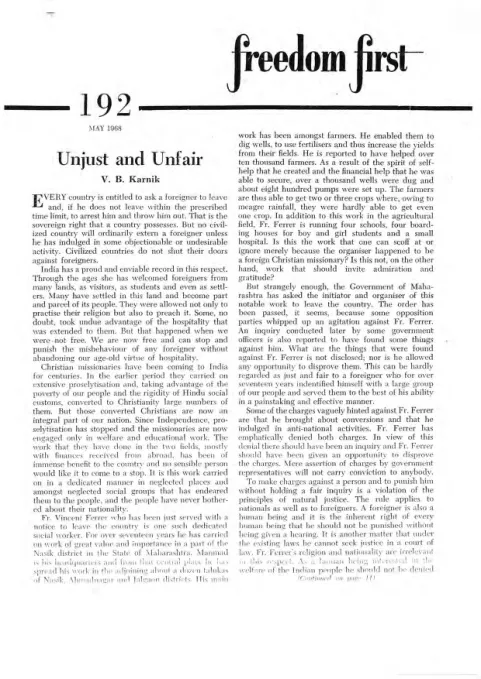
Unjust and Unfair
By V. B. Karnik
V. B. Karnik argues that the Maharashtra government’s order to extern the Christian missionary Fr. Vincent Ferrer from the Nasik district is unjust and unfair. Fr. Ferrer had spent seventeen years running agricultural extension work, wells, schools, boarding houses and a small hospital benefiting thousands of farmers around Manmad. Karnik contends that even though a country has the sovereign right to expel a foreigner, doing so without a fair inquiry or disclosed charges violates natural justice; he notes the vague, undisclosed charges of ‘conversions’ and ‘anti-national activities’ which Ferrer denies. The piece (continued from page 1 to page 11) ends noting that the government has since extended Ferrer’s stay by two months to allow an inquiry, which Karnik welcomes, while maintaining that as things stand the action against Ferrer remains unjust and unfair.
- Fr. Vincent Ferrer ran welfare and agricultural work in Nasik district for 17 years, helping over 10,000 farmers with wells, fertilizer, and irrigation.
- The Government of Maharashtra ordered Ferrer’s externment after opposition parties agitated against him.
- Charges against Ferrer (conversions, anti-national activities) were vaguely hinted but never disclosed or proven in a hearing.
- Karnik frames the case as a matter of natural justice and human rights, not religion or nationality.
- After the article was written, the government extended Ferrer’s permission to stay by two months pending inquiry.
Exports After UNCTAD
By A Special Correspondent
A Special Correspondent reviews the outcomes of the first (1964) and second (1968) UNCTAD conferences, drawing on Richard N. Gardner’s book In Pursuit of World Order. The piece argues the second UNCTAD, like the first, failed to reach consensus on major issues such as tariff preferences for developing-country exports, primary-product price stabilisation, and increased private capital flows. It criticises India’s own poor grasp of its export data and non-tariff barriers, and concludes (in a passage continued on page 4) that developing countries should focus on promoting their own exports rather than relying on appeals to rich nations, citing comparative export-to-national-income shares across Netherlands, Canada, UK, Italy, France, Japan and India (4.5% in 1966-67).
- UNCTAD I (1964) and UNCTAD II (1968) both failed to resolve major trade issues facing developing countries.
- Quotes Richard N. Gardner’s book In Pursuit of World Order on the political significance of the trade gap for developing nations.
- India’s own government lacks detailed data on non-tariff barriers and invisible export earnings.
- Comparative data: exports as share of national income were 40% in Netherlands, 24% Canada, 23% UK, 16% Italy, 15% France, 13% Japan, but only 4.5% in India (1966-67).
- Concludes developing countries should prioritise promoting their own exports rather than depend on concessions from rich nations.
Nuclear Non-Proliferation Treaty
By M. R. Masani, M.P.
M. R. Masani, M.P., lays out the case for and against India signing the Nuclear Non-Proliferation Treaty. He supports the government’s position of not developing nuclear weapons on economic and political grounds, citing Morarji Desai’s warning about the fantastic cost of a nuclear programme. He then works through arguments against signing the Treaty (that it would hinder peaceful atomic development, that it is discriminatory toward non-nuclear powers, that the Soviet Union has regressively resisted international inspection) and argues each is unconvincing given escape clauses in the Treaty’s articles. Masani concludes that not signing would isolate India in the company of Albania, Cuba, Romania, North Vietnam, North Korea and Communist China, cost India goodwill and economic assistance from the US and Canada, and forfeit any nuclear guarantee against China, while noting the government has a few months to decide and should form a parliamentary committee to study the issue.
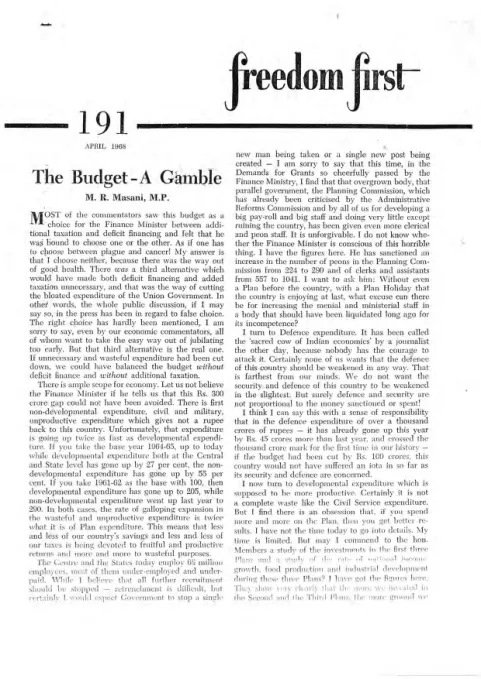
- Masani supports India’s position of not making nuclear weapons on both economic and political grounds.
- Quotes Morarji Desai’s March 1968 warning that a nuclear weapons race would break India economically.
- Reviews and rebuts arguments against signing the NPT: interference with peaceful atomic development, unfairness to non-nuclear states, and the 90-day exit clause under Article X.
- Warns that refusal to sign would place India alongside Albania, Cuba, Romania, North Vietnam, North Korea and China as NPT holdouts.
- Notes India risks losing US nuclear fuel supply and Canadian goodwill, and forfeiting the draft Security Council nuclear-guarantee resolution.
- Argues Indian public opinion on the issue is largely limited to intellectuals and elites rather than the masses.
- Recommends a small parliamentary committee study the Treaty in the months remaining before the final decision.
Fearless Warrior Of Peace
By G. L. Mehta
G. L. Mehta’s tribute to Martin Luther King, written after his assassination, describes King as a rare figure who restored faith in human nature through his commitment to non-violence and the ‘power of love.’ Mehta traces King’s Montgomery bus boycott, his explicit acknowledgment of debt to Gandhi’s philosophy of satyagraha (which Mehta traces further back through Thoreau’s Civil Disobedience to the Bhagavad Gita), and his subsequent role as a ‘true Satyagrahi’ battling for civil rights amid rising black power militancy and white resistance. The piece closes by comparing King’s assassination to those of Lincoln, Gandhi and Kennedy as tragic shames on a supposedly civilised world, and cites King’s Nobel Peace Prize description as ‘a fearless warrior of peace.’
- King organised the 381-day Montgomery bus boycott after a Black woman was arrested for violating segregation rules.
- King explicitly credited Gandhi’s philosophy of love and non-violent resistance as central to his own method of social reform.
- Mehta traces a lineage from the Gita to Thoreau to Gandhi to King.
- King was the youngest Nobel Peace Prize winner at 35.
- Despite King’s efforts, white resistance and Black militancy (‘black power’) continued to produce violence in the US through the late 1960s.
- Mehta likens King’s assassination to those of Lincoln, Gandhi, and Kennedy as tragedies for civilisation.
Essay 5
A brief institutional notice announces the establishment of the Leslie Sawhny Programme of Training for Democracy, a five-year initiative beginning April 1968 to train political workers and party cadres in citizenship, political organisation and democratic principles. The programme, named after the late Col. Leslie Sawhny (a Liberal International member who inspired and helped finance the project), will be run by a Board of Management chaired by N. A. Palkhivala, with M. R. Masani as Honorary Secretary and Treasurer, and other members including Shantilal Shah, V. B. Karnik, S. Mulgaokar, M. A. Sreenivasan and M. R. Pai; Arvind A. Deshpande is named Executive Secretary, headquartered at Mahatma Gandhi Road, Bombay.
- The Leslie Sawhny Programme of Training for Democracy launches in April 1968 for a five-year run.
- Aims to train political workers and party cadres from local units, trade unions, and youth/student groups across states and languages.
- Named in memory of Col. Leslie Sawhny, a Liberal International member who inspired and financed the project.
- Board of Management chaired by N. A. Palkhivala; M. R. Masani serves as Honorary Secretary and Treasurer.
- Other board members include Mrs. L. Sawhny, Shantilal Shah, V. B. Karnik, S. Mulgaokar, M. A. Sreenivasan, and M. R. Pai.
Another Year Of ‘Cultural Revolution’
By (Contributed)
This contributed piece reviews 1967 as ‘another year of cultural revolution’ in China, describing a year of Maoist campaigns to purge and discipline the party, army and populace. It details the PLA’s growing role as the only institution able to maintain order amid factional student and worker unrest, the emergence of Lin Piao as second only to Mao, and the sustained vilification of President Liu Shao-ch’i as ‘China’s Khrushchev.’ The piece also covers China’s deteriorating foreign relations in 1967, including the burning of the British Mission’s chancery in Peking by Red Guards and worsening ties with the USSR, Burma, Indonesia and Thailand, concluding that the Cultural Revolution’s chaos damaged China’s credibility as a model for other developing nations.
- 1967 saw an intensive but only partly successful campaign by Mao to end the disorder unleashed by the Cultural Revolution.
- The PLA (People’s Liberation Army) emerged as the only institution capable of restoring order among bureaucracy, party, and army.
- Lin Piao was described as ‘the closest comrade in arms’ and presumed successor to Mao.
- President Liu Shao-ch’i was repeatedly attacked as ‘China’s Khrushchev’ and ‘the leading person in authority following the capitalist path.’
- China’s foreign relations deteriorated sharply, including the burning of the British Mission’s chancery in Peking on August 22, 1967, and worsening relations with the USSR, Burma, Indonesia and Thailand.
s book critiquing the Mahajan Commission
A review, signed V.B.K., of A. R. Antulay’s book critiquing the Mahajan Commission’s report on the Maharashtra-Mysore-Kerala boundary dispute. The reviewer finds Antulay’s analysis painstaking and persuasive, arguing that the former Chief Justice Mahajan applied inconsistent standards to different disputed areas (favouring Mysore’s claim to Kasargod on linguistic-majority grounds while denying similar Marathi-majority claims in Belgaum, Akkalkot and Bidar), and suggests Mahajan’s general aversion to linguistic reorganisation of states coloured his judgment. The review concludes that the government, currently examining the report, would benefit from Antulay’s critique before deciding whether to accept the Commission’s contradictory recommendations.
- The book under review is by A. R. Antulay (Allied Publishers, Rs. 14), critiquing Justice Mahajan’s boundary commission report.
- Antulay shows Mahajan applied inconsistent tests: accepting Mysore’s claim to Kasargod on a lower linguistic threshold while rejecting comparable Marathi-majority claims to Belgaum, Akkalkot and Bidar.
- The reviewer suggests Mahajan’s known aversion to linguistic reorganisation of states may explain the report’s bias against Maharashtra.
- The review criticises the Government of India for appointing a commissioner with strong views against linguistic reorganisation without clear terms of reference.
- Belgaum’s 1951 census showed 51.4% Marathi speakers, reduced to 46-47% by 1961, yet the Commission held Kasargod’s 12.3% Kannada speakers as sufficient claim.
Towards Understanding Madras Politics
By Mr. Vedamurthy / Mr. Sridhara Murthy / Mr. M. D. Kini
A continuation of an ongoing exchange of letters titled ‘Towards Understanding Madras Politics,’ printing further replies from readers Vedamurthy and Sridhara Murthy responding to M. D. Kini’s earlier defence of the D.M.K. government, followed by Kini’s own rejoinder. Vedamurthy defends his earlier criticism of the World Tamil Conference and rejects Kini’s charge that opposing Hindi while preferring English is a pernicious double standard. Sridhara Murthy accuses Kini of DMK-phobia and cites M. R. Masani’s praise of the Madras government’s efficiency. Kini replies that only facts and figures, not opinions, can settle the debate, and that opposition to Hindi is not itself objectionable but the manner in which it was expressed was.
- The exchange continues a debate begun in earlier issues (April and March 1968) between M. D. Kini and reader critics over the D.M.K. government’s record.
- Vedamurthy defends his earlier comparison of the World Tamil Conference to a ‘circus’ or ‘carnival,’ citing agreement with Swarajya’s views.
- Sridhara Murthy cites M. R. Masani’s praise for the Madras government’s efficiency as a rebuttal to Kini’s skepticism.
- Kini’s rejoinder insists debate should rest on facts and figures rather than opinion, and clarifies his objection was to how anti-Hindi sentiment was expressed, not the position itself.
- The editor’s note states this closes the controversy in the magazine’s pages for reasons of space.
Review: Mahajan Report Uncovered (review of A. R. Antulay, Allied Publishers)
By V. B. K.
No summary was extracted for this article. Listed for completeness.
Leslie Sawhny Programme Of Training For Democracy
No summary was extracted for this article. Listed for completeness.
Without Comment
A short unsigned ‘Without Comment’ item, reprinted from Swarajya (March 30), argues that Communist parties cannot be treated as ordinary democratic political parties because subversion is their fundamental commitment; it likens Marx to the Communists’ ‘Rig Veda rishi’ and calls on the Chief Minister of Madras and the Central Congress government in Delhi to free themselves from Communist influence.
- Argues Communist parties’ ‘first love’ is subversion, making them fundamentally different from democratic parties.
- Cites Karl Jaspers on Marxist ideology’s destruction-then-creation logic.
- Calls on the Madras Chief Minister and the Central Congress government to remove Communist influence over their politics.
With Many Voices
The regular ‘With Many Voices’ feature collects short quoted excerpts from the Indian and international press during April 1968, on topics ranging from President Johnson’s personal philosophy, Philip Toynbee on Soviet untruthfulness, Malaysia’s transport minister warning of Communist expansion into Thailand, Morarji Desai’s comments on understanding Communists and on India’s poor practice of its philosophy, Martin Luther King’s remarks on race relations shortly before his death, P. Spratt in Swarajya on dictatorship and emotion, and a Weekend Review item on extremist calls for ‘armed revolution’ in Calcutta.
- Quotes President Johnson (Indian Express, April 2) on his personal philosophy as a free man and public servant.
- Quotes Philip Toynbee (Opinion, April 2) calling the lie the worst feature of Soviet society, worse than under Stalin.
- Quotes Malaysia’s Transport Minister Tan Sri Sardon Jubir warning of a Communist victory in Vietnam threatening Thailand, Malaysia and Indonesia.
- Quotes Morarji Desai twice: on understanding Communists’ grievance, and on Indian philosophy being high while practice is low.
- Quotes Martin Luther King (New York Times, April 7) days before his assassination on mutual need between Black and white Americans.
- Quotes P. Spratt (Swarajya, April 20) that dictatorship flourishes on emotion and group aggressiveness.
- Notes posters appearing in Calcutta calling for ‘armed revolution, here and now’ (Weekend Review, April 20).
Generated by the v1.5 extraction pipeline. Awaiting editorial review.
Metadata and summary are AI-extracted from the source PDF and reviewed for editorial accuracy. The original work is available via the Read PDF tab above (where present); paragraph-level citation inside the PDF is deferred to a future engagement.