periodical issue
Freedom First
By M. R. Pai
Printed at Inland Printers, 55 Gamdevi Road, Bombay 7 and Edited and published for the Democratic Research Service by V. H. Karnik at 127, Mahatma Gandhi Road, Bombay 1. · Bombay · 1968
12 pages
Freedom First
Summary
Freedom First No. 193 (June 1968) is a monthly issue of the Bombay-based classical-liberal periodical published by the Democratic Research Service and edited by M. R. Masani’s circle. The issue opens with M. R. Pai’s critique of the perquisites and patronage enjoyed by India’s professional politicians and his ten-point program of “social control” over them, followed by an editorial-style piece on the Paris Viet Nam peace talks signed “Atreya” that defends U.S. policy and attacks Western liberal critics of the Vietnam War such as J. K. Galbraith. Unsigned “Notes” comment on the stalled Assam reorganisation, the decline of Anti-Congressism as a political strategy, and the Leslie Sawhny Programme of Training for Democracy, alongside a “Without Comment” item on Indian communist leaders’ travel to the Soviet bloc. The remainder of the issue carries Chris Cook’s reprinted survey (via Socialist Commentary) of Portugal’s colonial wars in Angola, Mozambique and Guinea; Adam Adil’s report on liberalising ferment in Czechoslovakia, Poland and Romania under the heading “Winds Of Change In Eastern Europe”; R. Muthuswamy’s analysis of municipal and by-election trends in Kerala, U.P., Haryana, Rajasthan and West Bengal in “Trends In Recent Elections”; and the closing “With Many Voices” column of press quotations, including remarks from C. Rajagopalachari, Alexander Dubcek, and others, plus a subscription coupon and imprint.
Key points
-
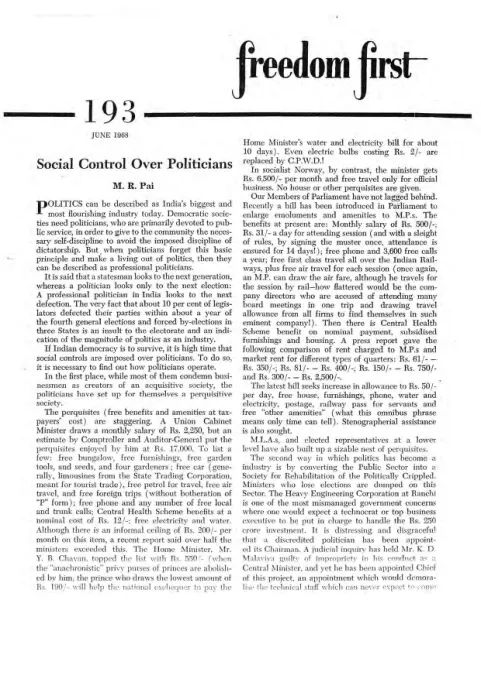
M. R. Pai’s “Social Control Over Politicians” itemises the lavish perquisites of Union Cabinet Ministers (Rs. 17,000/month versus a Rs. 2,250 salary) against Norway’s leaner system, and proposes a ten-point programme including abolishing perquisites and mandatory wealth disclosure.
-
Writing as “Atreya,” “The Viet Nam Peace Talks” frames Hanoi’s stalling over the Paris talks venue as insincere negotiating posture and attacks American liberal critics of the war, including Robert Kennedy and J. K. Galbraith, as amplifying Communist psychological warfare.
-
The unsigned “Notes” section argues the delay in Assam’s reorganisation between hill and plains populations is dangerous, and that “Anti-Congressism” has exhausted itself given Congress’s recovery in Kerala and Haryana by-elections.
-
Chris Cook’s “Portugal At War,” reprinted from Socialist Commentary, surveys Portugal’s colonial wars in Angola, Mozambique and Guinea, detailing 165,000 troops deployed and 42% of the 1966 budget spent, and concludes the war is unwinnable and “both wrong and harmful.”
-
Adam Adil’s “Winds Of Change In Eastern Europe” reports on Alexander Dubcek’s loosening of party control in Czechoslovakia, including the country’s first workers’ strike under communism, while contrasting Poland’s stiffening resistance to reform under Gomulka.
-
R. Muthuswamy’s “Trends In Recent Elections” analyses Indian municipal and by-election results, finding Congress inroads into Communist strongholds in Kerala and voters increasingly evaluating parties on performance rather than ideology.
-
The closing “With Many Voices” column quotes Alexander Dubcek wanting “Marks and Spencer, not Marx and Engels” and M. R. Masani comparing Indian attitudes to other nations with Brahmin treatment of Harijans.
Essays
Social Control Over Politicians
By M. R. Pai
M. R. Pai argues that Indian democracy is threatened by the rise of the “professional politician” who treats politics as a livelihood rather than public service. He itemises the lavish perquisites enjoyed by ministers, M.P.s and M.L.A.s (free housing, cars, travel, health benefits) against the modest official salaries, contrasts this with Norway’s leaner ministerial allowances, and describes how politicians further enrich themselves through control of the public sector, cooperative societies, and trade unions. He closes with a ten-point programme of “social controls,” including abolishing perquisites, mandatory disclosure of wealth, barring elected representatives from contact with administration, and reducing the size of ministries.
- Describes politics as India’s most flourishing “industry,” with roughly 10 percent of legislators defecting parties within a year of the fourth general elections.
- Details extravagant perquisites for Union Cabinet Ministers (estimated at Rs. 17,000/month by the Comptroller and Auditor-General) versus a Rs. 2,250 salary.
- Contrasts India’s minister perquisites with Norway’s leaner system (Rs. 6,500/month, official travel only, no house).
- Describes cooperative societies as a vehicle for transferring public funds to politicians’ pockets, citing RBI figures on rising cooperative credit society “overdues.”
- Cites George Fernandes’ High Court testimony that trade unions diverted worker funds to politicians’ elections.
- Criticizes the Heavy Engineering Corporation at Ranchi and the appointment of a politician found guilty of impropriety (Mr. K. D. Malaviya) as an example of the public sector being used to rehabilitate defeated politicians.
- Proposes a ten-point programme of social control, including abolishing perquisites, public disclosure of wealth, and restricting ministry sizes to about 10-12.
The Viet Nam Peace Talks
By “Atreya”
Writing under the pseudonym “Atreya,” the author reviews the opening of the Paris peace talks following President Johnson’s March 31 announcement halting bombing of North Vietnam and withdrawing from the presidential race. The piece frames North Vietnam’s stalling over the venue and its continued Tet-style offensives as evidence that Hanoi’s negotiating posture is not sincere, and attacks the American “liberal” opposition to the war—naming Robert Kennedy, John Kenneth Galbraith, Arthur Schlesinger and Walter Lippmann—as unwittingly serving Communist psychological warfare. It cites economist Leon Keyserling’s rebuttal of Galbraith’s Vietnam analysis and argues the U.S. must remain firm in Paris to prevent a wider Communist conquest of South-East Asia.
- Frames Johnson’s March 31 bombing halt and withdrawal from the presidential race as driven by domestic political pressure as much as by the war itself.
- Argues Hanoi stalled on the talks’ venue (insisting on Phnom Penh or Warsaw) before finally accepting Paris.
- Describes continued Viet Cong attacks after talks began (a renewed attempt on Saigon) as evidence the Tet offensive was not a genuine capitulation.
- Cites a Hanoi decree against “Counterrevolution” as evidence of domestic repression undermining North Vietnam’s claim to popular support.
- Attacks the American liberal fringe (Robert Kennedy, Galbraith, Schlesinger, Lippmann) as amplifying Communist psychological warfare against the Johnson administration.
- Cites economist Leon H. Keyserling’s rebuttal of Galbraith’s central thesis that the Vietnam conflict is an isolated nationalist struggle.
- Notes the Sino-Soviet rift is used by liberals like Galbraith as a hopeful sign, but argues it offers little consolation once South Vietnam and South-East Asia fall.
- Concludes that peace talks will only yield results if the U.S. stays firm and does not seek an “easy retrieval” driven by election-year pressure.
Notes (Assam Reorganization; Anti-Congressism)
This unsigned ‘Notes’ section addresses three domestic topics: the stalled reorganisation of Assam and the competing demands of hill and plains populations for autonomy; the exhaustion of ‘Anti-Congressism’ as a viable political strategy, illustrated by Congress’s recovery in Kerala and Haryana by-elections; and the completion of the second training camp of the Leslie Sawhny Programme of Training for Democracy at Lonavla, intended to cultivate non-partisan democratic leadership skills. A closing ‘Without Comment’ item, citing the Statesman’s special representative, catalogues the frequency of Indian Communist Party leaders’ trips to Moscow and other Communist capitals, often ostensibly for ‘rest and treatment.’
- Argues the Government of India’s delay in deciding on Assam’s reorganisation is dangerous, hardening positions on both sides.
- Describes the divide between the hill areas (seeking autonomy or separation) and the plains population (opposing dismemberment of the state).
- References the Pataskar formula and the Asoka Mehta Committee recommendations as proposed solutions to Assam’s reorganisation.
- Argues Anti-Congressism has ‘exhausted itself,’ citing Congress’s recovery in Kerala municipal elections and Haryana by-elections.
- Reports on the second study camp of the Leslie Sawhny Programme of Training for Democracy held at Lonavla for about thirty Bombay students.
- Cites a Statesman correspondent’s data that on average 75 Communist leaders from India travel annually to the USSR and other Communist capitals, often for ‘rest and treatment’ at their hosts’ expense.
- Names several CPI leaders (S. A. Dange, S. G. Sardesai, Rajeshwar Rao, Achuta Menon, Bhupesh Gupta, N. K. Krishnan, Bhowani Sen, Datta Deshmukh, Yogendra Sharma) as frequent visitors to Moscow and Prague.
Training for Democracy
Chris Cook, in a piece reprinted courtesy of Socialist Commentary, surveys Portugal’s three-front colonial war against African nationalist movements in Angola, Mozambique and Portuguese Guinea. He details the scale of Portuguese military commitment (165,000 troops, 42 percent of the 1966 budget), the roots of the guerrilla revolts (from Angola’s 1961 uprising led in part by Holden Roberto’s UPLA and Neto’s MPLA, to Mozambique’s FRELIMO under Eduardo Mondlane, to Amilcar Cabral’s nationalists in Guinea), and the human and economic toll, including refugee flight and repression. He concludes Portugal cannot win the war in the long term and that Salazar’s colonial mission is ‘both wrong and harmful.’
- Portugal deployed an estimated 165,000 troops and spent 42 percent of its 1966 budget defending Angola, Mozambique and Guinea.
- Angola’s revolt began in March 1961; by the following year some 350 coffee plantations lay destroyed, and an estimated 325,000 refugees fled to the Congo.
- Notes rival African nationalist factions—Holden Roberto’s UPLA and Agostinho Neto’s MPLA—divided the resistance in Angola.
- In Mozambique, some 40,000 Portuguese troops face an uprising directed by Dr. Eduardo Mondlane’s Front for the Liberation of Mozambique (FRELIMO) from Dar-es-Salaam.
- In Portuguese Guinea, nationalists under Amilcar Cabral control areas south of the Corubal River despite only 30,000 Portuguese troops defending the small territory.
- Cites a decade-old UNESCO survey finding 95 percent of Angolan children aged five to fourteen received no schooling.
- Concludes that Portugal’s war is unwinnable in the long run and that continuing it is ‘both wrong and harmful—for Portugal and for Africa.‘
Without Comment (visits of Indian communists to Russia and other communist countries)
By The Special Representative of the Statesman
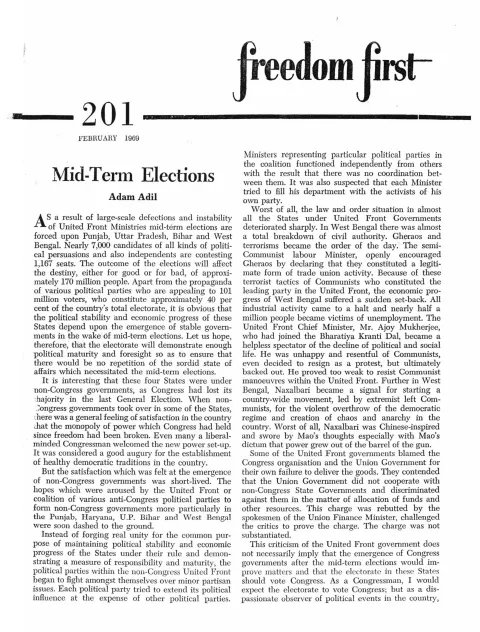
Adam Adil surveys signs of political and economic liberalisation across the Communist bloc a decade after Stalin’s ‘impregnable’ empire was consolidated over Eastern Europe. The essay recounts the historical ‘salami tactics’ by which communists seized power and liquidated opponents (naming Imre Nagy in Hungary, Slansky in Czechoslovakia, and Gomulka’s imprisonment under Stalin in Poland), then turns to the current thaw under Alexander Dubcek in Czechoslovakia—including new press freedom, the first workers’ strike under communism, and economic reform championed by Ota Sik and paralleling Evsei Libermann’s ideas in the USSR. It also touches on Romania’s growing independence from Moscow and, in a portion continued on page 11, on Poland’s crackdown on student and academic unrest under Gomulka and Soviet unease (including Pravda’s warning against Czechoslovak liberalisation), closing with cautious optimism that these changes may mark the beginning of communism’s end in the region.
- Describes Stalin’s post-war ‘salami tactics’ of gradually undermining democratic coalition partners in Eastern Europe to consolidate one-party rule.
- Names Imre Nagy (Hungary), Slansky (Czechoslovakia), and Gomulka’s imprisonment (Poland) as examples of Stalinist repression of both dissidents and rival communists.
- Reports Alexander Dubcek’s loosening of party control in Czechoslovakia, including new press freedom for intellectuals and the country’s first workers’ strike under communism in early April.
- Notes Czech economist Ota Sik’s push for economic reform, paralleling Evsei Libermann’s reforms in the Soviet Union, potentially permitting limited private enterprise.
- Describes Romania charting an independent course from Moscow on both domestic and international communist-movement policy.
- Contrasts this with Poland, where Gomulka is stiffening resistance to reform even as students and academics grow more assertive; the government closed eight academic departments at Warsaw University and fired six professors in response to unrest.
- Notes Poland’s Roman Catholic Episcopate has allied with student/professor agitation, protesting the government’s ‘brutal use of force.’
- Reports that Pravda warned against liberalising trends in Czechoslovakia and that the Soviet Ambassador in Prague openly sympathised with ousted leader Novotny, while Kosygin traveled to Czechoslovakia ostensibly for health reasons to manage the situation.
- Concludes cautiously that the changes might mark ‘the beginning of the ultimate end of communism’ in those countries.
Portugal At War
By Chris Cook
R. Muthuswamy analyses trends from recent Indian municipal and by-elections held after United Front ministries had formed in several states, arguing they represent the first genuine popular verdict on these governments. He describes Congress inroads into Communist Party strongholds in Kerala municipal polls, the collapse of the United Front ministry in Uttar Pradesh after SSP defections, a Congress upset in Rajasthan’s Pousa constituency against the Swatantra Party, and steadier Congress consolidation in Haryana after the mid-term elections. He concludes that voters are increasingly evaluating parties on performance rather than ideology or anti-Congress sentiment, penalising both defections and unstable coalitions.
- Argues Kerala and U.P. municipal elections were the first popular verdict on United Front ministries formed after the general elections.
- In Kerala, Congress and its ally captured 17 of 24 municipalities, though the Communist-aligned Civic Front held Calicut’s Municipal Corporation.
- In Uttar Pradesh, the United Front ministry collapsed after SSP threats over agrarian reforms, leading to President’s Rule; Congress and Jana Sangh made gains in the ensuing municipal elections.
- In Rajasthan, a local Congress leader defeated the Maharajkumar of Jaipur in Pousa constituency, previously a Swatantra Party stronghold, showing voter aversion to opportunistic alliances.
- In Haryana, Congress recovered an absolute majority after the mid-term elections, largely by refusing to re-admit defectors into its organisation.
- In Madhya Pradesh, defectors who formed a United Front ministry remain uncertain of their footing, with persistent reports the Chief Minister wished to rejoin Congress.
- In Krishnagar, West Bengal, a Congress candidate defeated the same opponents who had beaten him in 1967, reflecting disenchantment with the United Front government under Ajoy Mukherjee.
- Concludes that voters increasingly favour parties with an all-India character and stable administration over ideologically fragmented United Fronts, and that defections are proving costly to parties in this new political climate.
Winds Of Change In Eastern Europe
By Adam Adil
The closing ‘With Many Voices’ column collects short quotations from contemporary press and public figures on Cold War, Indian, and world politics, framed by an epigraph from Tennyson. Quoted figures include M. R. Masani, C. Rajagopalachari, Alexander Dubcek, George Papandreou, Anthony Wedgwood Benn, and Indian ministers R. N. Singh Deo and S. R. Vasavada, touching on themes from state financial control and dictatorship to Britain’s post-Suez role and Soviet base-building in the Middle East. The page also carries a subscription coupon for Freedom First and the publication’s imprint (Registered No. MH 272; printed at Inland Printers, Bombay; published for the Democratic Research Service by V. R. Karnik).
- Epigraph from Tennyson: ‘The deep / Moans round with many voices. Come, my friends, / ‘Tis not too late to seek a newer world.’
- Quotes M. R. Masani (Himmat) comparing Indian attitudes to other nations with Brahmin treatment of Harijans.
- Quotes C. Rajagopalachari (Swarajya) on state financial control turning institutions into party tools.
- Quotes Alexander Dubcek (The Economist) on wanting ‘Marks and Spencer, not Marx and Engels.’
- Quotes Anthony Wedgwood Benn, UK Minister for Technology, on the inadequacy of a political role limited to marking a ballot every five years.
- Includes the issue’s imprint: Registered No. MH 272; printed at Inland Printers, 55 Gamdevi Road, Bombay 7; published for the Democratic Research Service by V. R. Karnik at 127, Mahatma Gandhi Road, Bombay 1.
- Includes a subscription coupon for Freedom First at an annual subscription of Rs. 3.00.
Generated by the v1.5 extraction pipeline. Awaiting editorial review.
Metadata and summary are AI-extracted from the source PDF and reviewed for editorial accuracy. The original work is available via the Read PDF tab above (where present); paragraph-level citation inside the PDF is deferred to a future engagement.