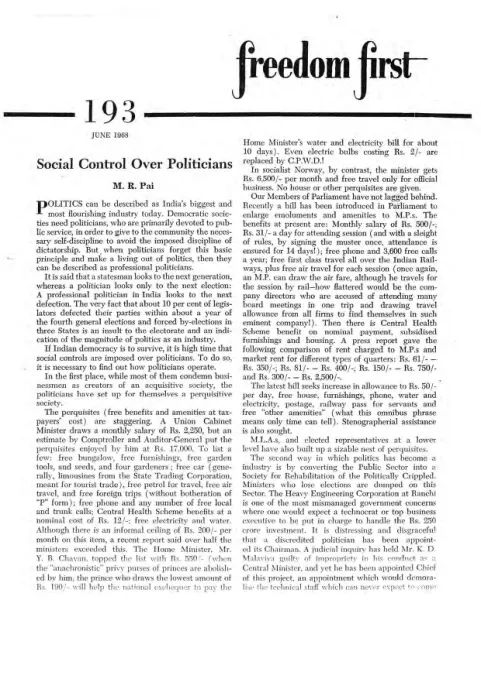
periodical issue
Freedom First
By M. R. Pai
Printed at Kernick Printers, 57 Garden Road, Bombay 1 and Edited and published for the ... Democratic Research Service by V. H. Karnik at 127, Mahatma Gandhi Road, Bombay 1 · Bombay · 1968
12 pages
Freedom First
Summary
Freedom First No. 195 (August 1968) is a monthly issue of the Bombay-based classical-liberal magazine, opening with M. R. Pai’s alarmed response to the Soviet Union’s decision to supply military aid to Pakistan, which he reads as exposing the bankruptcy of Nehruvian non-alignment and Indira Gandhi’s tilt toward Moscow. A. G. Mulgaokar contributes a two-part constitutional essay on legislative defections, tracing British precedent on offices of profit and weighing proposals from a Committee on Defection to curb party-switching by elected members. A short unsigned item warns that the Soviet Union may crush Czechoslovakia’s liberalising reforms as it did Hungary in 1956, citing dissident physicist Andrei Sakharov. “Atreya” surveys the run-up to the Communist-sponsored World Youth Festival in Sofia, detailing the factional infighting among Indian youth organisations over attending. Adam Adil discusses the debate, sparked by Professor A. B. Shah’s foreword to S. E. Hassnain’s book, over whether Indian Muslims are “backwardlooking” and calls for mutual outreach between Hindus and Muslims. The issue closes with a book review (J. P. Naik’s Education in the Fourth Plan), a report on a Leslie Sawhny Programme training camp for trade union workers with an internal straw poll of trainees’ political views, two Letters to the Editor (one urging a new citizens’ party, one from M. R. Masani recounting a Colombian Liberal Party contact), and the regular “With Many Voices” column of press quotations, alongside a subscription coupon.
Key points
-
M. R. Pai’s “Soviet Aid to Pakistan” argues Soviet arms aid to Pakistan humiliates Indira Gandhi’s foreign policy and calls for India to develop independent missile capability and end dependence on both Soviet arms and US PL-480 aid.
-
A. G. Mulgaokar’s two-part “Defections And Their Control” surveys the rise of legislative defections in India, drawing on British precedent on offices of profit, and reports a Committee on Defection’s proposals to bar defectors from ministerships and cap ministry size.
-
An unsigned item warns the Soviet Union may crush Czechoslovakia’s liberalising reforms as it did Hungary in 1956, citing dissident physicist Andrei Sakharov’s manuscript in support of the Czechoslovak reformers.
-
Writing as “Atreya”, the magazine surveys factional infighting among Indian youth organisations over representation at the Soviet-sponsored World Youth Festival in Sofia, and notes declining festival attendance as evidence of waning Soviet influence.
-
Adam Adil’s essay on “Indian Muslims” responds to A. B. Shah’s foreword to S. E. Hassnain’s book, arguing Muslims are not inherently backward-looking but that mutual Hindu-Muslim suspicion has entrenched grievance, and calls for closer social contact between the communities.
-
A review of J. P. Naik’s Education in the Fourth Plan praises his incentive-grant proposals while doubting the practicality of his ‘Swadeshi’ education plea, alongside a report on a Leslie Sawhny Programme training camp whose straw poll found trainees favoured Swatantra, Congress and Jan Sangh, with Morarji Desai the top choice for Prime Minister.
-
Letters to the editor include S. G. Padalkar’s call for a new citizens’ party representing the “well-meaning citizen” and the better sort of businessman, and M. R. Masani’s anecdote about restoring a Colombian Liberal Party leader’s lapsed subscription.
-
The closing “With Many Voices” column quotes C. Rajagopalachari on illiterate government and a Czechoslovak banner reading “Democratization must become democracy.”
Essays
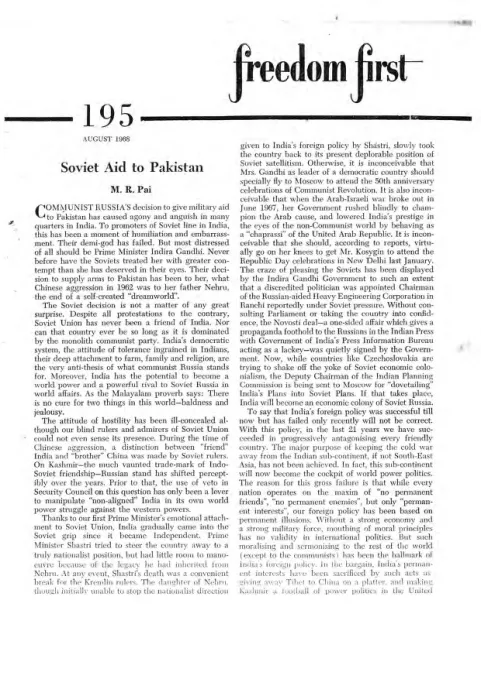
Soviet Aid to Pakistan
By M. R. Pai
M. R. Pai argues that the Soviet Union’s decision to arm Pakistan is a humiliating blow to Indira Gandhi’s foreign policy and exposes the folly of India’s dependence on Moscow since Nehru’s time. He contends the USSR has never been a true friend of India, given its ideological hostility to Indian democracy, and lists instances — the Novosti press deal, courting of Kosygin, silence on Tibet — where India has surrendered its interests to appease Soviet sensitivities. He calls for India to develop an independent missile deterrent, end U.S. PL-480 dependence and Soviet arms reliance, and pursue a foreign policy based on national self-interest rather than moral posturing.
- Soviet arms aid to Pakistan is described as a moment of humiliation for Indira Gandhi comparable to the 1962 Chinese aggression’s effect on Nehru.
- Pai argues the USSR has never truly been a friend to India given the ideological gulf between Communist rule and Indian democratic, pluralist society.
- He criticises the Government’s Novosti press deal and the Planning Commission Deputy Chairman’s Moscow trip to ‘dovetail’ India’s plans into Soviet plans.
- He proposes India develop its own missile delivery capability rather than a hydrogen bomb, to change how other powers treat it.
- He calls for ending PL-480 dependence on the U.S. and Soviet arms dependence, paired with agriculture-first economic policy, to secure genuine non-alignment.
- The essay closes with an appeal to Indian civilisational greatness (‘from Kautilya to Swami Vivekananda’) and a call for a change of leadership.
Defections And Their Control
By A. G. Mulgaokar
A. G. Mulgaokar surveys the growing problem of political defections by elected legislators in India, arguing that constant party-switching for personal gain is corroding public faith in democracy and the Constitution. He contrasts the stable two-party systems of Britain, the U.S. and British Commonwealth countries with the more volatile multi-party systems of continental Europe, and reviews British constitutional history on ‘offices of profit’ — the Act of Settlement of 1705 and subsequent amending legislation — as a comparative frame for the temptations that ministerial office presents to Indian legislators under one-party dominance. The essay continues on page 11 with detailed discussion of recommendations from a Committee on Defection, including proposals to bar defectors from ministerships, cap the size of ministries at roughly ten percent of a legislature’s membership, and arm the President and Governors with power to refuse a dissolution.
- Frames defections as a major threat to constitutional democracy in India, driven by personal gain rather than conscience.
- Contrasts stable two-party systems (Britain, U.S., British colonies) with less stable multi-party continental European systems.
- Reviews British legal history on ‘offices of profit’ (Act of Settlement 1705, amending Act of 1707, Re-election of Ministers Act 1919, 1926 amendment) as comparative background.
- Argues continuous one-party rule in India has degraded the seriousness of ministerial office, which is now sought purely for personal and family benefit.
- Reports a Committee on Defection’s recommendation that political parties adopt a code of ethics and that defecting legislators forfeit their seats.
- Continuation (p.11) covers further proposals: barring defectors from ministerships by statute, capping ministry size to about ten percent of legislature membership, and giving the President/Governor power to refuse dissolution and a mid-term poll.
Russia and Czechoslovakia
A short unsigned item reports that Russia appears poised to crush by threats or force the liberal reform trends emerging in Czechoslovakia, calling this a potentially worse repetition of its 1956 suppression of the Hungarian uprising. It notes protest from democrats worldwide and cites Soviet physicist Andrei Sakharov’s unpublished manuscript arguing that the Czechoslovaks’ pursuit of intellectual freedom should be supported, not suppressed, and warning that stifling free thought risks turning treacherous hypocrites and demagogues into bloody dictators.
- Warns Russia may use threats or force to destroy Czechoslovakia’s liberalising reforms, drawing a direct parallel to the 1956 Hungary invasion.
- Notes worldwide democratic protest against Soviet, East German, Polish and Hungarian pressure on Czechoslovakia.
- Cites Soviet physicist and hydrogen-bomb co-developer Andrei Sakharov’s privately circulated manuscript endorsing the Czechoslovak reformers.
- Expresses hope Russia will refrain from using force against a sovereign, independent country.
Communist Youth Festival
By “Atreya”
Writing under the pseudonym “Atreya”, the author surveys the troubled history and current politics of the Soviet-sponsored World Youth Festival, now scheduled for Sofia in 1968 after the Algiers venue collapsed with Ben Bella’s overthrow. The piece recounts a bitter tussle among Indian youth bodies — the Communist-aligned All India Students Federation, the All India Youth Federation, the All India Youth Congress, and the government-linked Bharat Yuvak Samaj — over who would represent Indian youth at Sofia, with Prime Minister Indira Gandhi drawn in as an ineffective mediator through Dinesh Singh. It closes by noting declining attendance figures for successive festivals (34,000 at Moscow in 1957 down to an expected small turnout at Sofia) against a backdrop of Soviet threats toward Czechoslovakia, arguing that global Communist youth fronts are losing their old capacity to stage-manage such gatherings.
- Recaps the history of Soviet-sponsored ‘front’ youth organisations (WFDY, Women’s Front, Peace Front) dating to Stalin’s era.
- Notes the 9th World Youth Festival was repeatedly relocated — from Algiers (cancelled after Ben Bella’s fall) to Sofia — due to fears of embarrassment in non-Communist host cities.
- Describes rival Indian youth bodies (Communist-aligned AISF/AIYF vs. Youth Congress and Bharat Yuvak Samaj) fighting over representation at Sofia.
- Reports Indira Gandhi’s ineffective mediation via Dinesh Singh and Morarji Desai’s decision to cut the Indian delegation to 16-20.
- Cites declining Festival attendance (Moscow 1957: ~34,000; Vienna: 18,000; Helsinki 1962: 10,800) as evidence Soviet youth fronts are losing influence.
- Frames Soviet threats against Czechoslovak liberalisation as part of the same context undermining the festival’s credibility.
Indian Muslims
By Adam Adil
Adam Adil engages the debate sparked by Professor A. B. Shah’s foreword to S. E. Hassnain’s book Indian Muslims, which argued that educated Indian Muslims suffer alienation and that Muslim society needs a renaissance akin to the 19th-century Hindu one. Adil argues Muslims are not inherently backward-looking, but that mutual Hindu-Muslim suspicion — Hindus regarding Muslims as a separate, sometimes disloyal community, and Muslims retreating into a defensive shell — has entrenched a sense of grievance on both sides. He calls for closer social contact between educated members of both communities and for political parties to avoid stoking communal fear, while noting encouraging signs of scientific and intellectual reappraisal of Islamic beliefs already underway in the Muslim world (Turkey, Iran, U.A.R., Pakistan).
- Responds to A. B. Shah’s foreword to S. E. Hassnain’s book Indian Muslims, which called for a renaissance among educated Muslims.
- Argues Muslim grievances about discrimination are ‘mostly imaginary’ in the sense of deliberate policy, but real as a felt sense of injustice.
- Blames both communities: Hindus have never made a serious effort to ‘own’ Muslims as part of Indian society, while Muslims have retreated into a separate shell.
- Notes even Muslim nationalists once at the forefront of the freedom struggle are now denounced by Hindu extremists as communalists.
- Calls for closer social contact between educated Hindus and Muslims and restraint by political parties from exploiting communal fear.
- Points to a wider Islamic intellectual re-examination (Abbasid-era precedent, and contemporary Turkey, Iran, U.A.R., Pakistan) as grounds for optimism about Muslim modernisation.
Review: Education in the Fourth Plan (Review and Perspective) — J. P. Naik, Nachiketa Publications
By R.M.
This page combines two short items. An unsigned (initialled ‘R.M.’) review of J. P. Naik’s Education in the Fourth Plan: Review and Perspective, a compilation of three lectures by the former Member-Secretary of the Education Commission, praises Naik’s analysis of 18 years of educational planning and his proposals for incentive grants and district-level involvement of educationists, while questioning the practicality of his call for a ‘Swadeshi’ education system given past failed experiments at Gujarat Vidyapeeth and Shanti Niketan. A report by ‘A Participant’ describes a training camp under the Leslie Sawhny Programme of Training for Democracy for 25 trade union workers in Bombay, detailing lecture topics and a straw poll of trainees’ political preferences (favouring Swatantra, Congress and Jan Sangh; strong support for Morarji Desai as Prime Minister in a hypothetical coalition; views on the atom bomb, Kashmir and Israel).
- Reviews J. P. Naik’s Education in the Fourth Plan, welcoming his incentive-grant and district-planning proposals but doubting the feasibility of his Swadeshi education plea given prior failures at Gujarat Vidyapeeth and Shanti Niketan.
- Reports a 12-day Leslie Sawhny Programme training camp for 25 Bombay trade union workers covering democracy, secularism, the language issue and industrial relations.
- Straw poll: trainees favoured Swatantra, Congress and Jan Sangh over PSP, SSP or Communist parties; Morarji Desai was the top choice for Prime Minister in a coalition, ahead of Y. B. Chavan, N. G. Ranga, M. R. Masani and A. B. Bajpai, with no support for Indira Gandhi.
- Trainees split on other issues: majority favoured English as link language, favoured atom bomb development, opposed total American withdrawal from Asia, and most thought the Kashmir problem unsettled and favoured recognising Israel.
- Notes a similar voting pattern was found among students at a parallel Maharashtra camp.
Leslie Sawhny Programme’s Class for Trade Union Workers
By A Participant
Two Letters to the Editor. S. G. Padalkar of Poona writes at length under the heading ‘Rally The Common Citizen,’ sketching the anxieties of the ‘well-meaning citizen’ over food shortages, foreign exchange, taxation and the Fourth Plan, and setting out policy prescriptions on defence, agriculture, exports and business confidence; he closes by calling for a new citizens’ party representing the interests of the well-meaning citizen and the better sort of business community, warning against both the ruling party and the dogmatic Jan Sangh and Left. M. R. Masani’s shorter letter recounts meeting the leader of Colombia’s Liberal Party in Bonn, who told him he had long valued receiving Freedom First but had stopped getting it, prompting Masani to arrange for his subscription to be restored.
- Padalkar diagnoses public disillusionment with the Fourth Plan and rising prices, taxes and shortages.
- He rejects strikes, demonstrations and dictatorship alike, endorsing liberal democracy, individual freedom and constitutional guarantees.
- Policy prescriptions include a stronger, modernised defence posture, closer alliance with America against China, agricultural modernisation, and export-oriented industrial reform.
- He calls for a new citizens’ party representing the ‘well-meaning citizen’ and the better sort of businessman, criticising the ruling party as well as the Jan Sangh and the Left as dogma-bound.
- Masani’s letter recounts an anecdote from Bonn about a Colombian Liberal Party leader who had lost his subscription to Freedom First and was pleased to have it restored.
Letters to the Editor: Rally the Common Citizen
By S. G. Padalkar
The closing ‘With Many Voices’ column collects short quotations from the contemporary press on politics of the day — Indian and international — ranging from criticism of the Praja Socialist Party’s weakness and Rajagopalachari’s remark on illiterate government, to commentary on the Soviet Union’s authoritarian character, the Vietnam War, and the Prague Spring, alongside a subscription coupon for Freedom First and the issue’s printer/publisher imprint (V. B. Karnik, 127 Mahatma Gandhi Road, Bombay 1).
- Quotes C. Rajagopalachari in Swarajya: government in India is ‘of the illiterate by the illiterate but… not for the illiterate.’
- Quotes Morarji Desai in Times of India: it was up to the people to see the Government behaved or disappeared.
- Includes quotations on the Soviet Union’s authoritarian character (Opinion) and on freedom being feared by Communist orthodoxy (Hindustan Times).
- Cites a Czechoslovak banner (‘Democratization must become democracy’) and Soviet writer Arkadiy V. Belinkov denouncing a government of ‘liars, tyrants, criminals and stranglers of freedom.’
- Ends the issue with a subscription coupon (Rs. 5.00 annual) and the printer/publisher imprint naming V. B. Karnik as publisher for Democratic Research Service.
Generated by the v1.5 extraction pipeline. Awaiting editorial review.
Metadata and summary are AI-extracted from the source PDF and reviewed for editorial accuracy. The original work is available via the Read PDF tab above (where present); paragraph-level citation inside the PDF is deferred to a future engagement.