periodical issue
Freedom First
Printed ... and published ... by V. B. Karnik at 127 Mahatma Gandhi Road, Bombay 1 · Bombay · 1968
12 pages
Freedom First
Summary
Freedom First No. 197 (October 1968) is devoted almost entirely to the Soviet-led invasion of Czechoslovakia of August 1968 and its aftermath. The issue assembles editorial commentary, a satirical piece, a reprinted Gandhi essay from 1938, foreign-press excerpts, and book reviews, all converging on the same argument: that the Warsaw Pact occupation was naked aggression dressed up in the language of fraternal assistance, that the Czechoslovak people’s passive resistance recalled Gandhian and pre-war Czech precedents, and that the affair exposed both the moral bankruptcy of Soviet communism and the timidity of the Indian government’s response. A separate, unrelated strand of domestic commentary addresses the contemporary Indian newspaper employees’ strike, arguing that trade-union tactics compromised journalistic independence and, incidentally, kept the Czechoslovak story from Indian readers during the crucial early days. The issue closes with book reviews (on secularism in India and on three Czechoslovakia-crisis pamphlets) and a page of quoted foreign and Indian press reactions to the invasion.
Key points
-
V. B. Karnik’s lead editorial “Hollow Triumph” condemns the Warsaw Pact invasion as pure aggression, describes Czechoslovak passive resistance modelled on Gandhian methods, and argues Russia’s occupation is an unsustainable “hollow triumph” that will cost it international standing and push back detente.
-
An unsigned “Let The World Know” piece documents the Soviet seizure of Czech publishing houses and universities, the underground flight of writers, and the clandestine radio network that smuggled delegates to a secret Fourteenth Party Congress.
-
G. L. Mehta’s “To Sing With The Angels” draws a parallel between the 1968 invasion and the 1938 Nazi occupation, recounting President Masaryk’s founding faith in democracy and asserting that Jan Masaryk was “brutally murdered” by Stalin’s agents in 1948 rather than having committed suicide.
-
M. R. Pai’s “Press Strike—Its Implications” argues the just-ended two-month Indian newspaper strike let communist-aligned journalists suppress coverage of Soviet arms aid to Pakistan and the Czechoslovak invasion, and calls for journalists to see themselves as a “noble profession” rather than a trade union.
-
A satirical piece attributed to “Josef Schweik” (translated by Tibor Szamuely) mocks Soviet propaganda by presenting a mock Rude Pravo editorial that “welcomes” the occupying troops as fraternal friends using absurd Leninist double-talk.
-
The issue reprints extracts from Gandhi’s 1938 essay “If I Were A Czech,” offering the Czechs “a weapon not of the weak but of the brave”: resolute non-violent refusal to submit to force.
-
Book reviews cover A. B. Shah’s Challenges to Secularism and three Czechoslovakia-crisis pamphlets, and the closing “With Many Voices” page quotes Jean-Paul Sartre calling the invasion “pure aggression…a war crime” and Rajagopalachari on the suppression of Czechoslovak liberalisation.
Essays
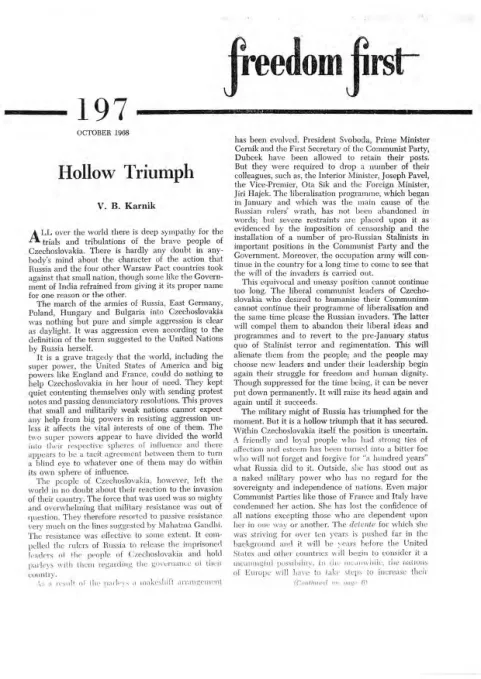
Hollow Triumph
By V. B. Karnik
V. B. Karnik’s lead editorial ‘Hollow Triumph’ (pp.1, 6) condemns the Warsaw Pact invasion of Czechoslovakia as pure aggression that the world, including the superpowers, failed to prevent, proving that militarily weak nations cannot expect help unless a great power’s own interests are at stake. He describes the Czechoslovak people’s Gandhi-style passive resistance, the enforced compromise that let Svoboda, Cernik and Dubcek keep their posts while liberal colleagues were purged, and argues the occupation is an unsustainable ‘hollow triumph’: it will alienate the Czechoslovak leadership from Moscow, cost the USSR international standing (even the French and Italian Communist parties condemned it), and push back detente for years while forcing European nations to rearm.
- Calls the five-nation Warsaw Pact invasion ‘pure and simple aggression’, meeting Russia’s own UN-proposed definition of the term
- Notes world powers, including the US, England and France, gave only verbal protest and did nothing concrete to help Czechoslovakia
- Describes Czechoslovak passive resistance modeled on Gandhian methods, which forced Russia to release imprisoned leaders and negotiate
- Details the post-invasion arrangement: Svoboda, Cernik and Dubcek retained their posts but liberal colleagues (Pavel, Sik, Hajek) were forced out and censorship reimposed
- Argues the Soviet position is untenable long-term: liberal communist leaders cannot both please Moscow and continue liberalisation
- Concludes Russia has won only a ‘hollow triumph’, losing international confidence and pushing detente further away
Let The World Know
An unsigned piece, ‘Let The World Know’ (p.2), reproduced from the Times Literary Supplement, chronicles the first days of the Soviet occupation of Czechoslovakia: the seizure of publishing houses, universities and the Academy of Sciences; the underground flight of writers such as Ivan Klima, Pavel Kohout and Milos Forman; and the clandestine radio network that smuggled nearly 1,000 delegates to a secret Fourteenth Party Congress. It describes the tonal arc of the clandestine broadcasts (from shock to relaxed defiance) and reproduces a protest song broadcast under the muzzles of Russian guns, ending with the refrain ‘Go away, go away!’
- Documents Russian occupation of Czech publishing houses, printing houses, schools, universities, and the Prague University Library
- Notes many writers and journalists went underground or were arrested; others (Klima, Kohout, Liehm, Svitak, Mucha, Skvorecky) were abroad at the time
- Describes the clandestine smuggling of ~1,000 delegates to the secret 14th Congress of the Communist Party of Czechoslovakia on 22 August
- Credits the clandestine radio network as essential to the effectiveness of Czechoslovak passive resistance
- Reproduces a protest song broadcast during the occupation, ending ‘Go away, go away!’
To Sing With The Angels
By G. L. Mehta
G. L. Mehta’s essay ‘To Sing With The Angels’ (p.3) opens from Maurice Hindus’s 1941 tale of Nazi-era Czechoslovak resistance to draw a parallel with 1968: both times a small nation, taught by figures like Masaryk and the memory of Jan Huss to love freedom more than life, was crushed by an overwhelming outside power. Mehta narrates President Masaryk’s founding faith in democracy through understanding and tolerance, contrasts Nazi occupation with the 1948 Stalinist-engineered coup (in which Jan Masaryk was, he says, ‘brutally murdered’ despite the official verdict of suicide), and quotes Lenin’s dictum that ‘communist morality is the morality which serves the [communist] struggle’ to explain how democratic institutions were subverted from within. He closes that 1968 again finds Czechoslovakia forced to howl with the wolves, but that the spirit of Huss is immortal and the Czechs will rise again.
- Frames 1968 as history repeating 1938: a small nation crushed by an overwhelming external power
- Recounts Maurice Hindus’s 1941 book ‘To Sing With the Angels’ about Nazi-era Czechoslovak resistance as an emotional touchstone
- Describes President Masaryk’s founding philosophy: faith, mutual understanding and tolerance as the basis of democracy
- Argues the 1948 Communist takeover was accomplished by Stalinist coup and infiltration, not popular will, citing Joseph Korbel’s account of ‘conquest by co-existence’
- States that Jan Masaryk was ‘brutally murdered’ by Stalin’s agents rather than having committed suicide, as officially reported
- Quotes Lenin on communist morality serving the party struggle by any means, including ‘ruse, dodges, tricks, cunning, unlawful methods’
- Ends on the theme that thought and faith cannot be permanently suppressed: ‘Huss is immortal. The Czechs will rise again.‘
Press Strike—Its Implications
By M. R. Pai
M. R. Pai’s ‘Press Strike—Its Implications’ (pp.5-6) analyses the recently concluded two-month Indian newspaper strike as an ill-advised, ill-prepared trade-union action that let communist-aligned journalists distort or suppress news to serve party ends. Pai argues the strike was called precipitately, without a strike fund, and let non-journalist demands dominate; along the way it suppressed public discussion of two urgent issues — Russian military aid to Pakistan and the Warsaw Pact invasion of Czechoslovakia — while the government of India’s equivocal response went largely unscrutinised. He contends journalists wrongly organised as a trade union rather than as members of a ‘noble profession’, urges banning outside union leadership, and calls for citizens and responsible journalists to reassert control against a politically-motivated vocal minority.
- Characterises the just-ended two-month press strike as ill-advised, ill-prepared and driven by an ‘agitational approach’ rather than negotiation
- Alleges communist-aligned journalists (‘card-carrying members of communist parties’) used the strike and their newsroom positions to slant or suppress news
- Cites a Calcutta daily finding that 10 of 16 reporters were card-carrying Communist Party members
- Argues the strike created a news vacuum that muted public debate on Russian military aid to Pakistan and the Czechoslovak invasion, and on the Indian government’s own hesitant response
- Calls for outside trade-union leadership to be banned and for journalists to see themselves as members of a noble profession rather than artisans
To Our Friends In Our Midst
By Josef Schweik (translated by Tibor Szamuely)
‘To Our Friends In Our Midst’ (pp.7, 11) is a savagely ironic satire attributed to ‘Josef Schweik’ (the Good Soldier Schweik persona), presented as the first editorial of the Rude Pravo party newspaper under new management after the invasion, translated by Tibor Szamuely and reprinted from the Sunday Telegraph. Writing in mock-servile Soviet-loyalist language, the piece ‘welcomes’ the occupying Warsaw Pact troops as fraternal friends, absurdly justifies the invasion using Leninist double-talk (minorities must accept majority will; Dubcek merely leads a ‘minority grouping’), dismisses comparisons to the Nazi occupation and to Munich as offensive nonsense, and thanks the Soviet Union for its ‘helping hand’ while conceding it must eventually be repaid by ‘giving them the boot as soon as possible’ — the satire’s real point being to expose the absurdity and cynicism of official Soviet-bloc propaganda.
- Presented as a mock editorial by ‘Josef Schweik’ taking over Rude Pravo after the invasion, translated by Tibor Szamuely
- Satirises Soviet propaganda by having the narrator welcome the occupying troops as fraternal allies rather than invaders
- Uses Leninist logic absurdly to argue Dubcek is merely a ‘minority grouping’ that must accept majority (Soviet) will
- Mocks comparisons between the Soviet occupation and the 1938 Nazi Munich betrayal as ‘misconceptions’ to be corrected
- Ends with a double-edged pledge of gratitude to the Soviet Union that is undercut by a threat to eventually ‘give them the boot’
If I Were A Czech
By Mahatma Gandhi
‘If I Were A Czech’ (p.8) reprints extracts from an article Mahatma Gandhi wrote in the latter half of 1938 when Nazi Germany invaded and occupied Czechoslovakia. Gandhi tells the Czechs he offers Benes ‘a weapon not of the weak but of the brave’: resolute non-violent refusal to bend to an earthly power, without bitterness, in the fullness of faith that spirit alone endures. He argues the science of war leads only to dictatorship while the science of non-violence leads to pure democracy, that small nations must either submit to the protection of dictators or become a constant menace to peace, and that unarmed non-violent resistance by men, women and children would be a novel experience for aggressors who have only ever known men yielding to force.
- Reprints extracts from Gandhi’s 1938 article addressed to the Czechs after Nazi occupation, framed here as history repeating in 1968
- Gandhi offers Benes ‘a weapon not of the weak but of the brave’: non-violent refusal to submit to force
- Argues ‘science of war leads one to dictatorship’ while ‘science of non-violence can alone lead one to pure democracy’
- States that small nations must either accept protection under dictators or remain ‘a constant menace to the peace of Europe’
- Insists his own honour, not victory, is what must be preserved even in inglorious peace or defeat
History Repeats Itself
By Tad Szulc, New York Times
Three short unsigned news items round out page 8. ‘History Repeats Itself’ cites George F. Kennan’s memoirs on the 1939 Nazi entry into Prague and draws a parallel to the 1968 Soviet occupation after ‘229 days of the democratic spring.’ ‘Protest in Moscow’ reports a small group of Russians, including Pavel Litvinov and the poet Natalya Gorbanevskaya, staging a Red Square protest against the invasion and being arrested. ‘What is Communism?’ relays an East European joke — that communism is a system for turning socialism into capitalism — now retold as bitterly apt given Soviet actions in Czechoslovakia.
- ‘History Repeats Itself’ quotes George F. Kennan’s 1939 Prague dispatch and Tad Szulc on parallels with the 1968 invasion
- ‘Protest in Moscow’ reports Red Square demonstrators including Pavel Litvinov, Mrs Yuri Daniel and poet Natalya Gorbanevskaya arrested for banners reading ‘Hands off the C.S.S.R.’
- ‘What is Communism?’ retells a joke calling communism ‘a system for turning socialism into capitalism,’ now called ‘hideous’ because it fits Soviet actions
Protest in Moscow
By A news item in New York Times
No summary was extracted for this article. Listed for completeness.
What is Communism?
By The New York Times
No summary was extracted for this article. Listed for completeness.
Dilemma For The Kremlin
By Courtesy: The Guardian Weekly
‘Dilemma For The Kremlin’ (p.9), an unsigned piece courtesy of The Guardian Weekly, analyses the divided counsels within the Kremlin over how far to press its control of occupied Czechoslovakia. It reviews the failure of Soviet expectations that a puppet government or a compliant Svoboda would quickly emerge, notes the surprising resilience of reformist leaders like Dubcek despite arrest and vilification, and observes that Moscow and Prague read ‘normalisation’ very differently — the Kremlin wanting a return to pre-January obedience, the Czechoslovaks wanting only the departure of occupying troops. It concludes that the Soviet politburo’s next moves will determine whether Russia cuts its losses or further damages its international reputation.
- Argues the Russians retain full military mastery over Czechoslovakia but hesitate, reflecting deep division within the Kremlin
- Details failed Soviet expectations: no puppet government emerged, Svoboda could not be cajoled, Dubcek’s team retained public support after returning from Moscow
- Notes the party’s own organ ‘Rude Pravo’ turned self-critical and chose a liberal praesidium after the invasion
- Observes that ‘normalisation’ means different things to the Kremlin (full pre-January obedience) and to Dubcek (troop withdrawal only)
- States the decision on further limits to Czechoslovak freedom rests with the 11 members of the Soviet politburo, including Kosygin and Suslov
Challenges to Secularism
The Reviews section (pp.10-11) opens with Arvind A. Deshpande’s review of A. B. Shah’s ‘Challenges to Secularism’ (Nachiketa Publications), praising Shah’s essays on cow-slaughter and Hindu-Muslim relations as placing him in the reformist tradition of Ranade and Raja Ram Mohan Roy, while noting Shah could have engaged more with Hindu thinkers who see communal identity itself as bound up with religious practice. This is followed by three shorter reviews (initialled A.A.D.) of Czechoslovakia-crisis pamphlets — D. B. Karnik’s ‘The Czechoslovak Crisis,’ and Pradip Bose’s ‘Nazism and Communism’ and ‘East European Turmoil and C.P.I.’ — the reviewer praising Karnik’s even-handed chronicle while criticising Bose for equating Nazism and Communism too loosely and for having too much residual faith in the CPI’s capacity for democratic reform.
- Deshpande reviews A. B. Shah’s ‘Challenges to Secularism,’ focusing on its essays on cow-slaughter and the position of India’s Muslim minority
- Notes Shah situates himself in the reformist tradition of Justice M. G. Ranade and Raja Ram Mohan Roy by challenging religious orthodoxy
- Cites Shah’s use of Nirad Chaudhury’s essay in ‘The Continent of Circe’ on the status of Indian Muslims as a minority
- A.A.D. praises D. B. Karnik’s ‘The Czechoslovak Crisis’ (with a foreword by Jethmalani) as a useful, fair chronicle of events and statements
- A.A.D. criticises Pradip Bose’s two booklets for equating Nazism and Communism as similarly ‘dated philosophies’ and for retaining faith that CPI members could become democratic socialists
With Many Voices
‘With Many Voices’ (p.12), the closing feature, gathers short quoted reactions to the Czechoslovak crisis from a wide range of international and Indian commentators — including Jo Grimond, Alexander Dubcek, V. P. Dutt, C. Rajagopalachari, Asoka Mehta, Jean-Paul Sartre, John Grigg and Frank Moraes — spanning late August to late September 1968, uniformly framing the invasion as aggression, a war crime, or an ominous precedent, punctuated with a subscription form for the magazine.
- Compiles dated quotations (29 August-21 September 1968) from Indian and international press and public figures on the Czechoslovak invasion
- Includes C. Rajagopalachari’s Swarajya remark that Soviet violence has ‘succeeded in suppressing the Czechoslovakian liberalization movement’
- Includes Jean-Paul Sartre’s Time statement calling the invasion ‘pure aggression…a war crime’ under international law
- Includes Asoka Mehta’s Janata figure citing over 18,000 tanks, 1,000 planes and 6.5 lakh soldiers used in the occupation
- Includes a subscription coupon for Freedom First addressed to the Democratic Research Service, Bombay
Generated by the v1.5 extraction pipeline. Awaiting editorial review.
Metadata and summary are AI-extracted from the source PDF and reviewed for editorial accuracy. The original work is available via the Read PDF tab above (where present); paragraph-level citation inside the PDF is deferred to a future engagement.