periodical issue
Freedom First
By Adam Adil, A. G. Noorani, Saadi, An Observer, V. B. Karnik
Edited and published for the Democratic Research Service, 127, Mahatma Gandhi Road, Bombay 1 · Bombay · 1968
12 pages
Freedom First
Summary
This issue of Freedom First (No. 198, November 1968) is dominated by two Cold War flashpoints — the Soviet-led invasion of Czechoslovakia and its aftermath, and the domestic confrontation between the Central Government and striking government employees, entangled with the Kerala government’s defiance of the Centre. Adam Adil’s lead editorial-style piece condemns Kerala Chief Minister E. M. S. Namboodiripad for defying the Essential Services Maintenance Ordinance during the September 19 strike, framing it as a test of Centre-State authority and Communist extra-territorial loyalty, and calls for firm Central action against the state government. A companion analysis, “Central Government Employees’ Strike” by An Observer, argues the strike was a Communist-engineered political manoeuvre rather than a genuine industrial dispute, criticises the Government’s handling of pay and service conditions, and urges restraint in disciplinary reprisals. A. G. Noorani reviews Stanley Kochanek’s study of the Congress Party’s internal machinery and the Prime Minister-Congress President relationship. Saadi’s “Dubcek’s Role — A New Angle” reassesses Alexander Dubcek’s conduct during the Soviet invasion, arguing popular pressure rather than Dubcek’s own initiative drove the Prague Spring reforms, and that his eventual capitulation left Czechoslovak resistance without leadership; this is paired with short news items on a Moscow dissidents’ trial and Soviet pressure on the French Communist Party. V. B. Karnik contributes a long piece, “India and Israel,” dissecting the Government of India’s pro-Arab pamphlet on the 1967 war, Dahyabhai Patel’s rebuttal pamphlet, and the arguments of socialist writers Isaac Deutscher and Simha Flapan, concluding that Indian policy remains captive to outdated pro-Arab prejudice. Shorter items include a reprinted letter from a US soldier killed in Vietnam, a note on crime in the Soviet Union, book advertisements (V. B. Karnik’s “Strikes in India” and M. R. Masani’s “The Communist Party of India”), and the regular “With Many Voices” column of press quotations.
Key points
-
Adam Adil’s “Namboodiripad’s Defiance” attacks Kerala Chief Minister E. M. S. Namboodiripad for defying the Essential Services Maintenance Ordinance during the September 19 Central Government employees’ strike, framing it as a constitutional violation and urging firm Central action against Kerala.
-
A. G. Noorani reviews Stanley Kochanek’s The Congress Party of India, tracing the Prime Minister’s growing dominance over the Congress President since the 1947 Kripalani episode and doubting the party has achieved the cohesion Kochanek’s book calls for.
-
An essay on Alexander Dubcek argues he did not originate Czechoslovakia’s liberalisation but was driven to it by a pre-existing popular thirst for freedom, and that his capitulation to Soviet pressure left Czechoslovak resistance without leadership.
-
Writing as “An Observer,” V. B. Karnik characterises the September 19 Central Government employees’ strike as a Communist-directed political manoeuvre rather than a genuine industrial dispute, criticising the Government’s own delay in convening a Pay Commission.
-
V. B. Karnik’s “India And Israel” contrasts the Government of India’s pro-Arab pamphlet with Dahyabhai Patel’s rebuttal, arguing the Government’s stance omits the 1919 Faisal-Weizmann agreement and remains “frozen around initial prejudices,” and engages socialist critics Isaac Deutscher and Simha Flapan on Israel’s origins.
-
A reprinted letter from Sgt. Jeffrey A. Davis, killed in Vietnam, explains to his wife why he felt obligated to fight despite disliking the war.
-
Companion items report a Moscow trial of Soviet dissidents protesting the Czechoslovakia invasion and Soviet pressure on the French Communist Party over its criticism of the occupation.
Essays
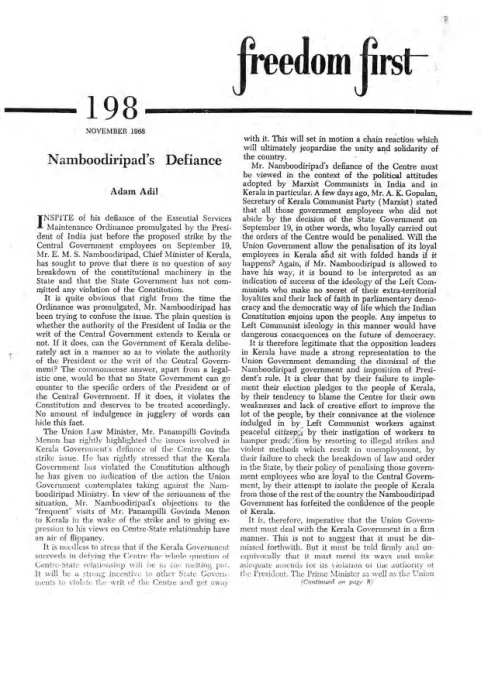
Namboodiripad’s Defiance
By Adam Adil
Adam Adil’s editorial attacks Kerala Chief Minister E. M. S. Namboodiripad for defying the Essential Services Maintenance Ordinance during the September 19, 1968 Central Government employees’ strike, arguing that no state government can lawfully act against the authority of the President or the Centre. The piece situates Namboodiripad’s stand within broader Marxist-Communist political attitudes in Kerala, citing A. K. Gopalan’s threat to penalise loyal employees, and argues that tolerating Kerala’s defiance would embolden other state governments and imperil national unity. It reports that opposition leaders in Kerala have demanded the government’s dismissal and President’s Rule, and closes (in the page 8 continuation) urging the Centre to deal firmly with Kerala without necessarily dismissing the ministry outright, provided the state “mends its ways.”
- Kerala CM E. M. S. Namboodiripad defied the Essential Services Maintenance Ordinance during the September 19 Central Government employees’ strike.
- The author frames this as a constitutional violation: no state government may counter specific orders of the President or Centre.
- Union Law Minister Panampilli Govinda Menon is cited as having rightly stressed the Kerala government’s constitutional violation.
- A. K. Gopalan (Kerala CPM secretary) reportedly said loyal government employees who ignored the strike call would be penalised.
- Opposition leaders in Kerala demanded dismissal of the Namboodiripad government and imposition of President’s Rule.
- The author warns that tolerating this defiance would encourage other state governments to challenge Central authority.
- The piece calls for the Centre to act firmly, though not necessarily via immediate dismissal, and anticipates President’s Rule and fresh elections if defiance continues.
How Will The Congress Fare?
By A. G. Noorani
A. G. Noorani reviews Stanley Kochanek’s “The Congress Party of India,” using it to trace the shifting balance of power between the Prime Minister and the Congress President from the Kripalani episode of 1947 through Nehru, Shastri, and Indira Gandhi. Noorani highlights Kochanek’s argument that the Congress President’s office has been reduced to a position with negligible independent power despite periodic resurgence, and that the Prime Minister’s dominance over the party organisation has only deepened over time. He closes by doubting that the party has developed the cohesiveness Kochanek’s book calls for, suggesting the Congress will prosper more from its rivals’ failures than from its own institutional merit.
- Review centres on Stanley Kochanek’s book on the Congress Party’s internal working: PM–Congress President relations, the Working Committee’s role, and leadership recruitment.
- Traces the Kripalani resignation episode of 1947 as the founding crisis establishing the ‘Nehru doctrine’ of PM supremacy over the party president.
- Describes a succession of Congress Presidents (Tandon, Sanjiva Reddy among others) whose authority remained subordinate to the Prime Minister.
- Quotes Kochanek describing the Congress President’s office as reduced to negligible power and prestige compared to the Prime Minister’s.
- Notes the Working Committee often resolved inter-state disputes (bilingual Bombay, Maharashtra-Mysore border, Assam reorganisation) ahead of formal government process.
- Kochanek’s book credits Congress’s electoral durability to its capacity to absorb newly politicised social and communal groups.
- Noorani is skeptical the party has achieved the cohesion Kochanek’s conclusion calls for, predicting Congress’s future success will depend more on rivals’ weakness than its own strength.
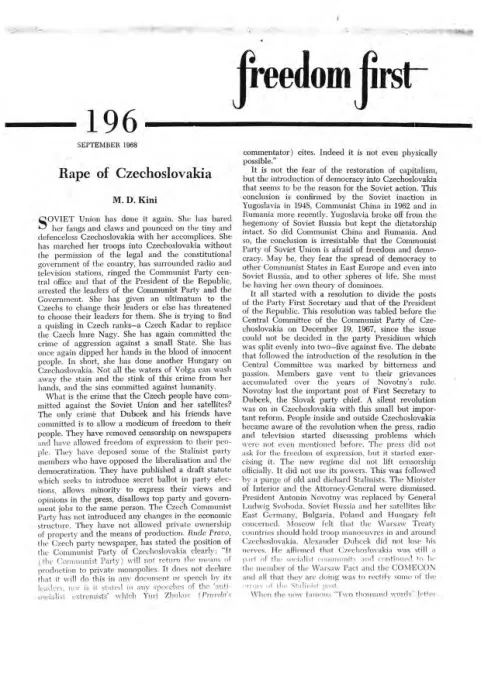
Dubcek’s Role — A New Angle
By Saadi
This item reprints a letter written by Sgt. Jeffrey A. Davis of Brownsburg, addressed to his wife and meant to be opened only after his death in the Vietnam War, as originally published in the Indianapolis Star. The soldier explains, in his own words, why he died — for his country, his family, and even for the anti-war protesters and ‘younger generation’ he did not identify with, insisting his death was purposeful despite his ambivalence about the war itself.
- A posthumous letter from Sgt. Jeffrey A. Davis, killed in Vietnam, addressed to his wife and reprinted from the Indianapolis Star.
- Davis says he may not understand or like the war but felt obligated to fight it.
- He frames his death as being for the American people, his family, and even for draft-card burners and protesters he disagreed with.
- He expresses hope that the ‘younger generation’ will find direction despite his criticism of them.
- The piece is presented without further editorial commentary, reproduced as a human-interest artifact of the Vietnam War era.
Central Government Employees’ Strike
By An Observer
Writing under the byline “Saadi,” this piece argues that Alexander Dubcek did not personally initiate Czechoslovakia’s liberalisation but was driven to reform by a pre-existing popular thirst for freedom among intellectuals, students, and economists such as Ota Sik. It contends that Dubcek’s ultimate surrender to Soviet military pressure — rather than following Imre Nagy’s path of defiance or leading underground resistance — has left Czechoslovak liberalisation dismantled, with press censorship, single-party dictatorship, and political bans re-imposed, even as popular resistance persists quietly. Accompanying short items describe a Moscow trial of Soviet dissidents protesting the invasion and a Soviet campaign to discipline the French Communist Party for its criticism of the invasion.
- Argues Dubcek, a loyal Moscow-trained Communist, did not originate the liberalisation movement but was compelled to follow a popular current already stirring among Czechoslovak intellectuals and students.
- Cites Czechoslovak ambassador Richard Dvorak’s pre-invasion claims about multi-party representation in parliament as evidence democratic moves were already underway.
- Contrasts Dubcek’s capitulation with the option of defying Russia as Imre Nagy did in Hungary in 1956, or leading underground resistance.
- Describes the post-invasion re-imposition of press censorship, banned political opposition, and single-party dictatorship as undoing everything the reform period built.
- Reports Soviet officials, including Vasily Kuznetsov, courting Dubcek’s rival Gustav Husak as a possible replacement.
- A companion item on the Moscow trial describes dissidents including Pyotr Grigorenko and poet Vadim Delone protesting the trial of Soviet demonstrators against the invasion.
- Another companion item reports Soviet efforts to discipline the French Communist Party and its leader Waldeck Rochet for criticising the invasion of Czechoslovakia.
India And Israel
By V. B. Karnik
Writing as “An Observer,” this analysis argues the September 19, 1968 one-day protest strike by Central Government employees was a Communist-organised political manoeuvre disguised as an industrial dispute, aimed at discrediting the Government rather than genuinely securing a need-based minimum wage. It contends Communist-controlled unions (the National Federation of Posts and Telegraphs Employees and the Confederation of Central Government Employees) dragged rank-and-file, largely apathetic workers into an illegal action that cost lives and jobs, while the Government’s compromise offer of arbitration was rejected for political reasons. The piece also criticises the Government’s own failures — delay in convening a Pay Commission, lumping together dissimilar categories of employees — and calls for measured, non-vindictive disciplinary action alongside restoration of union recognition.
- The September 19 strike is characterised as a suicidal, Communist-directed political manoeuvre rather than a genuine industrial dispute.
- Communist parties are said to have controlled the National Federation of Posts and Telegraphs Employees and the Confederation of Central Government Employees, plus some railway and defence unions.
- Figures named as aligned with the Communist-led action include S. M. Joshi and Peter Alvares, with S.S.P., P.S.P. and sections of the Jan Sangh also drawn in.
- About a dozen lives were lost and many injured in firings and lathi charges during the strike.
- The Government is criticised for delaying the Pay Commission and for administratively lumping together very different categories of employees (railway workers, postal staff, Secretariat clerks).
- The author urges the Government to withdraw the ordinances now that the emergency has passed and to treat one-day absence leniently, while still disciplining those who organised or engaged in illegal activity.
- The piece concludes that a strike is a poor tool for redress and that unions must recognise how a small Communist minority can manoeuvre them into damaging adventurist action.
Without Comment (Russia “Biggest Colonial Ruler”; Dissident Intellectuals Exiled; Polish Writer’s Protest)
V. B. Karnik examines the Government of India’s pro-Arab, anti-Israel foreign policy stance through the lens of two competing pamphlets: the Government’s own “India and Palestine — The Evolution of a Policy” and Dahyabhai Patel M.P.’s rebuttal, “India and Palestine — A Reply.” Karnik argues the Government’s pamphlet selectively omits facts, particularly the 1919 Faisal-Weizmann agreement and Britain’s actual historical opposition to Zionism, and credits Patel’s reply as a convincing, well-documented refutation. He extends the analysis to socialist critics of Israel — Isaac Deutscher and Simha Flapan — addressing and largely rejecting Deutscher’s claim that Israel is a mere tool of Western imperialism, citing Flapan’s data on Arab oil dependency on the West versus the comparatively minor American stake in Israel, and on the 1967 war’s origins in Arab mobilisation against Israel.
- Contrasts the Government of India’s official pamphlet on its pro-Arab, anti-Israel policy with Dahyabhai Patel M.P.’s rebuttal pamphlet.
- Argues the Government’s pamphlet omits the 1919 Paris Peace Conference agreement between the Arab delegation (led by the Sharif of Mecca’s son) and Chaim Weizmann.
- Notes the Government’s own pamphlet grudgingly admits Israel’s existence as a fact, which Karnik reads as some hope against Indian support for Arab efforts to destroy Israel.
- Engages socialist critic Isaac Deutscher’s 1967 New Left Review interview calling the June War ‘reactionary’ and Israel a Western outpost.
- Cites Simha Flapan’s booklet rebutting Deutscher, with statistics on Arab oil’s centrality (27% of world production, 60% of known reserves) to US Middle East interests versus comparatively minor US investment in Israel.
- Presents Flapan’s account of the 1967 war’s origins: Arab troop mobilisations under Nasser and Hussein, and Israel’s argument that its strike was defensive against encirclement.
- Details Flapan’s portrait of Israeli society: 91% nationalised land and resources, high trade union density, kibbutz movement’s outsized political role.
- Concludes the Government of India’s Arab-tilted policy remains ‘frozen around initial prejudices’ that public opinion in India has already moved past.
Generated by the v1.5 extraction pipeline. Awaiting editorial review.
Metadata and summary are AI-extracted from the source PDF and reviewed for editorial accuracy. The original work is available via the Read PDF tab above (where present); paragraph-level citation inside the PDF is deferred to a future engagement.