periodical issue
Freedom First
No. 201, February 1969
By M. R. Pai, Jayaprakash Narayan
Printed at Inland Printers, 55 Gamdevi Road, Bombay 7 and Edited and published for the Democratic Research Service by V. B. Karnik at 127 Mahatma Gandhi Road, Bombay 1. · Bombay · 1969
12 pages
Freedom First
Summary
Freedom First issue 201 (February 1969) is a full 12-page number of the Bombay-based liberal monthly edited by V. B. Karnik for the Democratic Research Service. Its lead pieces track the political churn following the collapse of United Front coalition governments in Punjab, Uttar Pradesh, Bihar and West Bengal, and the resulting mid-term elections, alongside foreign-affairs commentary on Sino-Soviet rivalry, India’s prospects for dialogue with China and Pakistan, and Communist insurgency along the Thailand-Malaysia frontier. Domestic themes include student unrest and national integration (reported from a Gandhi Centenary student camp in Trivandrum, with reader responses continued from the previous issue), a review of J. K. Galbraith’s The New Industrial State, and the regular back-of-book features: a first-person account of an Indian’s ordeal in Soviet labour camps and prisons, a review of the pamphlet Indo-Soviet Relations, and the ‘With Many Voices’ column of press quotations and subscription notice.
Key points
-
Adam Adil’s “Mid-Term Elections” surveys the political churn following the collapse of United Front coalition governments in Punjab, UP, Bihar and West Bengal, highlighting West Bengal’s law-and-order collapse and the Naxalbari uprising, and urges voters toward political stability while warning against Communist extremes of right and left.
-
V. B. Karnik’s “Dialogue With China And Pakistan” argues India should pursue sustained dialogue with both neighbours, drawing an analogy to ongoing US-China talks in Warsaw, and finds Pakistan more receptive than China to a “no war” pact.
-
Ian Tickle’s essay on Communist insurgency along the Thailand-Malaysia frontier describes Chin Peng training Malaysian Communist cadres from Thai soil and warns that the winding-down of the Vietnam War could free Communist forces to intensify regional pressure.
-
B. A. Deshpande reports on a Gandhi Centenary student leadership camp in Trivandrum, and a companion feature collects reader responses to an earlier “Student Unrest” article, with N. B. Desai estimating only 20-25% of student strikes concern genuinely academic issues.
-
S. S. M. Desai reviews J. K. Galbraith’s The New Industrial State, summarising Galbraith’s “technostructure” concept and his thesis that capitalist and socialist industrial systems are converging toward similar planning imperatives.
-
A “Without Comment” feature reprints Madan Mohan Hardat’s account of over a decade spent in Soviet labour camps after travelling to the USSR as a young revolutionary in 1940-41, alongside a review of the pamphlet Indo-Soviet Relations with essays by M. R. Masani and M. R. Pai.
-
The closing “With Many Voices” column quotes Lee Kuan Yew contrasting free-enterprise and socialist Asian economies, and letters mark Freedom First’s 200th issue, including N. G. Ranga’s memory of a 1951 Democratic Research Service book of parliamentary speeches criticising Nehru’s Tibet policy.
Essays
Mid-Term Elections
By Adam Adil
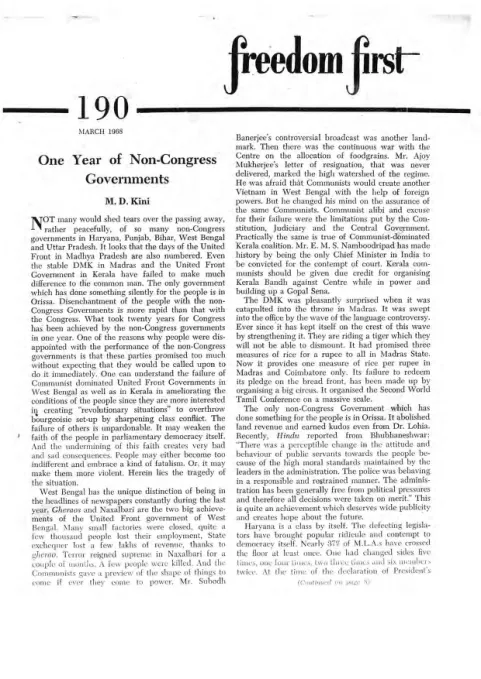
Adam Adil surveys the mid-term elections forced on Punjab, Uttar Pradesh, Bihar and West Bengal after United Front coalition governments collapsed amid defections and factional infighting. He argues that the initial hope non-Congress rule had inspired gave way to disillusion as coalition partners fought over patronage, law and order broke down (especially in West Bengal, where Naxalbari became a byword for Maoist-inspired violent revolt), and Congress failed to offer a compelling alternative. Writing as a self-described Congressman but ‘dispassionate observer,’ he urges the electorate to vote for political stability and warns against both Communist extremes, right and left, as anti-democratic threats to civil order.
- Nearly 7,000 candidates contested 1,167 seats across the four states, affecting roughly 170 million people.
- United Front coalitions fractured due to lack of coordination among ministers from different parties and struggles over patronage.
- West Bengal’s law and order collapse is highlighted, including gheraos endorsed by a semi-Communist labour minister and the Naxalbari uprising inspired by Maoist doctrine.
- Congress Chief Minister Ajoy Mukherjee is described as a helpless, weak figure unable to resist Communist maneuvering within the United Front.
- In Haryana, an early swing back toward Congress is noted even as Congress itself faces internal defections.
- The author frames the piece as nonpartisan, appealing to ‘mature judgment’ rather than campaigning for any party, while warning against Communist parties of the right or left.
Russian Attack on Mao
An unsigned news item reports Pravda’s attack on Mao Tse-tung, accusing him of reducing the Chinese Communist Party to ‘Communist in name only’ and of introducing a monarchical principle of hereditary succession into a draft Party charter, with Lin Piao named as ‘the heir of comrade Mao Tse-tung.’ The piece summarizes Pravda’s charges that Mao’s policies caused economic failure and unrest, and its confidence that ‘true Chinese Communists’ would eventually restore China to ‘the correct path.’
- Pravda, the official Soviet Communist Party journal, published the attack on January 11.
- The attack targeted a draft charter for the Chinese Communist Party to be submitted at its ninth congress later that year.
- Pravda accused Mao of installing a ‘military-bureaucratic dictatorship’ and replacing party functionaries with personally loyal ‘fanatics.’
- The article predicted Chinese Communists would eventually rise to restore ‘the correct path’ and undo Mao’s departure from Marxism.
Dialogue With China And Pakistan
By V. B. Karnik
V. B. Karnik argues for sustained dialogue between India and both China and Pakistan, drawing an analogy to the ongoing US-China talks in Warsaw. He addresses fears that Indira Gandhi’s stated willingness to open dialogue with China might amount to appeasement, arguing that a dialogue need not compromise ‘national honour and interest’ and that India should not let past humiliation (the Hindi-Chini-Bhai-Bhai era) foreclose diplomatic engagement. He is more optimistic about prospects with Pakistan, noting Pakistan’s openness to a ‘no war’ pact and mechanisms for dispute settlement, and urges both countries to reduce military expenditure in favour of economic development.
- A US-China dialogue has continued in Warsaw for over four years despite mutual hostility, used as a model for why India-China talks are worth pursuing.
- Karnik distinguishes between dialogue/settlement of disputes and the ongoing ideological ‘battle of ideals and values,’ arguing the latter must continue regardless of diplomatic relations.
- Indira Gandhi is quoted describing India and China’s attitudes toward the world and their own development as ‘entirely different.’
- Pakistan is described as more receptive than China to a ‘no war’ pact and to setting up machinery for resolving bilateral disputes.
- The article calls for reduced military expenditure by both India and Pakistan to allow more resources for economic development and popular welfare.
Letters to the Editor
The issue’s Letters to the Editor section carries celebratory notes marking Freedom First’s 200th issue, from P. G. Mavalankar (Director, Harold Laski Institute of Political Science, Ahmedabad) and from N. G. Ranga, M.P., who recalls the Democratic Research Service publishing a 1951 book of his and others’ parliamentary speeches criticizing Nehru’s Tibet policy, and jokes that he explains to foreigners abroad that his party’s name (Swatantra) means ‘Freedom First.’ A short unsigned item, ‘United States and Vietnam,’ reproduces outgoing US Secretary of State Dean Rusk’s answer on what went wrong in Vietnam, blaming Hanoi’s determined effort to take over South Vietnam by force.
- Both letters congratulate the magazine on reaching its 200th issue and 16 years of continuous publication.
- N. G. Ranga recalls a 1951 Democratic Research Service book collecting his, Masani’s, Kunzru’s, Shyamaprasad Mukherjee’s and P. Y. Deshpande’s parliamentary speeches criticizing Nehru’s Tibet policy.
- Ranga notes that he tells foreigners abroad that his political party’s name means ‘Freedom First.’
- Dean Rusk, quoted from U.S. News and World Report, attributes what went wrong in Vietnam to Hanoi’s persistent effort to take over South Vietnam by force, met by South Vietnamese and Allied forces.
United States and Vietnam
Ian Tickle examines the persistent Communist insurgency straddling the Thailand-Malaysia frontier, arguing that despite formal military and police cooperation agreements between the two countries, little real progress has been made. He describes Chin Peng, veteran of the failed 1950s Malayan Emergency, as reportedly leading renewed insurgent training on Thai soil, exploiting resentment between Malaysia’s Chinese and Malay communities, and building clandestine ‘people’s communes’ modeled on similar cells in Sumatra. Tickle warns that the winding down of the Vietnam War could free Communist forces to intensify pressure on Thailand and Malaysia, urging defensive alliances among the threatened Southeast Asian states themselves rather than reliance on the United States alone.
- Communist insurgency has been endemic in the jungle frontier area between Thailand and Malaysia since the 1950s Malayan Emergency.
- Chin Peng is reported to be training Malaysian Communist cadres from Thai territory, exploiting easy border crossings.
- The Communist strategy in Malaysia works chiefly through the Chinese racial minority, exploiting Chinese-Malay communal tension.
- Quasi-secret ‘people’s communes’ — self-supporting Communist jungle enclaves — have been discovered in Malaysia and in Indonesian Sumatra.
- The article warns that Communists are awaiting a coordinated signal from Peking rather than acting piecemeal.
- Continued on page 10: Thailand faces an even more dangerous frontier with Laos, porous to North Vietnamese infiltration; the author urges regional defensive alliances as both prophylactic and cure.
Communist Insurgency In Malaysia And Thailand
By Ian Tickle
B. A. Deshpande reports on the Inter-University Students Leadership Camp for National Integration, held in Trivandrum from 22 to 31 December as part of the Gandhi Centenary Committee’s programme, with delegates from about twenty-five universities. He summarizes talks on the role of students in national development, comparative religion, Gandhi’s ideas of Satyagraha and Ahimsa, the Constitution’s protection of fundamental rights, and the challenges of university education, while criticizing the camp’s discussions as often lacking sincerity of purpose among participants and leaving him uncertain of the camp’s overall value, though he found value in meeting students from other regions, including firsthand accounts of tensions in Nagaland and Assam.
- The camp was organized by the Gandhi Centenary Committee and inaugurated by Kerala’s Education Minister, M. Koya.
- Prof. A. G. Warrier’s talk on comparative religion argued that religion, in its true sense as distinct from ‘institutional religion,’ is inseparable from truth and reached through devotion.
- Prof. Balkrishna Pillai discussed Gandhi’s ideas of Satyagraha and Ahimsa, and controversially claimed Gandhi never opposed industrialisation nor advocated linguistic states.
- Discussion concluded that national integration could not be achieved by intensifying linguistic states and that English and regional languages play complementary roles.
- Continued on page 10: Principal Sankar Dasan Thampi discussed the Constitution’s fundamental rights chapter, and Vice-Chancellor Samuel Mathai spoke on the challenges of university education.
- Deshpande found many camp discussions insincere and was left uncertain about the camp’s overall purpose, though he valued exposure to conditions in Nagaland and Assam via fellow delegates.
Students And National Integration
By B. A. Deshpande
This feature collects reader responses to a ‘Student Unrest’ article from the previous issue. Principal J. W. Airan writes that while single-issue grievances (Vietnam, academic freedom, Israel) provide occasions for unrest in various countries, the deeper cause is the breakdown of traditional teacher-student relations as education has widened beyond traditional elites, combined with the state’s own curbing of academic freedom in exchange for funding. S. C. Khattri and D. Shiva Kumar largely endorse the original article’s diagnosis, with Shiva Kumar proposing student representation on university administrative boards. N. B. Desai’s response (continuing onto page 8, unsigned continuation) argues that only a small percentage of students actually engage in destructive unrest, attributing the deeper malady to social, economic, cultural and political causes including an overburdened, underqualified teaching corps, parental neglect due to economic pressure, and graduate unemployment that political parties exploit by recruiting disaffected youth.
- The feature responds to a ‘Student Unrest’ article by Jai Chinai published in a previous issue.
- Principal J. W. Airan links unrest partly to government policies resurrecting colonial-style controls over education in exchange for grants.
- D. Shiva Kumar of Mysore proposes a student representative on university administrative boards and a Dean for student welfare, citing Mysore University’s example.
- N. B. Desai’s continuation estimates 35-40% of student strikes concern non-academic matters, with only 20-25% connected to academic issues.
- Desai attributes underlying causes to compulsory universal education outpacing teacher quality, parental inattention amid urban economic pressure, and graduate unemployment exploited by political parties for recruitment.
- The piece closes urging political parties to ‘keep their hands off the student world’ and calling for a policy team of educationists, sociologists, psychiatrists and historians to redesign educational policy.
Student Unrest — A Point of View
By Principal J. W. Airan; S. C. Khattri, Kanpur; D. Shiva Kumar, Mysore; N. B. Desai, Bombay
S. S. M. Desai reviews J. K. Galbraith’s The New Industrial State (Oxford & IBH, Rs. 28), praising its analysis of how modern capitalism has been transformed by the technological imperatives of large-scale industry. Desai summarizes Galbraith’s argument that specialized technology and its accompanying demands for capital, time and coordinated planning have shifted real power in the corporation from owners and the profit motive to a salaried ‘technostructure’ motivated by pecuniary compensation, compulsion, identification and adaptation rather than personal profit. He notes Galbraith’s claim that capitalist and socialist industrial systems are converging toward similar planning imperatives, reducing the ideological stakes of their historic conflict, and closes by praising Galbraith’s style and coinages.
- Desai frames the review around the claim that the classical model of capitalism — profit motive plus impersonal market pricing — has been superseded by planning imperatives of modern technology.
- Galbraith’s concept of the ‘technostructure’ — the specialized technical, planning and managerial staff who actually run the modern corporation — is central to the review’s summary.
- The review notes Galbraith’s claim that business corporations, now dependent on state support for education and scientific advancement, become politically passive rather than assertive.
- Desai highlights Galbraith’s convergence thesis: both capitalist and socialist systems face the same technological compulsion toward detailed economic planning, reducing the basis for their historic ideological conflict.
- The review closes admiringly, calling reading the book ‘like enjoying a fresh wind blowing’ and praising Galbraith’s coinages such as ‘technostructure’ and ‘the Educational and Scientific Estate.‘
New Industrial Society
By S. S. M. Desai
The ‘Without Comment’ feature reprints, from a Hindustan Times letter, Madan Mohan Hardat’s first-person account of leaving British India for the Soviet Union in 1940-41 as a young revolutionary, only to be arrested on arrival and spend over a decade in Soviet labour camps and prisons (Lubianka, Nizhniy Tagil, Kazakhstan, Vorkuta) on charges of spying for the British and anti-Soviet agitation, before his eventual release in 1956, marriage to a Russian woman, and long struggle to obtain Indian citizenship, finally granted in 1962 with the help of Nehru’s intervention. The piece closes with his rhetorical question about his shifting identity as alleged ‘American,’ ‘British,’ or ‘Russian’ spy. A short unsigned review follows of the pamphlet Indo-Soviet Relations (Popular Prakashan, Re. 1), with contributions from Harish Kapur, M. R. Masani, A. D. Gorwala, A. G. Noorani, M. R. Pai and Jayaprakash Narayan, noting Masani’s essay on Soviet actions in Czechoslovakia and Pai’s warning against ‘dovetailing’ the Indian economy into the Russian economy.
- Madan Mohan Hardat travelled from Lahore to the Soviet Union in 1940-41 with Abdulla Safdar, a member of M. N. Roy’s League of Radical Congressmen, and was arrested immediately upon crossing into Soviet territory.
- He was held without trial across multiple labour camps and prisons over roughly 15 years, on charges including spying for the British and anti-Soviet agitation, with a second sentence of 25 years.
- Conditions eased somewhat under Khrushchev after 1955, allowing him to petition directly and eventually gain release in May 1956.
- He married a Russian woman he had corresponded with during his imprisonment and struggled for years to secure Indian citizenship, finally obtained in 1962 partly through Nehru’s intervention.
- The review of Indo-Soviet Relations notes essays by Harish Kapur (on shifts in Soviet policy toward India), M. R. Masani (on Soviet actions in Czechoslovakia), and M. R. Pai (warning against integrating the Indian economy with the Russian economy).
Without Comment: An Indian in Russian Prisons
The closing ‘With Many Voices’ column, headed by a Tennyson epigraph, collects short press quotations from January 1969 on themes ranging from Middle East diplomacy and Asian economic freedom versus socialism to the Indian election campaign, factory licensing delays, and Indo-Soviet trade negotiations. Contributors quoted include Lee Kuan Yew, Nirad C. Chaudhuri, Congress President Nijalingappa, C. Rajagopalachari, Dean Rusk and D. R. Gadgil, among others, followed by the magazine’s subscription form and imprint details (Registered No. MH 272; printed at Inland Printers, Bombay; edited and published by V. B. Karnik for the Democratic Research Service).
- Lee Kuan Yew is quoted distinguishing expanding-economy Asian countries that allow free enterprise from stagnant ones practising socialism.
- C. Rajagopalachari is quoted arguing that treating Pakistan’s hostility as axiomatic risks perpetuating India’s own bankrupt economic policy.
- A Japanese conference delegate contrasts Malaysia’s two-year timeline to start a factory with India’s two-year timeline merely to get permission to start one.
- The Economic Times is quoted reporting that Indo-Soviet wagon-deal trade negotiations reached a dead end over price disagreement.
- The issue’s imprint records Registered No. MH 272, printing by Inland Printers (55 Gamdevi Road, Bombay 7), and publication by V. B. Karnik for the Democratic Research Service, 127 Mahatma Gandhi Road, Bombay 1.
Generated by the v1.5 extraction pipeline. Awaiting editorial review.
Metadata and summary are AI-extracted from the source PDF and reviewed for editorial accuracy. The original work is available via the Read PDF tab above (where present); paragraph-level citation inside the PDF is deferred to a future engagement.