periodical issue
Freedom First
By Arvind A. Deshpande, Observer, V. B. Karnik, M. D. Kini, Ramu Pandit, G. A. Abba
Printed at Inland Printers, 55 Gamdevi Road, Bombay 7 and Edited and published for the Democratic Research Service by V. B. Karnik at 127 Mahatma Gandhi Road, Bombay 1. · Bombay · 1969
12 pages
Freedom First
Summary
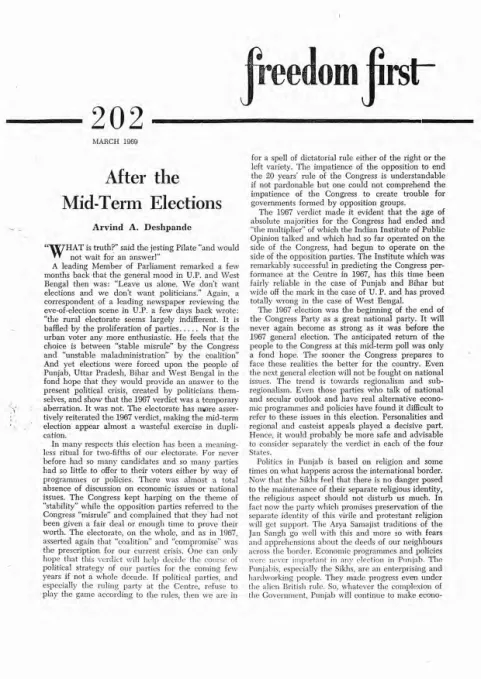
Freedom First No. 202 (March 1969) is a complete 12-page issue of the Bombay-based liberal monthly edited and published by V. B. Karnik for the Democratic Research Service. The issue opens with Arvind A. Deshpande’s post-mortem of the 1969 mid-term elections in Punjab, Uttar Pradesh, Bihar and West Bengal, arguing the results confirm rather than reverse the Congress party’s 1967 decline and that coalition politics is now the norm. An unsigned ‘Observer’ piece analyses the February 1969 Shiv Sena-led riots in Bombay, holding the Sena responsible while also criticising police preparedness and the passivity of other parties. Editor V. B. Karnik contributes a long essay on the Hindu-Muslim problem tracing the historical roots of communal estrangement, the failure of the national movement to retain Muslim confidence, and a critical notice of Hamid Dalwai’s book Muslim Politics in India. M. D. Kini’s ‘A Communist Tragedy’ surveys Indian Communist reactions to the Soviet invasion of Czechoslovakia, contrasting international Communist condemnation with continued Indian Communist support for Moscow, and quotes a new book by CPI intellectuals critical of the Soviet action. Ramu Pandit reviews T. G. McGee’s book The Southeast Asian City. G. A. Abba critiques Nath Pai’s constitutional amendment bill, defending the Golaknath judgment and warning against parliamentary encroachment on fundamental rights. The issue closes with ‘With Many Voices,’ a digest of press quotations on contemporary politics (Czechoslovakia, Ayub Khan, Bengal, Israel) and a subscription form for the magazine.
Key points
-
Arvind A. Deshpande’s “After the Mid-Term Elections” argues the 1969 election results confirmed rather than reversed Congress’s 1967 decline, offering four “lessons” including accepting coalition government and checking regionalism.
-
Writing as “Observer”, “Riots In Bombay” holds the Shiv Sena primarily responsible for the February 1969 Bombay riots tied to blocking Morarji Desai’s entry into the city, detailing a toll of over fifty deaths from police firing and thousands of arrests.
-
V. B. Karnik’s “Hindu–Muslim Problem” traces the historical roots of communal estrangement and Congress’s share of responsibility for Partition, and critically reviews Hamid Dalwai’s Muslim Politics in India while endorsing its call for a humanist trend within the Muslim community.
-
M. D. Kini’s “A Communist Tragedy” frames the Soviet invasion of Czechoslovakia as an “Indian Communist tragedy” too, reporting that the CPI banned from its own bookshops a book by party intellectuals, including Rajya Sabha MP K. Damodaran, that used Marx and Lenin’s own words to criticise the intervention.
-
Ramu Pandit reviews T. G. McGee’s The Southeast Asian City, summarising its thesis that Southeast Asian urbanisation is “pseudo-urbanization” driven by population pressure rather than industrialisation, with slum dwellers as a potential source of political instability.
-
G. A. Abba’s “Mr. Nath Pai’s Bill” argues against the proposed constitutional amendment restoring “parliamentary supremacy” after the Golaknath judgment, contending sovereignty resides in the people and Constitution rather than Parliament, and invokes the Weimar Republic’s collapse as a cautionary parallel.
-
The closing “With Many Voices” column quotes RSS leader M. S. Golwalkar and Home Minister Y. B. Chavan alongside commentary on Stalin’s partial historiographical rehabilitation in the USSR.
Essays
After the Mid-Term Elections
By Arvind A. Deshpande
Arvind A. Deshpande reviews the outcomes of the 1969 mid-term elections in Punjab, Uttar Pradesh, Bihar, and West Bengal, arguing that the electorate reaffirmed rather than reversed its 1967 verdict against Congress dominance. He surveys state-by-state results, contending the era of Congress absolute majorities has ended for good and that future elections will turn on regionalism rather than national issues. The essay closes with a comparative results table and four numbered ‘lessons’ for political parties, urging acceptance of coalition government, discouragement of political defection, and resistance to authoritarian drift.
- The mid-term poll was forced by political crisis rather than genuine demand from an electorate largely indifferent to further elections.
- The 1967 verdict is characterised as the beginning of the end of Congress as a dominant national party, not a temporary aberration.
- State-by-state analysis: Punjab politics driven by religious/Sikh identity concerns; UP sees Congress gains aided by the Prime Minister’s appeal and Muslim votes; Bihar remains fragmented under President’s rule; West Bengal’s United Front repeats its 1967 upset.
- A results table compares 1969 seat counts against 1967 (in brackets) across Congress, Jan Sangh, SSP, Swatantra, PSP, CPI, CPI(M), Akali Dal, BKD, and Bangla Congress.
- Four ‘lessons’ urge Congress to accept coalition politics, discourage political defection, allow parties committed to national interest to govern, and check the rise of regionalism.
Riots In Bombay
By Observer
Writing under the byline ‘Observer,’ this piece assigns primary responsibility for the February 1969 Bombay riots to the Shiv Sena and its leader, whose inflammatory rhetoric around blocking Deputy Prime Minister Morarji Desai’s entry into the city triggered days of violence. The author criticises the Sena for disclaiming responsibility while claiming credit for ending the unrest, faults other opposition parties (PSP, SSP, Communist Party) for opportunistically aligning with popular anger rather than condemning the violence, and details the riots’ toll — burnt police chowkis, milk booths and buses, looted shops, over fifty deaths from police firing, and thousands arrested. It closes with reflections on urban unemployment as combustible material for demagogic riot politics and a call for better civic mechanisms to mobilise public-spirited citizens against future unrest.
- The Shiv Sena and its leader are held primarily responsible for igniting the February 8-11 Bombay riots via inflammatory statements tied to blocking Morarji Desai’s entry into the city.
- Other opposition parties (PSP, SSP, CPI) are criticised for opportunistically joining anti-government criticism rather than condemning the violence, for fear of losing popularity.
- Riot toll: 19 police chowkis, 103 milk booths, 20 BEST buses burnt; 63 hotels and 123 shops looted; 52 deaths from police firing and 2 from rioters’ stone-throwing; about 5000 arrests.
- The police are praised for eventually curbing the riots but criticised as under-equipped and slow, with the Home Guards and military not called out in time.
- The riots achieved nothing on the underlying Maharashtra-Mysore border dispute that ostensibly motivated the Shiv Sena’s agitation.
- The author frames unemployed urban youth as combustible political material that any ‘clever demagogue’ can ignite.
Hindu–Muslim Problem
By V. B. Karnik
V. B. Karnik examines the historical roots of Hindu-Muslim estrangement in India, arguing that both communities bear responsibility though it is ‘historically wrong’ to place the blame chiefly on Muslims. He traces the failure of the national movement to retain the loyalty of the Muslim community, Gandhi’s efforts at unity through the Khilafat agitation and their unintended long-term costs, and the responsibility Congress bears alongside the Muslim League for Partition. A substantial closing section reviews Hamid Dalwai’s book Muslim Politics in India (with a foreword by Prof. A. B. Shah), criticising Dalwai’s sweeping characterisations of Muslims as inherently expansionist while endorsing his underlying plea for a modern, humanist trend within the Muslim community.
- Frames the Hindu-Muslim problem as a conflict between two communities each suspicious of the other, not a purely religious dispute.
- Argues Muslims, being numerically smaller, historically had to plead for special rights and privileges, which unfairly earned their leaders a reputation for communalism.
- Credits Gandhi’s Khilafat-era alliance-building with temporary Hindu-Muslim unity but questions whether it ultimately served national integration given the religious character it lent to politics.
- Holds Congress and Congress leaders jointly responsible with Jinnah and the Muslim League for Partition, citing Congress’s ‘monopolistic attitude’ from 1937 onward.
- Critically reviews Hamid Dalwai’s Muslim Politics in India, rejecting its claim that Muslims are ‘basically expansionist’ as a wild overgeneralisation not based on facts, while endorsing its plea for growth of a humanist trend among Muslims.
- Concludes that national integration requires guaranteeing Muslims a fair share in services, employment and development, not treating their demands as inherently communal.
A Communist Tragedy
By M. D. Kini
M. D. Kini’s ‘A Communist Tragedy’ describes the Soviet invasion of Czechoslovakia as a tragedy for the Communist movement itself, arguing that Indian Communists who approved the Soviet action are accomplices while most Communist parties elsewhere (including Italy and France) condemned it as a violation of the 1960 and 1957 Moscow declarations. He traces a history of Communist crimes overlooked by the faithful — the Stalinist purges, Khrushchev’s revelations, the Hungarian Revolution — and welcomes signs of internal dissent within Indian Communism, citing a new book by CPI intellectuals (including Rajya Sabha member K. Damodaran and Pauly V. Parakal) that quotes Marx and Lenin against the Soviet intervention, and which has been banned for sale by the CPI itself.
- Frames the Soviet invasion of Czechoslovakia as equally a ‘Soviet tragedy’ and an ‘Indian Communist tragedy,’ with Indian Communists as accomplices for approving the action.
- Notes that major Communist parties outside the Soviet bloc, including Italy and France, condemned the intervention as violating the 1960 Moscow Statement of 81 Communist Parties and the 1957 Moscow Declaration.
- Surveys prior Communist atrocities that failed to shake Indian Communist faith: the Stalinist purges of the 1930s, Khrushchev’s 1956 revelations, and the Hungarian Revolution.
- Reports that the CPI banned from its own bookshops a book by party intellectuals (including Rajya Sabha MP K. Damodaran) that used Marx and Lenin’s own words to criticise the Czechoslovakia intervention.
- Quotes extensively from the banned book’s arguments for democracy, open discussion, and national sovereignty within socialism, contrasting them with CPI’s actual practice.
Anatomy Of A Southeast Asian City
By Ramu Pandit
Ramu Pandit reviews T. G. McGee’s book The Southeast Asian City (G. Bell & Sons, 1967), praising its synthesis of demographic, economic and ecological patterns across primate cities such as Kuala Lumpur, Djakarta, Bangkok, Manila, Singapore and Rangoon. The review summarises McGee’s argument that Southeast Asian urbanisation is a ‘pseudo-urbanization’ driven by population pressure rather than industrial transformation, and that political elites governing these cities remain disconnected from the conditions of ordinary residents. Pandit highlights McGee’s warnings about slum dwellers as a potential source of political instability and his call for comprehensive planning over piecemeal resettlement schemes, closing with the reviewer’s hope that an Indian scholar will undertake a comparable study of Bombay and Calcutta.
- McGee’s book studies six Southeast Asian ‘primate cities’ — Kuala Lumpur, Djakarta, Bangkok, Manila, Singapore, Rangoon — using 56 plates, 12 tables and 35 maps/drawings.
- Central thesis: Southeast Asian urbanization is ‘pseudo-urbanization,’ driven by population pressure rather than industrialization as in the West.
- Political elites governing these cities have adopted Westernised lifestyles and remain distant from the conditions of the urban poor.
- McGee warns that slum dwellers constitute a potentially dangerous mass of political dynamite and fertile ground for revolutionary propaganda.
- The book argues for overall planning rather than piecemeal engineering of resettlement schemes as the solution to urban housing problems.
- The reviewer notes the book’s final chapter, on the future of Southeast Asian cities, is its most illuminating despite being only five pages long.
Mr. Nath Pai’s Bill
By G. A. Abba
G. A. Abba argues against Nath Pai’s proposed constitutional amendment bill, which claims to ‘restore’ parliamentary supremacy following the Supreme Court’s Golaknath judgment. Abba contends the Golaknath decision did not curtail Parliament’s power to impose reasonable restrictions on fundamental rights but only denied Parliament the power to abridge those rights outright, and that it is the people and the Constitution — not Parliament or the Supreme Court — that are truly sovereign. He characterises the bill as a vehicle for both the Government and Communists to expand state power at the expense of individual liberties, predicts the Supreme Court would strike down any resulting constitutional amendment, and closes by invoking the collapse of the Weimar Constitution as a cautionary parallel against enabling incremental authoritarianism.
- The Golaknath judgment denied Parliament the right to abridge Fundamental Rights but left intact its power to impose reasonable restrictions on them.
- Abba argues sovereignty resides in the people and the Constitution, not in Parliament or the Supreme Court, rebutting the bill’s framing around ‘parliamentary supremacy.’
- Notes the bill’s sponsors already agreed to subject constitutional amendments to approval by at least 50% of the states, undercutting their own claim to champion parliamentary supremacy.
- Frames the bill as serving the shared interests of the Government and the Communist Party in acquiring unlimited power, at the expense of the poor and of property rights alike.
- Predicts that if passed, the amendment would be challenged and struck down by the Supreme Court, making the bill ‘an exercise in futility.’
- Closes with a warning drawn from the subversion of the Weimar Republic’s constitution in 1933 against opening the door to totalitarianism.
With Many Voices
‘With Many Voices’ is the issue’s regular unsigned digest of press and public quotations, epigraphed with lines from Tennyson. This instalment collects short excerpts on Czechoslovakia, President Ayub Khan’s rule in Pakistan, the hanging of Jews in Baghdad, Communist China’s regional ambitions, Stalin’s rehabilitation in Soviet historiography, RSS leader M. S. Golwalkar’s remarks on India’s diplomatic isolation, Home Minister Y. B. Chavan’s comments on parties allied with the CPI-Marxists, and British and American commentary on the Middle East and Suez. The page also carries the magazine’s ownership/registration notice (Registered No. MH 272) and a subscriber enrolment form for Freedom First.
- Epigraphed with a Tennyson quotation (‘The deep / Moans round with many voices…’).
- Quotes commentators including The Observer, Frank Moraes, The Economic Times, RSS leader M. S. Golwalkar, Home Minister Y. B. Chavan, The Guardian Weekly, and the New York Times on topics from Ayub Khan’s Pakistan to Bengal’s Communist government.
- Includes commentary on the Soviet Union’s political weakness exposed by the Czechoslovakia intervention and on Stalin’s partial historiographical rehabilitation in the USSR.
- Carries the statutory ‘Statement about Ownership’ (Form IV) naming V. B. Karnik as printer, publisher and editor, published for the Democratic Research Service at 127 Mahatma Gandhi Road, Bombay.
- Includes a subscription enrolment coupon offering annual subscription at Rs. 5.00.
Generated by the v1.5 extraction pipeline. Awaiting editorial review.
Metadata and summary are AI-extracted from the source PDF and reviewed for editorial accuracy. The original work is available via the Read PDF tab above (where present); paragraph-level citation inside the PDF is deferred to a future engagement.