periodical issue
Freedom First
FREEDOM FIRST, C/o Democratic Research Service, 127, Mahatma Gandhi Road, Bombay 1 · Bombay · 1969
12 pages
Freedom First
Summary
This issue of Freedom First (No. 204, May 1969) opens with an analysis of West Bengal’s second United Front government, arguing that the CPI(M) has moved from being one of three leading UF partners in 1967 to the dominant force in 1969, systematically subordinating coalition allies, the administration, and the police to its own project of building a ‘Peoples Democracy’ on the Eastern European model. A second piece, by Arvind A. Deshpande, uses the Shankaracharya of Puri’s defence of untouchability as an occasion to argue that caste prejudice cannot be legislated away and must instead be overcome through the self-respect and effort of Harijans themselves. A. G. Noorani reviews Karl Kaiser’s book on West German foreign policy, tracing the shift from Adenauer-era ‘positions of strength’ diplomacy to the Ostpolitik of the Grand Coalition under Kiesinger and Brandt. Milovan Djilas contributes a speculative essay, ‘Russia in 1984’, arguing against Orwell’s totalitarian vision and predicting the crumbling of Marxist-Leninist ideology and the rise of a military-bureaucratic regime in the USSR. The issue closes with a review section, a ‘Without Comment’ column excerpting P. Kodanda Rao on parliamentary democracy and B. R. Shenoy on rising unemployment and social inequality in India, a Forum of Free Enterprise advertisement, and the regular ‘With Many Voices’ page of quotations from the world press.
Key points
-
Writing as “An Analyst”, “Bengal Preparing for ‘Peoples Democracy’” argues the CPI(M) has shifted from one of three leading United Front partners in 1967 to the coalition’s dominant force, embedding itself in West Bengal’s administration and police and distorting a 25-acre land ceiling policy into a vehicle for forcible land occupation.
-
Arvind A. Deshpande’s “Untouchability - The Indian Apartheid” responds to the Shankaracharya of Puri’s defence of untouchability, arguing the practice cannot be legislated away and must instead be worn down by Harijans’ own self-respect and achievement, comparing this to the American civil rights movement.
-
A. G. Noorani reviews Karl Kaiser’s German Foreign Policy in Transition, tracing West Germany’s shift from Adenauer’s “positions of strength” diplomacy to the Grand Coalition’s more flexible Ostpolitik under Kiesinger.
-
Milovan Djilas’s “Russia In 1984” offers a speculative counter to Orwell, predicting that by 1984 Marxist-Leninist ideology will be dead in the USSR and a military-bureaucratic regime will replace a fractured Communist Party.
-
An unsigned note describes a brief, inconclusive Budapest conference of European Communist states, chaired oddly by Alexander Dubcek, at which Romania refused Soviet requests for troop transit rights and further condemnation of China.
-
Book notices review the Novosti pamphlet “Fire Bell in the Night” on Martin Luther King’s murder as one-sided anti-American propaganda, and recommend “Czechoslovakia 1968” alongside D. B. Karnik’s The Czechoslovak Crisis.
-
A “Without Comment” column excerpts P. Kodanda Rao’s argument that party discipline makes parliamentary democracy “both undemocratic and anti-democratic,” and B. R. Shenoy’s data showing Indian unemployment rising from 5.3 million to roughly 10 million across three Five Year Plans.
Essays
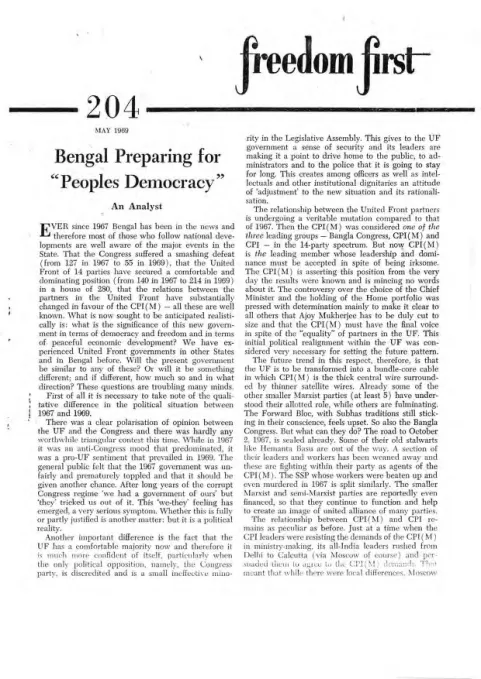
Bengal Preparing for “Peoples Democracy”
By An Analyst
Writing as ‘An Analyst’, the author argues that the 1969 West Bengal United Front government differs qualitatively from its 1967 predecessor: the UF now holds a comfortable legislative majority (214 seats, up from 140) against a badly weakened Congress, and public sentiment has shifted from anti-Congress to pro-UF. Within the coalition, the CPI(M) has moved from being merely one of three leading partners to the unquestioned dominant force, sidelining the Bangla Congress and CPI and treating smaller Marxist parties as ‘satellite wires’ around its ‘thick central wire’. The essay details how the CPI(M) is reshaping the civil service and police through transfers, promotions, and recruitment favoring party loyalists, while land redistribution policy (targeting holdings above 25 acres, an estimated 400,000 acres) is being used to build a mass base through forcible occupation the police are barred from stopping. The author also surveys the fraught relationship between CPI(M) and CPI, the ideological daylight between the CPI(M) and Naxalites over the timing of revolution, and the strategy of building a ‘state within the state’ aimed at eventually confronting the Centre.
- The UF’s 1969 majority (214 of 280 seats) is far larger than its 1967 tally (140), giving it more confidence and a longer time horizon than the earlier government.
- The CPI(M) has shifted from being ‘one of the three leading groups’ in the 1967 UF to being ‘the leading member’ whose dominance other partners must accept.
- The party is embedding itself in the administration and police through transfers, selective promotions, and new recruitment, described as building ‘a state within the State’.
- A land policy targeting holdings above 25 acres (about 400,000 acres) is being distorted into a vehicle for forcible occupation of land and fisheries, which the police are barred from stopping.
- The CPI(M) and CPI are described as competing for ‘monopoly leadership’ of the communist movement despite superficial UF unity, with the CPI(M) treating the ministries as an ‘instrument of struggle’ rather than a normal government.
- The essay contrasts the Naxalites’ open call for immediate violent struggle with the CPI(M)‘s more gradualist, electorally-participating strategy, while noting neither believes in achieving change through ‘the normal parliamentary process’.
Untouchability - The Indian Apartheid
By Arvind A. Deshpande
Arvind A. Deshpande responds to the Shankaracharya of Puri’s controversial defence of untouchability at a Vishwa Hindu Parishad address in Patna. The Shankaracharya had argued that Hindu scripture sanctioned untouchability, that as a religious head he was bound to defend it even while personally law-abiding, and that no government could stop him from ritually bathing after touching a Harijan. Deshpande treats these statements as self-refuting rather than dangerous, noting that even the Adi Shankaracharya reportedly admitted he could not justify the practice. He argues that untouchability is only the sharpest expression of the broader phenomenon of caste, which remains ‘the biggest political party in India’ (quoting Jayaprakash Narayan), and that reservations and other legal remedies have generated their own resentments without dissolving caste consciousness — even among ‘untouchables’ themselves, who maintain internal hierarchies. His conclusion, carried onto the essay’s continuation, is that untouchability cannot be abolished by legislation or by shaming religious leaders, but only by Harijans building self-respect, pride, and achievement on their own terms, comparing this to the American civil rights movement’s ‘We shall overcome’.
- The Shankaracharya of Puri publicly defended untouchability as scripturally sanctioned while claiming to personally obey secular anti-untouchability law, a position Deshpande calls ‘logical but amusing’.
- Deshpande argues prejudices this deep-rooted cannot be legislated away; they must be worn down by the ‘forebearance, tolerance, pride and self-respect’ of Harijans themselves.
- Citing A. C. Mayer’s ‘Caste and Kinship in Central India’, the essay frames untouchability as a more severe expression of the broader concept of ritual pollution running through caste as a whole.
- Reservations and other special privileges for Harijans are described as having created a ‘vested interest in backwardness’ and provoked resentment among caste Hindus, complicating rather than resolving the problem.
- The essay’s conclusion (continued from page 3 onto page 6) rejects reliance on legislation, arguing instead for Harijans to earn recognition through merit, echoing the U.S. civil rights movement’s ‘We shall overcome’.
Germany And Europe
By A. G. Noorani
A. G. Noorani reviews Prof. Karl Kaiser’s book ‘German Foreign Policy in Transition’ (Oxford University Press, 12s 6d), praising it as a work of rare candour and scholarly merit on West German foreign policy. Noorani summarises Kaiser’s account of how Bonn’s Cold War-era policy of reunification ‘through strength’ under Adenauer, premised on NATO membership and the eventual collapse of the East German regime, gave way under Chancellor Kiesinger’s Grand Coalition (from December 1966) to a more flexible Ostpolitik. He lists Kaiser’s six ‘major tenets’ of the new approach: preserving common national heritage rather than seeking regime collapse in the East; modifying exclusive claims to represent the German people (shown by ties with Romania); softening the Hallstein doctrine; a ‘live and let live’ posture toward East Germany; formal renunciation of the Munich agreement; and treating reunification as a consequence of eased European tensions rather than a precondition for them. Noorani notes two lingering constraints — continued NATO membership and West Germany’s non-recognition of the Oder-Neisse line — and closes by endorsing de Gaulle’s framing of the German question as fundamentally the European question, and Kaiser’s own suggestion that conditional recognition of the Oder-Neisse frontier could unlock further progress.
- The review covers Karl Kaiser’s ‘German Foreign Policy in Transition’, which examines how West Germany’s policy on reunification and international politics evolved after World War II.
- Noorani summarises Kaiser’s six-point account of the shift from Adenauer’s ‘positions of strength’ policy to the Grand Coalition’s Ostpolitik under Chancellor Kiesinger and Foreign Minister Schröder.
- Two constraints on the new policy are identified: continued NATO membership and West Germany’s refusal, under domestic pressure, to formally accept the Oder-Neisse line as Germany’s eastern border.
- Diplomatic overtures to Romania and Yugoslavia are cited as concrete results of the modified Hallstein doctrine.
- The review closes by endorsing de Gaulle’s view that ‘the German problem is indeed the European problem’ and Kaiser’s suggestion of conditional Oder-Neisse recognition as a way forward.
Russia In 1984
By Milovan Djilas
Milovan Djilas offers a speculative counter to George Orwell’s ‘1984’, arguing that while Orwell’s satire brilliantly exposed the absurdity of totalitarianism, the future of Communism will not resemble Oceania, Eurasia, and Eastasia. Djilas contends that world Communism has already fractured into national movements (citing Yugoslavia’s 1948 break and China’s 1963 schism), that Sino-Soviet relations are deeply strained, that Marxist-Leninist dogma faces an incurable ideological crisis, and that doubt has gripped even the ruling party bureaucracy — a crisis he argues will unfold differently in the Soviet Union than in Eastern Europe because the USSR’s small creative intelligentsia is being alienated while the masses remain passive. He predicts that by 1984 Marxist-Leninist ideology will be effectively dead in the USSR, the party will be in ruins, and a militaristic bureaucracy backed by the army and secret police will govern in its place — a weaker, more brittle regime than the current one, arising from internal rather than external causes, alongside a corresponding rise of national assertiveness among Communist states in Eastern Europe.
- Djilas argues world Communism no longer exists as a unitary movement but as a collection of increasingly divergent national movements.
- He cites the Yugoslav break of 1948 and the Sino-Soviet schism as evidence Marxist-Leninist ideological unity has already collapsed.
- He predicts that by 1984 the Communist Party in the USSR will be in ruins, replaced by a militaristic bureaucracy under army and secret police control, with ‘revisionism’ and new democratic ideas spreading despite this.
- The essay contrasts crisis dynamics in the USSR (creative intelligentsia alienated, masses passive, crisis ripening at the top among rival leaders) with crises elsewhere in Eastern Europe (currents of reform and national resistance with broader support).
- Soviet Communism is described as historically the first Communism to become ‘national’ under Stalin, merging imperialism and totalitarianism, a character Djilas expects to persist even as ideology fades.
An Odd Meeting
An unsigned note, credited to the Swiss Press Review and News Report, describes a brief and inconclusive conference of European Communist states in Budapest, chaired oddly by Czechoslovakia’s Alexander Dubcek. The note reports that the Soviet Union sought Warsaw Pact backing for more military manoeuvres in Eastern Europe and for the right to move Russian troops through Romania, but that Romania refused to cooperate on this or on condemning China over the Ussuri River border incidents, instead positioning itself as an honest broker between Moscow and Beijing. The only concrete outcome was a renewed, largely symbolic proposal for an all-European security conference, which the piece frames as an attempt by the Russians to save face after the international contempt provoked by the invasion of Czechoslovakia the previous August.
- The Budapest conference of European Communist states lasted only two hours and was chaired, oddly, by Czechoslovakia’s Alexander Dubcek.
- The USSR sought Warsaw Pact endorsement for more military manoeuvres in Eastern Europe and for transporting Russian troops through Romania.
- Romania refused to cooperate, positioning itself as a broker between the USSR and China rather than joining condemnation over the Ussuri border incidents.
- The only tangible result was a proposal for an all-European security conference, previously made and rejected in the West as hypocritical.
- The piece frames the conference as a face-saving exercise following international condemnation of the August 1968 invasion of Czechoslovakia.
Review: Fire Bell in the Night / Czechoslovakia 1968 / Books Received
By N. D.
The ‘Review’ section carries two book notices signed ‘N.D.’ The first covers ‘Fire Bell in the Night’, a Novosti Press Agency pamphlet on the murder of Dr. Martin Luther King and other atrocities against American Negro leaders; the reviewer dismisses it as one-sided Soviet propaganda that ignores the genuine progress the U.S. has made on civil rights and integration, and speculates whether such material is even meant to reach ordinary Russian readers or is intended solely for foreign consumption. The second reviews ‘Czechoslovakia 1968’, an Indian reprint of Economist articles on the Prague Spring and its suppression, recommending it alongside D. B. Karnik’s book ‘The Czechoslovak Crisis’ as complementary accounts — one narrating the day-by-day invasion, the other analysing its political implications. A ‘Books Received’ list follows, naming six forthcoming review titles including works published by the Forum of Free Enterprise and Lalvani Publishing House.
- The Novosti Press Agency pamphlet ‘Fire Bell in the Night’ on Martin Luther King’s murder is reviewed as one-sided anti-American propaganda that omits progress on U.S. civil rights.
- The reviewer speculates about whether Soviet propaganda pamphlets are permitted to reach ordinary Russian readers or are produced only for foreign audiences.
- ‘Czechoslovakia 1968’ (National Academy, Delhi), reprinting Economist articles, is recommended as a useful complement to D. B. Karnik’s ‘The Czechoslovak Crisis’.
- A ‘Books Received’ list previews six titles awaiting review, including works from the Forum of Free Enterprise and Lalvani Publishing House.
Without Comment: Parliamentary Democracy
By P. Kodanda Rao (quoted)
The ‘Without Comment’ column presents two excerpted arguments without editorial commentary. The first, drawn from an article by P. Kodanda Rao, argues that the party system corrupts parliamentary democracy by subordinating MPs’ conscience and constituency obligations to party discipline, quoting Maurice Duverger and Winston Churchill, and contending that party government is ‘both undemocratic and anti-democratic’ compared to a presidential system with greater freedom of conscience for legislators. The second excerpt, from an article by Prof. B. R. Shenoy, documents a sharp rise in Indian unemployment across the Five Year Plans (from 5.3 million in 1955-56 to roughly 10 million by 1966-67) and argues that income shifts toward a thin top layer of society, combined with stagnant or declining per-capita income since 1960-61, have driven growing numbers of families toward or below the poverty line, evidenced by falling per-capita consumption of cloth, foodgrains, edible oils and sugar alongside a boom in luxury consumption such as air-conditioned coaches, motorcars, and refrigerators.
- P. Kodanda Rao’s excerpt argues the party system, especially two-party systems, subordinates MPs’ individual conscience to party discipline, making parliamentary democracy ‘both undemocratic and anti-democratic’.
- The excerpt invokes Maurice Duverger’s ‘Political Parties’ and a 1955 Winston Churchill statement on the primacy of an MP’s conscience over party loyalty.
- B. R. Shenoy’s excerpt shows unemployment rising from 5.3 million (1955-56) to about 10 million (1966-67) across India’s first three Five Year Plans.
- Shenoy attributes growing ‘social injustice’ to income shifts concentrating gains among a thin top layer, amid overall income stagnation and decline since 1960-61.
- Falling consumption of cotton cloth, foodgrains, edible oils and sugar between 1961-62 and 1966-67 is cited as evidence of declining living standards for the Indian masses, contrasted with rising ownership of cars, refrigerators and air-conditioners among the well-off.
Without Comment: Growing Social Injustice
By Extracts from an article by Prof. B. R. Shenoy
The issue closes with ‘With Many Voices’, a regular column of unattributed and lightly-annotated quotations gathered from the world press on current political events — including remarks on Chinese foreign minister Chen Yi’s characterization of Americans and Russians, the risk of a Communist takeover in East Pakistan, J. B. Kripalani on the fragmentation of Indian states, C. Rajagopalachari on statism versus freedom, and commentary on the West Bengal political crisis and the year’s spate of authoritarian leaders. The page also carries the magazine’s subscription form (annual subscription Rs. 5.00, addressed to Democratic Research Service, Mahatma Gandhi Road, Bombay) and the printer’s colophon.
- The ‘With Many Voices’ column compiles brief quotations from global newspapers and public figures on current events, without editorial elaboration.
- Quoted figures include Chen Yi, Acharya J. B. Kripalani, C. Rajagopalachari, M. C. Setalvad, and Maulana Bhashani, among others.
- Several quotations concern the West Bengal political situation, echoing the lead article’s concerns about UF/CPI(M) governance.
- The page includes the magazine’s annual subscription form (Rs. 5.00) addressed via Democratic Research Service, Bombay.
Generated by the v1.5 extraction pipeline. Awaiting editorial review.
Metadata and summary are AI-extracted from the source PDF and reviewed for editorial accuracy. The original work is available via the Read PDF tab above (where present); paragraph-level citation inside the PDF is deferred to a future engagement.