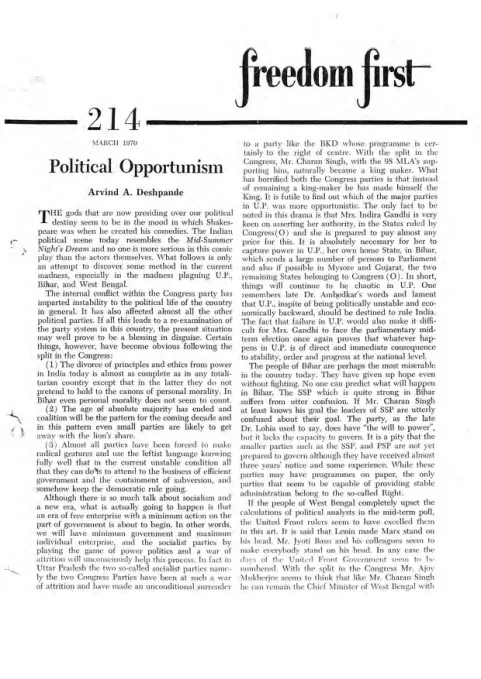
periodical issue
Freedom First
By Adam Adil, A. B. Shah, (A Student), Analyst, A Correspondent, V. B. Karnik, K. V. B.
Edited and published for the Democratic Research Service by V. B. Karnik at 127 Mahatma Gandhi Road, Bombay 1, and printed by him at Inland Printers, 55 Gamdevi Road, Bombay 7. · Bombay · 1969
12 pages
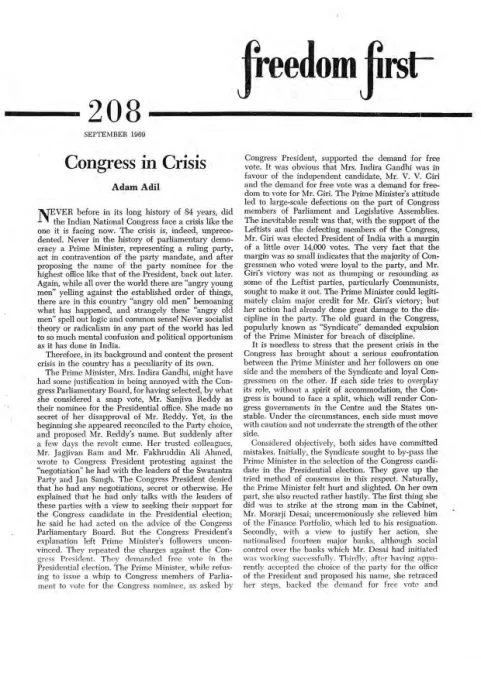
Freedom First
Summary
This is issue 208 of Freedom First (September 1969), the Bombay-based classical-liberal periodical edited by V. B. Karnik for the Democratic Research Service. The issue is dominated by the political crisis inside the Indian National Congress following the contested Presidential election of V. V. Giri and Indira Gandhi’s nationalisation of fourteen banks, alongside sustained alarm over threats to press freedom from the Prime Minister’s government and its supporters. Contributors include Adam Adil on the Congress split, A. B. Shah on pressure applied to newspaper editors, V. B. Karnik reviewing Brigadier J. P. Dalvi’s account of the 1962 war with China, and unsigned or pseudonymous pieces on Soviet writer Anatoly Kuznetsov’s defection, the first anniversary of the Soviet invasion of Czechoslovakia, a student seminar on unrest, and left-front violence in West Bengal. The issue closes with a review of a book on Bengal politics and a page of quoted press commentary titled ‘With Many Voices’.
Key points
-
Adam Adil’s “Congress in Crisis” surveys the unprecedented Congress crisis after Indira Gandhi backed independent candidate V. V. Giri for President over the party’s official nominee Sanjiva Reddy, leading to mass defections and Giri’s narrow victory.
-
An unsigned editorial marks the first anniversary of the Soviet invasion of Czechoslovakia, citing Jan Palach’s self-immolation as the year’s most notable act of resistance and the replacement of Dubcek by the more compliant Gustav Husak.
-
A. B. Shah’s “The Press and the Present Crisis” invokes Tocqueville to argue there is no half-way house between a free and regimented press, documenting government pressure on editors and mob attacks on The Statesman.
-
An unsigned piece recounts Soviet writer Anatoly Kuznetsov’s defection to Britain while researching a book on Lenin, smuggling manuscripts sewn into his coat lining.
-
A student report on a Democratic Research Service/Leslie Sawhny Programme seminar at S.N.D.T. Women’s University finds participants unanimously critical of strikes over tough exam papers while unable to agree on limits for student involvement in party politics.
-
Writing as “Analyst,” a piece describes clashes between police and CPM/SUC peasant organisations at Haroa and Bharatgarh, and the CPM’s shift toward appealing directly to policemen rather than confronting them.
-
V. B. Karnik reviews Brigadier J. P. Dalvi’s Himalayan Blunder, an account of the 1962 war with China that assigns greatest blame to Defence Minister Krishna Menon and Nehru while also holding senior army officers responsible.
-
K.V.B. reviews J. H. Broomfield’s Elite Conflict in a Plural Society on Bengal’s Bhadralok elite, showing how the same group that opposed the 1905 Partition welcomed the 1947 Partition rather than face incorporation into a Muslim-majority state.
Essays
Congress in Crisis
By Adam Adil
Adam Adil’s lead article surveys the unprecedented crisis in the Indian National Congress, precipitated when Prime Minister Indira Gandhi backed independent candidate V. V. Giri for President against the party’s official nominee, Sanjiva Reddy, leading to mass defections and Giri’s narrow victory by roughly 14,000 votes. The author holds both the Prime Minister and the conservative ‘Syndicate’ faction responsible for mistakes, and argues that the Working Committee’s conciliatory response has averted an immediate party split, though the underlying tensions over socialist policy versus party discipline remain unresolved. The essay urges both factions to cooperate for the sake of Congress’s role in India’s democratic stability.
- Congress faces its worst crisis in 84 years of history, driven by Mrs Gandhi’s open support for independent presidential candidate V. V. Giri over the party’s official nominee Sanjiva Reddy.
- Giri won the presidency by a margin of just over 14,000 votes with Leftist and defecting Congress support.
- The old guard ‘Syndicate’ demanded the Prime Minister’s expulsion for breach of party discipline.
- Mrs Gandhi’s dismissal of Finance Minister Morarji Desai and the nationalisation of fourteen major banks are presented as her attempt to justify her actions.
- The Congress Working Committee’s considerate handling of the crisis is credited with averting a party split.
Czechoslovakia — Sullen Resistance
This unsigned editorial marks the first anniversary of the Soviet-led invasion of Czechoslovakia, describing a year of ‘silent and sullen resistance’ by the Czechoslovak people, including the self-immolation of Jan Palach, and the removal of reformist leader Alexander Dubcek in favour of the more compliant Gustav Husak. The piece draws a lesson for other countries drifting toward Soviet influence: that Russia does not tolerate dissent and will use aggression across borders to suppress it.
- A year after the Soviet invasion, Czechoslovaks continue sullen, non-violent resistance including non-cooperation and slowdowns in production.
- Jan Palach’s self-immolation is cited as the most notable act of protest against the occupation.
- Alexander Dubcek was replaced by Gustav Husak, seen by Czechoslovaks as a Russian agent.
- The piece frames the episode as a warning to nations ‘gravitating towards Russia’ about intolerance of dissent.
The Press and the Present Crisis
By A. B. Shah
A. B. Shah’s essay opens with Tocqueville’s observation that there is no half-way house between a free press and a regimented one, and argues that this applies acutely to India in 1969. Shah documents specific instances of the Gandhi government and its supporters pressuring newspaper editors and managements — phone calls threatening editors, mob attacks on The Statesman and other papers by CPI(M)-led crowds, and proposals to convert newspapers into public trusts. He also discusses religious mob pressure on the press, such as protests over a painting of the Prophet published in the Marathi weekly Sadhana and over a Toynbee article in The Statesman. Shah rejects the government’s rhetoric about a dangerous ‘press monopoly,’ arguing that true concentration of power over mass communication lies with the government itself, and concludes that the real weakness of the Indian press is the complacency and opportunism of its own proprietors rather than external threats.
- Shah invokes Tocqueville’s Democracy in America on the absence of a middle ground between a free and a regimented press.
- Documents direct pressure by Mrs Gandhi’s government and supporters on newspaper editors, including threatening phone calls and mob attacks on The Statesman and other papers.
- Notes proposals to convert newspaper combines into public trusts and to reintroduce the price-page schedule struck down by the Supreme Court.
- Describes religious-mob threats to press freedom, citing the Sadhana cover depicting the Prophet Muhammad and a Statesman apology over a Toynbee article.
- Argues that fears of private ‘press monopoly’ are overstated compared to the government’s actual concentration of coercive power over media.
- Blames the ‘complacency and opportunism’ of Indian press proprietors, not external monopoly, for any erosion of press freedom.
Kuznetsov Chose Freedom
This unsigned piece recounts the defection of Soviet writer Anatoly Kuznetsov, author of Babi Yar and The Fire, who requested political asylum in London while ostensibly researching a book on Lenin, smuggling microfilm copies of his manuscripts in his coat lining. The article quotes at length from Kuznetsov’s own statement explaining his decision, describing Soviet literary censorship and the psychological toll of writing under constant political control, and notes the wider crackdown on independent-minded Soviet writers following the Czechoslovak invasion, including Sinyavsky, Daniel, Evtushenko, and Voznessensky, and pressure on Tvardovsky’s journal Novy Mir.
- Anatoly Kuznetsov, author of Babi Yar and The Fire, defected to Britain seeking political asylum while researching a book on Lenin.
- He smuggled microfilm copies of his manuscripts sewn into his coat lining.
- His own statement describes Soviet censorship as distorting his works ‘to the point of making them completely unrecognizable’.
- The piece links his defection to the broader crackdown on independent writers after the Czechoslovak invasion, including the trial of Sinyavsky and Daniel.
- Novy Mir editor Tvardovsky is described as under heavy pressure for maintaining literary and ideological independence.
Reflection on a Student Seminar
By (A Student)
Written by an anonymous student, this piece reports on a student seminar on ‘Student Unrest’ held at S.N.D.T. Women’s University in July 1969 under the joint auspices of the Democratic Research Service and the Leslie Sawhny Programme of Training for Democracy. About thirty students discussed the nature and causes of unrest, responsibility for it, and students’ role in politics and reform. The author notes that participants showed little interest in theoretical or international dimensions of unrest, unanimously criticised tough examination practices, blamed frustration from economic instability and unemployment, and were unable to agree on limits for student participation in party politics, though they favoured student activism against casteism and untouchability.
- A student seminar on ‘Student Unrest’ was held at S.N.D.T. Women’s University on 26 July 1969 under the Democratic Research Service and Leslie Sawhny Programme of Training for Democracy.
- About thirty students debated five themes: the nature of unrest, its causes, responsibility for it, student involvement in party politics, and students’ constructive role in reform.
- Participants unanimously assailed strikes over tough examination papers and felt students cared more about degrees than knowledge.
- Economic instability and unemployment were seen as major drivers of frustration.
- No consensus formula emerged on limits for student participation in national and party politics.
- Participants agreed students should work against casteism, parochialism, and untouchability.
New Tactic With Police
By Analyst
Writing under the byline ‘Analyst,’ this piece continues Freedom First’s ongoing coverage of conflict between West Bengal’s United Front government and the police. It describes violent clashes between police and CPM/SUC peasant organisations at villages Haroa and Bharatgarh, the killing of a police constable, and the resulting anger among rank-and-file policemen. The CPM is described as shifting tactics to try to win over policemen and officers directly rather than confront them, a move the author sees as a potentially significant new strategy. The piece closes by noting a successful jute mill strike backed by the United Front government across rival trade union federations.
- Clashes at Haroa (Basirhat) and Bharatgarh (Basanti) left several policemen and peasants dead, escalating tension between the West Bengal police and CPM/SUC-aligned peasant groups.
- Rank-and-file policemen grew agitated after a constable’s killing, leading to attacks on a police station and the Legislative Assembly.
- Senior police officers report being under pressure amid dismissals and disaffection within the force.
- The CPM under Jyoti Basu shifted tactics, appealing to policemen directly to align with the United Front rather than treating them as adversaries.
- A jute mill strike backed by the United Front government and multiple union federations succeeded, raising wages by Rs. 30.
Two Incidents
By A Correspondent
This report by ‘A Correspondent’ documents two violent incidents in West Bengal in July 1969: a clash between jotedars (landholders) and peasant cultivators at Madhusudanpur in 24 Parganas that left five jotedars and one peasant dead, followed by a mass peasant assembly and reprisal killings; and a clash at Bharatpur between S.U.C. and R.S.P. supporters that escalated into an attack on police, killing a constable and leading to the temporary forcible detention of a police sub-inspector and constable.
- At Madhusudanpur, disputes over wages between jotedars and peasants escalated into violence; five jotedars and one peasant were killed, and jotedars were later beaten to death by a mob of ten thousand peasants.
- At Bharatpur, a clash between S.U.C. and R.S.P. supporters led to the death of an R.S.P. worker and, days later, an armed peasant crowd killed a police constable and forcibly detained a sub-inspector and constable after stripping and assaulting them.
- Police reinforcements eventually rescued the detained officers and recovered stolen weapons.
Himalayan Blunder (review of Brigadier J. P. Dalvi’s book)
By M. R. Pai
V. B. Karnik reviews Brigadier J. P. Dalvi’s book Himalayan Blunder, an account by the commander of the 7th Brigade of the 1962 border war with China. Karnik praises it as the most significant and authentic account among the many books on the 1962 humiliation, detailing the brigade’s outnumbered stand at the Thagla Ridge, the chaotic ‘Forward Policy,’ and Dalvi’s frank apportioning of blame to Nehru and Defence Minister Krishna Menon for political opportunism, poor supply, and disorganised command, while also holding senior army officers, including himself, partly responsible. The review notes the book reproduces Sardar Patel’s 1950 letter to Nehru warning of the China threat, and closes by endorsing Frank Moraes’s foreword urging every Indian to read it.
- Brigadier Dalvi commanded the 7th Brigade, which bore the brunt of the Chinese assault at Thagla Ridge, outnumbered at least 20 to 1.
- Dalvi attributes the disaster chiefly to the government’s ill-prepared ‘Forward Policy’ of establishing unsupplied border posts, including the Dhola Post in NEFA.
- The book assigns greatest blame to Defence Minister Krishna Menon for starving the army and disorganising its chain of command, and to Nehru for his ‘credulity and negligence’.
- Dalvi also holds senior army officers, including himself, responsible for their part in the debacle.
- The book reproduces Sardar Vallabhbhai Patel’s 1950 letter to Nehru warning of the danger China posed to India’s security.
- Frank Moraes’s foreword, quoted approvingly, urges every Indian to read the book and form an independent judgment.
Review: Elite Conflict in a Plural Society: Twentieth-Century Bengal (J. H. Broomfield)
By K. V. B.
Reviewer ‘K.V.B.’ assesses J. H. Broomfield’s Elite Conflict in a Plural Society: Twentieth-Century Bengal (Oxford University Press), which examines the Bengali ‘Bhadralok’ elite’s nationalist struggle against British rule from 1912 to 1927. The review credits Broomfield with showing how the Bhadralok-led movement, narrowly based and disconnected from Muslims and lower-caste Hindus, generated communal discord that British administrators exploited, ultimately leading the same elite that opposed the 1905 Partition to welcome the 1947 Partition rather than face incorporation into a Muslim-majority state. The reviewer recommends the book to students of the national movement and the communal problem, while noting its high price limits its reach.
- Broomfield’s book covers the Bhadralok-led nationalist struggle in Bengal from 1912 to 1927, following the 1905 Partition and its 1912 annulment.
- The Bhadralok elite’s narrow social base, disconnected from Muslims (about 55% of the population) and lower-caste/untouchable Hindus, is presented as central to its eventual frustration and defeat.
- The book documents how communal politicians exploited resentment against Hindu landholders, moneylenders, and officials to mobilise Muslim opinion against Congress rule.
- The same Bhadralok group that opposed the 1905 Partition welcomed the 1947 Partition as preferable to incorporation into a Muslim state.
- The reviewer calls the book essential reading on Hindu-Muslim relations but notes its Rs. 50 price will limit readership.
With Many Voices
The closing page, ‘With Many Voices,’ is a compilation of press quotations from mid-August 1969 commenting on the Congress crisis, bank nationalisation, and Indira Gandhi’s leadership, drawn from sources including The Indian Express, The Statesman, Times of India, and figures such as C. Rajagopalachari, M. R. Masani, Jayaprakash Narayan, and Asoka Mehta. It reflects the range of contemporary opinion, largely critical of the Prime Minister’s methods, alongside a subscription form and the issue’s publication colophon naming V. B. Karnik as editor and publisher for the Democratic Research Service.
- The page collects critical press commentary on Mrs Gandhi’s handling of the Congress crisis and bank nationalisation from August 1969.
- Quoted figures include C. Rajagopalachari, M. R. Masani, Jayaprakash Narayan, N. G. Goray, and Asoka Mehta, among newspaper correspondents.
- Rajagopalachari is quoted calling Mrs Gandhi ‘an agent and instrument of the communists and fellow-travellers’.
- The colophon confirms the issue was edited and published by V. B. Karnik for the Democratic Research Service at 127 Mahatma Gandhi Road, Bombay.
Generated by the v1.5 extraction pipeline. Awaiting editorial review.
Metadata and summary are AI-extracted from the source PDF and reviewed for editorial accuracy. The original work is available via the Read PDF tab above (where present); paragraph-level citation inside the PDF is deferred to a future engagement.