periodical issue
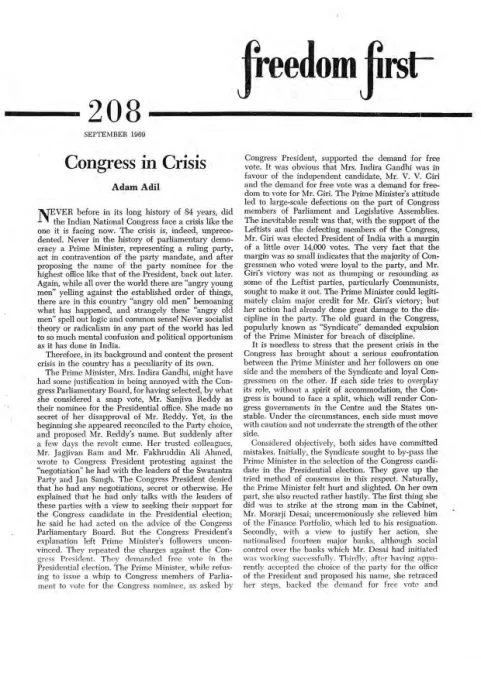
Freedom First
By Arvind A. Deshpande, A. G. Mulgaokar, Adam Adil, Analyst, Sadhu Singh Dhami, N. K. Sane, R. Muthuswamy, Padma Bhavnani
Edited and published for the Democratic Research Service by V. B. Karnik at 127 Mahatma Gandhi Road, Bombay 1, and printed by him at Inland Printers, 55 Gamdevi Road, Bombay 7. · Bombay · 1970
12 pages
Freedom First
Summary
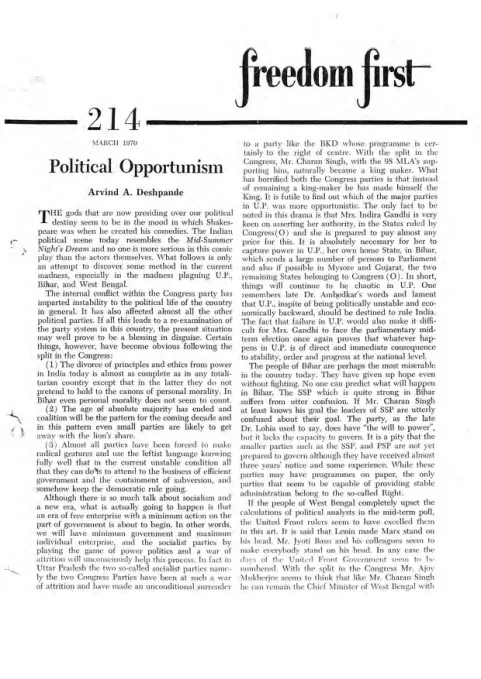
Freedom First No. 214 (March 1970) is a monthly issue of the Bombay-based liberal periodical edited by V. B. Karnik for the Democratic Research Service. The issue is dominated by commentary on the collapse of stable party politics in northern and eastern India: an editorial on the opportunistic realignments following the Congress split in Uttar Pradesh, Bihar, and West Bengal, and a detailed “Bengal Report” assessing one year of United Front rule in West Bengal and the growing organisational strength of the CPM. Legal and economic commentary is represented by a long analysis of the Supreme Court’s bank nationalisation judgment, and international affairs by a piece on the widening Sino-Soviet border conflict. Two book reviews cover, respectively, an American academic study of Gandhi’s reception in the United States and Svetlana Alliluyeva’s memoir Only One Year. The issue closes with a reader’s letter debating trade-union politics in the Jamshedpur strike (with an editorial reply), a column of quoted press opinion (“With Many Voices”), and the annual statutory ownership declaration for the magazine.
Key points
-
Arvind A. Deshpande’s “Political Opportunism” surveys the chaotic state politics of UP, Bihar and West Bengal following the Congress split, singling out Charan Singh’s rise to power in UP with 98 MLAs.
-
A. G. Mulgaokar analyses the Supreme Court’s judgment striking down the Bank Nationalisation Act for violating fundamental rights and the compensation guarantee, defending the Court’s constitutional role against critics including the Prime Minister.
-
Adam Adil traces the deteriorating Sino-Soviet relationship from 1956 to the 1969 Ussuri River border clash, noting China’s simultaneous talks with the US in Warsaw and urging India to consider its own dialogue with China.
-
Writing as “Analyst,” a “Bengal Report” assesses the first year of the CPM-led United Front ministry, finding over 300,000 acres of land forcibly occupied and CPM membership expanded to roughly 30,000 with a 110,000-strong paramilitary volunteer corps.
-
Sadhu Singh Dhami reviews C. Seshachari’s Gandhi and the American Scene, faulting it for not examining whether Gandhian satyagraha could resolve American racial conflict given Stokely Carmichael’s rejection of nonviolence.
-
Padma Bhavnani reviews Svetlana Alliluyeva’s memoir Only One Year, tracing her disillusionment with Communism to her mother’s suicide and the Kremlin’s refusal to register her marriage to Indian Communist Brajesh Singh.
-
A reader’s letter from N. K. Sane disputes an earlier article on the Jamshedpur strike, arguing it was driven by local “Mastans” (strongmen) rather than ideological Communist factions, with both sides agreeing on the need for statutory secret-ballot union recognition.
Essays
Political Opportunism
By Arvind A. Deshpande
Arvind A. Deshpande’s editorial-style essay surveys the chaotic state politics of Uttar Pradesh, Bihar, and West Bengal following the split in the Congress party. He argues that the divorce of principles from power, the end of clear majorities, and the rise of opportunistic coalitions have become the defining features of Indian politics, singling out Charan Singh’s rise to power in U.P., the demoralised state of Bihar’s SSP and PSP, and the CPM-led United Front’s dominance in West Bengal. The piece ends by warning that unless parties show restraint, continued instability at the state level will spread disorder to the national centre.
- Congress split has destabilised UP, Bihar, and West Bengal simultaneously
- Charan Singh became a ‘king’ rather than a king-maker in UP with 98 MLAs
- Bihar’s SSP has ‘the will to power’ but lacks ‘the capacity to govern’ per the late Dr. Lohia
- West Bengal’s United Front government is described as heading toward instability
- Author frames the era as one of a coming free-enterprise minimal-government dispensation
- Warns of a crisis of ambition and political opportunism threatening democracy
Bank Nationalisation And Fundamental Rights
By A. G. Mulgaokar
An untitled ‘Without Comment’ section reprints three short items: a Feb 15 Observer (London) piece on the resignation of Novy Mir editor Alexander Tvardovsky amid a Soviet crackdown on liberal literary tendencies; a tribute to Bertrand Russell on his death at 97, praising his philosophy and lifelong advocacy of peace and freedom while noting his sometimes harsh attitude to Western democracies; and a short obituary of American writer Louis Fischer, ‘a great friend of India.’
- Alexander Tvardovsky resigned as editor of Novy Mir amid a Soviet campaign against liberal literary tendencies
- Novy Mir published Solzhenitsyn’s ‘One Day in the Life of Ivan Denisovich’ during Tvardovsky’s editorship
- Bertrand Russell is eulogised as philosopher, mathematician, and champion of freedom who died aged 97
- Louis Fischer, American writer and political scientist with universal sympathies and deep ties to India, is remembered
Sino-Soviet Conflict
By Adam Adil
A. G. Mulgaokar analyses the Supreme Court’s judgment in the Bank Nationalisation case, defending the Court’s constitutional role against critics (including reported adverse comment from the Prime Minister and a former Supreme Court judge) who accused it of obstructing reform. He argues the Court acted well within its rights in striking down the Banking Companies (Acquisition and Transfer of Undertakings) Act and Ordinance for violating fundamental rights and the guarantee of compensation, while faulting the Court only for declining to rule on the Ordinance’s legality outright. The essay quotes the judgment extensively on Articles 19(1)(f) and 31, and closes by crediting Dr. R. C. Cooper and Mr. Palkhivala’s advocacy for bringing the constitutional issues before the Court with such skill.
- Supreme Court struck down the Bank Nationalisation Act/Ordinance as violating fundamental rights and the guarantee of compensation
- Author defends the Court’s constitutional role as complementary to, not a substitute for, the legislature
- Rejects criticism of the judgment as mostly ‘ill-informed’, including from the Prime Minister and an ex-Supreme Court judge
- The Court held that determining compensation for only some components of a banking undertaking’s value fails to give a true recompense
- Author credits Dr. R. C. Cooper and Mr. Palkhivala’s advocacy for the outcome
- The judgment is described as laying down broad and healthy constitutional principles on property rights and compensation
One Year’s Balance Sheet (Bengal Report)
By Analyst
Adam Adil traces the deterioration of Sino-Soviet relations from the 1956 denigration of Stalin through ideological estrangement to the 1969 Ussuri River border clash over Damansky/Chenpao island. He reports Moscow’s efforts, via negotiator Vassily Kuznetsov and a Pravda article by Sergei Tikhvinsky, to reach a non-aggression settlement with China, and contrasts this with China’s simultaneous talks with the United States in Warsaw. The author argues the Sino-U.S. talks are partly intended to pressure the Soviet Union into a border settlement, that the U.S. would side with Russia rather than China in any violent clash, and (continuing on page 8) that India should consider its own dialogue with China rather than adopting a rigid stance, given Pakistan’s diplomatic gains from courting Beijing.
- Sino-Soviet rift traced from Khrushchev’s 1956 denigration of Stalin to the 1969 Ussuri River (Damansky/Chenpao) border clash
- Moscow, via negotiator Vassily Kuznetsov, is reportedly seeking a non-aggression pact with China
- China has simultaneously opened talks with the U.S. in Warsaw, partly to pressure Moscow
- Author predicts the U.S. would side with Russia, not China, in a violent Sino-Soviet clash
- China’s 1962 border war with India is cited as evidence of its aggressive posture toward neighbours
- Author urges India to consider its own dialogue with China given Pakistan’s diplomatic gains from Sino-Pakistani friendship
Bengal Report
Writing as ‘Analyst’ in the ‘Bengal Report’ column, this essay assesses the first year of West Bengal’s CPM-led United Front ministry (writing as of 15 February 1970). It describes the government’s early anti-Centre posturing giving way to internal factional battles, forcible land occupation and industrial gheraos undermining police morale, capital flight and industrial closures, and escalating inter-party clashes between the CPM, Bangla Congress, and other partners. The piece concludes that the CPM has used the year to massively expand its membership, para-military volunteer corps, and Kisan Sabha base, entrenching its organisational power even as the state’s administration and economy have weakened.
- United Front ministry, with 218 of 280 seats, nears one year in office despite expectations of collapse
- Over 300,000 acres of land forcibly occupied and harvested in rural Bengal, undermining rural credit and order
- Flight of new industrial capital (500+ units reportedly relocating outside Bengal) and rising closures/lockouts
- CPM prioritised satellising smaller partner parties (Forward Bloc, Bangla Congress, CPI)
- CPM membership grew to ~30,000 with 65,000 associate members and a 110,000-strong para-military volunteer corps
- Bangla Congress, holding the Chief Ministership, is described as strategically positioned but politically ineffective
Gandhi And The American Scene
By Sadhu Singh Dhami
Sadhu Singh Dhami reviews C. Seshachari’s book ‘Gandhi and the American Scene’ (Nachiketa Publications, Bombay, Rs. 20), which surveys nearly fifty years of American reactions to Gandhi. The review praises the book’s historical breadth—linking Gandhi to Thoreau, Emerson, Whitman, and American figures like John Haynes Holmes, Roger Baldwin, and Martin Luther King—while criticising the book for failing to explore whether Gandhian Satyagraha could resolve the racial conflicts convulsing 1960s America, particularly given Black Power leaders’ rejection of nonviolence as unsuited to Black Americans’ circumstances.
- Reviewed book: ‘Gandhi and the American Scene’ by C. Seshachari, Nachiketa Publications, Rs. 20
- Book traces American reactions to Gandhi over roughly fifty years, via figures such as John Haynes Holmes, Roger Baldwin, Norman Thomas, and Martin Luther King
- Corrects the common claim that Thoreau’s ‘Civil Disobedience’ was Gandhi’s original inspiration for Satyagraha rather than a later confirming influence
- Discusses Satyagraha’s dependence on both parties valuing love and truth, limiting its applicability where ‘business is all-important’
- Faults the book for not examining whether a Gandhian solution could address American racial conflict
- Cites Stokely Carmichael’s view that nonviolence is a ‘luxury white people do not deserve’ and black people ‘cannot afford’
Strike In Jamshedpur (Letter to the Editor, with editor’s reply)
By N. K. Sane / R. Muthuswamy (reply)
A ‘Letter to the Editor’ from N. K. Sane of Jamshedpur responds to R. Muthuswamy’s earlier article ‘Jamshedpur Strike-Lessons’ (Freedom First No. 213, February 1970), disputing claims about industrial relations, Communist involvement, and union recognition practices in Jamshedpur over four decades of labour history. Sane argues the strike was driven by local Congressite factionalism and ‘Mastans’ (strongmen) rather than a genuine Communist takeover attempt, and calls for statutory secret-ballot recognition of representative unions. Muthuswamy’s brief reply follows, noting areas of agreement on the need for legislated union recognition via secret ballot.
- Responds to R. Muthuswamy’s ‘Jamshedpur Strike-Lessons’ article in Freedom First No. 213 (February 1970)
- Sane, a former Jamshedpur trade unionist, disputes characterisations of Communist attempts to take over unions
- Argues the strike was controlled by local ‘Mastans’ (strongmen/Dadas) among the workers rather than by ideological factions
- Calls for statutory secret-ballot recognition of majority unions to resolve recognition disputes
- Muthuswamy’s reply agrees on the need for legislation ensuring representative union recognition by secret ballot
Search For Truth
By Padma Bhavnani
No summary was extracted for this article. Listed for completeness.
s disillusionment with Communism through her mother
Padma Bhavnani reviews Svetlana Alliluyeva’s memoir ‘Only One Year’ (translated by Paul Chavchavadze, Hutchinson & Co., 35sh), describing it as a painful, searching act of self-analysis rather than an apology for her defection from the Soviet Union. The review traces Alliluyeva’s disillusionment with Communism through her mother’s suicide, the arrests of relatives and friends, her father Stalin’s legacy compared with Lenin’s, and the persistence of repression under Brezhnev-Kosygin rule after a brief thaw under Khrushchev, including the Kremlin’s refusal to register her marriage to Brajesh Singh.
- Reviewed book: ‘Only One Year’ by Svetlana Alliluyeva, translated by Paul Chavchavadze, Hutchinson & Co.
- Described as a book of self-analysis and search for truth, not a defence of her defection
- Traces her disillusionment to her mother’s suicide and the realities of Soviet ‘secret police’ repression
- Contrasts her father Stalin’s ‘collective farming’ policy with Lenin’s ‘co-operative plan’
- Notes continuation of Stalinist patterns under the Kosygin-Brezhnev-Mikoyan ‘Triumvirate’ after Khrushchev’s fall
- The Kremlin’s refusal to register her marriage to Indian Communist Brajesh Singh is cited as a final breaking point
With Many Voices
The closing ‘With Many Voices’ column collects short quoted opinions from the Indian press during February 1970 on Indian politics, socialism, bank nationalisation, and West Bengal’s instability, from figures including N. A. Palkhivala, A. K. Gopalan, Asoka Mehta, Justice Hegde, Durga Das, Frank Moraes, and Jayaprakash Narayan. The page also carries the statutory ‘Statement about Ownership and Other Particulars of Freedom First’ (Form IV), naming V. B. Karnik as printer, publisher, and editor, published from 127 Mahatma Gandhi Road, Bombay, for the Democratic Research Service.
- Quotes N. A. Palkhivala on socialism as ‘the opiate of the people’ turning opportunity into opportunism
- Quotes Justice Hegde of the Supreme Court on constitutional social goals being used as ‘a mere alibi’
- Quotes Jayaprakash Narayan: ‘I don’t know who is not a socialist in this country today’
- Quotes Durga Das on national leadership depending on alliance with ‘regional barons’ rather than popular will
- Statutory Form IV filing lists V. B. Karnik as printer, publisher and editor of Freedom First, published monthly from Bombay for the Democratic Research Service
Generated by the v1.5 extraction pipeline. Awaiting editorial review.
Essay 9
No summary was extracted for this article. Listed for completeness.
Metadata and summary are AI-extracted from the source PDF and reviewed for editorial accuracy. The original work is available via the Read PDF tab above (where present); paragraph-level citation inside the PDF is deferred to a future engagement.