periodical issue
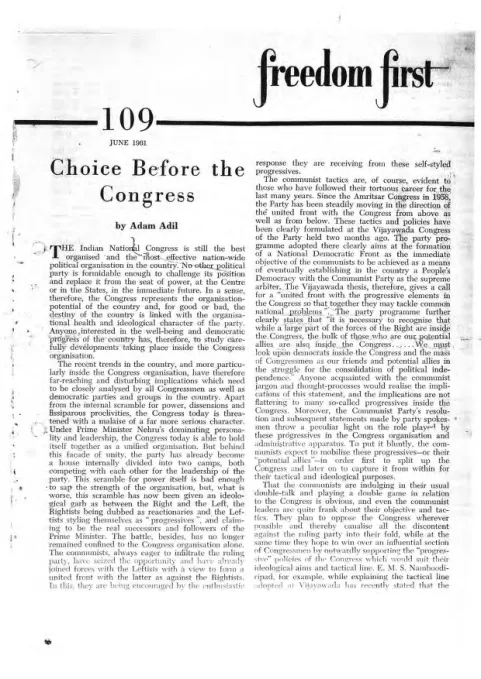
Freedom First
Freedom First, C/o Democratic Research Service, 127, Mahatma Gandhi Road, Bombay 1 (colophon, faint: '...by V. B. Karnik at 127, Mahatma Gandhi Road ... Printed at ... 55 Gandhi Road, Bombay') · Bombay · 1970
12 pages
Freedom First
Summary
Freedom First issue 215 (April 1970) opens with M. R. Masani’s parliamentary critique of the Union Budget, arguing that two decades of planning have left India economically stagnant and that the new budget’s excise levies, railway freight hikes, and deficit financing will fall hardest on the poor while doing nothing to genuinely diffuse economic ownership. Adam Adil’s piece on Laos and Cambodia surveys Communist North Vietnamese and Pathet Lao advances on the Plain of Jars and the fall of Prince Norodom Sihanouk in Cambodia, arguing that Asian democracies bear a duty to resist Communist infiltration in South-East Asia. Jayaprakash Narayan contributes a reflective essay on the limits of state power in engineering social change, calling for revived people’s initiative (jana shakti) along Gandhian lines and proposing constitutional and administrative reforms. B. N. Datar reviews Christopher Mayhew’s book Party Games on the British Labour Party. An unsigned contributed piece details cost overruns, delays, and design disputes plaguing Soviet-aided industrial projects in India (Bokaro, Ranchi, Durgapur, and the IDPL pharmaceuticals plant). The Review section covers three books: Chanchal Sarkar’s collection of essays on the Indian press and mass media, a booklet surveying world Communist parties, and Mulk Raj Saraf’s Jammu and Kashmir Guide 1969. The issue closes with the recurring ‘With Many Voices’ column of press quotations from Indian public figures on contemporary politics.
Key points
-
M. R. Masani’s “Let Us Modernise Our Thinking,” a parliamentary budget speech, attacks twenty years of planning for stagnant per capita income and argues state-sector investment returns only 2 paise per rupee against 7 paise in the private sector.
-
Adam Adil’s “Laos & Cambodia” surveys North Vietnamese and Pathet Lao advances on the Plain of Jars and the coup against Prince Norodom Sihanouk, arguing Asian democracies bear primary responsibility for resisting Communist infiltration in South-East Asia.
-
Jayaprakash Narayan’s “Some Suggestions” argues genuine social change requires revived jana shakti (people’s power) along Gandhian lines rather than top-down state planning, and proposes a Constitutional Council to bind Centre-state disputes.
-
B. N. Datar reviews Christopher Mayhew’s Party Games on the British Labour Party’s shift from 1930s utopian socialism to 1960s pragmatism, and Mayhew’s finding that MPs cannot effectively influence the executive.
-
An unsigned contributed piece catalogues cost overruns and delays at Soviet-aided projects including Bokaro, whose completion slipped from 1968 to 1973 with costs rising to about Rs. 800 crores, and IDPL’s “huge loss” from unsuitable Soviet-supplied design.
-
Arvind A. Deshpande reviews Chanchal Sarkar’s Challenge and Stagnation on the Indian mass media, endorsing its harsh diagnosis and proposal to treat newspapers as a public utility.
-
The closing “With Many Voices” column includes inflammatory quotes from West Bengal politicians Harekrishna Konar and Ajoy Mukherjee and Guru Golwalkar’s remark equating secularism with being a “staunch Hindu.”
Essays
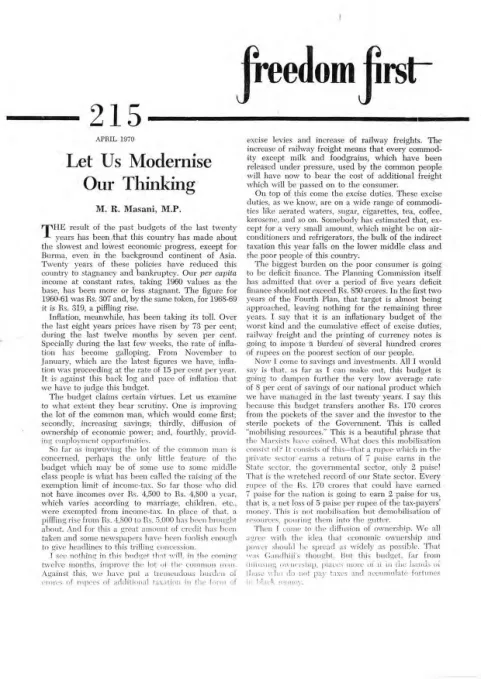
Let Us Modernise Our Thinking
By M. R. Masani, M.P.
M. R. Masani, M.P., delivers a parliamentary speech attacking the Union Budget as a continuation of twenty years of stagnation-inducing planning. He argues per capita income has barely risen since 1960-61 while inflation has surged (73 per cent over eight years, 15 per cent annualised in the most recent months), and that the budget’s excise duties and railway freight increases will burden the poor and lower middle class, that deficit financing is approaching the Planning Commission’s own five-year ceiling within two years, and that the budget will further depress India’s already low savings rate by diverting Rs. 170 crores from private investment (earning 7 paise per rupee) into unproductive state-sector use (2 paise per rupee). He mocks Indira Gandhi’s self-description as ‘forward looking,’ accusing her and her circle of a dated 1930s Cambridge Marxism out of step with modern European social democracy, quoting the West German SPD’s programme favouring free markets and competition. He closes by quoting I. K. Gujral’s (rendered as ‘B. K. Nehru’ in the text) view on the changed nature of modern wealth.
- Argues twenty years of Indian economic policy produced the slowest growth in Asia outside Burma
- Cites per capita income stagnation (Rs. 307 in 1960-61 to Rs. 319 in 1968-69) and rising inflation (73% over eight years)
- Criticises the budget’s excise duties and rail freight hikes as regressive, hitting the poor hardest
- Argues deficit financing is nearing the Planning Commission’s five-year Rs. 850 crore ceiling far too early in the Fourth Plan
- Contends state-sector investment returns only 2 paise per rupee versus 7 paise in the private sector, calling this ‘demobilisation’ not ‘mobilisation’ of resources
- Accuses Indira Gandhi of outdated 1930s-vintage Marxist thinking, contrasting with modern West German and Swedish social democracy
- Calls on the Prime Minister to ‘modernise her own thinking’ before she can modernise the country
Laos & Cambodia-Communist Infiltration
By Adam Adil
Adam Adil surveys the deteriorating military and political situation in Laos and Cambodia in early 1970. He describes North Vietnamese and Pathet Lao forces overrunning the Plain of Jars and threatening Vientiane and Luangprabang, with particular danger to Sam Thong (US aid headquarters) and Long Cheng (a secret CIA-run guerrilla base). He notes Hanoi’s strategic interest in securing a buffer zone and protecting the Ho Chi Minh Trail. Turning to Cambodia, he describes the overthrow of Prince Norodom Sihanouk while abroad in Moscow, replaced by a government under General Lon Nol that adopted an anti-Vietnamese, anti-Chinese stance and sought the return of the International Control Commission to oversee withdrawal of North Vietnamese and Viet Cong forces. The author argues America’s declared troop withdrawal from Vietnam and the East-of-Suez pullback raise the question of whether South-East Asian democracies will be left exposed, and calls on Asian democracies (Japan, India, Ceylon, Malaysia) to take up the primary responsibility of resisting Communist aggression in the region.
- Details Communist advances on the Plain of Jars and threats to Vientiane and Luangprabang
- Identifies Sam Thong and Long Cheng as strategically critical US/CIA-linked sites in Laos
- Describes the coup against Prince Norodom Sihanouk and the new Lon Nol government’s anti-Vietnamese stance
- Notes Cambodia’s appeal to reconvene the International Control Commission, with Russia and Poland as complicating factors
- Frames the primary duty of resisting Communist aggression in South-East Asia as belonging to Asian democracies, not just the US and Britain
Some Suggestions
By Jayaprakash Narayan
Jayaprakash Narayan reflects on India’s twin problems of change and development, arguing that a mistaken notion that these can be achieved through state power alone has persisted since independence. He credits Gandhiji with recognising the limits of state power and championing jana shakti (people’s power), noting that pre-British India possessed self-reliant village institutions, panchayats, guilds, and religious-educational institutions that British rule undermined. Narayan argues that genuine change requires persuasion and awakened popular initiative rather than commands, laws, or top-down planning, citing the failure of community development schemes as evidence that imposed cooperation cannot substitute for aroused local initiative. He warns that without accelerated growth, India’s population (540 million) will reach 665 million by 1980 and unemployment will double to 27 million by the end of the Fourth Plan. He then proposes concrete political and constitutional reforms: an amendment to the People’s Representation Act via a high-power committee, addressing political instability through a Constitutional Council empowered to bind disputes between states and Centre (amending Article 263), reviving proposals for an advisory President’s Council, administrative reform to end the cycle of shelved committee reports, and state-level autonomous industrial and agricultural development corporations insulated from political patronage.
- Identifies a persistent mistaken notion that state power alone can effect social change and development
- Credits Gandhiji with the concept of jana shakti (people’s power) as a needed complement to state power
- Describes pre-British India’s self-governing village institutions, guilds, and religious-educational bodies as later weakened under British rule
- Argues genuine change requires persuasion and grassroots initiative, not commands, citing failed community development schemes
- Warns of population growth to 665 million by 1980 and unemployment doubling to 27 million by the end of the Fourth Plan
- Proposes a high-power committee to amend the People’s Representation Act ahead of the next general elections
- Calls for a binding Constitutional Council (amending Article 263) to settle Centre-state disputes, distinct from an advisory President’s Council
- Proposes autonomous, patronage-free state industrial and agricultural development corporations
Task Of Radicalism (review of ‘Party Games’ by Christopher Mayhew, M.P.)
By B. N. Datar
B. N. Datar reviews Christopher Mayhew’s book Party Games, a semi-autobiographical account by a British Labour politician examining what the Labour Party sought to achieve before the war versus what it achieved in power, and the differences between Labour and the Tories. Datar traces Mayhew’s intellectual formation (including the influence of G. D. H. Cole), his rejection of the Russian model, his critique of race relations in the USA, and his account of Labour’s shift from 1930s utopianism to 1960s pragmatism as living standards rose and old appeals to socialism lost their force. The review highlights Mayhew’s conclusion that MPs cannot effectively influence the executive or represent constituents’ views, his examination of alternatives including a third party or an American-style presidential executive, and his diagnosis of five defects in Britain’s development (neglect of the human factor in technological change, stress from artificial consumer demand, exacerbated grievance, delinquency, and neglected mental health). Datar concludes that Mayhew’s central theme—the recasting of conventional attitudes—constitutes ‘the task of radicalism today.’
- Mayhew’s book is a semi-autobiographical account of the British Labour Party’s aims versus its record in power
- Traces Mayhew’s formation under G.D.H. Cole and his rejection of the Russian model and race relations in the USA
- Describes the generational shift in the Labour Party from 1930s utopian socialism to 1960s pragmatism amid rising living standards
- Cites Mayhew’s finding that MPs cannot effectively influence the executive nor adequately represent constituents
- Notes Mayhew’s five diagnosed defects in Britain’s post-war development, including neglect of the human factor in technology and rising mental illhealth
- Datar frames ‘recasting of conventional attitudes’ as the shared task facing Britain and, implicitly, other democracies
Soviet-Aid Projects
By (Contributed)
This contributed, unsigned piece catalogues cost overruns, delays, and design controversies at Soviet-aided industrial projects in India. The Bokaro steel plant has suffered its fourth major delay since 1964, with the first-stage completion date now pushed to early 1973 from an original 1968 target, and costs rising from an estimated Rs. 590 crores to around Rs. 800 crores. The piece details disputes over Soviet insistence on full managerial control, rejection of Indian-produced refractories, and criticism from Professor K. V. Subrahmanyam that Soviet policy is ‘derogatory to the self-respect of the country.’ It further reports under-utilisation and demand miscalculation at the Ranchi Heavy Engineering Corporation and Durgapur Mining and Allied Machinery Corporation, and a parliamentary inquiry finding ‘huge loss’ at the Indian Drugs and Pharmaceuticals Ltd. (IDPL) plant due to unsuitable design, second-hand equipment, and vastly overestimated demand for tetracycline-group drugs, with the Soviets also accused of ‘tremendous’ under-estimation of production costs (citing Vitamin B1 estimated at Rs. 100/kg versus an actual Rs. 1,200/kg).
- Bokaro steel plant delayed a fourth time; completion pushed from 1968 to early 1973, costs risen from Rs. 590 crores to about Rs. 800 crores
- Dispute over Soviet Union’s insistence on full managerial control and rejection of Indian-made refractories for coke ovens
- Professor K. V. Subrahmanyam criticises Soviet aid policy as reducing Indian industry to ‘a satellite of its Russian counterpart’
- Ranchi (Heavy Engineering Corporation) and Durgapur (Mining and Allied Machinery Corporation) projects show serious under-utilisation from overestimated demand
- Parliamentary inquiry into IDPL found a ‘huge loss’ from faulty equipment, unsuitable designs, delays, and possibly second-hand plant built for China
- Soviet cost estimates for Vitamin B1 (Rs. 100/kg estimated vs Rs. 1,200/kg actual) cited as evidence of gross under-estimation
Review: Challenge and Stagnation (review of Chanchal Sarkar, Vikas Publications)
By ARVIND A. DESHPANDE
Arvind A. Deshpande reviews Chanchal Sarkar’s Challenge and Stagnation (Vikas Publications), a collection of lectures and essays on the Indian mass media. The review endorses Sarkar’s harsh diagnosis that the Indian press suffers from ‘heavy blindness, creeping paralysis, gutless, imbecile apathy and obsessive neurosis,’ noting the stark gap between India’s 158 million literates and its mere 6.5 million newspaper circulation. It highlights Sarkar’s critique of All India Radio’s news presentation and his profile of the decline of editor K. Rama Rao, along with Sarkar’s proposal to treat newspapers as a public utility akin to roads and electricity, including subsidising newspaper access for schoolteachers. Deshpande praises the book as rewarding despite some structural padding, and hopes for a cheaper edition.
- Reviews Chanchal Sarkar’s Challenge and Stagnation, a collection on the Indian mass media
- Cites the gap between 158 million Indian literates and a newspaper circulation of only 6.5 million
- Highlights Sarkar’s harsh diagnosis of the Indian press as suffering multiple ‘diseases’
- Notes the book’s critique of All India Radio’s news presentation and profile of editor K. Rama Rao’s decline
- Highlights Sarkar’s proposal to treat newspapers as a public utility, including subsidised access for schoolteachers
- Recommends the book to all thinking citizens and hopes for a cheaper edition
A Survey of the World Communist Parties (review of booklet, Free News and Feature Service)
By K. V. B.
A short unsigned notice (initialled K. V. B.) describes a booklet, A Survey of the World Communist Parties, published by the Free News and Feature Service, itself an Indian edition of a booklet from the International Documentation and Information Centre in The Hague. The booklet covers ninety-nine Communist parties worldwide, fourteen of them ruling and the rest in opposition (some illegal), giving membership figures, leader names, and party journal titles for each.
- Reviews A Survey of the World Communist Parties, an Indian edition of a Hague-based International Documentation and Information Centre booklet
- Covers 99 Communist parties worldwide, 14 ruling and the remainder in opposition or illegal
- Provides membership figures, leadership, and party journal names for each listed party
- Recommended as useful to students of communist affairs in India
Jammu and Kashmir Guide 1969 (review, edited by Mulk Raj Saraf, Universal Publication)
By V. K. KARKARIA
V. K. Karkaria reviews Jammu and Kashmir Guide 1969, edited by Mulk Raj Saraf, a 500-page reference volume covering the state’s economic, historical, and political development through short articles, tables, indices, and a ‘Who’s Who’ chapter. The review finds the book valuable as a mine of information but criticises its bulk (recommending thinner paper) and faults it for lacking a dedicated chapter on tourism, arguably Kashmir’s most important trade. Karkaria attributes the state’s underdevelopment to a lack of large industries, raw materials, coal, electricity, and private investment, arguing investment will only flow once political instability recedes. The review calls the book a commendable effort better suited as a trade directory than a tourist guide.
- Reviews Mulk Raj Saraf’s edited Jammu and Kashmir Guide 1969, a 500-page reference volume
- Praises its coverage of economic, historical, and political development via short articles, tables, and a Who’s Who chapter
- Criticises the absence of a dedicated tourism chapter despite tourism’s importance to the state’s economy
- Attributes Kashmir’s underdevelopment to lack of industry, raw materials, and investment tied to political instability
- Concludes the book functions better as a trade directory than a tourist guide
With Many Voices (miscellany of quoted press excerpts)
The issue closes with ‘With Many Voices,’ a recurring column of press quotations from Indian political and public figures dated between February and March 1970, prefaced by a Tennyson epigraph. The quotations touch on West Bengal political violence (Harekrishna Konar, Ajoy Mukherjee), campus politics at BHU, Congress splits, secularism and Hindu identity (Guru Golwalkar), Prince Norodom Sihanouk’s balancing diplomacy shortly before his overthrow, and criticisms of India’s constitution and caste in politics.
- Recurring press-quotations column titled ‘With Many Voices’, prefaced with a Tennyson epigraph
- Includes inflammatory quotes from West Bengal politicians Harekrishna Konar and Ajoy Mukherjee on land seizure and violence
- Includes Guru Golwalkar’s remark equating secularism with being a ‘staunch Hindu’
- Includes Prince Norodom Sihanouk’s own description of his political manoeuvring, shortly before his overthrow (covered in the Adam Adil article)
- Includes C. Rajagopalachari’s and others’ comments on Indian political instability and constitutional design
Generated by the v1.5 extraction pipeline. Awaiting editorial review.
Metadata and summary are AI-extracted from the source PDF and reviewed for editorial accuracy. The original work is available via the Read PDF tab above (where present); paragraph-level citation inside the PDF is deferred to a future engagement.