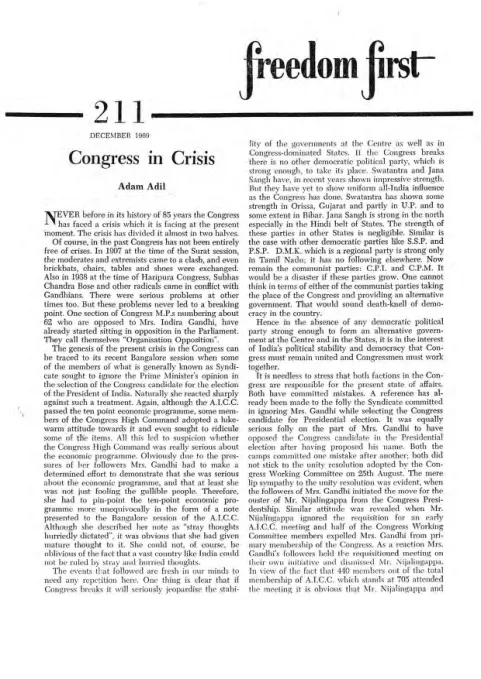
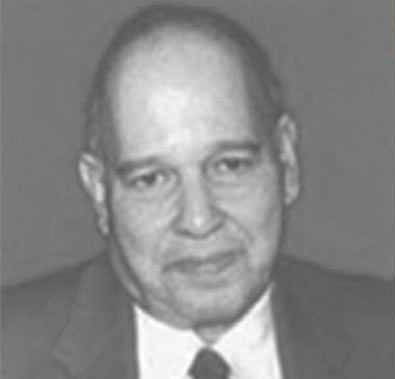
periodical issue
Freedom First
By M. R. Pai
Edited and published for the Democratic Research Service by V. B. Karnik at 127 Mahatma Gandhi Road, Bombay 1, and printed by him at Inland Printers, 55 Gamdevi Road, Bombay 7. · Bombay · 1971
12 pages
Freedom First
Summary
This is the June 1971 issue (No. 229) of Freedom First, the monthly journal of the Democratic Research Service edited by V. B. Karnik. The issue is dominated by the unfolding crisis in East Pakistan: the lead article argues for international intervention in Bangla Desh on human-rights grounds, and a later ‘Without Comment’ item reproduces a US State Department official’s statement on the refugee crisis. Other contributors address Indian economic planning’s failures, press freedom and the government’s ambivalence toward a free press, a review-essay on the 1969 Congress split, and Cold War-inflected pieces on Soviet strategy in Sudan and the Rogers peace mission in the Middle East. The issue closes with the regular ‘With Many Voices’ page of press quotations.
Key points
-
V. B. Karnik’s “Non-Interference and Bangla Desh” argues the Panchsheel principle of non-interference has historically shielded atrocities and calls for economic sanctions against Pakistan rather than military intervention.
-
R. Muthuswamy’s “The Quest For Peace In Mid-east” traces the Rogers Plan and Sadat’s shift away from Soviet dependence, arguing reopening the Suez Canal offers the best route to a just Middle East peace.
-
M. R. Pai’s “Planning Plans” attacks the confusion and waste of India’s centralised planning, citing heavy losses at Hindustan Steel and other public-sector undertakings and warning of an eventual popular reckoning.
-
Ian Tickle’s “The Sudan In Soviet Strategy” argues Soviet aid to General Numeiry’s suppression of the southern rebellion reflects a calculated bid for Red Sea naval access rather than ideological sympathy.
-
Arvind A. Deshpande’s “Freedom Of The Press” warns that Indira Gandhi’s talk of a “committed” press threatens the ideal Nehru once championed, and reports the Working Journalists’ call to place PTI and UNI under independent statutory control.
-
M. D. Kini reviews Kuldip Nayar’s and Rajinder Puri’s books on the 1969 Congress split, faulting Indira Gandhi’s tactics against the “Syndicate” while judging the episode a poor reflection on Indian democratic norms.
-
A “Without Comment” item reproduces US Assistant Secretary of State Joseph Sisco’s statement praising India’s fifth national election and describing American support for East Pakistani refugee relief.
-
The closing “With Many Voices” page compiles press quotations on the Bangla Desh crisis, including C. Rajagopalachari questioning whether the Great Powers have abandoned South Asia to China.
Essays
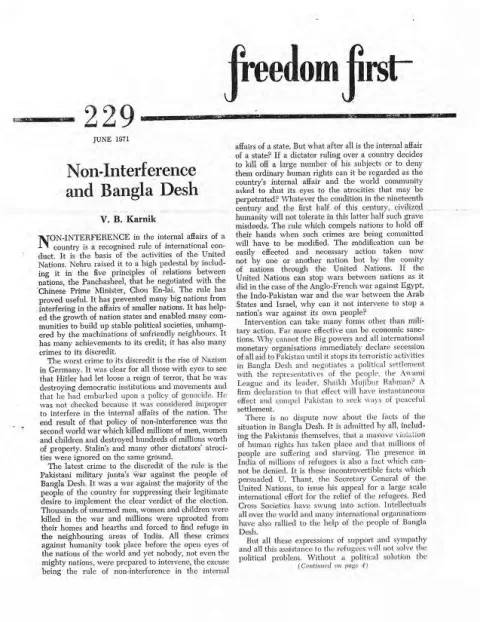
Non-Interference and Bangla Desh
By V. B. Karnik
V. B. Karnik argues that the international principle of non-interference in a state’s internal affairs, elevated by Nehru into the Panchsheel, has historically enabled great crimes—citing Nazi Germany and Stalin’s USSR—and is now shielding Pakistan’s military junta as it wages war on the people of Bangla Desh. He contends that mass killings, forced displacement of refugees into India, and suppression of an electoral verdict are matters the world community cannot treat as purely internal, and calls for economic sanctions (withdrawal of all aid to Pakistan) rather than military intervention to compel a negotiated political settlement with the Awami League and Sheikh Mujibur Rahman. The piece, continued from page 1 to page 4, closes by warning that a prolonged war of attrition will only deepen instability and that the comity of nations should not ignore the danger this poses to peace and freedom generally.
- The rule of non-interference in internal affairs, embodied in Nehru’s Panchsheel, has both protected small nations and shielded major atrocities (Nazi Germany, Stalin’s USSR).
- Pakistan’s military junta’s war against Bangla Desh is presented as the latest crime sheltered by this rule.
- Karnik calls for economic sanctions—withdrawal of all international aid to Pakistan—as a more effective and less violent form of intervention than military action.
- He notes UN Secretary-General U Thant’s appeal for international relief and the mobilisation of Red Cross societies and intellectuals worldwide.
- Without a political settlement, the presence of millions of refugees in India will become a permanent burden, and prolonged conflict risks turning into disruption and anarchy that threatens the wider region.
The Quest For Peace In Mid-east
By R. Muthuswamy
R. Muthuswamy surveys the diplomatic history of Middle East peace efforts since 1969, from the American ‘Rogers plan’ calling for Israeli withdrawal from occupied territories, through the U.N.-mediated Jarring mission, to the change of leadership in Egypt following Nasser’s death. He argues that Sadat’s foreign policy marks a genuine, if incomplete, shift away from Soviet dependence, citing Sadat’s overtures on recognising Israel and reopening the Suez Canal, and his removal of pro-Moscow figures such as Vice-President Ali Sabri. The essay concludes that reopening the Suez Canal is the best available route to a just Mid-East peace, though Israel’s objections centre on preventing renewed Egyptian military use of the vacated east bank.
- Since February 1969 the four big powers have sought a solution to the Israeli-Arab conflict; the 1969 American ‘Rogers plan’ called for Israeli withdrawal from six-day-war territories in exchange for Arab peace guarantees.
- The plan was rejected by the Soviets as ‘pro-Israeli’ and stalled further amid Soviet military buildup in Egypt and Palestinian hijackings.
- Sadat’s succession after Nasser’s death brought a notable shift: willingness to recognise Israel’s right to exist and reopen the Suez Canal as an international waterway in return for territorial withdrawal.
- Sadat dismissed pro-Moscow Vice-President Al Sabri and other ministers, suggesting an effort to reduce Soviet influence over Egypt.
- The author frames Suez’s reopening as economically vital for Egypt and strategically significant for Soviet naval ambitions in the Indian Ocean, while Israel’s core objection is to potential renewed military use of the canal’s east bank.
Planning Plans
By M. R. Pai
M. R. Pai attacks the confusion and waste in India’s centralised economic planning, opening with the bureaucratic muddle over whether the Planning Commission has been abolished, downgraded, or upgraded following an ordinance transferring its functions to a new Planning Ministry. He argues that centralised, comprehensive planning fails both because it violates market laws that reflect human nature and because, in a democratic setup, it cannot be enforced without the coercive apparatus (rationing, restriction on criticism, suppression of press and property rights) that authoritarian systems use. Pai catalogues large losses at public-sector undertakings (Hindustan Steel, Bhopal Heavy Electricals, Machinery and Allied Mining Corporation) and state-government waste, and closes by warning that continued mismanagement is producing a crisis that will eventually force a reckoning against the political and bureaucratic class responsible.
- A political dispute over control of the Planning Commission—variously described by President Giri, PM Indira Gandhi, and the new Planning Minister as demoted, undiminished, or upgraded—exemplifies the incoherence of Indian planning.
- Pai distinguishes legitimate planning (assessing both financial and administrative capacity) from the Indian government’s overreach into comprehensive, centralised control of the economy.
- Centralised planning fails for two reasons: it defies market forces rooted in human nature, and in a democracy it cannot be enforced without curbing civil liberties, the press, the judiciary, and property rights the way communist states do.
- Cites specific losses: Hindustan Steel’s accumulated losses sufficient to fund half of another steel plant, Machinery and Allied Mining Corporation’s wiped-out Rs. 20 crore capital, and Bhopal Heavy Electricals’ Rs. 57 crore losses, plus wasteful state schemes (a Gujarat textbook costing Rs. 65,500, a Maharashtra poultry plant losing Rs. 11 lakhs).
- Warns that inflation and licensing-driven corruption benefit a small class of politicians, bureaucrats, and ‘corrupt business men’ at the expense of the landless and fixed-income middle classes.
- Predicts that unless this managerial incompetence is checked, Indian planning will end in a crisis and an ‘epitaph…written with the tears of politicians whom no one will be able to save from the fury of the masses.‘
The Sudan In Soviet Strategy
By Ian Tickle
Ian Tickle analyses growing Soviet influence in the Sudan, arguing that Moscow’s large-scale aid to General Numeiry’s regime in crushing the southern rebellion is driven not by sentiment but by strategic calculation, as the Soviets seek naval and base access on the Red Sea and Indian Ocean to complement their established position in Egypt. He situates this within a broader Soviet-Chinese rivalry for influence over African liberation movements, notes that President Sadat’s moves toward peace with Israel and away from Soviet dependency have made Egypt a less reliable client, and observes that the Sudan itself supports secessionist movements in Chad and Ethiopia even as it suppresses its own southern rebellion—a contradiction the author frames as driven by pan-Arab strategic interest rather than principle.
- Soviet aid to Sudan’s military ruler General Numeiry to suppress the southern rebellion reflects a calculated strategic move to establish Red Sea/Indian Ocean bases rather than genuine friendship.
- Soviet influence in Egypt has grown since the 1967 war through military and technical aid, but President Sadat’s peace overtures toward Israel represent a deliberate effort to reduce Soviet dependency.
- The Soviet Union has been outflanked in Africa by China’s support for guerrilla movements, prompting a renewed, selective Soviet courtship of ‘revolutionary-democratic’ parties, evidenced by a Moscow-published book on ‘Political Parties of Africa.’
- The Sudan offers the USSR valuable strategic value on the Red Sea, complementing existing Soviet access at Aden and Socotra, making it comparably important to Egypt in oceanic strategy.
- Despite suppressing its own southern black African rebellion, the Sudanese regime supports secessionist movements (FROLINA in Chad, Eritrean liberation forces) elsewhere, a contradiction the article attributes to pan-Arabist strategic calculation rather than to disapproval of secession as such.
- The Numeiry regime has survived ten coup attempts and, per the author, owes its survival and the trajectory of Sudanese politics to Soviet aid and infiltration.
Freedom Of The Press
By Arvind A. Deshpande
Arvind A. Deshpande, invoking Nehru’s stated preference for a completely free press over a suppressed one, warns that recent statements by the Prime Minister and the Union Minister of State for Information about a ‘committed’ press signal a drift away from the ideal of an unqualified free press. He surveys competing definitions of press ‘commitment,’ criticises the Prime Minister’s complaints that the press is out of touch with rural India and gave insufficient coverage to development news, and argues such failings reflect low literacy and circulation rather than press bias—citing comparative circulation figures showing India’s newspapers reach only 15 per 1000 population versus much higher figures in Japan, the UK, USA, USSR and Sweden. He reports on the Indian Federation of Working Journalists’ conference in Gandhinagar, which called for transferring PTI and UNI management to statutory corporations free of government control, and concludes that experimentation and voluntary reform of ownership patterns, not government interference, should guide any changes to safeguard editorial freedom.
- Deshpande opens with Nehru’s stated preference for a ‘completely free Press, with all the dangers involved in the wrong use of that freedom’ over a suppressed or regulated one.
- He argues that talk of a ‘committed’ press by the Prime Minister and the Union Minister of State for Information signals a troubling departure from this ideal, given ambiguity over what ‘commitment’ means.
- The Prime Minister’s criticisms—that the press gave only 5% of news space to development news and was urban-oriented—are contrasted with the press’s poor prediction of the 1971 parliamentary election result.
- India’s newspaper circulation, at roughly 15 copies per 1000 population, lags far behind Japan (469), UK (479), USA (310), USSR (264) and Sweden (505), which the author attributes to low literacy and reading habits rather than press failure.
- The Indian Federation of Working Journalists’ conference in Gandhinagar urged transferring management of PTI and UNI, and major newspaper groups, to statutory corporations independent of both industrial owners and government control.
- Deshpande concludes that new patterns of ownership should evolve through voluntary experimentation, not government interference, to protect editorial freedom and democracy itself.
Seven Months That Shook India
By M. D. Kini
M. D. Kini reviews two recent books on the 1969 Congress split — Kuldip Nayar’s ‘India: The Critical Years’ and Rajinder Puri’s ‘A Crisis of Conscience’ — praising Nayar’s decade-spanning diary-based account and Puri’s sharp character sketches of the era’s leading political figures (Nijalingappa, Morarji Desai, Kamaraj, Chavan, and Indira Gandhi). The essay narrates the crisis chronologically from the contested Presidential nomination following Zakir Husain’s death through Mrs. Gandhi’s bank nationalisation, the expulsion of dissenters, and the final Congress split, drawing extensively on Nayar’s reporting of Congress Working Committee and Parliamentary Board proceedings. Kini closes with a critical assessment finding fault with both Mrs. Gandhi’s conduct (threats against colleagues, capture of the party organisation) and her opponents’, concluding that the episode reflects poorly on Indian democratic norms and evokes the legacy of Tilak, Gandhi, Nehru and Patel.
- Reviews two books on the 1969 Congress crisis: Kuldip Nayar’s diary-based ‘India: The Critical Years’ and Rajinder Puri’s ‘A Crisis of Conscience,’ the latter praised for its sharp personality assessments.
- Recounts the presidential succession dispute after Zakir Husain’s death, Mrs. Gandhi’s push for her own nominee (Mr. Reddy vs. Sanjiva Reddy per the Congress Parliamentary Board) against the ‘Syndicate.’
- Details Mrs. Gandhi’s sudden nationalisation of fourteen major banks by ordinance and her removal of Morarji Desai from the Finance Ministership within days.
- Chronicles the organisational battle: expulsion/suspension moves against Arjun Arora, Fakhruddin Ali Ahmed, and C. Subramaniam, Mrs. Gandhi’s suspension from primary Congress membership, and the final Congress Parliamentary Party vote of confidence in her.
- Kini’s concluding assessment is critical of both sides, faulting Mrs. Gandhi’s tactics (threats, capturing the organisation, filing nomination papers while opposing colleagues) and asserting that the episode did not enhance democratic norms.
- The essay ends by contrasting the party’s rapid unraveling in under seven months with its founding and consolidation over seven decades by leaders such as Tilak, Gandhi, Nehru and Patel.
Without Comment (American View)
This ‘Without Comment’ item reproduces, without editorial gloss, a statement by Mr. Joseph J. Sisco, US Assistant Secretary of State for Near Eastern and South Asian Affairs, delivered before the Foreign Affairs Committee of the US House of Representatives on the situation in India, Pakistan, and Ceylon. Sisco praises India’s fifth national election as a democratic achievement, notes India’s expanded regional role including aid to Ceylon against insurgents, and expresses American concern over the internal conflict in Pakistan and its impact on India-Pakistan relations, describing US support for UN High Commissioner-organised relief efforts for East Pakistani refugees in India.
- Joseph J. Sisco, US Assistant Secretary of State for Near Eastern and South Asian Affairs, praised India’s successful conduct of its fifth national election as a democratic achievement.
- He noted India’s more active regional role, including assistance to Ceylon in dealing with insurgents.
- Sisco described the internal conflict in Pakistan (East Bengal) as having impaired institutional capacity and worsened India-Pakistan relations.
- The US stated it had taken the lead in supporting the UN High Commissioner for Refugees’ international relief effort for refugees fleeing East Pakistan to India.
- The statement is presented ‘without comment’ by Freedom First, as sourced from UNI (United News of India).
With Many Voices
The closing ‘With Many Voices’ page compiles brief press quotations from Indian and international commentators on the Bangla Desh crisis, Cold War diplomacy, the Congress party, and press freedom, framed by an epigraph from Tennyson. Quoted sources include Time, The Economist, C. Rajagopalachari writing in Swarajya, K. Santhanam, Rajinder Puri, and Durga Das, alongside a subscription coupon for Freedom First and the issue’s colophon naming V. B. Karnik as editor and publisher for the Democratic Research Service.
- A compilation of short press quotations under the recurring ‘With Many Voices’ feature, opened with an epigraph from Tennyson.
- Quotations touch on the Bangla Desh crisis (‘the issue is mankind versus Islamabad’ — Thought; ‘If Bangla Desh is alive at all, it is living in West Bengal’ — The Economist), superpower diplomacy, and Indian politics.
- C. Rajagopalachari is quoted from Swarajya questioning whether the Great Powers have left South Asia to ‘the tender mercies of Mao Tse-tung.’
- The page includes a subscriber coupon (annual subscription Rs. 5.00) addressed to Freedom First, c/o Democratic Research Service, 127 Mahatma Gandhi Road, Bombay 1.
- The colophon records that the issue was edited and published for the Democratic Research Service by V. B. Karnik at 127 Mahatma Gandhi Road, Bombay 1, and printed at Inland Printers, 55 Gamdevi Road, Bombay 7; Registered No. MH 272.
Generated by the v1.5 extraction pipeline. Awaiting editorial review.
Metadata and summary are AI-extracted from the source PDF and reviewed for editorial accuracy. The original work is available via the Read PDF tab above (where present); paragraph-level citation inside the PDF is deferred to a future engagement.