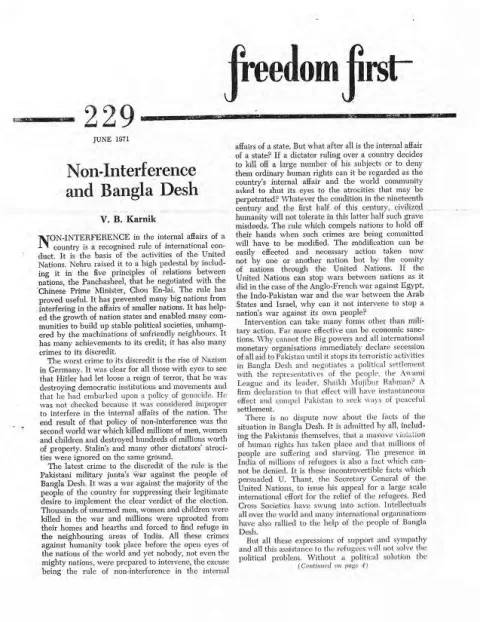
periodical issue
Freedom First
By V. B. Karnik, R. Muthuswamy, M. R. Masani, A. B. Shah, Abraham Brumberg, V. B. Patankar, N. J. Tavaria
Edited and published for the Democratic Research Service by V. B. Karnik at 127 Mahatma Gandhi Road, Bombay 1, and printed by him at Inland Printers, 55 Gamdevi Road, Bombay 7. · Bombay · 1971
12 pages
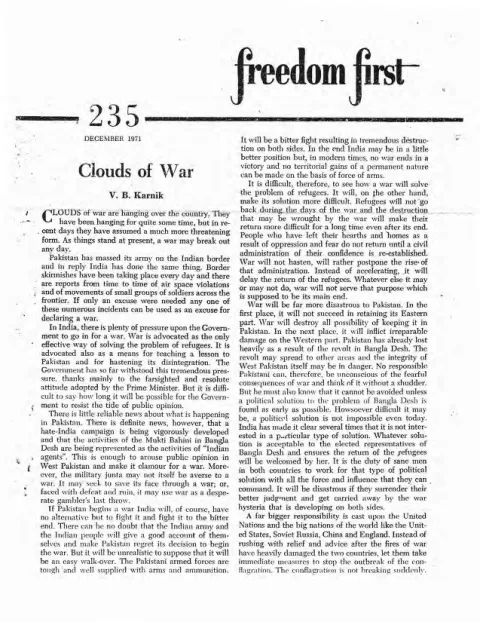
Freedom First
Summary
Freedom First issue 235 (December 1971) appeared on the eve of the India-Pakistan war, and its lead pieces are dominated by that crisis. V. B. Karnik’s opening editorial-essay ‘Clouds of War’ surveys the massing of troops on the border, the refugee crisis from East Pakistan, and argues that war will not solve the underlying political problem of Bangla Desh, urging a negotiated settlement backed by international pressure. The issue also carries an editorial tribute to the late correspondent K. K. Sinha, a set of unsigned ‘Notes’ on Ruling Congress violence in Delhi, the banning/delay of books by Customs authorities, and prospects for Sino-Indian normalisation, plus a report on a Delhi seminar (sponsored by the Indian Liberal Group) opposing proposed press-ownership legislation. R. Muthuswamy analyses factional strain inside the CPM ahead of its Madurai party congress. M. R. Masani’s ‘The End of The U.N.?’ attacks the UN’s expulsion of Taiwan and admission of Communist China as a moral and strategic catastrophe. An extract from an Observer interview with World Bank president Robert McNamara covers global population growth. A. B. Shah’s ‘The Meaning of Jodhpur’ uses an attack on Vice-Chancellor V. V. John by engineering students to argue for the independence of Indian universities from government and populist pressure. Abraham Brumberg reviews Andrei Amalrik’s Involuntary Journey to Siberia, and V. B. Patankar reviews a small biographical volume on Gandhi. The issue closes with a reader’s letter on Indo-US relations and the ‘With Many Voices’ page of quoted commentary from the world press.
Key points
-
V. B. Karnik’s “Clouds of War” surveys the India-Pakistan standoff on the eve of war, arguing conflict will not solve the Bangla Desh refugee crisis and urging international pressure toward a negotiated settlement.
-
An editorial tribute mourns Freedom First correspondent K. K. Sinha, while a report on an Indian Liberal Group seminar records unanimous opposition to proposed press-ownership-diffusion legislation.
-
Unsigned “Notes” condemn Ruling Congress violence in Delhi, the year-long Customs delay in releasing Ved Mehta’s “Portrait of India”, and cautiously welcome signs of a Sino-Indian thaw.
-
R. Muthuswamy’s “C.P.M. In Wilderness” analyses the party’s isolation ahead of its Madurai congress and its double-faced strategy of public moderation alongside cadre-driven agitation.
-
M. R. Masani’s “The End Of The U.N.?” attacks the expulsion of Taiwan and admission of Communist China as a moral and strategic catastrophe comparable to the League of Nations’ collapse over Abyssinia.
-
An extract from an Observer interview with World Bank president Robert McNamara warns developing-world population could reach 14,500 million even under an optimistic fertility scenario.
-
A. B. Shah’s “The Meaning Of Jodhpur” uses the attack on Vice-Chancellor V. V. John to argue for financially independent universities insulated from populist and political pressure.
-
Abraham Brumberg reviews Andrei Amalrik’s “Involuntary Journey to Siberia” on rural Soviet servitude, and a further review recalls Gandhi’s humility through U. R. Rao’s reminiscences, while a reader’s letter on Indo-US relations and “With Many Voices” close the issue.
Essays
Clouds of War
By V. B. Karnik
V. B. Karnik’s ‘Clouds of War’ surveys the deteriorating India-Pakistan standoff of late 1971: troop mobilisation on the border, skirmishes, and the domestic pressure on the Indian government to go to war as a way of resolving the refugee crisis and ‘teaching Pakistan a lesson.’ Karnik argues that war would be catastrophic for both sides, especially Pakistan, and that it would not solve but rather delay the return of refugees, since resettlement requires a restored civil administration that war destroys. He calls for a political solution to the Bangla Desh question, urges the United Nations and major powers to intervene with relief and pressure rather than wait for war to break out, and credits the Indian government’s restraint and the Prime Minister’s diplomacy for holding the line against war fever so far.
- Describes troop build-ups, border skirmishes, and air-space violations between India and Pakistan as war clouds gathering by December 1971.
- Notes domestic Indian pressure to go to war framed as the only way to solve the refugee problem and to punish/dismember Pakistan.
- Argues war will not solve the refugee crisis: refugees will not return during wartime destruction, and war delays rather than hastens restoration of civil administration.
- Predicts war would be disastrous for Pakistan, destroying any chance of retaining its Eastern part and endangering the West as well.
- Calls on the UN, US, USSR, China and Britain to intervene with relief and diplomatic pressure to avert war and secure a political settlement acceptable to elected Bangla Desh representatives.
- Credits the Indian Prime Minister’s ‘farsighted and resolute attitude’ for the government’s restraint against public pressure toward war so far.
Essay 2
An unsigned editorial tribute, signed ‘Editor’, mourning the death of K. K. Sinha, a Freedom First correspondent from Calcutta killed in a car accident near Kharagpur. It recalls Sinha’s long career writing on Bengal politics for the magazine, his early association with the Radical Humanist movement and with M. N. Roy, and his work for democratic forces in Bengal.
- Reports the death of correspondent K. K. Sinha in a car accident near Kharagpur.
- Notes his extensive writing for Freedom First on Bengal’s political problems.
- States he was an early adherent of and close collaborator with ‘Mr. M. N. Roy’ in developing the Radical Humanist movement.
- Describes him as an ardent democrat who worked for the growth of democratic forces in Bengal.
Essay 3
A short unsigned report on a one-day seminar held at the India International Centre, New Delhi, on November 14, 1971, sponsored by the Indian Liberal Group (affiliated to Liberal International). Journalists and intellectuals agreed that proposed legislation to diffuse ownership of the press would harm rather than help press freedom, would damage well-organised newspapers, and bypassed the Press Council, which should instead investigate the matter before any legislation is considered.
- Reports unanimous agreement at the seminar that proposed press-ownership-diffusion legislation would be both unnecessary and undesirable.
- Argues the legislation would destroy better-organised newspapers and damage press freedom as a whole.
- Notes the Press Council was bypassed and should be asked to investigate before any legislation proceeds.
- Calls for owners, editors, and journalists to cooperate to maintain press independence and resist outside (including legislative) interference.
- Lists prominent participants including Frank Moraes, M. R. Masani, A. G. Noorani, Asok Chanda, Inder Jit, D. R. Mankekar, Asoka Mehta, A. D. Mani, R. Talib, V. M. Tarkunde, and B. R. Shenoy.
Essay 4
A set of three unsigned editorial ‘Notes.’ The first condemns violent seizure of Old Congress property at Jantar Mantar Road by Ruling Congress activists in Delhi as roundly condemned across public opinion, and warns that the Ruling Congress’s tolerance of unlawful methods damages its own reputation and democratic legitimacy. The second, ‘Banning of Books,’ criticizes Customs authorities for holding up Ved Mehta’s Portrait of India over objectionable content (quotations from Nehru, Radhakrishnan and Lal Bahadur Shastri, and a map) for nearly a year before release, and argues that book banning by Customs officers is an unjustifiable, colonial-era practice that should end; it also notes a similar case involving Daniel Loshak’s Pakistan Crisis. The third, ‘Sino-Indian Relations,’ welcomes signs of a thaw in China’s foreign policy and urges India to normalise relations with China cautiously, without abandoning vigilance over its own defences.
- Condemns Ruling Congress activists’ violent takeover of Old Congress property at Jantar Mantar Road as damaging to rule of law and party legitimacy.
- Criticizes the nearly year-long Customs delay in releasing Ved Mehta’s Portrait of India over ‘objectionable’ quoted statements and a map.
- Argues banning books via Customs officer discretion is a wrong, colonial-era practice that should end as early as possible.
- Cites a parallel case: pressure reportedly exerted on an Indian publisher to drop Daniel Loshak’s Pakistan Crisis.
- Welcomes signs of improving Sino-Indian relations following recent shifts in Chinese foreign policy, while cautioning against swinging to naive over-trust (‘Bhai-Bhaism’) and neglecting India’s defences.
C.P.M. In Wilderness
By R. Muthuswamy
R. Muthuswamy’s ‘C.P.M. In Wilderness’ analyses the Communist Party of India (Marxist) ahead of its December 1971 Madurai party congress. He traces internal disagreement over draft political resolution tactics, the party’s growing national and international isolation (having lost its trade-union allies to a CITU breakaway and lacking support from either the Soviet-aligned CPI or the Chinese-aligned Naxalites), and describes the party’s use of general strikes and agitation as a strategy to rebuild mass influence. He argues the party’s twin strategy is to appear moderate/progressive in public while retaining capacity to create trouble through cadre infiltration of other parties’ agitations.
- The CPM prepares for its Madurai party congress amid internal disagreement over tactics in the draft political resolution.
- The party has lost ground both nationally (isolation from Congress and rival communist factions) and internationally (no external patron among USSR-aligned CPI or China-aligned Naxalites).
- Describes formation of the breakaway Centre for Indian Trade Unions (CITU) under Mr. Ranadive after a split from AITUC.
- Recounts CITU’s role in recent Bombay textile and municipal transport strikes and a coordinated all-India one-day strike on 23 November.
- Argues the CPM pursues a double-faced strategy: creating trouble at various fronts while cultivating a public image of supporting progressive measures brought in by the ‘New Congress’.
- Notes that Mr. Namboodiripad (Kerala) and Mr. Jyoti Basu (West Bengal) both sought to build revolutionary potential and wreck parliamentary government while in office, alienating coalition partners.
The End Of The U.N.?
By M. R. Masani
M. R. Masani’s ‘The End of The U.N.?’ rebuts the three arguments advanced for admitting Communist China to the UN and expelling Taiwan: universality (which he says the UN Charter does not actually mandate, since membership requires being ‘peace-loving’), the claim that the Mao regime ‘represents’ 700 million Chinese (which he calls a monstrous perversion given the regime’s record of genocide in Tibet, extermination of millions, and a rising tide of people risking their lives to flee to Hong Kong), and the hope that UN admission will make the regime peaceable (contradicted, he argues, by the belligerent tone of Chinese statements at the UN itself). He blames President Nixon’s diplomatic reversal for the narrow 59-55 vote and describes the outcome as catastrophic on three counts: the expulsion of a founding, law-abiding member (Taiwan); the demoralising blow to mainland Chinese opposed to the regime; and the effective end of the UN as a meaningful peacekeeping body now that a hostile veto power sits on the Security Council, comparing the moment to the League of Nations’ collapse after failing to confront aggression in Abyssinia and elsewhere.
- Rebuts the ‘universality’ argument by citing the UN Charter’s requirement that members be ‘peace-loving States’.
- Cites Radio Moscow’s allegation that Chinese leaders exterminated 25 million of their own people, and reports of a sharp rise (16,500 in ten months) in Mainland Chinese fleeing to Hong Kong, as evidence against the claim the regime ‘represents’ its people.
- Argues post-admission statements by the Chinese UN representative show increased arrogance rather than any softening.
- Holds President Nixon and the US administration responsible for the narrow 59-55 vote after starting and failing to control the diplomatic ‘landslide’.
- Frames the vote as catastrophic in three ways: expelling founding member Taiwan, demoralising anti-regime Chinese on the mainland, and ending the UN’s credibility as a peacekeeping body now that China’s veto joins the Soviet veto.
- Draws an extended parallel to the League of Nations’ failure over the Italian invasion of Abyssinia and the Soviet attack on Finland, arguing appeasement of aggressors destroyed that body and could do the same to the UN.
Population Problem (extracts from an interview with Mr Robert McNamara, President of the World Bank, published in the Observer of London; interviewer Mr Frances Cairncross)
Extracts from a long Observer (London) interview conducted by Frances Cairncross with World Bank President Robert McNamara on the global population problem. McNamara warns that developing-world population, at roughly 2,000 million and growing 2.6% annually, could rise to 14,500 million before stabilising even under an optimistic scenario reaching replacement-rate fertility by 2040. He says population-planning programmes in most developing countries remain very weak (with Korea and Taiwan the main exceptions), that political acceptance of population control is spreading but far more action is needed, and that the World Bank advises but does not condition loans on a country’s adoption of population policy.
- McNamara states developing-world population (about 2,000 million, or 2,600 million counting mainland China) is growing about 2.6% annually, doubling in 25 years.
- Even reaching replacement-rate fertility (two children per couple) by 2040 would still let population rise to about 14,500 million before stabilising.
- Says only Korea and Taiwan among developing nations have shown significant results from population planning programmes; most others remain very weak.
- States about 25 developing nations now have official population planning programmes, which he calls immense progress but still far short of what’s needed.
- Confirms the World Bank does not make loans conditional on a country adopting an effective population policy, even where a government’s policy is clearly inadequate.
The Meaning Of Jodhpur
By A. B. Shah
A. B. Shah’s ‘The Meaning of Jodhpur’ responds to Professor V. V. John’s Times of India article on the attack on him by engineering students at Jodhpur University, where he was Vice-Chancellor. Shah argues the attack reflects a broader decline in the rule of law and institutional authority in India, driven by a political culture in which populist agitation and violence increasingly substitute for reasoned decision-making. He praises John as a rare vice-chancellor who tried to raise standards and resist populist pressure, contrasts the earlier Chief Minister Sukhadia’s hands-off support with the later Chief Minister Barakatullah Khan’s unwillingness to confront student agitation for fear of losing his narrow electoral base in Jodhpur, and calls for the creation of independently-financed ‘national’ universities free from dependence on government funding or student-body-driven political pressure.
- Situates the attack on V. V. John within a broader pattern of declining rule of law and rising populist violence in Indian public life.
- Praises John as an unusually capable, reform-minded vice-chancellor who improved instruction, recruited talented young faculty, and built up campus institutions during Sukhadia’s tenure as Chief Minister.
- Argues the political calculation of Chief Minister Barakatullah Khan, dependent on a narrow electoral margin in Jodhpur, explains the local administration’s refusal to back the university against student violence.
- Calls for financially independent ‘national’ universities, funded by public-spirited citizens and business rather than government, to protect academic standards from political and populist pressure.
- Frames the broader question as whether Indian higher education, and by extension Indian democracy, can survive if universities remain hostage to political winds.
Rural Servitude (review of Involuntary Journey to Siberia by Andrei Amalrik)
By Abraham Brumberg
No summary was extracted for this article. Listed for completeness.
Review: Mahatma Gandhi: The Man and his Mission (by U. R. Rao, ed. G. S. Pohekar, United Asia Publications)
By V. B. Patankar
No summary was extracted for this article. Listed for completeness.
Letter to the Editor: We And America
By N. J. Tavaria
No summary was extracted for this article. Listed for completeness.
With Many Voices (compiled quotations column)
Abraham Brumberg reviews Andrei Amalrik’s Involuntary Journey to Siberia, describing Amalrik as one of the most impressive figures of the Soviet ‘Democratic Movement,’ twice arrested and sentenced (for ‘parasitism’/nonconformist views) despite his constitutional-rights-based legal defense. Brumberg summarises the book’s two parts — the circumstances of Amalrik’s 1965 arrest, trial and exile to a Siberian kolkhoz, and his observations of harsh, degraded rural Soviet life among peasants he describes as ‘nasty, brutish and short,’ still effectively serfs of the state. Brumberg situates the book alongside Amalrik’s earlier Will the Soviet Union Survive Until 1984? and argues its portrait of rural servitude and its warnings about buried social tension carry weight because of Amalrik’s demonstrated personal integrity in refusing to ‘give way to fear.’
- Introduces Andrei Amalrik as a 33-year-old Russian playwright/historian, twice arrested for ‘anti-Soviet’ writings, and a leading figure of the Soviet ‘Democratic Movement.’
- Notes the book’s two-part structure: Amalrik’s 1965 arrest/trial/exile, and his account of peasant life on a Siberian kolkhoz near Tomsk.
- Describes the peasants as still effectively serfs of the state, uninformed, addicted to vodka, and subject to arbitrary treatment by local officials.
- Cites Amalrik’s view that ‘these are people with whom you can do anything,’ judged by Brumberg to carry the ‘ring of truth’ despite possibly overstated conclusions.
- Warns that unresolved rural grievances constitute a store of potential unrest that could erupt more violently than anything in Russia’s past if reforms are not made.
Essay 10
V. B. Patankar reviews U. R. Rao’s Mahatma Gandhi: The Man and his Mission (edited by G. S. Pohekar), a short 110-page book of reminiscences drawn from Rao’s editorship of United Asia magazine. The review highlights anecdotes illustrating Gandhi’s humility and character — his lack of a lamp for reading at night in prison, his concern for poor children in London’s East End, and his premonition of being shot — and quotes Rao’s summary judgment that Gandhi was ‘essentially and profoundly a human being’ beneath whatever public role he occupied.
- Introduces U. R. Rao’s book as drawing on his editorship of United Asia magazine for glimpses of Gandhi’s personality.
- Highlights an anecdote about Gandhi lacking even a lamp to read by at night in prison despite public birthday celebrations for him.
- Recounts Gandhi’s concern for poor children in London’s East End during the Round Table Conference, giving away birthday gifts he received.
- Notes the book’s suggestion that Gandhi had a premonition of being shot, linked to his teaching on Ahimsa.
- Quotes Rao’s assessment of Gandhi as ‘essentially and profoundly a human being claiming kinship with the meek, the gentle and the simple in heart.‘
Essay 11
A letter to the editor from N. J. Tavaria titled ‘We and America,’ reflecting bitterly on the deterioration of Indo-US relations. Tavaria recalls that three US presidents made ‘honest, wholehearted’ efforts to help India economically, credits Kennedy specifically for backing India during a moment of need, but argues India repaid this with ingratitude — criticizing US actions in Vietnam, sabotaging an Indo-US education foundation plan, and equating token Soviet aid with much larger American assistance. He argues India now faces a President Nixon driven purely by self-interest and political gain, with whom India’s earlier posture of moral entitlement no longer works.
- Argues three successive American presidents made genuine efforts to help India economically without demanding conditions.
- Credits Kennedy for ‘spontaneous and unconditional response’ to India’s needs at a time of crisis.
- Criticizes India’s later conduct: criticizing the US over Vietnam while accepting its wheat aid, and sabotaging an Indo-US education foundation plan under communist pressure.
- Argues India publicly overstated the significance of Soviet aid relative to much larger American assistance.
- Frames President Nixon as a self-interested ‘political trickster’ with whom India’s earlier assumptions about American generosity no longer apply.
Essay 12
The ‘With Many Voices’ page collects short quoted commentary from the Indian and international press on the unfolding India-Pakistan crisis, the UN vote on Chinese representation, and related world affairs, drawing on sources such as the Indian Express, U.S. News & World Report, the Economist, Encounter, and Le Monde. Contributors quoted include Badr-Ud-Din Tyabji on Yahya Khan, David Lawrence on the Taiwan expulsion, J. R. D. Tata on industrial licensing, V. V. John on Indian complacency, President Chiang Kai-shek’s denunciation of Mao Tse-tung, and Alexander Solzhenitsyn on the secrecy of the Nobel Prize award process, among others. The page also carries the subscription form for Freedom First, published by the Democratic Research Service and edited by V. B. Karnik.
- Compiles press quotations on Yahya Khan’s likely provocation of India, the UN vote expelling Taiwan, and prospects following China’s UN admission.
- Quotes J. R. D. Tata criticizing excessive government procedural complexity as a hindrance to industrial growth.
- Quotes V. V. John questioning whether India reflects on its values beyond defending ‘square miles of territory.’
- Quotes President Chiang Kai-shek denouncing Mao Tse-tung as a ‘traitorous, deceitful, aggressive, terroristic bandit.’
- Quotes Alexander Solzhenitsyn questioning the secrecy surrounding the Nobel Prize.
- Includes the Freedom First subscription form, noting the magazine is edited and published for the Democratic Research Service by V. B. Karnik and printed at Inland Printers, Bombay.
Generated by the v1.5 extraction pipeline. Awaiting editorial review.
Metadata and summary are AI-extracted from the source PDF and reviewed for editorial accuracy. The original work is available via the Read PDF tab above (where present); paragraph-level citation inside the PDF is deferred to a future engagement.