periodical issue
Freedom First
A Journal of Liberal Ideas
By Suzanne Labin, M. R. Masani, A. G. Noorani, S. K. Rau, Hippopotamus, Anil C. Dharker, Geeta Doctor
Published for the Democratic Research Service by J. R. Patel, Associate Editor, Freedom First at 127, M. Gandhi Road, Bombay 1 and printed by him at Inland Printers, 55 Gamdevi Road, Bombay 7. · Bombay · 1972
16 pages
Freedom First
Summary
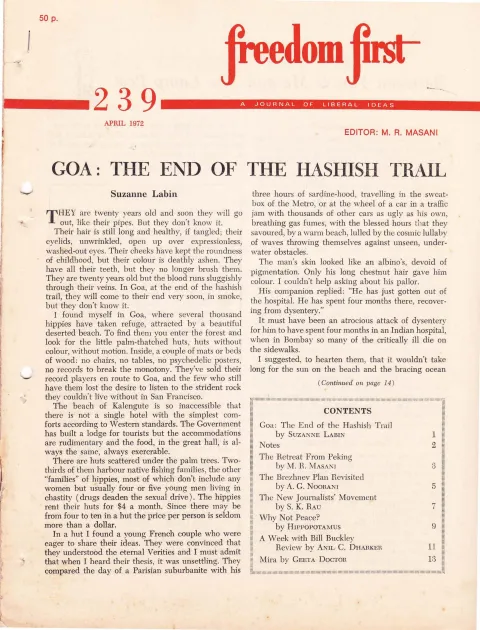
Freedom First No. 239 (April 1972), edited by M. R. Masani, is a monthly journal of liberal ideas published from Bombay for the Democratic Research Service. The issue mixes foreign-affairs commentary with domestic Indian politics and cultural criticism. Its lead piece, Suzanne Labin’s “Goa: The End of the Hashish Trail,” is a reported essay on the hippie colony at Kalengute beach, describing physical deterioration among young Western drug users and the informal economy of exploitation and dependency that has grown up around them. The editor’s own “Retreat from Peking” excoriates President Nixon’s China visit as a betrayal of Taiwan and a propaganda coup for Mao Tse-tung’s regime, while A. G. Noorani’s “The Brezhnev Plan Revisited” tracks Soviet moves toward an Asian collective-security pact aimed at containing China, and “Hippopotamus” defends Willy Brandt’s Ostpolitik against conservative critics. S. K. Rau chronicles the formation of the National Union of Journalists (India) as a revolt against the older, allegedly politically infiltrated Indian Federation of Working Journalists. The unsigned “Between You & Me and the Lamp Post” column comments on the 1972 state elections and a controversy over an Encyclopaedia Britannica commission. The issue closes with two reviews (of William Buckley’s diary-memoir Cruising Speed and of Alyque Padamsee’s stage production of Gurcharan Das’s play Mira) and a page of quoted press miscellany, “With Many Voices.”
Key points
-
Suzanne Labin’s “Goa: The End of the Hashish Trail” reports on the hippie colony at Kalengute beach, describing physical deterioration among young Western drug users alongside the local cottage economy it has sustained.
-
M. R. Masani’s editorial “The Retreat From Peking” calls Nixon’s China visit a “moment of infamy” that betrayed Taiwan and Tibet’s claims to self-determination for no reciprocal concession.
-
A. G. Noorani’s “The Brezhnev Plan Revisited” argues Moscow’s undisclosed Asian collective-security proposal is aimed at containing China despite persistent denials.
-
S. K. Rau recounts the formation of the National Union of Journalists (India) as a revolt against the politically infiltrated Indian Federation of Working Journalists.
-
Writing as “Hippopotamus”, “Why Not Peace?” defends Willy Brandt’s Ostpolitik treaties against critics who call them premature or an overestimation of German leverage.
-
Anil C. Dharker reviews William F. Buckley’s diary-memoir “Cruising Speed”, pushing back on Buckley’s argument that majority freedom sometimes requires suppressing minorities.
-
Geeta Doctor reviews Alyque Padamsee’s staging of Gurcharan Das’s play “Mira” as a visually striking “20th century look at the phenomenon of sainthood”.
Essays
Goa: The End of the Hashish Trail
By Suzanne Labin
Suzanne Labin’s reported essay follows the hippie colony that has settled on Goa’s Kalengute beach, drawn by a beautiful, undeveloped beach and cheap living. She describes young Westerners, many only twenty, whose bodies are already breaking down from hashish, malnutrition, and disease: sunken eyes, ashen skin, dysentery, sores that go untreated because the nearest hospital is overwhelmed. The essay details the huts they rent from local fishing families, the improvised economy of cooked food sold by Indian villagers, and a visit to a hut shared by an American-Israeli man, a French woman, their nine-year-old daughter (kept out of school), and a newly arrived Swedish teenager who is being inducted into the group’s customs. It closes (in the continuation on pages 14-15) with a visit to a beachside bistro, a meditation on the class condescension of poorer hippies toward penniless Indians, and Labin’s closing observation that the trickle of hippie money has lifted local fishing families out of destitution even as the hippies themselves waste away — a reversal, she suggests, of the usual relationship between rich Westerners and the poor of the East.
- The hippie colony at Kalengute beach in Goa numbers several thousand and lives in huts without electricity, furniture, or modern comforts.
- Prolonged hashish use, dysentery, and malnutrition are producing visible physical deterioration in residents who are typically only twenty years old.
- A local cottage economy has grown up selling cooked food and hut rentals to the hippies, since no markets exist in Kalengute.
- New arrivals with money are absorbed into the group and taught its customs by longer-term residents, in a self-perpetuating cycle.
- Labin argues the modest income hippies bring has measurably raised the local fishing population out of a prior state of semi-starvation.
The Retreat From Peking
By M. R. Masani
M. R. Masani’s editorial argues that President Nixon’s visit to Peking was a moment of infamy comparable to the U.N.’s expulsion of the Republic of China, even though he grants that seeking to divide the Soviet Union from Communist China is in principle a legitimate strategic aim. He contends that the visit humiliated pro-American academics and Chiang Kai-shek’s Taiwan, betrayed Tibet’s and Taiwan’s claims to self-determination, and secured no reciprocal concessions from Peking, with even sympathetic observers like James Michener and William Buckley coming away disillusioned. Masani cites a purportedly leaked secret Chinese Communist Party document, “The International Situation and Publicity Directive,” which frames the Nixon visit as a propaganda and infiltration opportunity for Peking rather than a genuine diplomatic opening, and closes by quoting the Chinese philosopher Lin Yutang’s line comparing Nixon to Neville Chamberlain.
- Masani calls Nixon’s Peking visit a ‘moment of infamy’ analogous to the U.N.’s seating of Communist China.
- He argues the visit betrayed Taiwan’s President Chiang Kai-shek and the self-determination claims of Taiwan and Tibet.
- William Buckley reportedly declared himself ‘no longer interested in Richard Nixon’ after witnessing the visit.
- A cited leaked Chinese Communist document frames the visit as useful chiefly for stepping up subversive propaganda activities in the U.S.
- Masani closes with Lin Yutang’s epigram likening Nixon to Neville Chamberlain.
The Brezhnev Plan Revisited
By A. G. Noorani
A. G. Noorani revisits the 1969 Brezhnev Plan for Asian collective security, arguing that nearly three years on, Moscow still has not disclosed its details, forcing India and other Asian states to guess at Soviet intentions from scattered remarks. He traces the diplomatic record from Brezhnev’s original 1969 statement, through U.S. Secretary of State Rogers’s complaint that the Soviets gave no clarification when asked, to India’s own shifting position, from External Affairs Minister Dinesh Singh’s 1969 admission that no formal proposal had even been shown to India, to Swaran Singh’s 1972 statement endorsing the idea in principle. Noorani notes that India, having secured a bilateral Indo-Soviet Treaty, now seems to prefer bilateral arrangements to the multilateral scheme Moscow favours, while Japan has moved from indifference to cautious openness. He concludes that despite persistent Soviet denials, the plan is clearly aimed at containing China and envisages military dimensions, and that Moscow’s evident aim is to extend its influence across Asia.
- The Brezhnev Plan for Asian collective security was first publicly floated in June 1969 but its details have never been officially disclosed.
- The U.S. State Department said in 1969 that Soviet officials, when asked directly, could give no clarification of what the plan actually entailed.
- India’s official position has shifted: from Dinesh Singh’s 1969 statement that no printed proposal had been shown to India, to Swaran Singh’s 1972 endorsement of the plan’s aims.
- Indira Gandhi has preferred a bilateral security arrangement with Russia over the multilateral Asian scheme Moscow envisages.
- Noorani concludes the plan is directed against China and does envisage military aid, despite Soviet denials, citing analysis by Soviet publicist Spartak Beglov.
The New Journalists’ Movement
By S. K. Rau
S. K. Rau recounts the formation of the National Union of Journalists (India) at a Delhi convention in January 1972, presenting it as a revolt against the older Indian Federation of Working Journalists (IFWJ), founded in 1948 under K. Rama Rao and later led by M. Chalapati Rau of the National Herald. Rau credits the IFWJ with winning wage-board protections for journalists but argues it had since been captured by political factions who used union machinery to reward loyalists and purge independent or non-aligned journalists, creating an adversarial relationship between editors and staff that outside political interests exploited. He describes an earlier regional revolt via the UP Journalists’ Association and situates the new NUJ, formed by delegates from across India, as a non-political professional trade union meant to restore an accountable, self-regulating profession.
- The IFWJ was founded in 1948 by journalists including K. Rama Rao and grew wage-board protections for the profession.
- Rau argues the IFWJ leadership became politically infiltrated, using accreditation and other levers to punish non-aligned journalists.
- A precursor revolt, the UP Journalists’ Association, fought and won recognition from the government some five years earlier.
- The National Union of Journalists (India) was formed at a Delhi convention on January 23-24, 1972, with existing units in Uttar Pradesh, Tamil Nadu, and Madhya Pradesh affiliating immediately.
- Rau frames the NUJ as a non-political professional trade union meant to keep ‘extraneous elements’ out of journalism.
Why Not Peace?
By Hippopotamus
Writing under the pseudonym “Hippopotamus,” the author defends West German Chancellor Willy Brandt’s Ostpolitik against critics who narrowly defeated ratification of non-aggression treaties with the USSR and Poland in the Bundesrat. The piece rebuts Anthony Hartley’s Foreign Affairs critique that Ostpolitik should have waited for greater European unity and that Brandt overestimates Germany’s negotiating leverage, arguing instead that the treaties simply acknowledge losses already sustained and that German reunification is neither possible nor, for most Germans, still desirable. The author lists the opposition’s formal objections (Soviet influence over German policy, unilateral acceptance of division, insufficient improvement for East Germans, and weakened NATO cohesion) and dismisses them as overstated, concluding that Brandt’s peace policy will ultimately prevail domestically and deserves support.
- The Bundesrat narrowly rejected (21-20) a motion to fast-track ratification of the non-aggression treaties with the USSR and Poland.
- Anthony Hartley’s Foreign Affairs article criticised Ostpolitik as premature and overestimating Germany’s bargaining power relative to the Soviet Union.
- The author counters that the treaties merely accept territorial and political realities already lost, not new concessions.
- The formal opposition case (four objections) is summarized and rejected as failing to identify any real new Soviet leverage over West Germany.
- The author predicts reunification is now neither possible nor widely desired, framing eventual German Democratic Republic change as evolutionary rather than driven by outside power politics.
A Week with Bill Buckley
By Review by Anil C. Dharker
Anil C. Dharker reviews William F. Buckley Jr.’s diary-memoir Cruising Speed, describing it as a week’s record in diary form written after Buckley’s brother won a Senate seat in 1970. Dharker portrays the Buckleys as an American equivalent of the Kennedys — wealthy, large, politically prominent — and finds the book entertaining but self-indulgent, noting Buckley’s evident lack of modesty and the parade of eccentric acquaintances (including trustees of a fund with links to the John Birch Society and figures who see communists everywhere). Dharker credits Buckley’s wit and intellectual honesty, but pushes back hard on the substance of one of Buckley’s stock speeches, which argues that safeguarding majority freedom sometimes requires suppressing a minority (implicitly including groups like the Yippies and Black Panthers) — a position Dharker calls self-refuting on liberal grounds, since it is precisely by liberal tolerance that Buckley himself is permitted to hold and voice such views.
- Cruising Speed is a diary-format memoir written shortly after Buckley’s brother won a U.S. Senate seat in 1970.
- Dharker compares the Buckley family’s wealth, prominence and size to the Kennedys.
- The review highlights eccentric figures around Buckley, including trustees of a fund linked to the John Birch Society.
- Buckley’s speech on the ‘usefulness of repression’ argues majority freedom sometimes requires suppressing minorities like the Yippies and Black Panthers.
- Dharker calls this position ironic, since it is liberal tolerance that permits Buckley’s own minority views to be expressed.
Mira
By Geeta Doctor
Geeta Doctor reviews Alyque Padamsee’s stage production of Gurcharan Das’s play Mira, describing it as a ‘visual enactment’ in which four actors narrate and project rather than conventionally act out the story of the Rajput princess-saint Mirabai, set against three large screens showing Rajput miniature-style imagery. The review praises the production’s integration of sight, sound, and stylised, heightened language, and highlights Das’s own framing of the play as a ‘20th century look at the phenomenon of sainthood,’ with Mira’s arc from shy bride to figure who vanishes in blinding light also embodying a conflict between the bloodthirsty goddess Kali and the joyful, child-like Krishna to whom Mira ultimately turns. Doctor judges some plot elements (such as a cup of poison becoming nectar) more dramatic than convincing, but calls the overall production a triumph of Padamsee’s directorial vision that leaves the audience feeling they have briefly shared ‘the ecstasy of Mirabai.’
- The production, directed by Alyque Padamsee from Gurcharan Das’s play, uses four actors who narrate/project rather than act out Mira’s story in the conventional sense.
- Three large screens display Rajput-miniature-style imagery and shadow projections as part of the staging.
- Das describes the play as a ‘20th century look at the phenomenon of sainthood.’
- The narrative stages a symbolic conflict between the goddess Kali (whom Mira’s husband compels her to propitiate) and the child-like Krishna to whom Mira is devoted.
- Doctor finds some plot turns (e.g., poison turning to nectar) dramatically effective but not fully convincing, while praising the production overall as a directorial triumph.
Generated by the v1.5 extraction pipeline. Awaiting editorial review.
Metadata and summary are AI-extracted from the source PDF and reviewed for editorial accuracy. The original work is available via the Read PDF tab above (where present); paragraph-level citation inside the PDF is deferred to a future engagement.