periodical issue
Freedom First
By A. G. Noorani, Dharma Vira, Geeta Doctor, Steven J. Staats, Dinesh Kale, J. R. Patel, Vrunda Moghe
Published for the Democratic Research Service by J. R. Patel, Associate Editor, Freedom First at 127, M. Gandhi Road, Bombay 1 and printed by him at Inland Printers, 55 Gamdevi Road, Bombay 7. · Bombay · 1972
16 pages
Freedom First
Summary
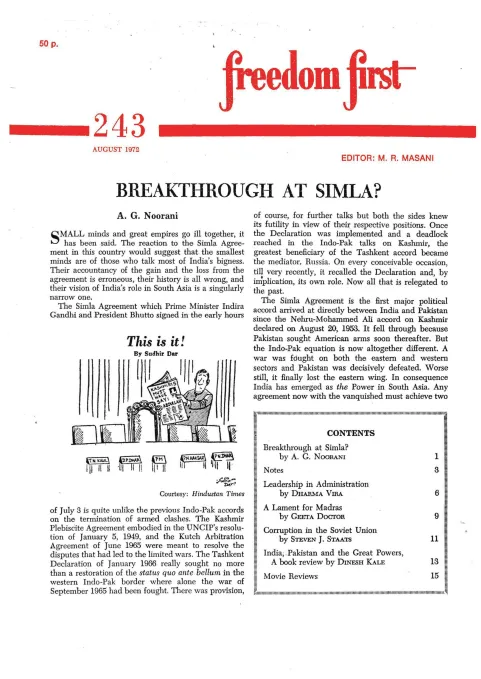
Freedom First No. 243 (August 1972), edited by M. R. Masani, is a single 16-page issue of the Bombay classical-liberal monthly published for the Democratic Research Service. The issue opens with A. G. Noorani’s defence of the Simla Agreement between Indira Gandhi and Z. A. Bhutto, arguing that the accord is a realistic, bilateral settlement rather than either a Versailles-style diktat or a toothless preamble. The ‘Between You & Me and The Lamp Post’ notes column ranges across domestic and international affairs: J.P. Narayan’s clash with a Madhya Pradesh minister over dacoit surrenders, scepticism about a possible McGovern presidency in the United States, cautious optimism about the Vietnam War, communist infiltration of India’s Socialist Forum, and the disappearance of Zhores Medvedev from a Kiev conference. Dharma Vira, a former civil servant and governor, laments the decline of principled administrative leadership since independence and the empty rhetoric of political ‘commitment’. Geeta Doctor mourns the vanished character of old Madras under the pressure of urban growth and careless city planning. Steven J. Staats, in a piece abridged from Problems of Communism, analyses corruption as a structurally integral, not incidental, feature of the Soviet bureaucratic economy. Dinesh Kale reviews William J. Barnds’s India, Pakistan and the Great Powers, and the issue closes with two brief film reviews (of Dirty Harry and V. Shantaram’s Pinjra) and the regular ‘With Many Voices’ page of quotations.
Key points
-
A. G. Noorani’s “Breakthrough at Simla?” defends the Simla Agreement between Indira Gandhi and Bhutto as a durable, non-punitive bilateral settlement rather than a Versailles-style diktat.
-
The “Notes” column covers J.P. Narayan’s clash with Madhya Pradesh’s Chief Minister over dacoit surrenders, scepticism about a McGovern presidency, and the mysterious disappearance of scientist Zhores Medvedev.
-
Dharma Vira’s “Leadership in Administration” contrasts pre-independence administrative decisiveness with post-independence drift, warning that demands for civil-servant “commitment” would destroy service neutrality.
-
Geeta Doctor’s “A Lament for Madras” mourns the vanished character of the old city under urban growth, citing declining cleanliness and haphazard planning of the Marina Beach.
-
Steven J. Staats’s “Corruption in the Soviet Union” argues corruption, via mechanisms like blat and the tolkach, is structurally integral to the Soviet command economy rather than an aberration.
-
Dinesh Kale reviews William J. Barnds’s “India, Pakistan and the Great Powers”, crediting it as a perceptive account that concludes US arms aid to the subcontinent has failed.
-
Film reviews cover “Dirty Harry” and V. Shantaram’s “Pinjra”, and the closing “With Many Voices” page quotes C. B. Irani on elected tyranny and Shimon Peres on freedom versus equality.
Essays
Breakthrough at Simla?
By A. G. Noorani
A. G. Noorani defends the Simla Agreement signed by Indira Gandhi and President Bhutto against domestic critics who he says misjudge both India’s gains and the historical context. He argues the accord is the first major bilateral India-Pakistan political settlement since the failed 1953 Nehru-Mohammed Ali accord, distinguishes it from the Tashkent Declaration and earlier ceasefire arrangements, and contends that a durable rather than imposed peace serves India’s interests better than a punitive settlement, quoting Bhutto’s own remark that ‘a durable peace and an imposed peace are contradictions.’ Noorani rebuts the charge that India gave away gains by noting Pakistan itself waived advantages under the UN Security Council’s December 1971 resolution. He closes by arguing the Simla Agreement’s bilateralism is durable only if Pakistan is not driven too hard, and that a Kashmir settlement and a tripartite India-Pakistan-Bangladesh accord remain achievable if both sides show the same spirit of give-and-take.
- Domestic critics of the Simla Agreement are accused of faulty historical accounting and a narrow view of India’s regional role.
- The Simla Agreement is framed as the first major direct India-Pakistan political accord since the 1953 Nehru-Mohammed Ali agreement on Kashmir.
- Noorani invokes Bismarck via Kissinger to argue for a non-punitive, non-Versailles peace despite India’s decisive military victory.
- The UN Security Council’s December 1971 ceasefire resolution is cited to show Pakistan, not just India, made concessions under the Simla accord.
- The agreement commits both countries to bilateral resolution of disputes and non-alteration of the Kashmir ceasefire line pending final settlement.
- Noorani concludes the accord opens a prospect of durable peace, contingent on both sides continuing the ‘give and take’ shown at Simla.
Notes
The ‘Notes’ column, headed ‘Between You & Me and The Lamp Post’, covers six short items. It criticises Madhya Pradesh Chief Minister P. C. Sethi for publicly attacking Jayaprakash Narayan and the Sarvodaya movement over the surrender of dacoits, and reports Vinoba Bhave’s tongue-in-cheek apportionment of credit for the surrender. It considers the possibility of a McGovern presidency in the US, arguing most American voters would still back Nixon, and recalls McGovern’s 1948 support for the Communist-backed Henry Wallace candidacy as evidence of persistent naivety. A third item finds cautious optimism in Vietnam war news despite the resumption of Paris talks, and criticises John Kenneth Galbraith’s 1968 forecast of an imminent South Vietnamese government collapse as having been proven wrong. A fourth item, on communist infiltration of the Socialist Forum, names several Indian politicians identified by the London Economist as ex-communists in government. The column closes with two items: the mysterious disappearance of scientist Zhores Medvedev from a Kiev gerontology conference, apparently due to secret police action, and a squib about Communist China ranking the US as only its fourth-greatest security threat.
- P. C. Sethi, Chief Minister of Madhya Pradesh, publicly accused J.P. Narayan and Sarvodaya workers of undermining the state government over dacoit surrenders.
- Vinoba Bhave apportioned credit for the dacoit surrenders between the dacoits, police, Bhoodan workers, and ‘God’.
- The column argues most American voters, Republican or Democrat, would back Nixon over McGovern despite volatility in the electorate.
- McGovern’s 1948 support for Henry Wallace, described as a Communist Party-backed candidate, is cited as evidence of ongoing political naivety.
- John Kenneth Galbraith’s February 1968 prediction of an imminent collapse of the South Vietnamese government and army is quoted and mocked as having failed to materialise.
- The London Economist is cited identifying a Cabinet minister, several junior ministers, party general secretaries and a new state chief minister as former communists inside the Indian government.
- Zhores Medvedev’s non-appearance at a Kiev gerontology conference is attributed to interception by the secret police, linked rhetorically to other post-Moscow-summit repression of Soviet dissidents.
Leadership in Administration
By Dharma Vira
Dharma Vira, a former senior civil servant and state governor, contrasts the decisive, contact-rich leadership style of pre-independence imperial administration with the drift he perceives in post-independence India. He credits early national leaders such as Nehru and Vallabhbhai Patel with leading by example and sustaining a service ethic through personal example rather than coercion, but argues that later politicians became ‘power-hungry’ and eroded both political leadership and service integrity through sycophancy and interference in day-to-day administration. He describes the roles of politicians (policy-making) and permanent services (advice, implementation, and continuity) as constitutionally intended to be complementary, and closes by attacking the vogue for demanding civil servants be ‘committed’ to an unspecified ideology, warning that any move toward ideological loyalty tests would destroy the constitutionally guaranteed permanence and neutrality of the civil service and open the door to a spoils system.
- Pre-independence administration is described as decisive, hands-on, and maintained a ‘satisfactory government’ through direct contact with the people despite being an imperial regime.
- Independence brought a shift from a law-and-order government to a welfare state, creating a new partnership of politicians, permanent services, and the public.
- Nehru, Rafi Ahmed Kidwai, Abul Kalam Azad, Gobind Vallabh Pant, and Vallabhbhai Patel are credited with leadership by example that carried the civil services through the difficult post-independence years.
- Vira argues newer politicians became power-hungry and eroded the constitutional division of labour between policy-making politicians and implementing, continuity-providing civil servants.
- He criticises loose talk of civil servant ‘commitment’, arguing that if it means loyalty to a particular political ideology it would violate the Constitution and force mass resignations whenever governments change.
- He warns such a shift would replace administrative continuity with a spoils system of political appointments.
A Lament for Madras
By Geeta Doctor
Geeta Doctor writes an elegiac essay on the transformation of Madras over roughly a decade, contrasting the vanished East India Company-era Mess House and the leisurely, distinctive character of the old city with the flats, traffic, and anonymity that have replaced it. She questions nostalgia for its own sake but argues Madras has genuinely lost a ‘standard’ and ‘essential quality’, citing declining cleanliness, proliferating slums, livestock roaming the streets, and visible destitution including leprosy sufferers reduced to what she reads as threatening rather than merely begging behaviour. She extends the lament to public institutions, describing poor visitor behaviour at the Madras Museum and the crowding, over-population and haphazard planning of the Marina Beach, including the controversial rehabilitation of fishermen on the beachfront near the University of Madras. She closes by arguing city planners should attend to the felt ‘spirit’ of a city and its inhabitants rather than imposing arbitrary top-down schemes.
- The essay opens by recalling the demolished East India Company-era Mess House as a symbol of old Madras’s vanished character.
- Doctor contrasts eccentric, individuated old neighbours and houses with new, homogeneous ‘flats’ and identical households following an ‘all-India standard’ set by Femina magazine.
- She argues Madras’s decline is visible in reduced cleanliness, proliferating slums, and livestock roaming amid garbage.
- Lepers reduced to begging in the streets are described as having taken on a ‘menacing’ rather than merely pitiable character.
- Public institutions such as the Madras Museum are cited as sites of visitor misbehaviour and administrative indifference.
- Migration statistics (600,000 migrants into Madras 1951-61) are cited to explain, though not excuse, the city’s strained infrastructure.
- The essay closes by urging planners to attend to a city’s cumulative ‘spirit’, drawing an analogy to the old custom of propitiating a place’s tutelary deity before entering it.
Corruption in the Soviet Union
By Steven J. Staats
Steven J. Staats, in a piece abridged from the journal Problems of Communism, argues that corruption in the Soviet Union is not an aberration but a structurally integral feature of the command economy and bureaucratic state. Defining corruption via Samuel P. Huntington as behaviour that deviates from accepted norms to serve private ends, Staats catalogues mechanisms such as blat (personal influence used to obtain otherwise-unavailable favors) and the tolkach (an expediter who operates informally to secure scarce industrial supplies), arguing these practices arise because the planned economy chronically fails to match supply with demand. He discusses ‘black-market bureaucracy’ as corruption that effectively introduces market features into the command system, cites Communist Party members’ frequent involvement despite the Party’s ostensible role of oversight, and explains how the nomenklatura appointment system can shield corrupt officials from prosecution. He concludes that corruption performs a real social function, ‘humanizing’ the harshness of centrally imposed modernization, and is unlikely to be eradicated because of the important role it continues to play in Soviet life.
- Corruption is defined, following Samuel P. Huntington, as ‘behavior of public officials which deviates from accepted norms in order to serve private ends.’
- Staats argues Soviet press corruption-reporting is itself distorted, sometimes deployed selectively to discredit minority groups such as Jews.
- Blat (personal influence) and the tolkach (expediter) are identified as informal mechanisms compensating for the planned economy’s chronic supply-demand mismatches.
- The concept of ‘black-market bureaucracy’ frames corruption as introducing functional market features into an otherwise rigid command economy.
- Corruption is shown to persist within the Communist Party itself, the very institution meant to monitor and control it, implying a shared interest among officials in concealment.
- The nomenklatura system, which requires a higher party or governmental body’s consent before an official can be prosecuted, is described as a structural shield for corrupt officials.
- Staats concludes corruption ‘humanizes’ the harsh effects of top-down Soviet modernization and is likely to remain integral to Soviet life, comparing its permanence to ‘Vodka and Kasha’.
India, Pakistan and the Great Powers, A book review
By Dinesh Kale
Dinesh Kale reviews William J. Barnds’s India, Pakistan and the Great Powers (Pall Mall, London, 1972), calling it a well-timed and competently executed account of thirty years of subcontinental history that survives the upheaval of the 1971 war and its aftermath without losing validity. Kale summarises the book’s account of US, Soviet, and Chinese involvement in the subcontinent from the early 1950s through the 1971 war, including the Panch Sheel and Bhai-Bhai period with China, the 1958 Aksai Chin road dispute, Ayub Khan’s 1959 joint-defence proposal rejected by Nehru, and Chou En-lai’s 1959 territorial settlement proposal, also rejected. He notes the book’s final chapters assess US policy options, concluding that arms aid and alliances have failed and more economic aid, delivered without expectation of major foreign-policy returns, would serve US interests better. Kale praises the book as easy to read despite its length and ‘a perceptive and important’ contribution, useful to both American and Indian readers, while noting pointedly that no one in India’s own Foreign Service could likely produce a work of comparable competence.
- The reviewed book, India, Pakistan and the Great Powers by William J. Barnds (Pall Mall, London, 1972, 388pp, £4.25), reviews thirty years of subcontinental history and US policy options toward it.
- Kale credits the book with retaining validity despite being finished before the 1971 war and its aftermath.
- The book traces Sino-Indian relations from the Panch Sheel/Bhai-Bhai period through the 1958 Aksai Chin dispute to the post-1962 hardening of border positions.
- Ayub Khan’s 1959 joint-defence proposal and Chou En-lai’s 1959 territorial-settlement offer are both noted as having been rejected by Nehru.
- The book concludes US arms aid and alliance strategy in the subcontinent has failed, and greater economic aid without guaranteed long-term returns is advised instead.
- Kale rates the book ‘exceptionally easy-reading’ and praises Barnds while remarking that no one in India’s Foreign Service could likely match its competence.
Movie Reviews
Two brief film reviews close the issue’s culture pages. J. R. Patel reviews Dirty Harry (mistakenly listed in the table of contents as ‘The Lone Ranger’), describing Clint Eastwood’s Inspector Harry Callahan as a brutish but effective San Francisco cop whose confrontation with the psychopathic killer Scorpio dramatises the tension between due-process protections and public safety; Patel argues the film’s ending is ‘deceptive’ in suggesting no real institution would have let such a killer go free. Vrunda Moghe reviews V. Shantaram’s Marathi film Pinjra (Cage), praising it as an ‘unforgettable classic’ about a clash between a village schoolteacher modelled on Sane Guruji and a travelling dancing girl, in which the teacher’s moral idealism collapses into disgrace once he is drawn into her world.
- J. R. Patel reviews Clint Eastwood’s Dirty Harry, focusing on the killer Scorpio’s release on a legal technicality after Miranda-style rights violations.
- Patel argues the film misleadingly implies institutional actors (DA, courts, mayor) rather than Harry himself are responsible for letting a psychopath go free.
- Vrunda Moghe reviews V. Shantaram’s Marathi film Pinjra (Cage), describing it as his return to form after ‘bouncing failures’ in Hindi cinema.
- Pinjra is summarised as a clash between an idealistic village schoolteacher (modelled on Sane Guruji) and a gypsy dancing girl, ending in the teacher’s moral collapse.
Essay 8
‘With Many Voices’ is the issue’s closing page of curated quotations from contemporary press and public figures, framed by an epigraph from Tennyson. The quotes touch on a wide range of 1972 political events: commentary on Indira Gandhi’s premiership, criticism of Indian planning rhetoric, Z. A. Bhutto, Leonid Brezhnev on the incomprehensibility of the Chinese, Shimon Peres on freedom versus equality, and a wry item about Soviet citizens needing to register their names when buying a typewriter in Czechoslovakia. The page also carries the magazine’s subscription form for Freedom First, published by the Democratic Research Service in Bombay.
- The page collects short quotations from figures including Z. A. Bhutto, Leonid Brezhnev, Shimon Peres, Kakuei Tanaka, and various Indian and international commentators.
- One quote from C. B. Irani warns that ‘tyranny does not cease to be tyranny simply because it is perpetrated by the elected representatives of the people.’
- A quote from Shimon Peres argues societies that prioritise freedom over equality fare better by equality than those prioritising equality over freedom.
- The page includes Freedom First’s subscription form, listing its address as c/o Democratic Research Service, 127 Mahatma Gandhi Road, Bombay 1.
Generated by the v1.5 extraction pipeline. Awaiting editorial review.
Metadata and summary are AI-extracted from the source PDF and reviewed for editorial accuracy. The original work is available via the Read PDF tab above (where present); paragraph-level citation inside the PDF is deferred to a future engagement.