periodical issue
Freedom First
A Journal of Liberal Ideas
By M. R. Masani, Geeta Doctor, A. G. Noorani, Prof. F. A. Mechery, Zarin Minocher-Homji
Published for the Democratic Research Service by J. R. Patel, Associate Editor, Freedom First at 127, M. Gandhi Road, Bombay 1 (Phone: 254341) and printed by him at Inland Printers, 55 Gandevi Road, Bombay 7. · Bombay · 1972
16 pages
Freedom First
Summary
This is Freedom First No. 244 (September 1972), the monthly journal of the Democratic Research Service edited by M. R. Masani, published in Bombay. The issue opens with Masani’s own “Happy Anniversary,” a wry, first-person account of his dealings with All India Radio over the Silver Jubilee of Independence, which he uses to indict twenty-five years of governmental centralisation and the survival of press and broadcast controls inherited from the colonial state. The unsigned “Between You & Me and the Lamp Post” column follows with short notes on exchange controls, threatened withdrawal from international copyright conventions, and corruption in the Soviet Union. Geeta Doctor’s “The Hard Pressed Students” reviews new Bombay college magazines (Movement, Sophiascope, Elph) against the fate of the banned magazine Experiment, arguing that suppressing frank student writing does more harm than the writing itself. A. G. Noorani’s “The P.M., Dr. Faridi & Aligarh” is a detailed, document-heavy account of the Aligarh Muslim University (Amendment) Act, 1972, built around Prof. J. G. Tiwari’s analysis of Communist inroads at Aligarh and Dr. A. J. Faridi’s dated diary of pre-election assurances allegedly given by Indira Gandhi and Congress leaders on Aligarh’s autonomy, which the piece argues were never honoured. Prof. F. A. Mechery’s “Kerala: Politics vs. Education” analyses the standoff between private college managements and the Kerala state government over fee unification, situating it within a longer history of political parties (Congress, Kerala Congress, Muslim League, Marxists) exploiting the state’s private-dominated higher-education sector. Zarin Minocher-Homji’s “English and the Indian Theatre” argues that Indian plays written or translated into English routinely ring false because the language does not match the characters’ real social idiom, and calls on Indian playwrights to find the right idiom rather than abandon English theatre. The issue closes with “With Many Voices,” a page of unattributed political quotations culled from the world press (Indira Gandhi, The Economist, Time, J. R. D. Tata, and others), alongside the subscription coupon.
Key points
-
M. R. Masani’s “Happy Anniversary” uses his own censored All India Radio interview to indict twenty-five years of governmental centralisation on the Independence Silver Jubilee, crediting Nehru’s restraint for surviving democratic dialogue.
-
The “Notes” column warns that exchange controls, visa denials and a threatened withdrawal from copyright conventions amount to a new curtain on India’s intellectual contact with the West.
-
Geeta Doctor’s “The Hard Pressed Students” surveys new Bombay college magazines and recounts the unjust suppression of the independent magazine Experiment over its frank content.
-
A. G. Noorani’s “The P.M., Dr. Faridi & Aligarh” documents Communist inroads at Aligarh Muslim University and Dr. A. J. Faridi’s diary of pre-election autonomy assurances from Indira Gandhi that were never honoured.
-
Prof. F. A. Mechery’s “Kerala: Politics vs. Education” analyses the standoff between private college managements and the state government over fee unification, exploited by every major political party.
-
Zarin Minocher-Homji’s “English and the Indian Theatre” argues Indian plays performed in English ring false because the language is not the natural idiom of the country’s socially marginal characters.
-
The closing “With Many Voices” page quotes J. R. D. Tata on government’s concentration of economic power alongside remarks from Indira Gandhi and George Wallace.
Essays
Happy Anniversary
By M. R. Masani
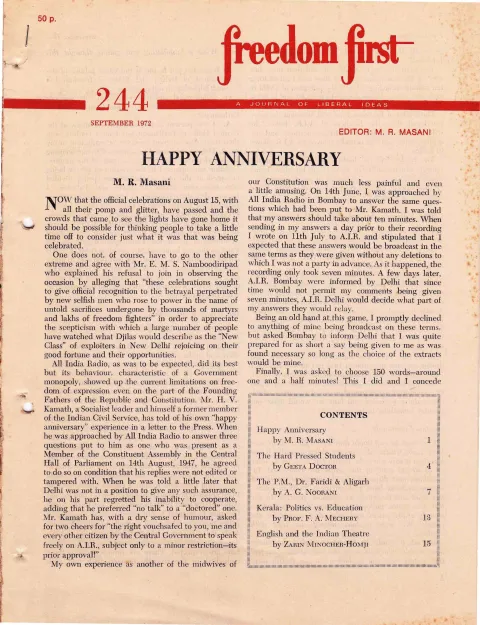
In “Happy Anniversary,” M. R. Masani reflects on the official Silver Jubilee celebrations of India’s independence and uses his own dealings with All India Radio as a case study in the country’s continuing lack of free expression. He recounts how H. V. Kamath’s earlier radio interview was subject to a threatened "prior approval" restriction, and then narrates in detail his own exchange with A.I.R.: he was asked for a ten-minute recording, told the terms would not be altered, but later informed that Delhi — not Bombay — would decide which of his answers, cut to 150 words, would actually be broadcast. Masani refused those terms and instead publishes in Freedom First the full text of the questions and his answers, marking in italics the portions A.I.R. actually relayed. His answers argue that the dreams of 1947 have been frustrated, that poverty and inequality have worsened under “socialist” policies of the last decade, that Gandhi was conspicuously absent from the actual transfer-of-power ceremony because he opposed Partition, and that the two great achievements of twenty-five years of independence are the survival of democratic dialogue/Rule of Law (credited chiefly to Nehru’s restraint) and a non-denominational public life — both of which he sees now threatened by the 24th and 25th Constitutional Amendments.
- Masani frames the 25th Independence anniversary as an occasion for sober stock-taking rather than celebration.
- H. V. Kamath’s own account illustrates the same A.I.R. censorship pattern Masani later experienced.
- A.I.R. Bombay agreed to a full, unedited ten-minute recording, but A.I.R. Delhi later said it would select the broadcastable portion; Masani refused and published everything, in italics marking what was actually aired.
- Masani rejects both the official euphoria and E. M. S. Namboodiripad’s total dismissal of the anniversary as illegitimate.
- His radio answers argue that poverty, unemployment and inflation are as bad or worse than in 1947, contra the promises of Nehru’s ‘tryst with destiny’.
- He credits Nehru specifically with resisting the temptation to smash constitutional opposition, crediting this restraint for surviving democratic dialogue and Rule of Law.
- He states Gandhi was deliberately absent from the transfer-of-power ceremony because he opposed Partition, a fact Masani treats as historically significant.
- He flags the recently enacted 24th and 25th Constitutional Amendments as a threat to Fundamental Rights and judicial supremacy.
The Hard Pressed Students
By Geeta Doctor
Geeta Doctor’s “The Hard Pressed Students” surveys the state of Bombay college journalism through several new and older student magazines. She praises Movement, a new independent Bombay University student paper produced outside any single college’s control, for tackling real problems of the student community with a constructive tone, though she notes its Xavierite bias and an over-fondness for dating events from the 1970-71 agitation. She contrasts two college magazines — the wholesome, sheltered Sophiascope from Sophia College and the earnest but overwrought, jargon-laden Elph from Elphinstone College — and then recounts the cautionary tale of Experiment, an independent Elphinstone student magazine that was suppressed by the college authorities after its first issue (which included a story on abortion, references to homosexuality, and mild jokes at the Establishment’s expense) was denounced as containing ‘the seeds of depravity.’ Doctor argues in retrospect that the suppression was unjust and hypocritical, since such topics are commonplace in ordinary reading matter, and that authorities would do better to provide students realistic outlets for expression than to suppress them and risk ‘producing a future generation of morons.’
- Movement is praised as the first Bombay-wide, non-college-affiliated student magazine to tackle real educational and social problems with a constructive (not adversarial) tone.
- Doctor notes Movement’s Xavierite bias and its editor Aspi Chinoy’s tendency to date events from the 1970-71 agitation as if nothing mattered before it.
- Sophiascope (Sophia College) is characterised as innocuous, wholesome convent-school-style fare.
- Elph (Elphinstone College) is criticised for pompous, circumlocutory prose and over-reliance on borrowed quotations and foreign-lifted material.
- Experiment, Elphinstone’s earlier independent student magazine, was suppressed by college authorities after its first issue touched on abortion and homosexuality and was accused of ‘the seeds of depravity.’
- Doctor argues the suppression of Experiment was unjust: such topics are common in ordinary books and periodicals and are not properly a crime for a student magazine to discuss.
- She concludes that denying students realistic outlets for expression, rather than moderating rather than banning them, risks producing a ‘future generation of morons.‘
Between You & Me and the Lamp Post
The unsigned editorial column ‘Between You & Me and the Lamp Post’ (continuing from page 3 onto page 4) covers three items: a warning that India is progressively cutting off contact with the non-communist world through exchange restrictions, denial of visas to American students and scholars, and a reported government move to withdraw from the Berne and Universal Copyright Conventions, which the column argues would licence Indian piracy of foreign authors’ work; a report that the Union Government’s own conduct — expropriating General Insurance and India Iron & Steel shareholders and small farmers’ ‘surplus’ land — undercuts its claims to defend property rights; and a note welcoming a rare Indian-press item on corruption inside the Soviet Union (the ‘Soviet Spiv’), comparing Soviet black-marketeer ‘tolkachis’ to the Indian ‘fixer’ without whom the planned economy cannot function, and speculating (via the deaths of Naxalite leader Charu Mazumdar and Mr. Nagarwala) about whether India is evolving its own ‘swadeshi’ pattern of convenient prisoner deaths in custody.
- The column warns that exchange controls, denial of visas to US students, and a threatened Indian withdrawal from the Berne/Universal Copyright Conventions amount to a new ‘curtain’ on India’s intellectual contact with the non-communist world.
- It contrasts this with the free flow of funds and cooperation permitted to communist-aligned groups from Russia and Eastern Europe.
- It criticizes the Union Government’s own ‘highway robbery’ against General Insurance and India Iron & Steel shareholders and small farmers as undermining any government claim to a moral high ground on property.
- It praises rare Indian press coverage of corruption in the Soviet Union, likening the Soviet ‘tolkachi’ fixer to the Indian black-marketeer/permit-and-quota fixer.
- It raises the question, via the mysterious deaths of Naxalite leader Charu Mazumdar and Mr. Nagarwala in custody, of whether India is evolving its own pattern of convenient ‘natural’ deaths of political prisoners.
- It notes Bihar Socialist leader Karpoori Thakur’s claim that Mazumdar ‘was murdered’ and calls, alongside E. M. S. Namboodiripad and A. B. Vajpayee, for an independent inquiry.
The P.M., Dr. Faridi & Aligarh
By A. G. Noorani
A. G. Noorani’s ‘The P.M., Dr. Faridi & Aligarh’ examines the Aligarh Muslim University (Amendment) Act, 1972 from constitutional, administrative, and political angles. The first half leans heavily on Prof. J. G. Tiwari’s analysis in Indian Communist, titled ‘Communists Take Over Aligarh Muslim University,’ which traces a decades-long struggle at Aligarh between Communist-aligned faculty and anti-Communist Islamic and liberal-democratic elements, culminating (Tiwari argues) in a Communist-friendly administration under Vice-Chancellor Dr. Alim and Education Minister Dr. Nurul Husain, and in a new Act that concentrates virtually all effective power in the Vice-Chancellor’s discretion at the expense of elected staff and student representation. The second half turns to Dr. A. J. Faridi’s own dated, diary-style catalogue of assurances given to him before the 1971 Lok Sabha elections by Congress leaders including Prime Minister Indira Gandhi — regarding Urdu, minority educational autonomy, and Aligarh Muslim University specifically — assurances Noorani says were solicited for Muslim electoral support and then not honoured in the actual amendment. Noorani closes by contrasting the personal integrity he attributes to Faridi with what he calls Faridi’s political misjudgment, and by generalising the episode into a broader indictment of broken promises in Indian politics, quoting Chief Justice Hidayatullah’s remark in the Privy Purse case that ‘princes were not the only people in whose words trust should not be placed.’
- The essay uses Prof. J. G. Tiwari’s journal article to argue that Communist-aligned faculty progressively took over key appointments at Aligarh from the early 1950s onward, aided by a ‘new wave’ of collaboration with Congress and the appointment of Dr. Nurul Husain as Education Minister.
- Tiwari’s analysis (as quoted) states the new Act leaves effective power almost entirely with the Vice-Chancellor’s unbridled discretion, with only a handful of the 230 university body members being elected representatives of staff or students.
- Noorani presents Dr. A. J. Faridi’s detailed, dated diary of meetings (December 1970 - June 1972) with Congress leaders including Chandra Jit Yadav, Kedar Nath, D. P. Misra, and finally Indira Gandhi herself, in which an eight-point programme covering Urdu, Aligarh Muslim University, and minority councils was allegedly agreed to.
- Faridi’s record states that the Prime Minister personally received a copy of the eight-point programme and discussed it, and that paragraphs 54 and 55 later inserted into the Congress Election Manifesto were understood by all parties to refer specifically to Aligarh Muslim University.
- The essay argues these assurances were solicited for Muslim electoral support in 1971 but were not honoured when the actual Amendment Act was drafted, with drafting entrusted instead to ministers who gave no hint the Bill would take the shape it did.
- Noorani distinguishes between Faridi’s personal integrity, which he calls undivided, and his political judgment, which he calls misguided.
- The essay closes by quoting Chief Justice Hidayatullah’s Privy Purse case remark that trust should not be placed even in the word of the powerful, generalising Aligarh into a broader critique of broken political promises.
Kerala: Politics vs. Education
By Prof. F. A. Mechery
Prof. F. A. Mechery’s ‘Kerala: Politics vs. Education’ analyses the 1972 higher-education crisis in Kerala, where private managements run 119 of the state’s colleges against only 14 run by government, and 85% of students depend on private institutions. Mechery traces how a quarter-century of unplanned educational growth, capitation fees, and unequal fee structures between private and government colleges produced chronic friction, which erupted into the current agitation over ‘fee unification.’ He shows how every major political formation — the Nair Service Society, Christian minority bodies, the Kerala Congress, the ruling Congress, the Congress (O)-led opposition coalition, the Muslim League, and the Marxist party under E. M. S. Namboodiripad — moved to exploit the standoff for factional advantage, at the cost of the students, who lost working days, delayed examinations, and quota-linked admissions elsewhere in the country. Mechery argues the actual fee differences involved are modest and that the deeper problem is the absence of any coherent national policy for higher education; he calls for preserving the autonomy of private institutions (a hallmark, he says, of liberal education) while introducing firm anti-corruption controls on appointments and admissions, restricting expensive post-graduate teaching to universities and selected centres, and resisting the drift toward treating university education as indistinguishable from mass schooling.
- Private managements run 119 of Kerala’s colleges versus only 14 run by government, and 85% of students depend on private institutions up to the highest levels.
- A quarter-century of unplanned, uncoordinated educational growth left private colleges dependent on capitation fees and other ‘illegal practices’ to bridge revenue shortfalls, which were then politically condoned.
- The actual fee gap between private and government institutions is modest (roughly Rs.12-80/year depending on level), undercutting the scale of public outrage over ‘fee unification.’
- Every major political actor — Nair Service Society, Christian bodies, Kerala Congress, ruling Congress, Congress (O), Muslim League, and the Marxists under Namboodiripad — used the agitation to advance its own coalition politics.
- The 1971-72 academic year’s strikes forced postponement of examinations to June-July 1972 and delayed students’ admissions elsewhere in India under the quota system, at real cost to the students themselves.
- Mechery defends the autonomy of private educational institutions as a hallmark of liberal education, while calling for firm anti-corruption controls on appointments and admissions.
- He argues post-graduate teaching, being expensive and requiring genuine intellectual exchange, should be concentrated in universities or selected centres rather than diffused across ordinary colleges.
- He warns against ‘mass production’ in higher education and against treating a college education as indistinguishable from basic schooling.
English and the Indian Theatre
By Zarin Minocher-Homji
Zarin N. Minocher-Homji’s ‘English and the Indian Theatre’ argues that Indian plays performed in English — whether written originally in English or translated from Indian languages — frequently ring false because English is not the natural idiom of the uneducated villager, manual labourer, domestic servant, or traditional grandmother who so often populate Indian drama. She rejects the counter-argument that translated European plays face no such problem, noting that the shared cultural context of European languages makes such translations feel natural in a way that is not available across the gulf between vernacular Indian social worlds and English. She also rejects the alternative of writing in the artificial ‘Indian English’ some Indians actually speak, arguing this idiom is suited only to caricature and comic effect, not serious drama. She concludes that Indian playwrights writing in English face the near-impossible task of finding a persuasive idiom for characters who would never naturally speak English, and urges more Indian playwrights to work at solving this problem, since the spoken word is of prime importance to the theatre.
- Minocher-Homji argues language, not spectacle or design, is the foundational element of serious theatre.
- She identifies a recurring ‘false note’ in Indian plays performed in English, whether originally written in English or translated from Indian languages.
- The falsity arises because socially marginal or uneducated Indian characters (villagers, labourers, servants, grandmothers) are never plausible speaking natural English.
- She distinguishes this from European-to-English stage translations, which work because of shared cultural context between European languages.
- She dismisses ‘Indian English’ as a viable dramatic idiom, arguing it is suited only to caricature, not serious themes.
- She calls on Indian playwrights to solve the idiom problem as a precondition for truly great English-language Indian theatre.
Essay 6
No summary was extracted for this article. Listed for completeness.
Essay 7
‘With Many Voices’ is the issue’s unsigned closing feature, a page of short, unconnected quotations drawn from the world press (Indian Express, The Economist, Time, US News & World Report, Encounter, Sunday Standard) covering topics from Indira Gandhi’s remarks on domestic trust and the wage-price trade-off, to US election-year commentary on McGovern, Nixon and Wallace, to J. R. D. Tata on the concentration of economic power in government hands, to wry asides on Chile’s economic crisis and Egyptian radio patriotism. It is followed by the journal’s subscription coupon and colophon, naming the Democratic Research Service (127, Mahatma Gandhi Road, Bombay) as publisher and J. R. Patel as Associate Editor and printer.
- The column collects short quotations without editorial commentary, opening with an epigraph from Tennyson.
- Quoted figures include Indira Gandhi (twice), George Meany, George Wallace, Leon Trotsky, and J. R. D. Tata, among unnamed editorial voices from The Economist and Time.
- J. R. D. Tata is quoted from a shareholders’ statement observing that no government has taken greater precautions to concentrate real economic power in its own hands.
- The page closes the issue with the Freedom First subscription coupon and the publication’s colophon (Democratic Research Service, Bombay; J. R. Patel, Associate Editor and printer).
Generated by the v1.5 extraction pipeline. Awaiting editorial review.
Metadata and summary are AI-extracted from the source PDF and reviewed for editorial accuracy. The original work is available via the Read PDF tab above (where present); paragraph-level citation inside the PDF is deferred to a future engagement.