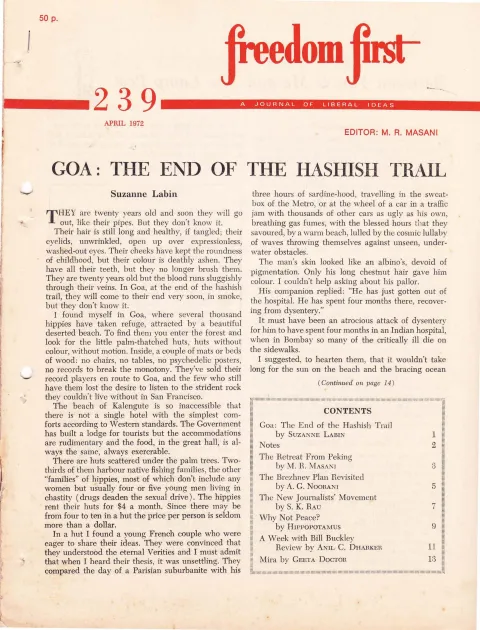
periodical issue
Freedom First
A Journal of Liberal Ideas
By J. R. Patel, Chitra Sen
FREEDOM FIRST, C/o Democratic Research Service, 127, Mahatma Gandhi Road, Bombay 1 · Bombay · 1972
16 pages
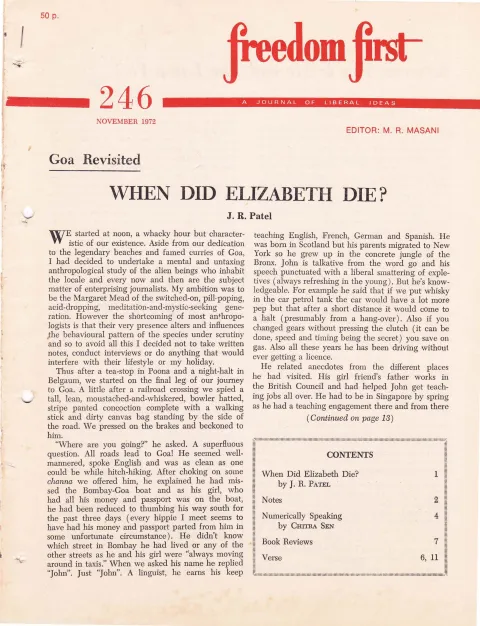
Freedom First
Summary
Freedom First No. 246 (November 1972), edited by M. R. Masani, opens with J. R. Patel’s travelogue-essay “When Did Elizabeth Die?”, a wry first-person account of a road trip to Goa that turns into an anthropological sketch of the hippie trail at Calangute and Anjuna in the early 1970s, ending on a mordant note about a hippie’s death by overdose going unremarked. The editorial section “Between You & Me and The Lamp Post” comments on farmers organising against land-reform legislation, an Oxford honorary degree for Lord Hailsham, a Congress Working Committee row over the “weaker sections,” the naming of a new Union Territory capital “Indira Giri,” and Delhi’s diplomatic overtures to Uganda’s President Amin. Chitra Sen contributes a popular-mathematics piece on topology (the Möbius strip, Klein bottle) and on very large numbers. A reader’s letter objects to proposed amendments empowering government to cancel private mining leases, and a satirical poem, “My Babujee Days,” lampoons the cost and disruption of a prime-ministerial visit to IIT Powai. The book-review section covers Richard H. Solomon’s study of Mao and Chinese political culture (reviewed by Anil Dharker), S. P. Aiyar and S. V. Raju’s edited volume on the 24th and 25th Constitution Amendment Bills and fundamental rights (reviewed by Sujata Manohar), and Suraj Bhan Agrawal’s study of Indian price trends (reviewed by M. P. Appachu). Two poems appear: Alan Ross’s “Yogis at Chowpatty Beach” and the unsigned parody “My Babujee Days.” The issue closes with “With Many Voices,” a compilation of quotations from the contemporary press on politics, inflation, and world affairs.
Key points
-
J. R. Patel’s “When Did Elizabeth Die?” is a wry travelogue of the hippie trail at Calangute and Anjuna, closing on a hippie’s overdose death passing unremarked among her peers.
-
The “Notes” column welcomes the new Farmers’ Federation of India against land-reform legislation, mocks the naming of Arunachal Pradesh’s capital “Indira Giri”, and criticises Delhi’s diplomatic warmth toward Idi Amin.
-
Chitra Sen’s “Numerically Speaking” introduces the Möbius strip and Klein bottle before turning to very large numbers and mathematics’ influence on aesthetics.
-
A reader’s letter from Dinesh C. Kale criticises proposed amendments empowering government to cancel mining leases at will, warning it would deter investment in dependent industries.
-
A satirical poem, “My Babujee Days”, lampoons the cost and stage-managed disruption of a prime-ministerial visit to IIT Powai’s convocation.
-
Anil Dharker reviews Richard H. Solomon’s study of Mao’s revolution as a struggle against Confucian filial piety, and Sujata Manohar reviews a compiled volume on the 24th and 25th Constitution Amendment Bills.
-
M. P. Appachu reviews Suraj Bhan Agrawal’s statistical study of Indian price trends, and Alan Ross’s poem “Yogis at Chowpatty Beach” closes the issue’s cultural content before “With Many Voices”.
Essays
When Did Elizabeth Die?
By J. R. Patel
J. R. Patel recounts a hitch-and-drive trip from Bombay to Goa, opening with an encounter with an eccentric American hitchhiker named John and proceeding to an ironic, self-aware “anthropological” survey of the hippie colonies at Calangute and Anjuna beaches. The piece profiles local characters such as “James Bond Butterfly,” a Goan hippie-cum-local celebrity, and recounts mishaps including a near-miss with an armed squatter at a hilltop monastery. The essay closes on the story of a hippie named Elizabeth whose overdose death passes unremarked among her peers, which the author uses to reflect wryly on detachment, mortality, and the counter-culture’s dependence on the very society it claims to reject, before a final ironic aside about being nearly robbed of a car part on the drive home.
- The narrator undertakes a self-consciously mock-anthropological road trip to Goa, disclaiming any real journalistic method.
- Hitchhikers and expatriate drifters (John, then ‘James Bond Butterfly’) supply comic colour and folklore about the hippie trail from Kathmandu and Afghanistan into Goa.
- Anjuna and Calangute are depicted as the ‘winter hippie capital of Asia,’ with repeated, mostly good-natured friction between Goan locals, Indian day-trippers, and Western hippies.
- An encounter with an armed German squatter at a monastery turns menacing, ending in shots fired and a stolen knife.
- The essay’s emotional turn comes from casual news of a hippie named Elizabeth’s death by overdose, met with total indifference by her peers, prompting the narrator’s reflection on nihilism, rootlessness and the hollow freedom of the counter-culture.
- The piece ends on a bathetic note: the travellers, robbed of a windshield wiper on their return, muse that dying happy on a Goan beach may be preferable to dying in “some idiot traffic accident.”
Notes
The unsigned editorial notes column takes up several current events: the formation of a new Farmers’ Federation of India under Bhanu Pratap Singh to resist “land reforms” legislation, contrasted with a government-backed farmers’ working group headed by a communist; an ironic commendation of Lord Hailsham’s 1971 remarks on law, liberty and property as the foundation of freedom; a report on a bitter Congress Working Committee exchange between Jagjivan Ram and K. D. Malaviya over neglect of the “weaker sections”; mockery of the choice of “Indira Giri” as the name for the new Arunachal Pradesh capital; an anecdote about Indira Gandhi being locked out of a VIP guest house in Gandhinagar; and criticism of New Delhi’s diplomatic warmth toward Uganda’s President Idi Amin despite his anti-Indian rhetoric, plus a note on cartoonist Rajinder Puri’s new weekly Stir.
- Welcomes the new, non-party Farmers’ Federation of India (led by Bhanu Pratap Singh) as a hopeful development against land-reform legislation, while noting a rival, government-aligned farmers’ working group is headed by a communist, Dr. Z. A. Ahmed, and includes N. G. Ranga.
- Approvingly quotes Lord Hailsham’s 1971 Commonwealth Law Conference remarks that freedom depends on constitutional conditions of law, property, and security, and uses them to criticise governments that discard constitutional safeguards in the name of economic advance.
- Reports the AICC session in Gandhinagar where Jagjivan Ram publicly accused the Congress Party of empty rhetoric about the ‘weaker sections’ amid a lavish official dinner.
- Mocks the naming of Arunachal Pradesh’s new capital ‘Indira Giri’ as symptomatic of sycophancy and administrative sterility.
- Notes a report that Indira Gandhi was locked out of her room at a Gandhinagar guest house and jokes about blaming the CIA.
- Criticises the Government of India’s friendly overtures to Uganda’s President Amin despite his hostile rhetoric toward India, framing it as diplomatic self-abasement.
- Flags cartoonist Rajinder Puri’s newly launched Delhi weekly Stir and reproduces one of his cartoons.
Numerically Speaking
By Chitra Sen
Chitra Sen’s popular-science essay introduces the Möbius strip and its properties (one side, one edge, and the counter-intuitive result of cutting it along its length), traces its invention to the German mathematician August Ferdinand Möbius, and extends into related topological curiosities such as the Klein bottle and the four-colour map problem. The second half of the essay shifts to a meditation on very large numbers — doubled paper thickness, the wheat-and-chessboard legend, Eddington’s estimate of the number of electrons in the universe, and the largest known prime-adjacent number of the day — before closing with a discussion of mathematics’ influence on art, citing the golden section, the Parthenon, and Professor Birkhoff’s formula for aesthetic measure.
- Explains how to construct a Möbius strip and demonstrates that it has only one side and one edge.
- Notes that cutting a Möbius strip along its centre line produces a single, longer, two-sided strip rather than two separate strips, and quotes two mathematical limericks on the subject.
- Attributes the strip’s invention to August Ferdinand Möbius and describes Felix Klein’s related one-surfaced ‘Klein bottle.’
- Surveys other topological puzzles: the genus of surfaces, and the unresolved question of how many colours are needed to map a flat surface versus a Möbius strip or torus.
- Uses the wheat-and-chessboard legend and Eddington’s estimate of the number of electrons in the universe to illustrate the human difficulty of grasping very large numbers.
- Closes by linking mathematics to aesthetics via the golden section, the Parthenon’s proportions, and Professor Birkhoff’s formula for ‘aesthetic measure’ (M = O/C).
Book Reviews
A reader’s letter signed Dinesh C. Kale criticises proposed amendments to the Mines and Minerals (Regulation and Development) Act, 1957, which would empower the Central Government to cancel any mining lease at will and transfer it to a government enterprise. The letter argues this discretionary power, unconstrained by parliamentary or judicial oversight, would deter private investment in mining and threaten the wider industries (cement, steel, paints, chemicals) that depend on stable access to mineral deposits, while conceding that some private mine-owners do engage in malpractice that existing law is already adequate to punish.
- The proposed amendment would let the Central Government cancel any mining lease ‘whenever it feels it expedient’ and transfer it to a state enterprise, without need to justify the action in Parliament or Court.
- Warns that uncertainty over lease security will discourage investment in mine development, which typically requires several years before an owner recoups costs.
- Points out that whole downstream industries (cement, steel, paints, pigments, chemicals) depend on continued access to specific mineral deposits and would be vulnerable to Government pressure.
- Acknowledges some private mine-owners cheat on royalty and mine unsafely, but argues existing legislation is sufficient to punish this if enforced strictly.
- Predicts the amendment, if enacted, will likely be challenged in court.
Verse
A short satirical piece reprints a poem, “My Babujee Days” (sung to the tune of “My Favourite Things”), originally published in the IIT magazine Technik, mocking the cost, disruption, and stage-managed pomp surrounding a visit by the Prime Minister to the IIT Powai campus for its tenth annual convocation — helipads built over sports grounds, repainted buildings, and restricted access for parents.
- Reports that a Prime Ministerial visit to IIT Powai’s convocation cost as much as a lakh of rupees for ninety minutes of helicopter time.
- Describes physical alterations made for the visit: helipads built over a volleyball field and running track, repainting, and renovation.
- Notes that only one parent per student was permitted to attend the function due to space taken up by visiting MPs.
- Reproduces the full satirical poem from the student magazine Technik, parodying the pageantry of the visit.
Essay 6
Anil Dharker reviews Richard H. Solomon’s Mao’s Revolution and the Chinese Political Culture (University of California Press), a ten-year study using social-science interview methods with Chinese emigres in Taiwan and Hong Kong. The review summarises the book’s four-part structure covering Chinese upbringing and education, adult social/political attitudes, Mao’s own political style forged against Confucian tradition, and the post-1949 period through 1969, highlighting the book’s central argument that Mao’s revolution was as much a struggle against ingrained Confucian filial piety and authority as a political one, evidenced by his promotion of ‘speak bitterness’ (su-k’u) meetings.
- The book took nearly ten years to prepare and is divided into four self-contained parts covering education, adult social/political attitudes, Mao’s political style, and the post-1949 period to 1969.
- Notes the author’s reliance on interviews with Chinese emigres in Taiwan and Hong Kong (using controlled sampling and ‘psychological projective tests’) since the author could not visit China, and that Solomon is aware of and tries to correct for emigre bias.
- Frames Confucian filial piety, transferable as loyalty to ruler and state, as the traditional political-cultural order that Mao’s revolution had to overturn.
- Highlights Mao’s promotion of su-k’u (‘speak bitterness’) meetings as a technique to break peasants’ habituated submission to authority and mobilise political consciousness.
- Concludes that the book shows Mao’s leadership to be as much cultural-psychological as political, and that his Cultural Revolution’s turn to the student generation reflects the partial, incomplete nature of that cultural transformation.
Essay 7
Sujata Manohar reviews Fundamental Rights and the Citizen, edited by S. P. Aiyar and S. V. Raju (Academic Books Ltd.), a compilation on the controversy surrounding the 24th and 25th Constitution Amendment Bills of 1971, which followed the Golak Nath v. State of Punjab judgment and the Indira Congress’s landslide 1971 election victory. The review describes the book’s structure (legal-background articles, ‘The Debate’ section of press pieces and speeches, ‘Views that Matter’ from named commentators, editorial excerpts, and readers’ letters) and highlights Indira Gandhi’s parliamentary speech as the volume’s rare balanced defence of the amending bills, while summarising the underlying constitutional dispute over Parliament’s power to abridge fundamental rights via Article 31(c).
- The reviewed volume compiles material on the 24th and 25th Constitution Amendment Bills of 1971, known respectively as Nath Pai’s Bill and the post-election formulation, addressing the supremacy of Parliament versus the judiciary.
- Notes the legal background is supplied by articles from S. P. Sathe, V. Shankar, and a note by T. R. Andhyarujina, but regrets the absence of a dedicated note on the bills’ legislative history and rationale.
- Highlights Indira Gandhi’s parliamentary speech, quoted at length, as the one balanced argument in support of the bills, arguing there need be no confrontation between Parliament and judiciary.
- Explains that the bills followed the Supreme Court’s 1967 Golak Nath v. State of Punjab decision, which held that Parliament could not amend the Constitution to abridge fundamental rights, and that the new Article 31(c) was inserted to shield certain directive-principle legislation from judicial review.
- Describes the ‘Views that Matter’ and editorial-excerpt sections featuring contributions/comments involving J. C. Shah, B. P. Sinha, C. Rajagopalachari, R. S. Gae, A. B. Shah, N. A. Palkhivala, M. R. Masani, Nayantara Sehgal, M. V. Paranjape, Rajni Patel, and Indrajit Gupta.
- Concludes the book is a valuable record of one of the most publicly debated pieces of legislation after the Hindu Code Bill, worth possessing despite its price.
Essay 8
M. P. Appachu reviews Suraj Bhan Agrawal’s Price Trends in India (Sultan Chand & Sons), a UGC-funded, twelve-chapter statistical study of inflationary trends in the Indian economy across three consumer price indices, covering causes of price rises, taxation, tax evasion, and black money up to the mid-Fourth Plan period. The reviewer praises the book’s data and critical stance on government anti-inflationary measures but notes its high price undercuts its usefulness to students.
- The book is a UGC-financed, Indian Council of Social Science Research-supported statistical study of price trends across twelve chapters, forty-five tables, and five graphs.
- Covers causes of inflationary trends, the three consumer price indices, and current issues including high taxation, tax evasion, and black money.
- Credits the author for critically assessing government anti-inflationary measures and proposing a positive price policy for future planning.
- Notes the wholesale price trends in food and other commodity groups are presented up to the mid-Fourth Plan period.
- Criticises the Rs. 25 price as undercutting the book’s value as a resource for the student community.
Essay 9
A short poem by Alan Ross, reprinted courtesy of Encounter, depicting the surreal, detached scene of yogis and sadhus half-submerged at Chowpatty Beach, Bombay, juxtaposed against a Tilak statue, umbrella-wielding clerks, and the general theatre of Indian public life, evoking a mood of silence and withdrawal from politics.
- Describes bathers and sadhus at Chowpatty Beach as visually decapitated, detached figures amid bronze-coloured ocean and black cattle.
- Contrasts the silence and stillness of the yogis with the surrounding political noise, evoked through the statue of Tilak (‘stone orator’) and imagery of protest (‘no cries of corruption’).
- Closes with an image of saddhus honoured with marigold wreaths and clerks opening umbrellas as insurance against the sea, framing the scene as a kind of surveillance of the Arabian Sea.
Essay 10
The back-cover feature ‘With Many Voices’ compiles brief quotations from contemporary newspapers and magazines (The Economist, U.S. News & World Report, Times of India, Himmat, Sunday Standard, Hindu, Indian Express, Statesman, Time) on topics ranging from the 1972 U.S. presidential election and Indira Gandhi’s views on Asian nationalism versus communism, to Indian inflation, government bonuses, and George Fernandes’s remark equating the Prime Minister with the Central Intelligence Agency.
- Includes quotations on the U.S. presidential election, satirising both American exceptionalism and foreign interest in U.S. politics.
- Quotes Indira Gandhi’s view that ‘the great danger in Asia is not communism but nationalism.’
- Reports on the Union Cabinet’s decision to grant government employees interim relief and a bonus amid rising inflation.
- Includes George Fernandes’s quip that ‘the only real Central Intelligence Agency is the Prime Minister, who has all the Indian intelligence agencies under her control.’
- Compiles further wry press quotations on Soviet-East European relations, the British Empire, Bernard Shaw, and Senator McGovern’s candidacy.
Generated by the v1.5 extraction pipeline. Awaiting editorial review.
Metadata and summary are AI-extracted from the source PDF and reviewed for editorial accuracy. The original work is available via the Read PDF tab above (where present); paragraph-level citation inside the PDF is deferred to a future engagement.