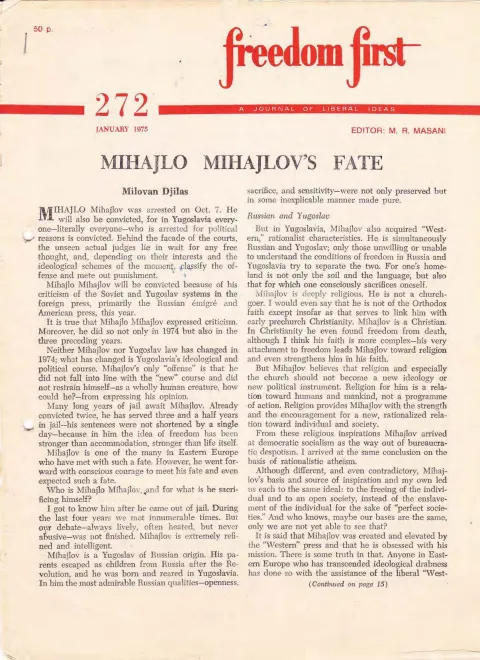
periodical issue
Freedom First
A Journal of Liberal Ideas
By J. R. Patel, A. G. Noorani, Farok Contractor, James Burnham, Geeta Doctor, Kamla Chowdhry, A. Chatterjee
Published for the Democratic Research Service by J. R. Patel, Associate Editor, Freedom First at 127, M. Gandhi Road, Bombay 1 ('Phone: 254341) and printed by him at Inland Printers, 55 Gamdevi Road, Bombay 7. · Bombay · 1973
16 pages
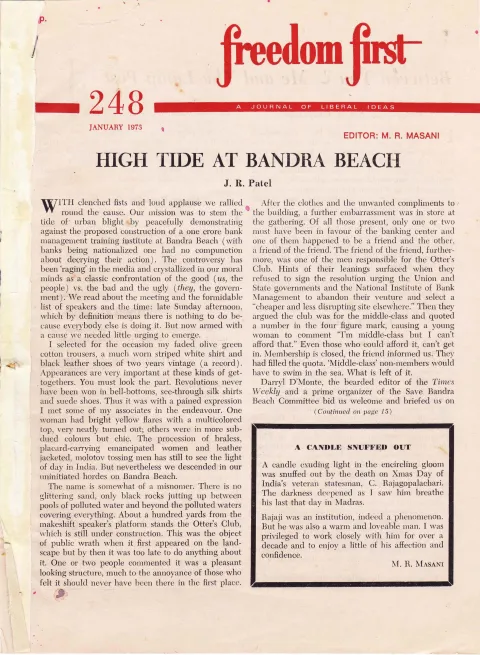
Freedom First
Summary
Freedom First issue 248 (January 1973), edited by M. R. Masani, opens with an editorial note mourning the death of C. Rajagopalachari on Christmas Day 1972 and moves through the magazine’s usual mix of editorial commentary, reportage, and review. The ‘Between You & Me and The Lamp Post’ column takes up Vietnam peace terms, the Allende government’s difficulties in Chile, Jagjivan Ram’s disavowal of Marxism, the Tamil Nadu Assembly chappal-throwing incident, Soviet bond issues aimed at Western private investors, and the renaming of Indian roads after ‘contemporary nincompoops.’ A. G. Noorani re-examines whether India offered Pakistan a Kashmir-for-Hyderabad-and-Junagadh barter in 1947, concluding President Bhutto’s account is factually wrong though Pakistan’s own conduct on plebiscites was equally inconsistent. Farok Contractor gives a skeptical account of the Asia ‘72 trade fair in Delhi, and James Burnham criticizes President Nixon’s billion-dollar grain deal and technology transfers to the Soviet Union as strengthening an adversarial regime for dubious returns. Geeta Doctor profiles playwright Girish Karnad through a comparison of two stagings of Tughlaq. J. R. Patel’s ‘High Tide at Bandra Beach’ satirizes a middle-class protest against a proposed bank training institute on Bandra Beach. The issue closes with two book reviews (a symposium on the crisis in higher education, and A. K. Warder’s survey of Indian historiography), a reprinted Swiss report on Soviet propaganda infiltration of the Indian press, a page of contemporary quotations (‘With Many Voices’), a Peanuts strip, and the subscription form for Freedom First.
Key points
-
J. R. Patel’s “High Tide at Bandra Beach” satirises a middle-class protest against a proposed bank training institute, mocking the demonstrators’ performative radicalism.
-
The “Notes” column compares Allende’s Chile to Indira Gandhi’s Congress as governments resting on thin democratic mandates, and mocks the renaming of colonial-era roads after obscure contemporary figures.
-
A. G. Noorani’s “A Kashmir-Hyderabad Barter?” finds President Bhutto’s claim of a 1947 Patel offer factually wrong, tracing the actual documented record of failed plebiscite negotiations.
-
Farok Contractor’s skeptical account of the Asia ‘72 trade fair finds neglected foreign pavilions and domestic crowds treating it as cheap entertainment rather than genuine trade.
-
James Burnham criticises Nixon’s billion-dollar grain and technology deal with the Soviet Union as strengthening an adversarial regime for dubious returns.
-
Geeta Doctor profiles playwright Girish Karnad through his newly published play “Tughlaq”, and Kamla Chowdhry reviews a seminar volume on the crisis in higher education.
-
A. Chatterjee reviews A. K. Warder’s survey of Indian historiography, and a Swiss Press Review piece on Peter Sager’s banned book on Soviet infiltration of the Indian press closes alongside “With Many Voices”.
Essays
High Tide at Bandra Beach
By J. R. Patel
J. R. Patel’s ‘High Tide at Bandra Beach’ is a satirical first-person account of a Sunday demonstration against a proposed one-crore bank management training institute at Bandra Beach, Bombay. The piece mocks the protestors’ performative radicalism and costuming, then the demonstration itself: Sheriff Mrs. Mehaboob Nasrullah’s remarks on democracy, a call for a ‘Demolition Squad,’ accusations of corruption, and an MLA’s promise to press the issue with the Chief Minister. Patel is skeptical that the protest changed anything, closing with an image of the crowd dispersing to buy street food from the same vendors they had just been protesting alongside.
- The protest opposed a Rs. 1-crore bank management training institute (backed by the National Institute of Bank Management) planned for Bandra Beach.
- Patel frames the demonstration as a performance of radical chic among the mostly middle-class attendees.
- The Otter’s Club, already built nearby, is cited as an example of exclusive, already-existing encroachment that protestors implicitly tolerate.
- Sheriff Mrs. Mehaboob Nasrullah addressed the crowd on democracy and government responsiveness.
- Darryl D’Monte, editor of the Times Weekly and organizer of the Save Bandra Beach Committee, welcomed and briefed attendees (article continues on page 15, covering further speeches by Municipal Councillor Boman-Behram and MLA George D’Souza).
- Turnout of roughly 500 people is described as poor given the stakes.
- Patel closes by criticizing the protestors’ own indifference/hypocrisy toward the beach vendors whose livelihood depends on public use of the shore.
A Kashmir-Hyderabad Barter?
By A. G. Noorani
The unsigned ‘Between You & Me and The Lamp Post’ column (the editor’s regular department) runs through several short items: praise for the journal’s earlier skepticism of a Vietnam ‘peace’ deal and warnings against a ‘peace of the graveyard’; a comparison of Chile’s Allende government (38% of the vote) to Indira Gandhi’s Congress (43%) as evidence that India’s own government rests on a similarly thin democratic mandate, drawing on a Swiss commentator’s critique of Allende; a mocking item on Defence Minister Jagjivan Ram belatedly denying he is a Marxist at a rally for Mrs. Gandhi’s birthday; disapproval of MPs and MLAs throwing chappals in the Tamil Nadu Legislative Assembly; a wry item on the Soviet Union raising capital from private Western investors via government bonds; and a closing item mocking the renaming of Indian roads (previously honoring Canning, Wellesley, Curzon, Clive, and Hastings) after obscure contemporary figures, including a Rae Bareilly road renamed for a personal staffer of the Prime Minister.
- Approves the earlier December 1972 issue’s rejection of a hasty Vietnam settlement and praises Thieu’s refusal to accept a premature truce.
- Cites Swiss commentator Charles Exbrayat’s analysis that Allende’s failure in Chile stemmed from pursuing radical change without majority support (38%), and draws a pointed parallel to Mrs. Gandhi’s Congress winning only 43% of votes cast.
- Reports Jagjivan Ram’s belated denial, at an AICC gathering marking Mrs. Gandhi’s birthday, that he is a Marxist, calling it ‘queer birthday greetings.’
- Criticizes the chappal-throwing incident in the Tamil Nadu Legislative Assembly and the resulting footwear ban for visitors.
- Notes the Soviet Union’s plan to raise capital from private investors in the West through government bonds, calling out the irony given Communist domestic policy.
- Mocks the renaming of Indian roads named after colonial-era figures (Canning, Wellesley, Curzon, Clive, Hastings) in favour of obscure contemporary namesakes, citing a Rae Bareilly road renamed after a member of the Prime Minister’s personal staff.
Asia ‘72: Super Mela
By Farok Contractor
A. G. Noorani examines President Zulfikar Ali Bhutto’s November 1972 claim that India’s Sardar Patel had once offered Pakistan Kashmir in exchange for Junagadh and Hyderabad. Noorani argues Bhutto is factually wrong: the actual November 1947 offer, recorded in Lord Mountbatten’s note and Sardar Patel’s published correspondence, proposed an overall settlement of all three princely states’ accession based on the democratic principle that accession should follow the will of the people where ruler and majority community differed — not a barter of Kashmir specifically for the other two states. Drawing on the memoirs of Pakistani Secretary-General Chaudhri Mohammad Ali and correspondence between Nehru, Jinnah, and Liaquat Ali Khan, Noorani traces the collapse of plebiscite negotiations over ‘modalities,’ and closes by arguing that Jinnah’s short-sighted insistence on rulers’ rights (until reversed by India’s own use of that argument in Kashmir) and Bhutto’s own later intrigues both did lasting damage, while urging that 1973 is not too late to give Kashmir’s people the democratic rights promised since 1947.
- Bhutto told a tribal jirga at Landikotal on November 27, 1972 that Sardar Patel had once offered India would give Kashmir to Pakistan in exchange for Junagadh and Hyderabad, and that Pakistan ‘unfortunately’ declined.
- Noorani finds the actual documented November 1947 offer (Mountbatten’s note, Patel’s published correspondence) proposed a general democratic principle for all three states’ accession, not a specific Kashmir-for-Junagadh-and-Hyderabad swap.
- Quotes at length from the Mountbatten-Jinnah discussion of November 1, 1947, in which Jinnah rejected a plebiscite formula that would have included Hyderabad.
- Chaudhri Mohammad Ali’s memoirs describe deadlocked November-December 1947 talks in Delhi and Lahore over the ‘modalities’ of a Kashmir plebiscite, including troop withdrawal and administration during the vote.
- Notes Sardar Patel’s own remark to Liaquat Ali Khan: ‘Why do you compare Junagadh with Kashmir? Talk of Hyderabad and Kashmir, and we could reach an agreement.’
- Concludes both India and Pakistan behaved with cynicism and inconsistency on communal grounds and the use of force, and that Jinnah’s rigid legalism and Bhutto’s later confrontational policy over Kashmir both damaged Pakistan, culminating in the 1971 breakup.
- Argues it is ‘not too late’ in 1973 to give Kashmir’s people the democratic rights promised in 1947.
Feeding Those That Bite
By James Burnham
Farok Contractor recounts a visit to the Asia ‘72 (rebranded India ‘72) trade fair in Delhi shortly before its official close on December 17, 1972. He describes the foreign pavilions as neglected and understaffed by the fair’s final days, with little sign of genuine international trade, even as domestic visitors flocked to it as cheap entertainment — a ‘Super Mela.’ He praises the architectural quality of many Indian pavilions but singles out Bihar’s and especially Goa’s exhibits as shoddy and poorly maintained, describing Goa’s near-empty display cases. He closes wondering whether the entire fair had any real relevance to Asian trade, given crowds were more interested in eating snacks and buying consumer goods than negotiating deals.
- Asia ‘72 (later India ‘72) trade fair in Delhi officially ended December 17, 1972; Contractor visited in its final days.
- Foreign pavilions were largely unmanned, neglected, and showed little real international trade activity by fair’s end.
- Newspapers called the fair a triumph for India’s exports, but Contractor is skeptical, noting other countries seemed to sell little beyond items within import limits.
- Domestic visitors treated the fair as an inexhaustible source of cheap entertainment (‘Super Mela’), regardless of the trade purpose.
- Praises the architectural design of many Indian pavilions (sloping planes, parabolic curves) as a departure from typical urban Indian construction.
- Singles out Bihar and especially Goa’s pavilions as shoddy, sparsely stocked, and poorly staffed, in contrast to well-kept private-sector and State Trading Corporation exhibits.
- Describes attendees eating ragda and buying local consumer goods rather than engaging in trade negotiations, questioning the fair’s relevance to actual Asian trade.
Tughlaq and Its Creator
By Geeta Doctor
James Burnham criticizes President Nixon’s plan to ship a billion dollars’ worth of U.S. grain, factories, computers, and technology to the Soviet Union to address its worst grain deficit in history, arguing that Communist regimes are structurally unable to feed their populations because farmers under such systems lack incentive. He warns that strengthening Soviet infrastructure (especially trucking, on which he says Hitler’s defeat partly hinged) primarily benefits and legitimizes the Communist regime rather than its people, since regime stability is closely tied to the population’s food situation. Burnham is skeptical of the economic and strategic rationale for the deals — noting the U.S. gets little of value in return besides Jewish emigration priced at $10,000-$35,000 a head — and proposes that any negotiations should demand reciprocal Soviet concessions opening up Soviet society (free entry/exit, books, periodicals, radio and TV) rather than simply strengthening the regime for uncertain returns.
- Nixon authorized U.S. firms to build a huge factory complex and supply trucks, computers, chemical/synthetic fabric plants, and Siberian oil/gas development technology to the USSR.
- Burnham argues Communist regimes chronically cannot produce enough food because farmers lack interest or incentive under collectivized systems, contrasting pre-Communist grain-surplus status of Russia and Eastern Europe.
- Warns that U.S.-supplied trucking capacity in particular would strengthen the Soviet regime; invokes the historical claim that Hitler would have won the Nazi-Soviet war without U.S. trucks.
- Sees little clear benefit to America from the deal: minimal raw materials or manufactured goods needed from the USSR, mostly deferred/speculative oil and gas prospects.
- The one clear ‘payment’ identified is emigration of Soviet Jews, priced by the Kremlin at $10,000 to $35,000 per head.
- Criticizes the ‘belly-Communism theory’ that a well-fed Communist state becomes friendlier, calling it historically unsupported (citing Persia, Athens, Rome, Germany, Japan, USSR).
- Proposes the U.S. should demand reciprocal openness measures from Moscow — free movement of people, books, periodicals, radio and TV — as a condition of the deals.
The Crisis in Higher Education (Review)
By Kamla Chowdhry
Geeta Doctor profiles playwright Girish Karnad on the occasion of his acclaimed play Tughlaq being published in book form by Oxford University Press, comparing the Theater Group’s flashier 1970 Bombay stage production (led by Kabir Bedi) with Karnad’s own more carefully constructed text. She argues Karnad synthesizes Sultan Muhammad bin Tughlaq’s historical cruelty and visionary idealism into a coherent tragic figure, tracing the play’s turning point (Scene Six) and the role of the opportunist Aziz as an ironic mirror to Tughlaq’s failed idealism. Doctor judges the play episodic and somewhat manipulative in its secondary characters but ultimately establishes Karnad among India’s leading contemporary playwrights, showing that a play addressing an Indian historical theme can succeed both in the original Kannada and in English translation.
- Karnad’s Tughlaq was newly published in book form by Oxford University Press, the first in a new drama series.
- Contrasts the visually spectacular 1970 Theater Group Bombay production starring Kabir Bedi with Karnad’s more measured written text.
- Argues Karnad’s play synthesizes the historical Tughlaq’s cruelty and visionary idealism into a coherent tragic character rather than resolving the contradiction.
- Identifies Scene Six as the play’s turning point, where Tughlaq loses control of events he once dominated.
- Describes the character Aziz, an opportunistic dhobi, as an ironic mirror of Tughlaq whose success contrasts with Tughlaq’s failure.
- Notes the play’s structural weakness: episodic construction and somewhat thinly drawn secondary characters.
- Concludes Tughlaq’s success in both Kannada and English translation establishes Karnad among India’s foremost contemporary playwrights.
A Survey of Indian Historiography (Review)
By A. Chatterjee
Kamla Chowdhry reviews The Crisis in Higher Education (edited by G. D. Parikh, Leslie Sawhny Programme, Bombay), a collection of papers from a seminar co-sponsored by the Leslie Sawhny Programme for Training for Democracy and the Friedrich-Naumann-Stiftung in January 1971. She summarizes contributions by Prof. V. V. John (locating the crisis in declining academic standards and teacher failure), Prof. A. B. Shah (on the politics of university reform and the need for concerned intellectuals and outside institutional support), and J. P. Naik (offering concrete policy suggestions endorsed by the seminar). Chowdhry raises pointed questions about whether the volume’s recommendations were ever addressed to an identifiable decision-maker, but recommends the inexpensive volume as worth acquiring for its range of establishment academic views on the crisis.
- The volume collects seminar papers from a January 1971 Bombay seminar sponsored by the Leslie Sawhny Programme and Friedrich-Naumann-Stiftung.
- Prof. V. V. John’s paper argues the crisis is a decline in academic standards constituting ‘a major crisis in higher education,’ locating failure among both teachers and the student clientele.
- Prof. A. B. Shah’s paper addresses politics-in-universities and recommends educating policy-making groups and creating institutions insulated from government and popular pressure.
- J. P. Naik made concrete policy suggestions for higher education reform, endorsed by the seminar.
- Chowdhry questions whether any of the recommendations were ever directed at an identified decision-maker or implemented.
- Recommends the volume (Rs. 10) as worth acquiring for its range of establishment academic perspectives on the causes of the crisis.
Moscow’s Hand in India: A Swiss View
A. Chatterjee reviews A. K. Warder’s A Survey of Indian Historiography (Popular Prakashan, Bombay), praising it as a comprehensive chronological and geographical survey (including chapters on Ceylon and Nepal) that defends the indigenous pauranika tradition of Indian historical writing against dismissal by foreign and Indian historians trained in the Graeco-Roman mold. The review discusses Warder’s argument that ancient Indian historians embellished factual accounts with legend and folklore as an integral part of their belief-structure rather than mere unreliability, and that this should not disqualify Indian historiography from serious study, especially given modern Western historiographical schools (citing Collingwood and Toynbee) that also question a purely ‘string of facts’ model of history. Chatterjee notes Warder singles out S. A. Dange as an ‘honourable exception’ among modern historians, and closes by recommending the book strongly to readers interested in probing assumptions about Indian historiography, though not as casual or introductory reading.
- Warder’s book surveys Indian historiography chronologically and geographically, including chapters on Ceylon and Nepal.
- Warder criticizes ‘imperial’ historians for disregarding ancient Indian historical writing and instead proposes the ‘pauranika Indian view’ as the true tradition of Indian civilisation’s historiography.
- Warder singles out Comrade S. A. Dange (author of India from Primitive Communism to Slavery) as an ‘honourable exception’ among modern historians.
- Chatterjee notes ancient Indian historians embedded folklore and legend in their accounts as integral to contemporary belief-structures, not simply as unreliable reporting, citing Kalhana’s Rajatarangini as an example despite its reputation for realism.
- Cites R. G. Collingwood’s idealistic school of historiography and Arnold Toynbee’s remark that historical study is governed by the dominant tendencies of its time and place, to contextualize why Indian historiography should not be judged solely by 19th-century positivist standards.
- Chatterjee recommends the book for readers who wish to probe the basic assumptions of history as commonly taught, but warns it is not casual reading.
s 1966 book Moscow
An unsigned piece, credited to the Swiss Press Review, discusses Dr. Peter Sager’s 1966 book Moscow’s Hand in India, which documented extensive Soviet infiltration of the Indian press and bribery/corruption on a ‘grand scale,’ including evidence that the Communist Party of India (which claimed independence from Moscow) was effectively directed from the Soviet Embassy’s Information Department. The piece notes India’s dependence on the Soviet Union has increased since 1966 rather than decreased, and reports that India has banned export of the book, which the piece interprets as evidence the Indian government does not want the extent of Soviet influence known. It states the book remains available through a Swiss bookseller and recommends it as still relevant today, given that Soviet propaganda activity in developing countries has only intensified since 1966.
- Discusses Dr. Peter Sager’s 1966 book Moscow’s Hand in India, based on Zurich police department analysis of evidence including material allegedly typed in the Soviet Embassy’s Information Department in New Delhi.
- Describes the Communist Party of India’s claimed independence from Moscow as compromised by direct Soviet Embassy involvement in Indian media influence.
- States India’s reliance on and infiltration by the Soviet Union has increased, not decreased, since 1966.
- Reports the Indian government banned export of the book on grounds it could affect ‘friendly relations with the USSR.’
- The book remains available outside India through SOI Booksellers in Berne, Switzerland, at 25.50 Swiss francs plus postage.
- Frames the book’s relevance as extending beyond India, given increased Soviet propaganda activity across the developing world since 1966.
With Many Voices
The back-page ‘With Many Voices’ column, headed by a Tennyson epigraph, gathers short quotations from contemporary public figures and publications on politics and world affairs, including remarks by C. Rajagopalachari, Mao Tse-tung, Piloo Mody, Billy Graham, Nirad Chaudhuri, A. G. Noorani, William F. Buckley, a Chinese Vice Foreign Minister, Ayn Rand on George McGovern, and The Economist. The page also carries the Freedom First subscription form and the masthead identifying J. R. Patel as Associate Editor and the printer/publisher details.
- Column epigraph is from Tennyson: ‘The deep moans round with many voices… ‘Tis not too late to seek a newer world.’
- Quotes C. Rajagopalachari (Illustrated Weekly) on the depressing political situation compelling recourse to God.
- Quotes Mao Tse-tung twice via Time magazine, including a remark about revolution being made ‘with men who eat bark’ rather than well-paid taxi-drivers.
- Quotes Nirad Chaudhuri twice via Illustrated Weekly, including that ‘Socialism in India is only middle-class capitalism… the expression of hatred of the poor against the rich.’
- Quotes Ayn Rand (National Review) calling McGovern’s candidacy ‘a declaration of war on the American people by America’s intellectuals.’
- Includes the Freedom First subscription form (Rs. 5 annual, Rs. 3 for students) addressed to Democratic Research Service, 127 Mahatma Gandhi Road, Bombay 1.
- Masthead states the issue was published for the Democratic Research Service by J. R. Patel, Associate Editor, and printed at Inland Printers, Bombay.
Generated by the v1.5 extraction pipeline. Awaiting editorial review.
Essay 10
No summary was extracted for this article. Listed for completeness.
Metadata and summary are AI-extracted from the source PDF and reviewed for editorial accuracy. The original work is available via the Read PDF tab above (where present); paragraph-level citation inside the PDF is deferred to a future engagement.